Myth
"Panthenol is Biotin."
Fact
Panthenol is associated with Vitamin B5, while Biotin is Vitamin B7.
HairsnCares Ingredient Intelligence · Provitamin B5 Hydration Science
Panthenol — commonly called Provitamin B5 — is used in shampoos, conditioners, masks, leave-ins and scalp products to support hydration, softness, flexibility and manageability.
Panthenol is not Biotin, and it is not a hair-growth medicine. Rinse-off and leave-on formulas behave differently, the complete formulation determines performance, and persistent scalp symptoms deserve proper evaluation.
Shop Panthenol Hair Products →
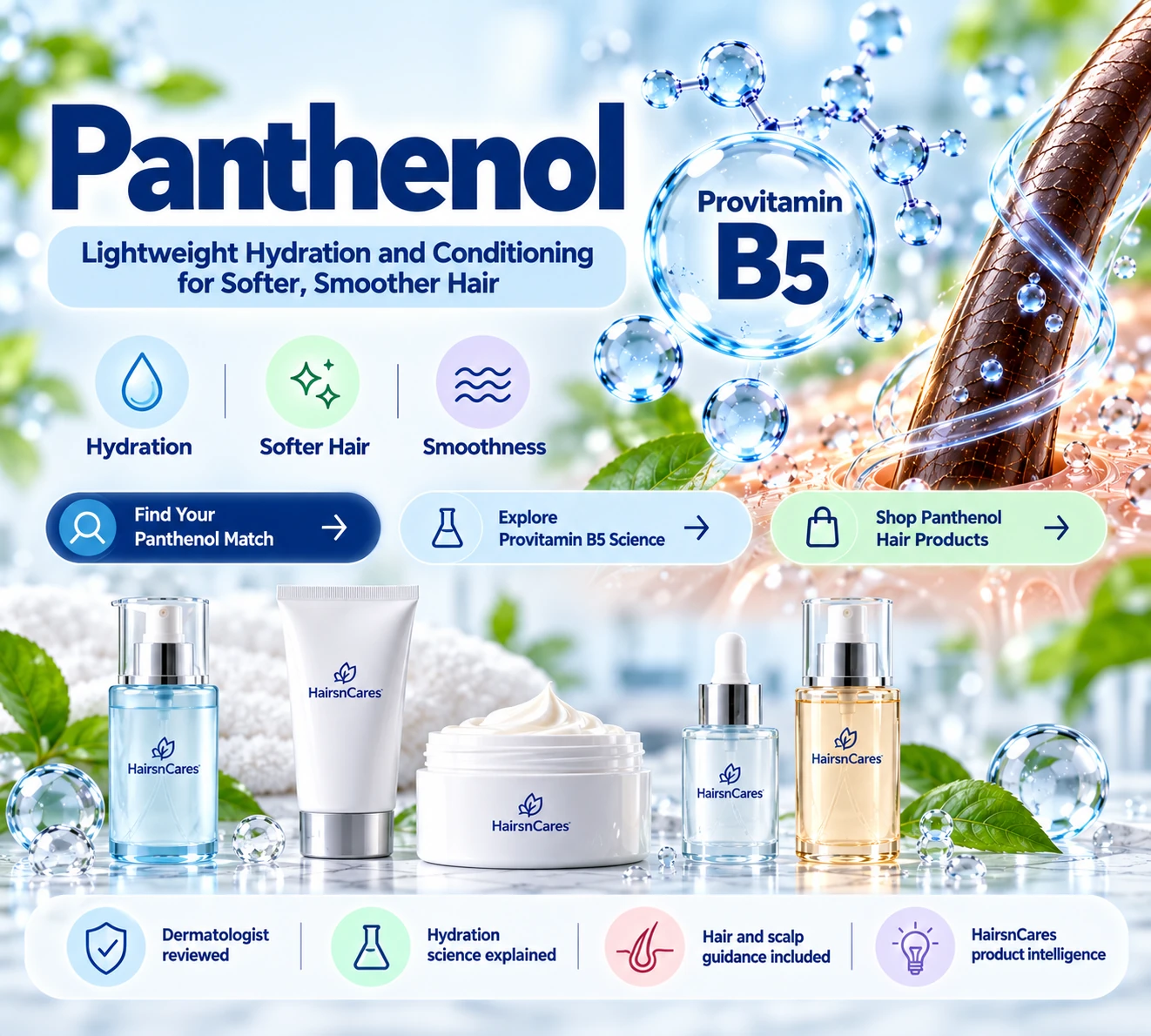
Quick Ingredient Answer
Panthenol is a cosmetic ingredient related to pantothenic acid — hence the familiar name Provitamin B5. In haircare it works mainly as a humectant and conditioning agent, which is why it turns up across shampoos, conditioners, masks, leave-ins, serums and scalp products. Users typically notice better slip, softness, flexibility, less static and easier combing. What it cannot do: regrow hair, permanently repair the non-living fibre, or correct a dietary Vitamin B5 deficiency through shampoo. Format, concentration and the complete formulation decide the result.
Medically reviewed by Dr. Amit S. Agarkar — MBBS, MD Dermatology, FCPS, DDV · Reviewed 24 July 2026 · Next review July 2027 · Evidence-led review methodology
Overview
Panthenol is a cosmetic ingredient related to pantothenic acid — which is exactly why it is marketed as Provitamin B5. In topical formulations it may function as a humectant, as a hair-conditioning agent, and as an antistatic ingredient, while also improving how a product feels to use. It appears in both rinse-off and leave-on formulas, and its performance depends on concentration and the complete formulation.
That "Provitamin B5" label is where most of the confusion starts. It sounds nutritional, so people assume a shampoo is delivering a vitamin. It isn't. Panthenol, pantothenic acid and Biotin are three different things doing three different jobs:
| Panthenol | Pantothenic Acid | Biotin |
|---|---|---|
| Cosmetic Provitamin B5 ingredient | Vitamin B5 itself | Vitamin B7 |
| Used in hair and skincare formulations | Nutritional and biological vitamin | Nutritional vitamin |
| Supports hydration and conditioning | Different chemical identity | Not interchangeable with Panthenol |
| Not a hair-growth medicine | Not equivalent to shampoo Panthenol | Deficiency claims require medical context |
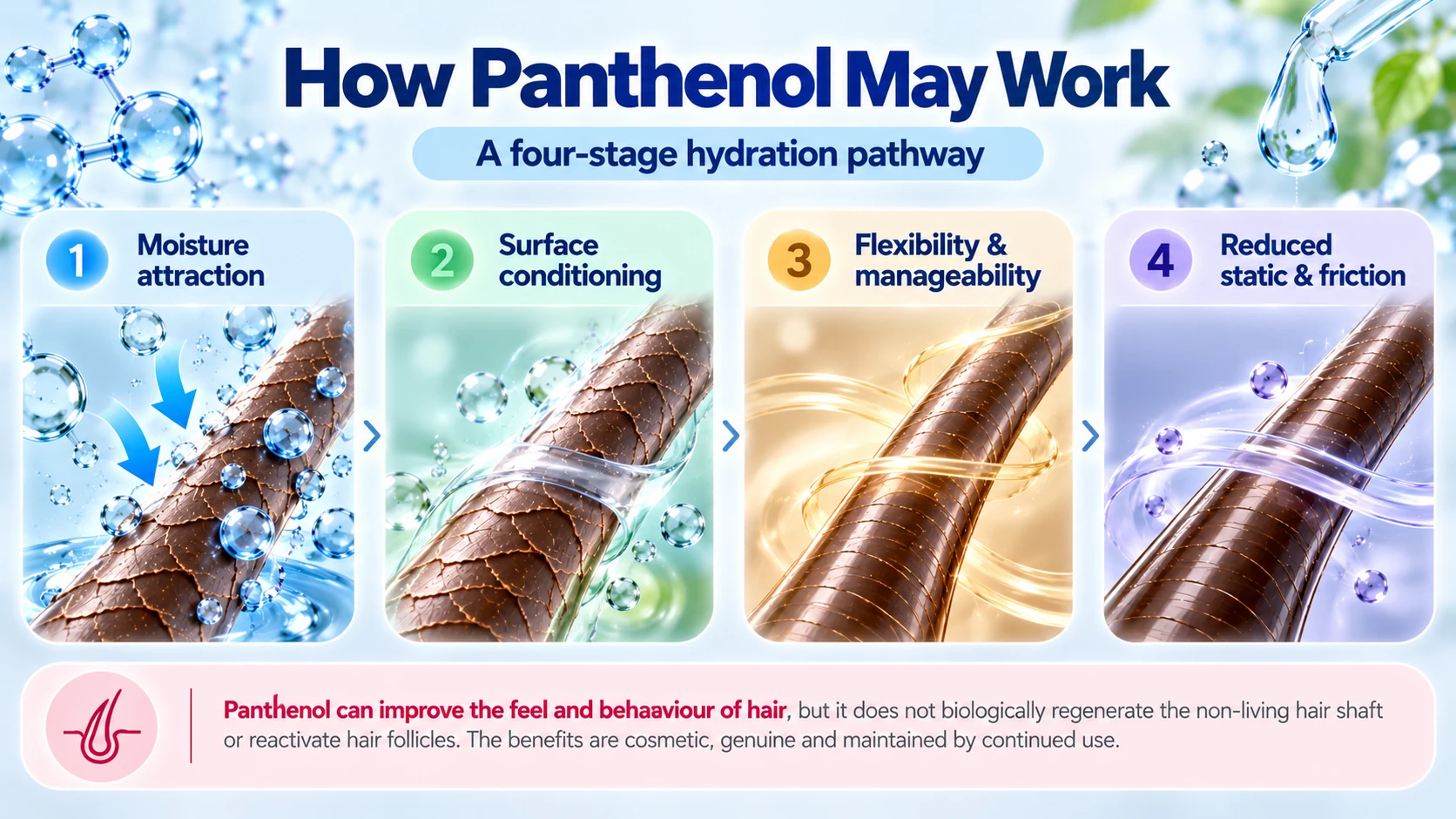
How Panthenol May Work
What a well-formulated Panthenol product may do at the surface of hair and scalp — described as cosmetic conditioning, which is what it is.
Panthenol may help attract and retain water within the cosmetic film surrounding the hair or skin surface.
It may improve smoothness and reduce the rough feel of dry or damaged lengths.
Better hydration and conditioning may improve combability and how the fibre bends rather than snaps.
Conditioning may reduce static, tangling and friction-related mechanical stress.
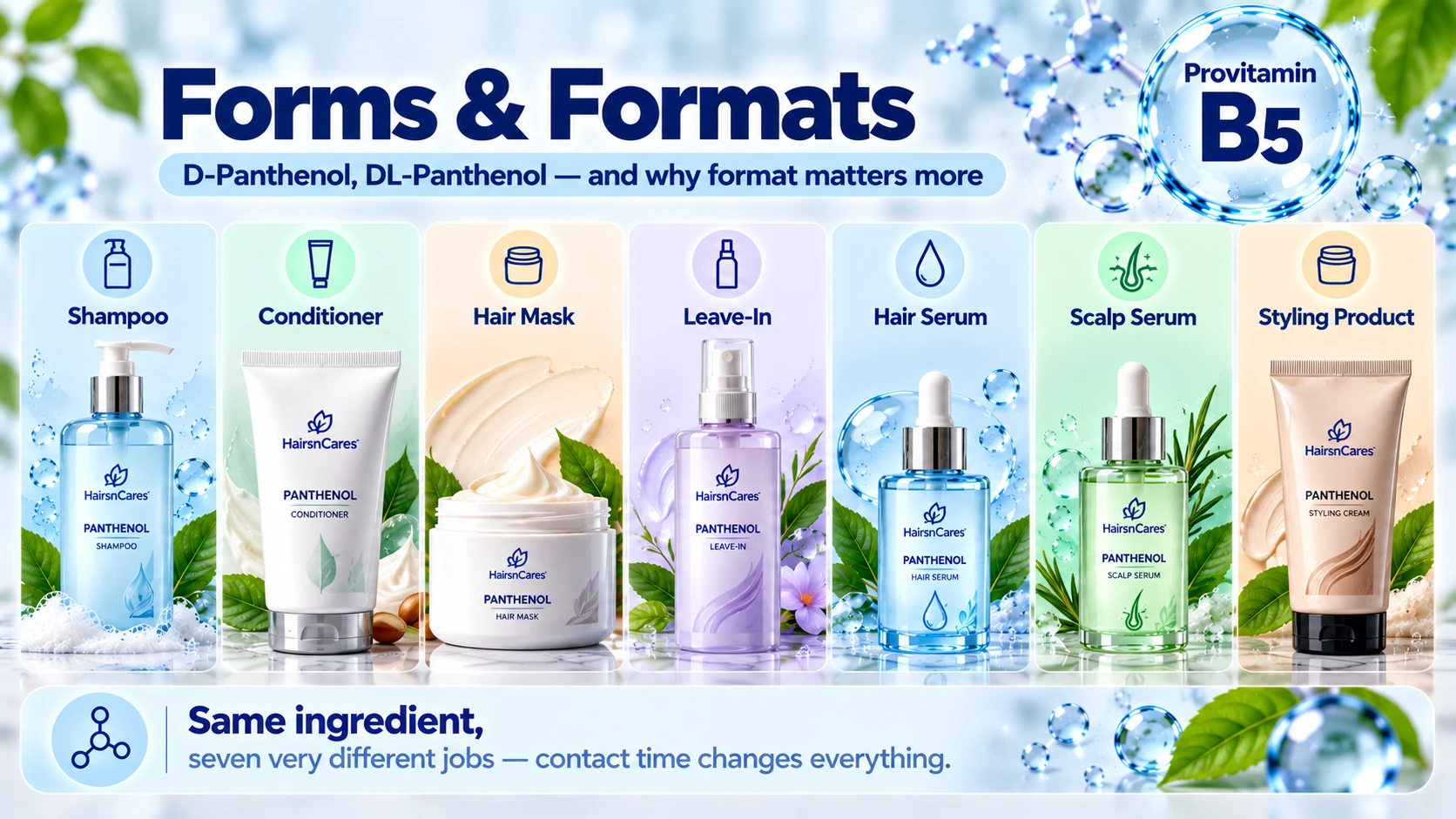
Forms & Formats
Two questions people ask about Panthenol labels: which form is it, and which product should I buy? The honest answer is that the second question matters far more than the first.
D-PanthenolDexpanthenol
The dextrorotatory form, commonly discussed as the biologically active one and widely used in cosmetic and topical products. Note that cosmetic D-Panthenol in a conditioner is not the same context as a prescription or medical dexpanthenol preparation.
DL-Panthenol
A racemic mixture containing both D- and L-forms, appearing in some cosmetic raw materials and finished formulations. Its presence on a label is not a reason to reject a product.
Primarily a cleansing product. Panthenol may support conditioning and scalp feel, but contact time is relatively limited — a shampoo should not be expected to perform like a leave-in.
Supports slip, softness and detangling, and is often the most useful routine format for lengths and ends. Match the formula weight to your hair type rather than assuming richer is better.
A richer conditioning format, often combining Panthenol with lipids, proteins or silicones. Excellent for damaged or coarse lengths — and the format most likely to weigh down fine hair if overused.
Longer contact means ongoing hydration and manageability support through the day. The amount you use matters more here than in any other format.
Often combines Panthenol with polymers, silicones or botanical ingredients, designed around frizz control, smoothness or heat-styling support.
Intended specifically for scalp use, often alongside Niacinamide, Allantoin or other soothing ingredients. It does not replace treatment for active scalp disease — and a lengths serum is not a substitute for it.
May support flexibility, film formation and antistatic benefits within a styling system. Hold and finish are set by the complete formula, not the Panthenol in it.
Hair Benefits · Who May Benefit
Nine profiles where Panthenol-containing products are commonly considered — each with a format direction and the point at which something else serves you better.
Lightweight hydration and softness support, especially when paired with conditioning agents that hold the moisture in.
Conditioner / leave-in
Very dry hair may need lipids too. Dry hair →
Improved conditioning, flexibility and surface feel in lengths that have been processed or over-styled.
Mask / leave-in
Structural damage needs trimming. Damaged hair →
Moisture support and reduced friction may improve manageability and the appearance of frizz.
Serum / leave-in
Humidity matters too — see below. Frizz care →
Hydration, slip and detangling are the priorities here, and Panthenol supports all three within a suitable formula.
Leave-in / mask
Fine curls: go lighter. Curly hair →
Panthenol appears in plenty of lightweight formulas — but the complete product can still weigh hair down, so format and amount decide.
Light conditioner / small leave-in
Keep it off the roots. Light conditioners →
Gentle cleansing and good conditioning support colour-care routines; reduced friction helps the whole strand behave.
Conditioner / serum
Wash frequency matters as much. Colour care →
May meaningfully improve feel, slip and manageability — but cannot reverse the structural chemical damage bleaching causes.
Mask + leave-in
Pair with lipids and protein. Ceramides →
Conditioning and flexibility support that makes styling gentler — without claiming to repair heat damage.
Serum / heat-compatible leave-in
Confirm heat compatibility on the label. Heat damage →
Scalp-specific formats may improve comfort — but scalp dryness must be distinguished from inflammatory or infectious conditions.
Scalp serum · doctor-guided
Persistent symptoms need assessment. Ask Dr. Amit →
Expert notePatients often arrive convinced a "Provitamin B5" shampoo will do something for shedding. It won't — that's a different conversation entirely. What Panthenol does do well is make hair easier to handle, and hair that tangles and snaps less is hair you keep more of. That's worth having, as long as we're honest about which problem it solves.
Interactive · Educational only
Nine quick questions. The result is an educational pathway — never a diagnosis, prescription, guaranteed result or mandatory routine.
This checker provides educational ingredient guidance only. It does not diagnose scalp disease, prescribe treatment, guarantee a result or replace dermatologist consultation.
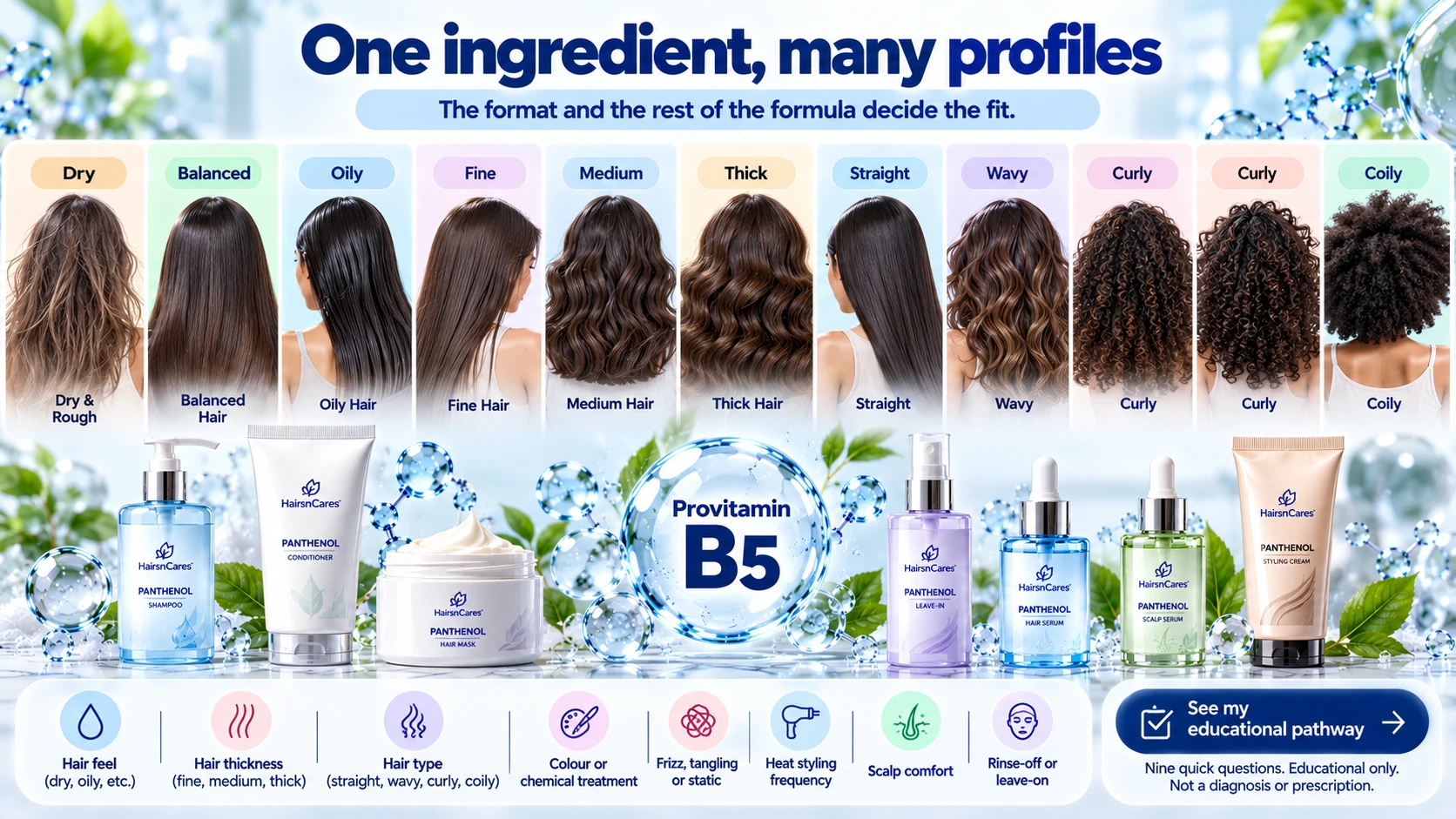
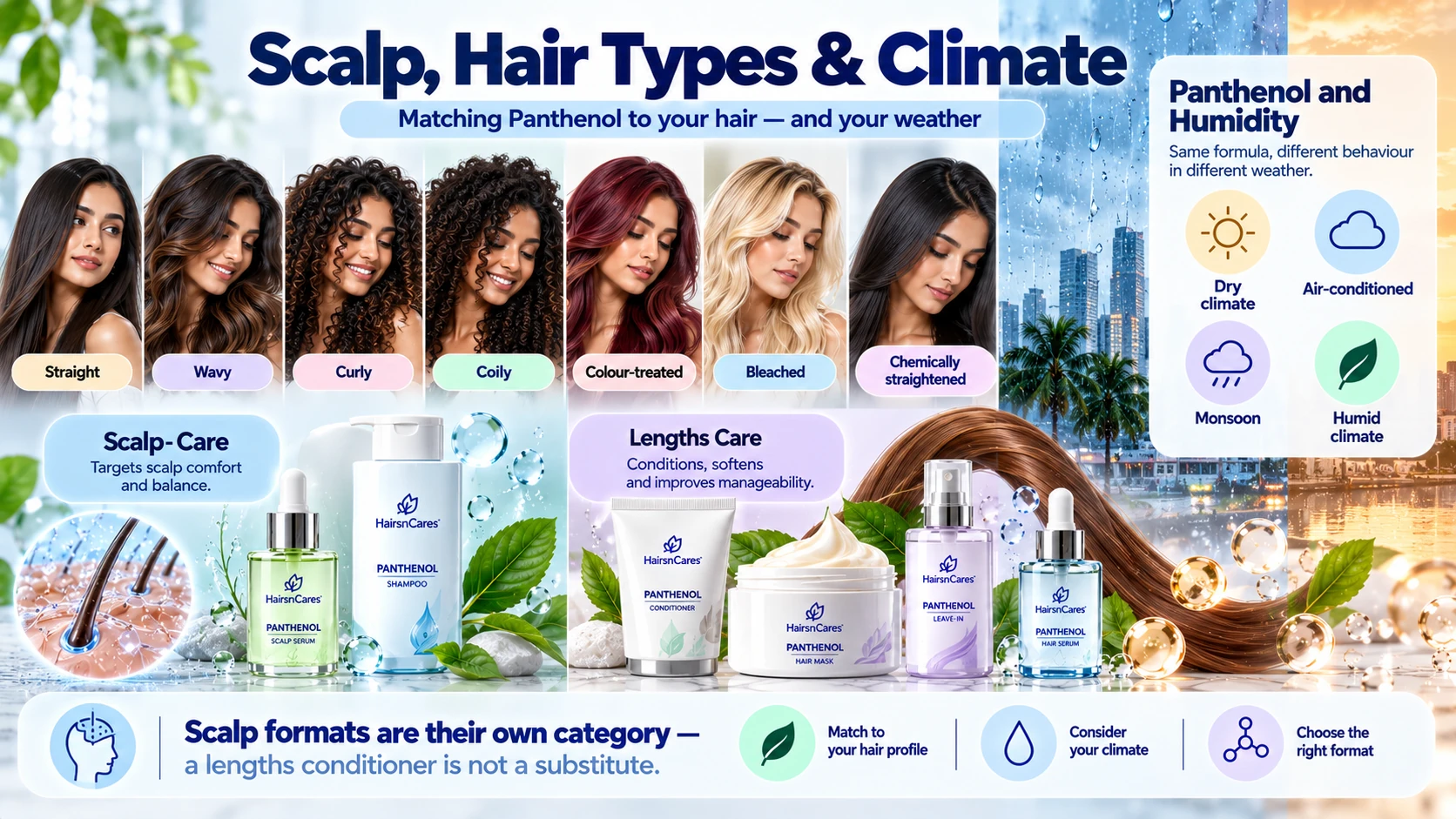
Scalp, Hair Types & Climate
Hair-type direction first, then the humidity question that decides how any humectant behaves on your head.
| Profile | Main need | Product direction | Supporting ingredients | Common mistake |
|---|---|---|---|---|
| Fine hair | Hydration without weight | Light conditioner or small leave-in | Lightweight humectants | Rich masks near the roots |
| Thick hair | Even conditioning | Mask plus conditioner | Lipids, fatty alcohols | Too little product, unevenly spread |
| Straight hair | Smoothness, no grease | Light conditioner or serum | Conditioning polymers | Over-applying near the scalp |
| Wavy hair | Definition plus slip | Light leave-in | Glycerin, polymers | Weighing down the wave |
| Curly hair | Moisture and detangling | Leave-in plus conditioner | Ceramides, oils | Under-conditioning |
| Coily hair | Maximum moisture retention | Rich mask plus leave-in | Lipids, butters | Judging by squeaky-clean feel |
| Low-porosity hair | Avoid buildup | Lightweight formats | Light humectants | Layering heavy leave-ins |
| High-porosity hair | Retain moisture | Mask plus leave-in | Ceramides, proteins | Humectants alone with nothing to seal |
| Colour-treated hair | Colour-friendly conditioning | Conditioner plus serum | Gentle surfactants | Frequent strong cleansing |
| Bleached hair | Feel and flexibility | Mask plus leave-in | Ceramides, hydrolysed protein | Expecting structural restoration |
| Heat-damaged hair | Smoothing, protection | Serum plus mask | Silicones, lipids | Skipping heat protection |
| Chemically straightened hair | Support weakened fibre | Mask plus gentle routine | Proteins in balance | Overloading rich products |
| Oily scalp, dry ends | Separate scalp and ends | Light scalp wash; ends-only conditioning | Mild surfactants | Applying masks to the scalp |
| Dry scalp, normal lengths | Scalp comfort | Scalp serum, not a lengths product | Niacinamide, Allantoin | Assuming flakes always mean dryness |
Humectant-rich formulas interact with the water around them and with the rest of the formula, so the same leave-in can behave differently in Mumbai's monsoon and a dry winter. But frizz is also driven by porosity, styling polymers, conditioning and hair structure — so humectants shouldn't be blamed for every humidity-related problem. Pick your conditions:
Comparisons · Interactive Lab
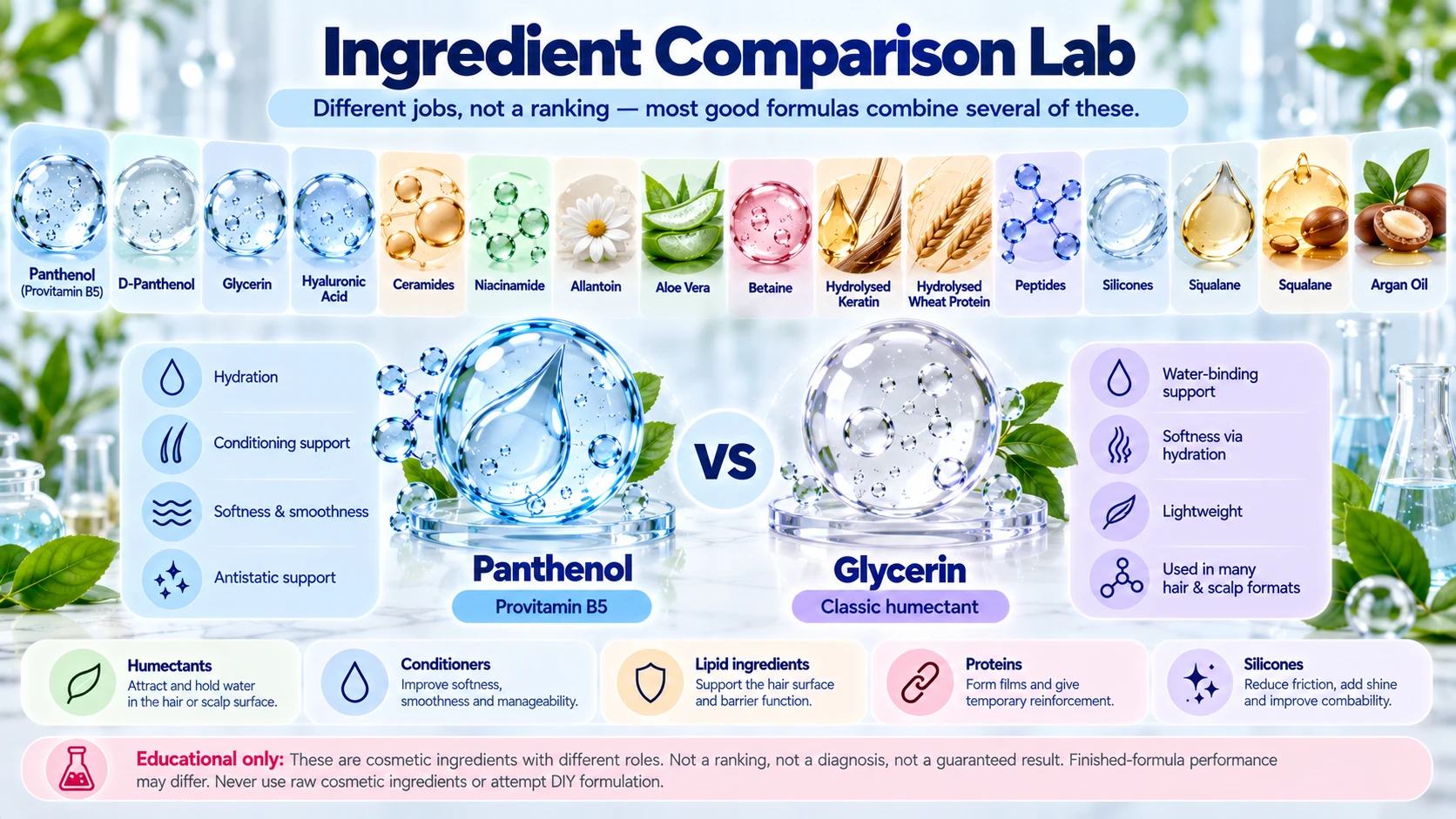
Pick any two of fifteen ingredients for a side-by-side profile. No fake hydration scores, no fake penetration scores, no universal winner — and cosmetic conditioning is never permanent repair.
Select exactly two:
Footnotes: descriptions reflect typical cosmetic roles, not rankings or scores. Finished-formula performance may differ. Never use raw cosmetic ingredients or attempt DIY formulation.
Both can act as humectants, but they're chemically and functionally distinct. Glycerin is the classic water-binding workhorse; Panthenol adds conditioning, flexibility and antistatic support alongside its humectant role. Both frequently coexist in one formula, and formula texture, humidity, porosity and supporting ingredients decide which you notice.
Panthenol is a humectant and conditioning ingredient supporting hydration, flexibility and softness, often in lightweight formulas. Ceramides are lipid-family ingredients supporting barrier and surface-conditioning systems in repair-oriented products. Not interchangeable — dry, damaged hair frequently benefits from a formula containing both.
Panthenol supports hydration, flexibility and softness. Hydrolysed proteins form films and give temporary reinforcement, improving the feel of damaged fibres — though excessive protein-rich use can leave some hair stiff. Panthenol doesn't replace protein, protein doesn't replace hydration, and the right balance is whatever your hair responds well to.
Different vitamins, different ingredients: Panthenol relates to Vitamin B5, Biotin is Vitamin B7. They are not interchangeable, and a Panthenol shampoo does not perform the function of oral vitamin treatment. Supplementation for suspected deficiency belongs in a medical conversation — we don't promote unnecessary Biotin supplements.
Hyaluronic Acid and Sodium Hyaluronate are water-binding polymers used in hydration-focused formulas, where molecular size and the formula shape the sensory result. Both may appear in one product, and neither guarantees lasting hydration alone — conditioning lipids or polymers are usually needed to make hydration stick.
Silicones are conditioning polymers that reduce friction and boost shine and combability; Panthenol works through hydration and conditioning support. They're complementary rather than competing, they coexist happily in many formulas, and buildup depends on product design, hair type and cleansing routine.
"Panthenol is Biotin."
Panthenol is associated with Vitamin B5, while Biotin is Vitamin B7.
"Panthenol directly regrows hair."
Panthenol is mainly used for hydration and conditioning, not as a direct hair-growth medicine.
"Panthenol permanently repairs damaged hair."
It may improve softness, flexibility and surface condition, but does not biologically regenerate the hair shaft.
"More Panthenol always gives better results."
Concentration, delivery system and complete formulation determine performance.
"Panthenol shampoo corrects Vitamin B5 deficiency."
Topical cosmetic use is not equivalent to nutritional treatment.
"Panthenol and Glycerin are identical."
Both may function as humectants, but they are chemically and functionally distinct.
"Panthenol is only useful for dry hair."
It may appear in lightweight products for fine, curly, coloured and normal hair.
"Panthenol always weighs hair down."
Weight depends primarily on product format, concentration and supporting ingredients.
"A Panthenol conditioner can treat scalp disease."
Cosmetic conditioners do not replace treatment for inflammatory or infectious scalp conditions.
"Every Provitamin B5 product performs the same."
Rinse-off time, product format, concentration and formulation can change the user experience.
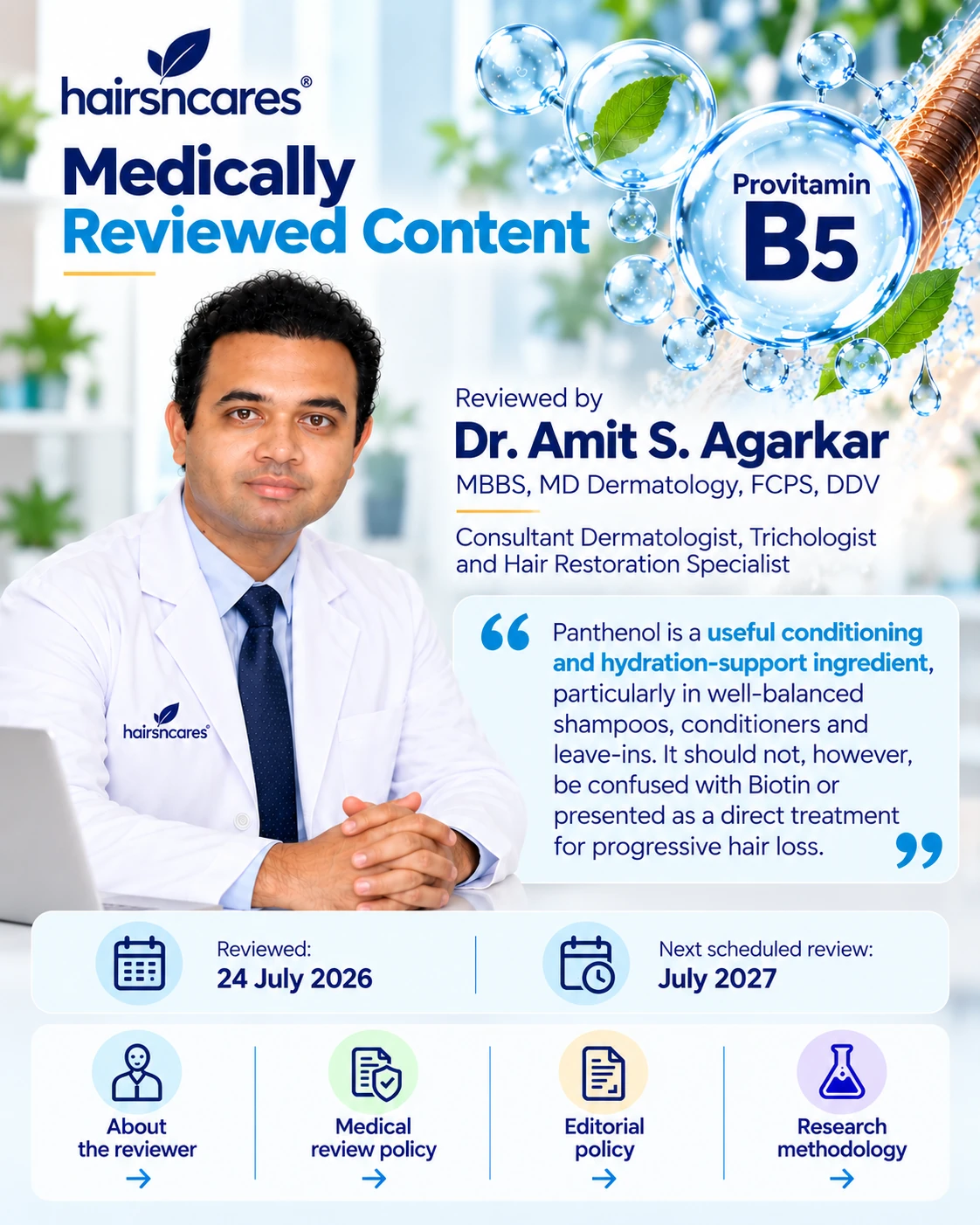
"Panthenol is a useful conditioning and hydration-support ingredient, particularly in well-balanced shampoos, conditioners and leave-ins. It should not, however, be confused with Biotin or presented as a direct treatment for progressive hair loss."
Product Finder · Doctor-Curated
Product data loads from the live HairsnCares catalogue. Filter to shortlist, then let the Hydration Finder personalise.
{{PRICE}} MRP {{MRP}} · {{DISCOUNT}}
{{STOCK_STATUS}} · {{RATING}} ({{REVIEW_COUNT}} reviews)
{{PRICE}} MRP {{MRP}} · {{DISCOUNT}}
{{STOCK_STATUS}} · {{RATING}} ({{REVIEW_COUNT}} reviews)
{{PRICE}} MRP {{MRP}} · {{DISCOUNT}}
{{STOCK_STATUS}} · {{RATING}} ({{REVIEW_COUNT}} reviews)
Availability, pricing, ratings and ingredient declarations load from the live catalogue. Genuine reviews only — nothing on this page is invented.
The finder walks the full journey: hair texture → dryness and roughness → chemical and heat history → porosity tendencies → frizz, tangling and static → scalp condition → Panthenol vs Glycerin vs Ceramides vs proteins vs oils → matching products → dermatologist escalation when required.
Where your hair starts, and what's already been done to it.
The details that decide format weight and application.
Weigh humectants, lipids, proteins and oils, then see matches.
Dermatologist review for persistent or unclear scalp symptoms.
The tool provides educational ingredient guidance and product discovery. It does not diagnose scalp disease or prescribe treatment.
Humectant · classic water-binding support
Explore Ingredient →
Humectant polymer · surface hydration
Explore Ingredient →
Barrier lipids · smoothing support
Explore Ingredient →
Soothing support · scalp comfort
Explore Ingredient →
Soothing agent · comfort support
Explore Ingredient →
Humectant · gentle moisture support
Explore Ingredient →
Botanical · hydration and soothing
Explore Ingredient →
Protein · temporary reinforcement
Explore Ingredient →
Protein-derived · conditioning support
Explore Ingredient →
Emollient lipid · softness and slip
Explore Ingredient →
Plant oil · shine and lubrication
Explore Ingredient →
Conditioning polymers · smoothing
Explore Ingredient →
Gentle cleansing systems
Explore Ingredient →
Conditioning · comfort and balance
Explore Ingredient →
Safety · Use & Expectations
Technique, supporting ingredients, realistic expectations and the reaction ladder — clarity, not fear.
Glycerin, Betaine, Hyaluronic Acid and amino acids share the water-binding work — useful, but they need something to hold moisture in.
Ceramides, cholesterol, fatty acids, squalane, argan and jojoba oils give humectants somewhere to stay. Best in masks and leave-ins.
Hydrolysed proteins and peptides add temporary reinforcement; Niacinamide, Allantoin and Aloe Vera support scalp comfort in leave-on formats.
Silicones, polyquaterniums, fatty alcohols, conditioning polymers, mild surfactants and antioxidants shape slip, cleansing and stability.
Improved slip, softer feel, easier combing, reduced static, smoother texture and better manageability.
Better hydration support, less rough-feeling hair, improved flexibility, reduced appearance of dryness, more manageable curls and waves, and improved comfort from suitable scalp formulas.
Panthenol cannot independently correct androgenetic alopecia, nutritional deficiency, hormonal or autoimmune hair loss, scarring alopecia, severe scalp inflammation, fungal scalp infection, major chemical damage or broken fibres.
Cosmetic products may temporarily improve their appearance. Permanent removal requires trimming — there is no way around that.
Review product amount, placement and frequency.
Stop use and seek professional guidance.
Seek urgent medical attention.
FAQs · Curated Answers
Honest answers to the questions we hear most often about Panthenol and Provitamin B5.
Panthenol is a cosmetic ingredient commonly described as an alcohol analogue of pantothenic acid, which is why it is widely known as Provitamin B5. In haircare it is used mainly as a humectant and hair-conditioning agent, appearing in shampoos, conditioners, masks, leave-ins, serums and scalp products.
Not exactly. Pantothenic acid is Vitamin B5 itself; Panthenol is a related cosmetic ingredient often called Provitamin B5. They are chemically distinct, and using a Panthenol shampoo is not the same thing as nutritional Vitamin B5 intake — topical cosmetic use does not correct a dietary deficiency.
In suitable formulations Panthenol may help attract and retain water within the cosmetic film around the hair, support surface conditioning, improve softness and flexibility, reduce rough feel and static, and make combing easier. These are cosmetic conditioning effects — real and noticeable, but not biological repair of the hair shaft.
D-Panthenol (also called dexpanthenol) is the dextrorotatory form, commonly discussed as the biologically active one, while DL-Panthenol is a racemic mixture containing both D- and L-forms. Both appear in cosmetic raw materials. In finished haircare, performance depends on formulation, concentration and intended use rather than the form alone.
It is a reasonable choice. As a humectant and conditioning ingredient, Panthenol may support hydration, softness and a less rough feel in dry hair. Very dry or coarse hair often benefits from pairing it with lipid-rich ingredients rather than relying on humectants alone.
It may improve how damaged hair feels and behaves — better slip, flexibility, smoothness and manageability. It does not rebuild the fibre: hair above the scalp is non-living, so cosmetic conditioning improves condition and appearance without regenerating structure. Badly split ends still need trimming.
Often, yes. Better hydration and reduced friction can improve manageability and the appearance of frizz. Frizz is also influenced by porosity, styling polymers, conditioning and weather, so the whole formula and routine matter more than any single ingredient.
It suits many curly and coily routines, where slip, detangling and hydration are priorities. Curly hair tends to run drier because natural oils travel less easily along curved fibres. Choose the format to match your density — lightweight leave-ins for fine curls, richer masks for coarse or high-porosity hair.
Yes — Panthenol appears in many lightweight formulas suited to fine hair. What weighs hair down is usually the complete product, not Panthenol itself. Fine hair generally does best with light conditioners or small amounts of leave-in applied to mid-lengths and ends.
Generally yes. Colour-treated hair benefits from gentle cleansing, good conditioning and reduced friction, all of which Panthenol-containing products can support. Wash frequency, water temperature and heat use influence colour longevity alongside the products you choose.
It may improve softness, slip and manageability in bleached hair, which is often rough and porous. It cannot reverse structural chemical damage — bleaching permanently alters the fibre. Many bleached-hair routines pair Panthenol with lipids and, where suitable, some protein.
Panthenol appears in scalp formulations aimed at comfort and hydration and may help a dry, tight-feeling scalp. However, dry scalp is not always a simple moisture problem — flaking may reflect dandruff, seborrheic dermatitis, psoriasis, eczema or contact dermatitis, which need appropriate assessment rather than a conditioner.
No. Panthenol is a hydration and conditioning ingredient, not a hair-growth medicine. It does not treat androgenetic alopecia or reactivate follicles, and it does not replace medically indicated treatments. By improving flexibility and reducing friction it may help limit avoidable breakage, which is different from stimulating growth.
No — they are different vitamins and different ingredients. Panthenol relates to Vitamin B5; Biotin is Vitamin B7. They are not interchangeable, and a Panthenol shampoo does not perform the same function as oral vitamin treatment. Supplementation for suspected deficiency belongs in a medical conversation, not a shampoo aisle.
Both can act as humectants, but they are chemically and functionally distinct. Glycerin is a classic, widely used water-binding humectant; Panthenol adds conditioning, flexibility and antistatic support alongside its humectant role. Neither is universally superior, and many products contain both.
Panthenol is a humectant and conditioning ingredient supporting hydration and softness; ceramides are lipid-family ingredients supporting barrier and lipid-oriented conditioning. They are not interchangeable — they do different jobs, and dry or damaged hair often benefits from a formula that includes both.
Usually yes, and the combination is common: hydration and protein address different needs. Panthenol does not replace protein, and protein does not replace hydration. The balance depends on how your hair responds — excessive protein-rich use can leave some hair feeling stiff.
Buildup is generally a property of the whole product — its conditioning polymers, silicones, oils and how much you use — rather than Panthenol alone. Heavy leave-ins layered repeatedly on fine or low-porosity hair are the usual cause. Adjust amount and placement, and cleanse appropriately.
Panthenol is generally well tolerated, but any cosmetic product can cause irritation in a susceptible individual. Reactions frequently trace back to fragrance, preservatives, essential oils, botanical extracts, surfactants or conditioning polymers rather than Panthenol itself, so don't assume the hero ingredient is the culprit.
See a dermatologist for a painful scalp, persistent burning, broken or oozing skin, thick plaques or scale, pustules, crusting, significant swelling or suspected infection; for sudden patchy hair loss or severe unexplained shedding; for severe itching or reactions to multiple products; after a recent transplant, microneedling or chemical burn; for symptoms in children; or when symptoms continue despite changing products.
Generic answers end where your individual hair begins. Get a personalised, dermatologist-designed assessment in minutes.
Your Next Step
The best product depends on hair texture, porosity, dryness, chemical damage, heat exposure, frizz, scalp condition, product weight, your climate and whether the routine actually fits your life.
Medical Disclaimer: This HairsnCares ingredient guide is intended for general education and product discovery. It does not replace diagnosis, prescription or personalised advice from a qualified dermatologist. Panthenol products differ in ingredient form, concentration, delivery system, product format and supporting ingredients. Cosmetic products may improve softness, hydration, flexibility and manageability but cannot biologically regenerate non-living hair fibres or directly treat most forms of hair loss. Stop use and seek medical advice if significant irritation, swelling, broken skin, severe burning, persistent scalp scaling or unusual hair shedding occurs.
Your cart is empty