Myth
"Selenium Sulfide regrows hair."
Fact
It is a scalp-care active. It may improve the scalp environment, but it does not treat pattern hair loss.
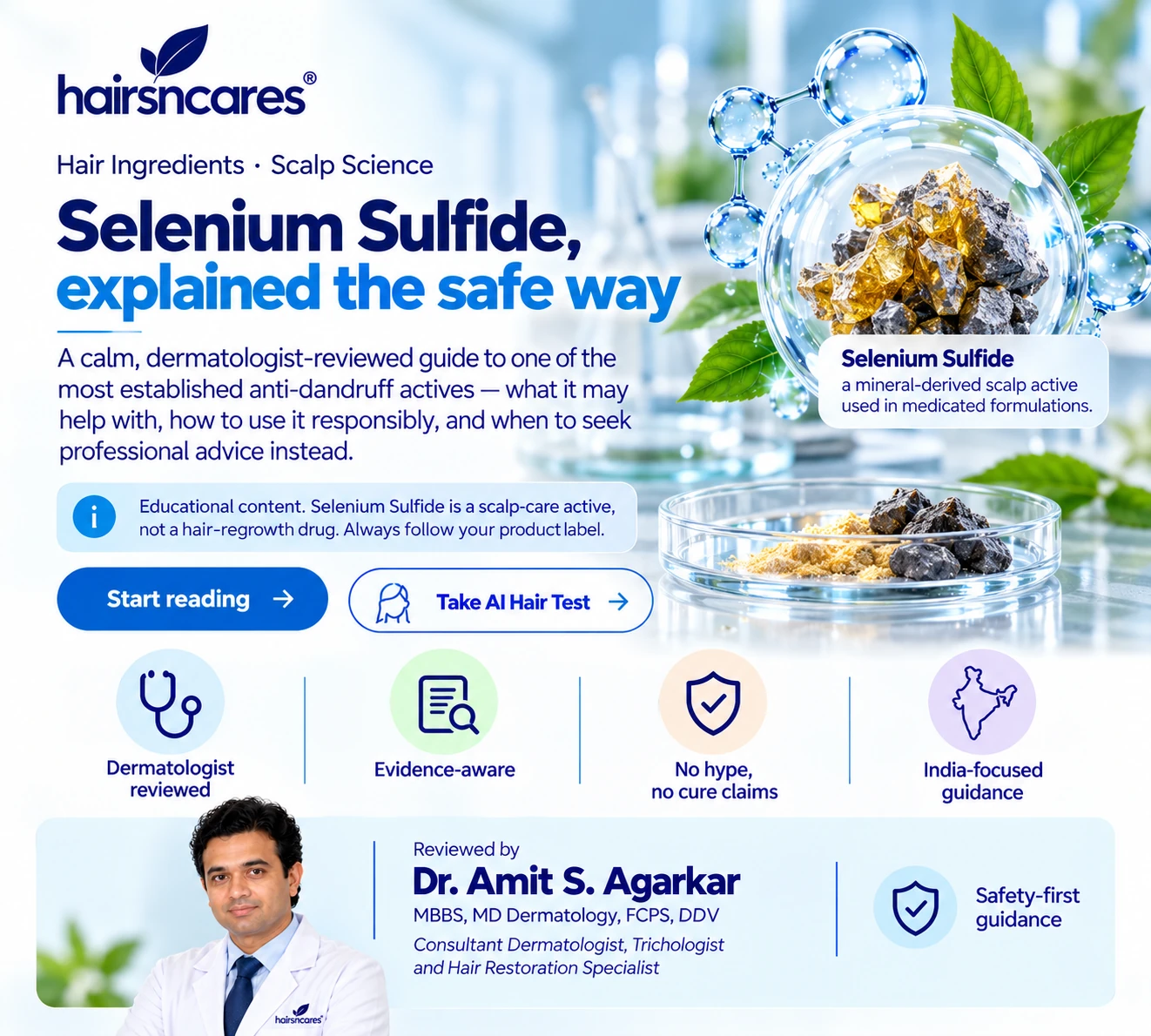
Hair Ingredients · Scalp Science
A calm, dermatologist-reviewed guide to one of the most established anti-dandruff actives — what it may help with, how to use it responsibly, and when to seek professional advice instead.
Educational content. Selenium Sulfide is a scalp-care active, not a hair-regrowth drug. Always follow your product label.
Quick Clinical Answer
Selenium Sulfide is a topical antifungal and antiseborrheic active used in medicated shampoos and scalp preparations. It may help control dandruff, seborrheic dermatitis and yeast-linked flaking when used as the label directs. It is not a hair-regrowth medicine, and it is not the same as a dietary selenium supplement. If symptoms are severe, patchy, painful or not improving, a dermatologist — not a stronger bottle — is the right next step.
Medically reviewed by Dr. Amit S. Agarkar — MBBS, MD Dermatology, FCPS, DDV · Reviewed 15 July 2026 · Next review July 2027
Overview
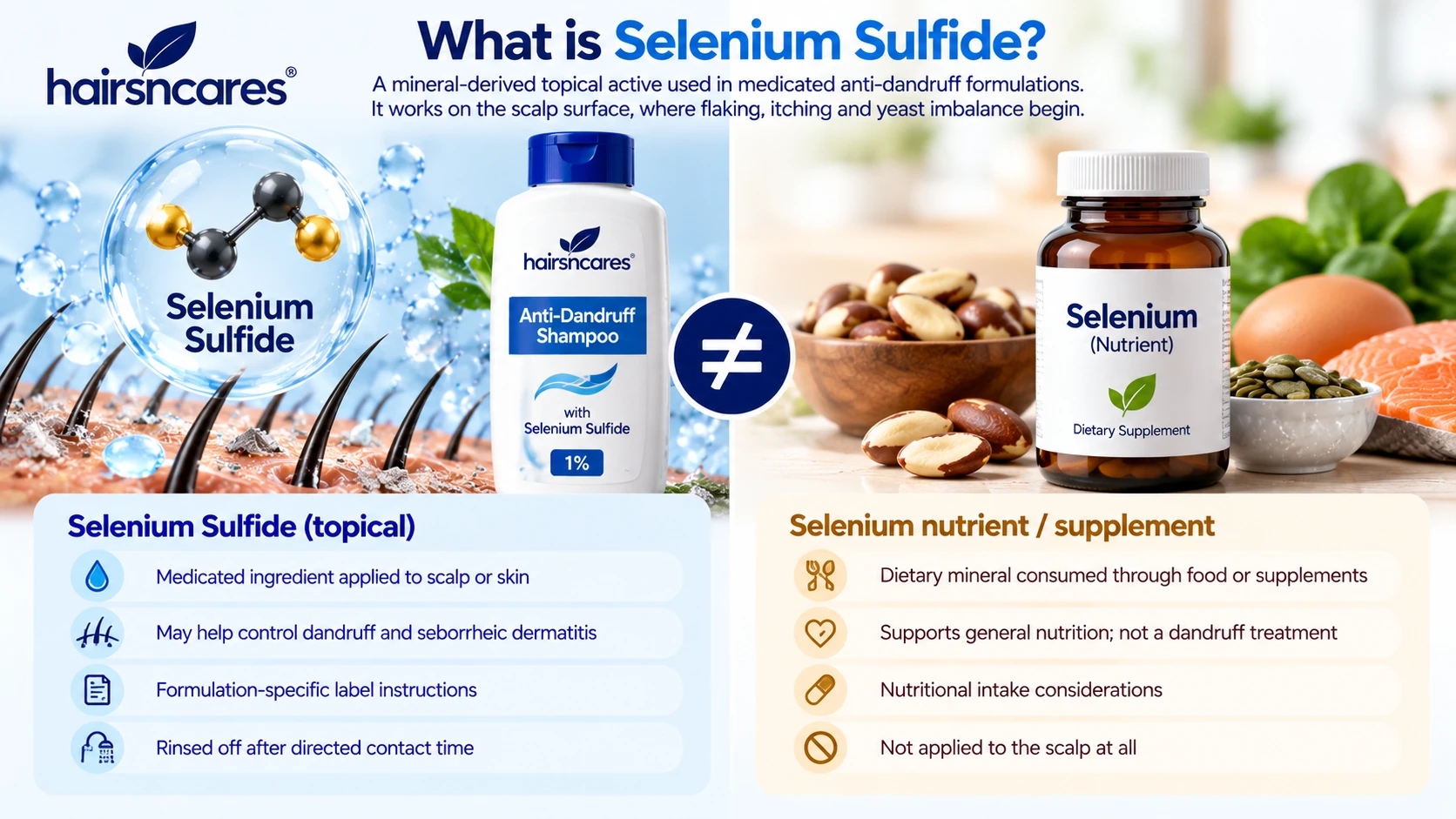
Selenium Sulfide is a mineral-derived topical active that has been used in medicated anti-dandruff formulations for decades. It works on the scalp surface, where flaking, itching and yeast imbalance actually begin.
You may have seen it listed on medicated shampoo labels in strengths like 1% or 2.5%. In daily practice, many people are confused between the topical ingredient and the selenium found in food and supplements — they are completely different things used for completely different purposes. The table below settles it clearly.
| Selenium Sulfide (topical) | Selenium nutrient / supplement |
|---|---|
| Medicated ingredient applied to scalp or skin | Dietary mineral consumed through food or supplements |
| May help control dandruff and seborrheic dermatitis | Supports general nutrition; not a dandruff treatment |
| Formulation-specific label instructions | Nutritional intake considerations |
| Rinsed off after directed contact time | Not applied to the scalp at all |
Related reading: What causes dandruff? · Seborrheic dermatitis guide
How It Works
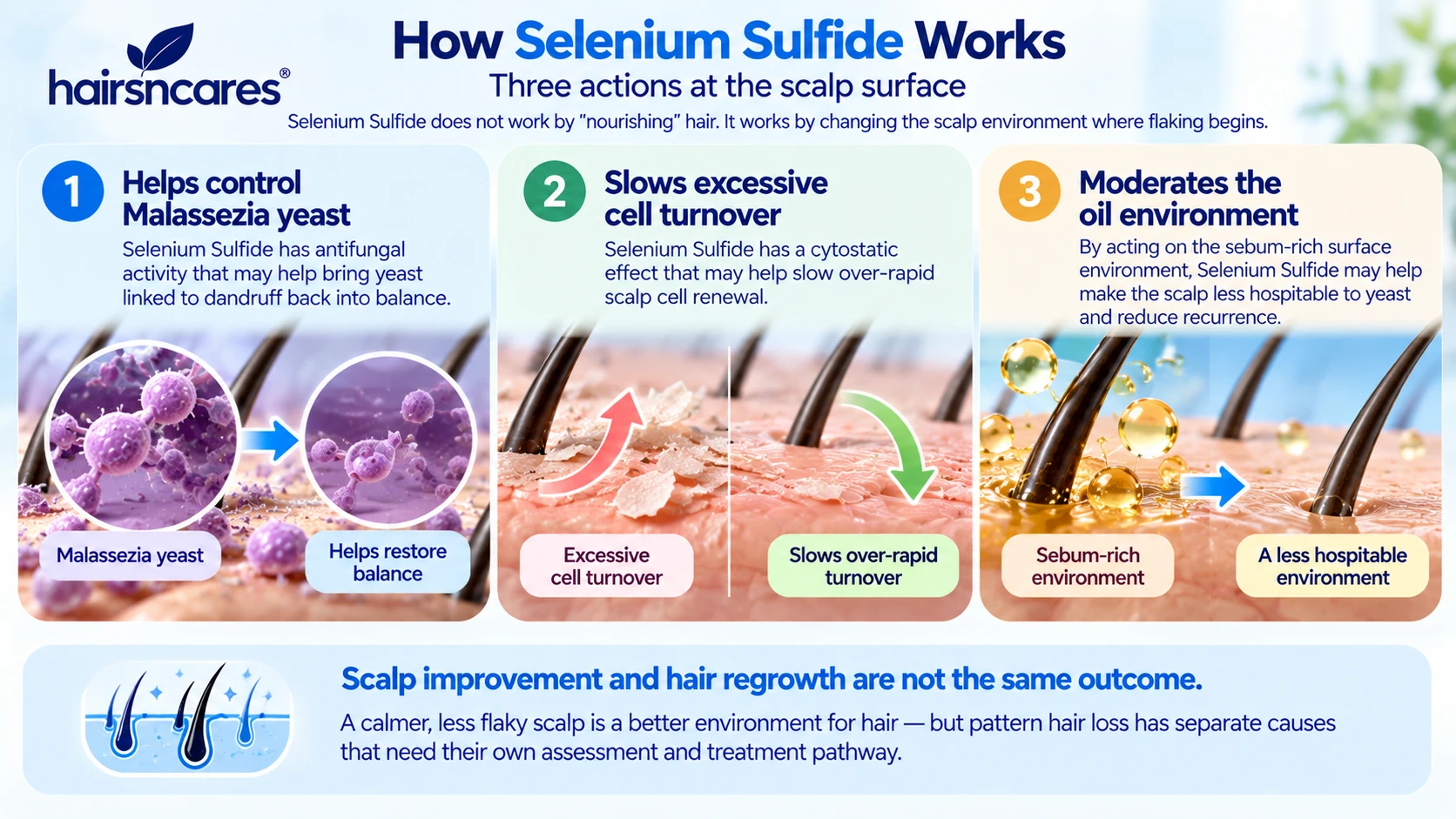
Selenium Sulfide does not work by "nourishing" hair. It works by changing the scalp environment where flaking begins.
A naturally occurring scalp yeast is linked to dandruff and seborrheic dermatitis in many people. Selenium Sulfide has antifungal activity that may help bring this back into balance.
Flakes form when scalp cells renew and shed too quickly, clumping into visible dandruff. Selenium Sulfide has a cytostatic effect that may help slow this over-rapid turnover.
Scalp oil feeds the yeast involved in seborrheic flaking. By acting on the sebum-rich surface environment, the ingredient may help make the scalp less hospitable to recurrence.
Benefits · Concern Matrix
These are the situations where Selenium Sulfide is most commonly considered. "May help" is the honest phrasing — responses vary between people, products and conditions.
Visible flaking with or without itching. Often responds to consistent, label-directed medicated washing.
Flaking with redness, greasier scale and irritation — usually needs a doctor's confirmation and a planned routine.
Persistent itch tied to yeast imbalance may settle as the scalp environment normalises.
Some formulations are used on affected skin for this condition — only under medical guidance.
May be suitable for
Pause and seek advice first
Expert noteDo not judge a medicated scalp routine in a few days. Many people switch products too quickly and lose the benefit of consistency. If flaking and itching are gradually settling week by week, the routine is usually on track — sudden worsening is the signal to reassess, not slow progress.
Interactive · Educational only
Five quick questions. This tool gives an educational pathway, never a diagnosis or prescription.
This checker is educational and cannot diagnose any condition or replace a consultation. If in doubt, speak with a dermatologist.
Strengths
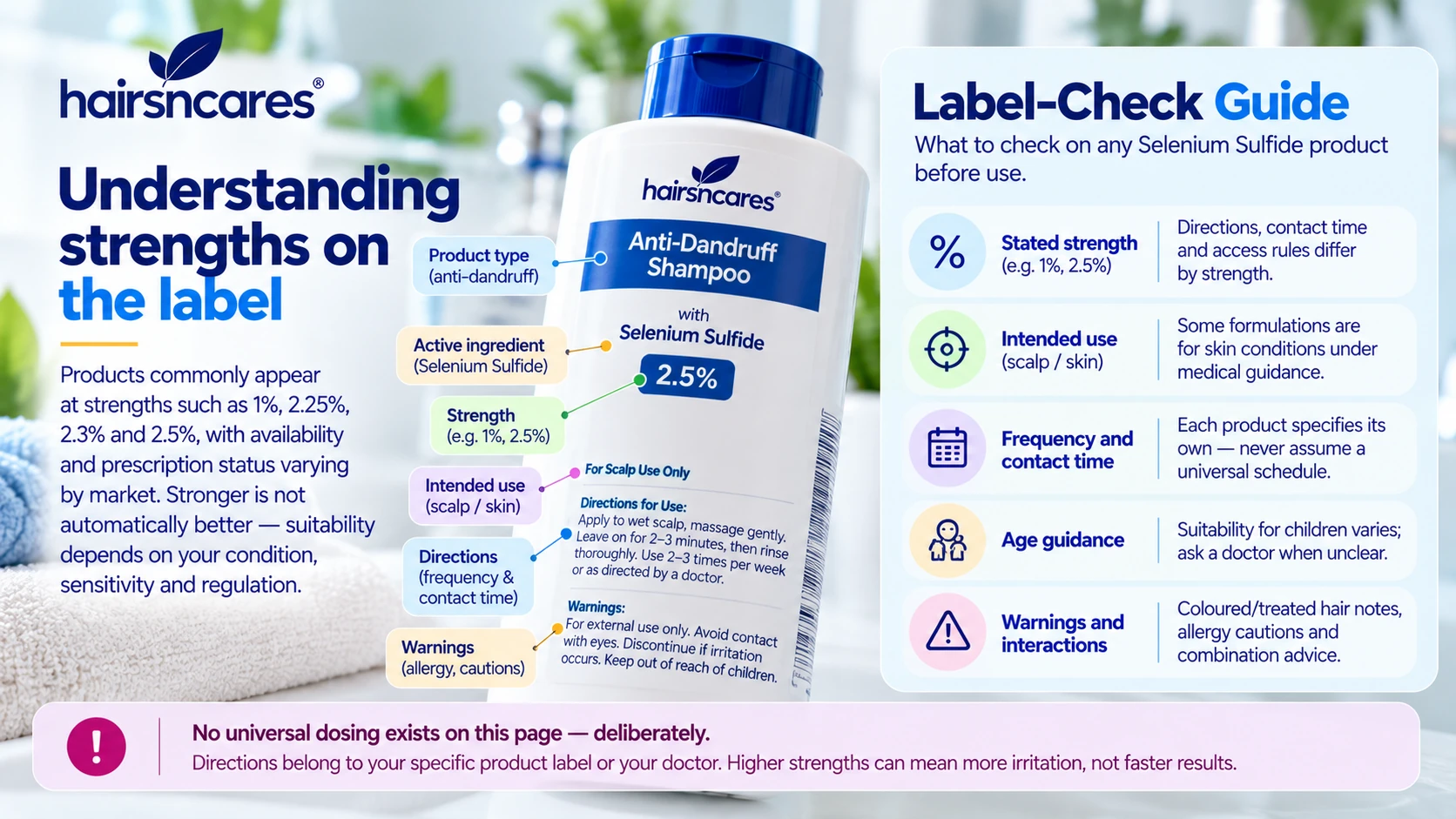
Products commonly appear at strengths such as 1%, 2.25%, 2.3% and 2.5%, with availability and prescription status varying by market. Stronger is not automatically better — suitability depends on your condition, sensitivity and regulation.
| Check | Why it matters |
|---|---|
| Stated strength (e.g. 1%, 2.5%) | Directions, contact time and access rules differ by strength |
| Intended use (scalp / skin) | Some formulations are for skin conditions under medical guidance |
| Frequency and contact time | Each product specifies its own — never assume a universal schedule |
| Age guidance | Suitability for children varies; ask a doctor when unclear |
| Warnings and interactions | Coloured/treated hair notes, allergy cautions and combination advice |
How to Use
The framework below follows the universal principles printed on medicated labels. Your product's own directions always take precedence.
Every scalp responds differently. This general arc describes many — not all — label-directed routines.
Little visible change is normal. Some people notice texture or scent differences first. Watch for irritation.
Flaking and itching may begin settling with consistent use. Fluctuation between washes is common.
If responding, improvement typically consolidates. Your product or doctor defines the review point.
Dandruff often recurs after stopping. Many routines shift to a reduced maintenance frequency — as directed.
Doctor's tipIf you keep changing anti-dandruff products because results feel slow, pause and reassess. Sometimes the problem is not the product but a missing diagnosis — seborrheic dermatitis, psoriasis and fungal infection can look similar and respond very differently.
Safety
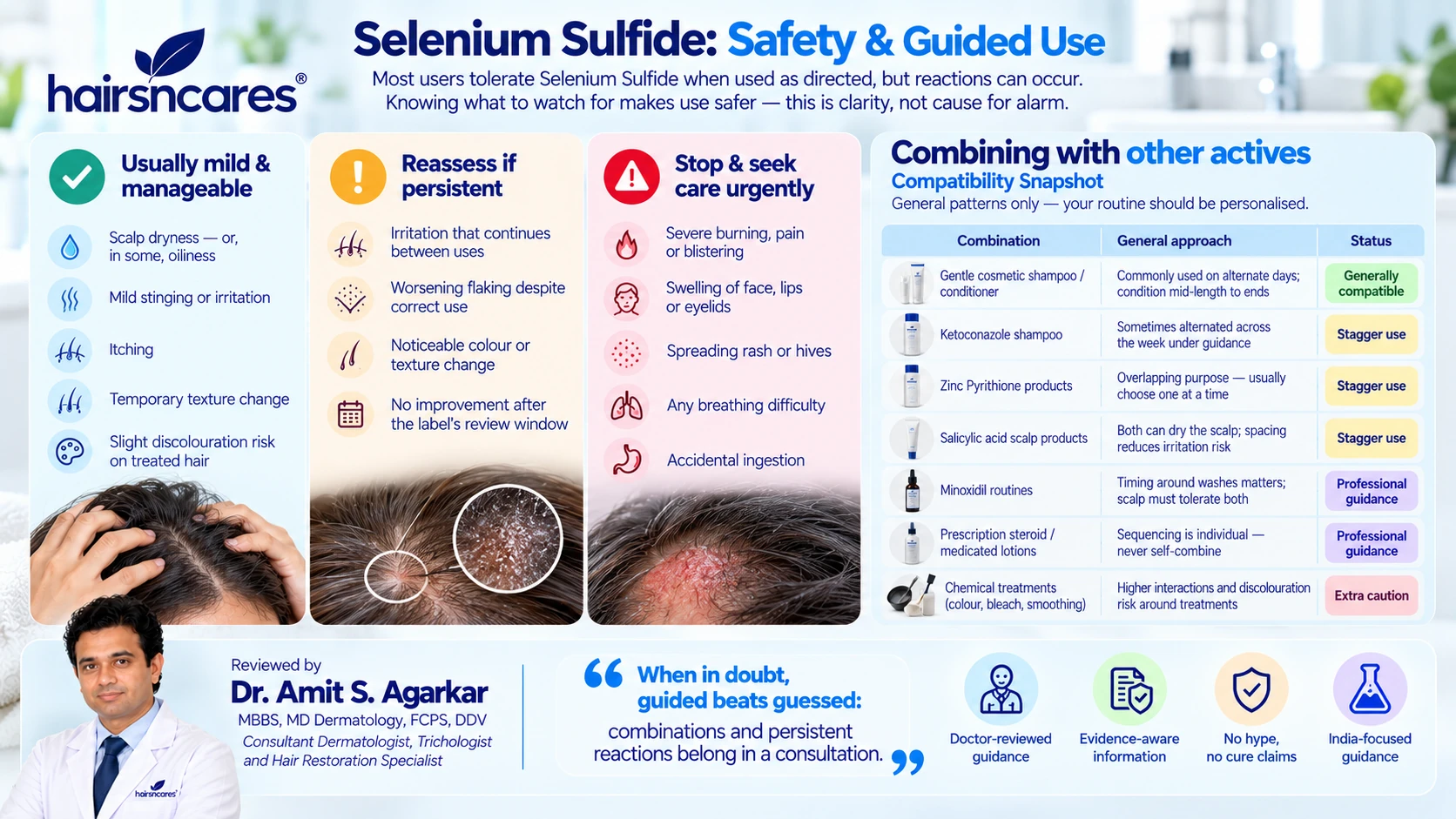
Most users tolerate Selenium Sulfide when used as directed, but reactions can occur. Knowing what to watch for makes use safer — this is clarity, not cause for alarm.
| Combination | General approach | Status |
|---|---|---|
| Gentle cosmetic shampoo / conditioner | Commonly used on alternate days; condition mid-length to ends | Generally compatible |
| Ketoconazole shampoo | Sometimes alternated across the week under guidance | Stagger use |
| Zinc Pyrithione products | Overlapping purpose — usually choose one at a time | Stagger use |
| Salicylic acid scalp products | Both can dry the scalp; spacing reduces irritation risk | Stagger use |
| Minoxidil routines | Timing around washes matters; scalp must tolerate both | Professional guidance |
| Prescription steroid / medicated lotions | Sequencing is individual — never self-combine | Professional guidance |
| Chemical treatments (colour, bleach, smoothing) | Higher interaction and discolouration risk around treatments | Extra caution |
Comparisons · Interactive Lab
Pick any two actives to compare their general profiles. No active is universally "best" — the right one depends on your condition, response history and medical advice.
Select exactly two:
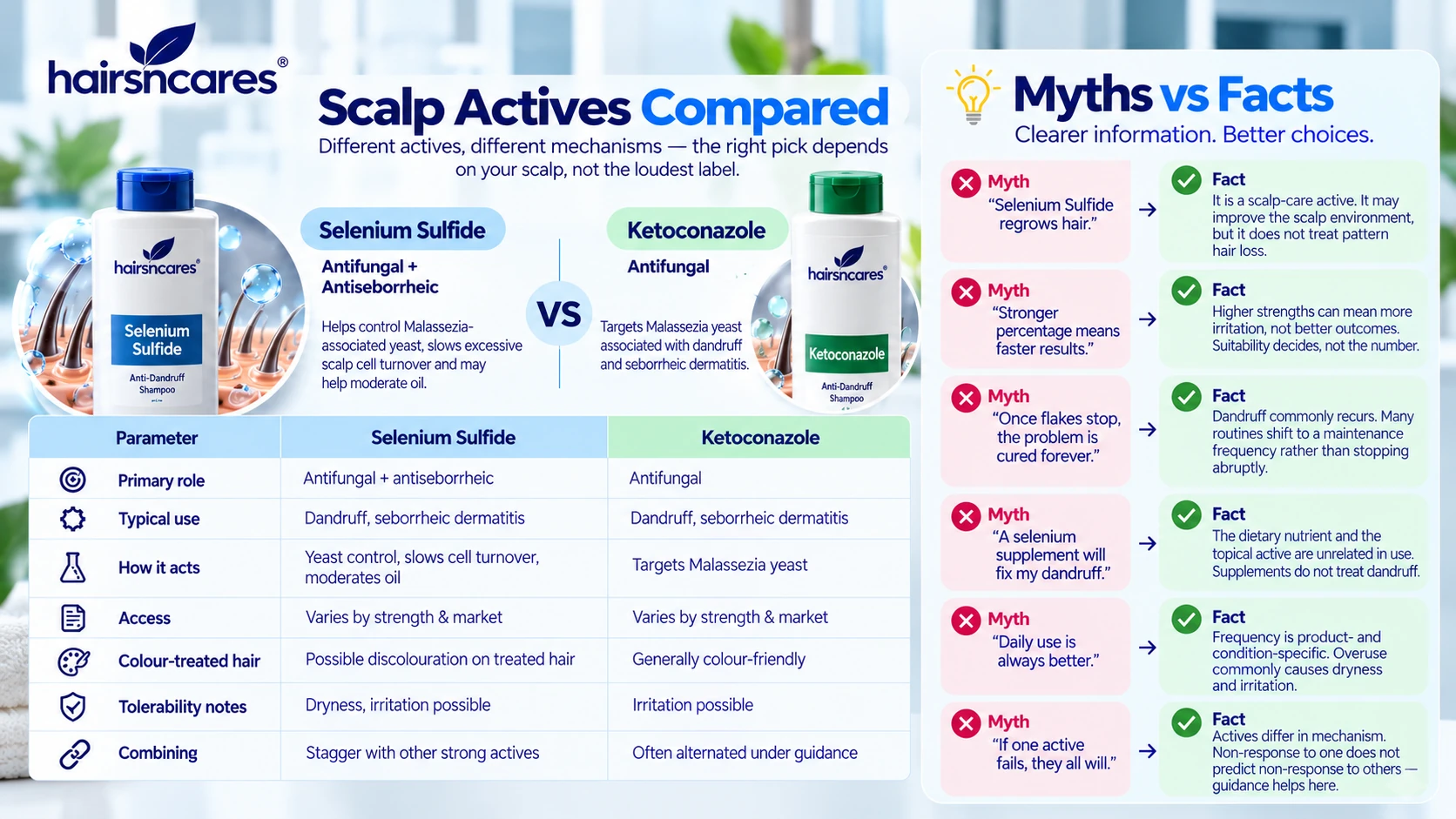
"Selenium Sulfide regrows hair."
It is a scalp-care active. It may improve the scalp environment, but it does not treat pattern hair loss.
"Stronger percentage means faster results."
Higher strengths can mean more irritation, not better outcomes. Suitability decides, not the number.
"Once flakes stop, the problem is cured forever."
Dandruff commonly recurs. Many routines shift to a maintenance frequency rather than stopping abruptly.
"A selenium supplement will fix my dandruff."
The dietary nutrient and the topical active are unrelated in use. Supplements do not treat dandruff.
"Daily use is always better."
Frequency is product- and condition-specific. Overuse commonly causes dryness and irritation.
"If one active fails, they all will."
Actives differ in mechanism. Non-response to one does not predict non-response to others — guidance helps here.
"My rule for medicated scalp care is simple: right diagnosis, right ingredient, right label, right review point. Selenium Sulfide is a genuinely useful active when those four line up — and a source of frustration when they don't."
Products · Doctor-Curated
Product data below loads from the live HairsnCares catalogue. Filters help you shortlist — the AI Hair Test personalises further.
{{PRICE}}
{{PRICE}}
{{PRICE}}
Prescription-strength options require valid medical advice. Availability, pricing and access rules load from the live catalogue and comply with Indian regulation.
Answer guided questions about your scalp, hair and history — free, private, dermatologist-designed.
Start the test →
Severe, persistent or confusing symptoms deserve a consultation, not another guess.
Book a consult →
Shop by concern with products matched to your assessment — not to marketing.
Shop by concern →
Antifungal active in cosmetic anti-dandruff care.
Read guide →
Traditional antiseborrheic used in scaling conditions.
Read guide →
Broad-spectrum antifungal in medicated formulations.
Read guide →
Botanical often found in supportive scalp care.
Read guide →
For readers who want to go deeper, these independent medical resources cover Selenium Sulfide and the conditions discussed here.
External links open in a new tab and lead to independent organisations whose content HairsnCares does not control. References are educational, not treatment instructions.
FAQs · Curated Answers
Honest answers to the questions we hear most often about Selenium Sulfide.
Selenium Sulfide is a topical active used in medicated shampoos and scalp preparations. It may help control dandruff, seborrheic dermatitis and the yeast imbalance often linked to flaking and itching. It is used on the scalp or skin as directed on the product label, and it is not a hair-regrowth medicine.
No. Selenium Sulfide is a topical medicated ingredient applied to the scalp or skin. The selenium nutrient is a dietary mineral consumed through food or supplements. They are not interchangeable, and a supplement will not act as a dandruff treatment.
Selenium Sulfide is not a hair-regrowth drug. By helping calm flaking, itching and yeast-linked irritation, it may support a healthier scalp environment. Pattern hair loss has separate causes and needs its own assessment and treatment pathway with a dermatologist.
Frequency depends on the specific product, its strength and your condition, so always follow the label or your doctor's advice. Many medicated routines begin with limited weekly use and adjust based on response. More frequent use is not automatically better and can increase dryness or irritation.
Products commonly appear in strengths such as 1%, 2.25%, 2.3% or 2.5%, and availability differs by market and regulation. Stronger is not automatically better — the right choice depends on your condition, scalp sensitivity and local prescription rules. Check the label and ask a pharmacist or dermatologist if unsure.
Responses vary. Some people notice less flaking and itching within the first weeks of consistent, label-directed use, while others need longer. If there is no meaningful improvement after the period your product or doctor suggests, or symptoms worsen, review the routine with a dermatologist.
Selenium Sulfide can occasionally cause discolouration or texture changes, and this may be more noticeable on coloured, bleached or chemically treated hair. Read the product label, rinse thoroughly, and consider asking a professional before regular use on treated hair.
Do not self-start medicated actives during pregnancy or lactation. Safety decisions here are individual, so please consult your doctor or dermatologist before using Selenium Sulfide products in these situations.
Use in children should be guided by a doctor. Labels differ on age suitability, and children's scalps can be more sensitive. Seek professional advice before applying medicated anti-dandruff products to a child's scalp.
Possible effects include scalp dryness or oiliness, mild irritation, stinging, itching, temporary texture changes and, occasionally, discolouration of hair. Most mild effects settle with correct use. Stop and seek medical advice for severe burning, swelling, rash, blistering or any signs of an allergic reaction.
Combinations should be planned, not random. Some pairings are commonly staggered across the week; others, like prescription treatments or Minoxidil routines, need professional guidance on timing and scalp condition. Avoid stacking multiple strong actives on the same day without advice.
Both are established anti-dandruff actives that target yeast-linked flaking, and neither is universally better. Choice depends on your condition, response history, scalp sensitivity, availability and medical advice. Some people alternate actives under guidance when one alone is not enough.
Gradual improvement with occasional fluctuation can be normal, but clear worsening is a signal to pause. Stop use if you develop significant burning, pain, swelling, spreading redness or open areas, and consult a dermatologist rather than pushing through irritation.
See a doctor if symptoms are severe, painful, bleeding, rapidly spreading, patchy, or simply not improving after label-directed use; if you are pregnant, breastfeeding, treating a child, or already on prescription treatments; or if you are unsure whether the problem is really dandruff. Conditions like psoriasis and fungal infection can look similar and need different care.
Availability varies by strength and formulation, and some options may be pharmacy or prescription channels depending on regulation. HairsnCares lists dermatologist-curated scalp-care options and can guide you to suitable products after understanding your concern — start with the AI Hair Test or a consultation.
Generic answers end where your individual scalp begins. Get a personalised, dermatologist-designed assessment in minutes.
Your Next Step
Random product switching delays results. A guided assessment matches the right ingredient, strength and routine to your actual concern — safely.
Medical Disclaimer: This page is for educational purposes only and does not constitute medical advice, diagnosis or treatment. Selenium Sulfide products must be used according to their specific label directions or a doctor's guidance. Always consult a qualified dermatologist for persistent, severe or unclear symptoms, before use in pregnancy, lactation or children, before combining active ingredients, and before starting prescription treatments. Individual results vary. If you experience a severe reaction, stop use and seek medical care immediately.
Your cart is empty