When the surface is relatively smooth
- Hair may feel softer
- Light may reflect more evenly
- Fibres may tangle less
- Friction may be reduced
Hair Biology · Structure 01
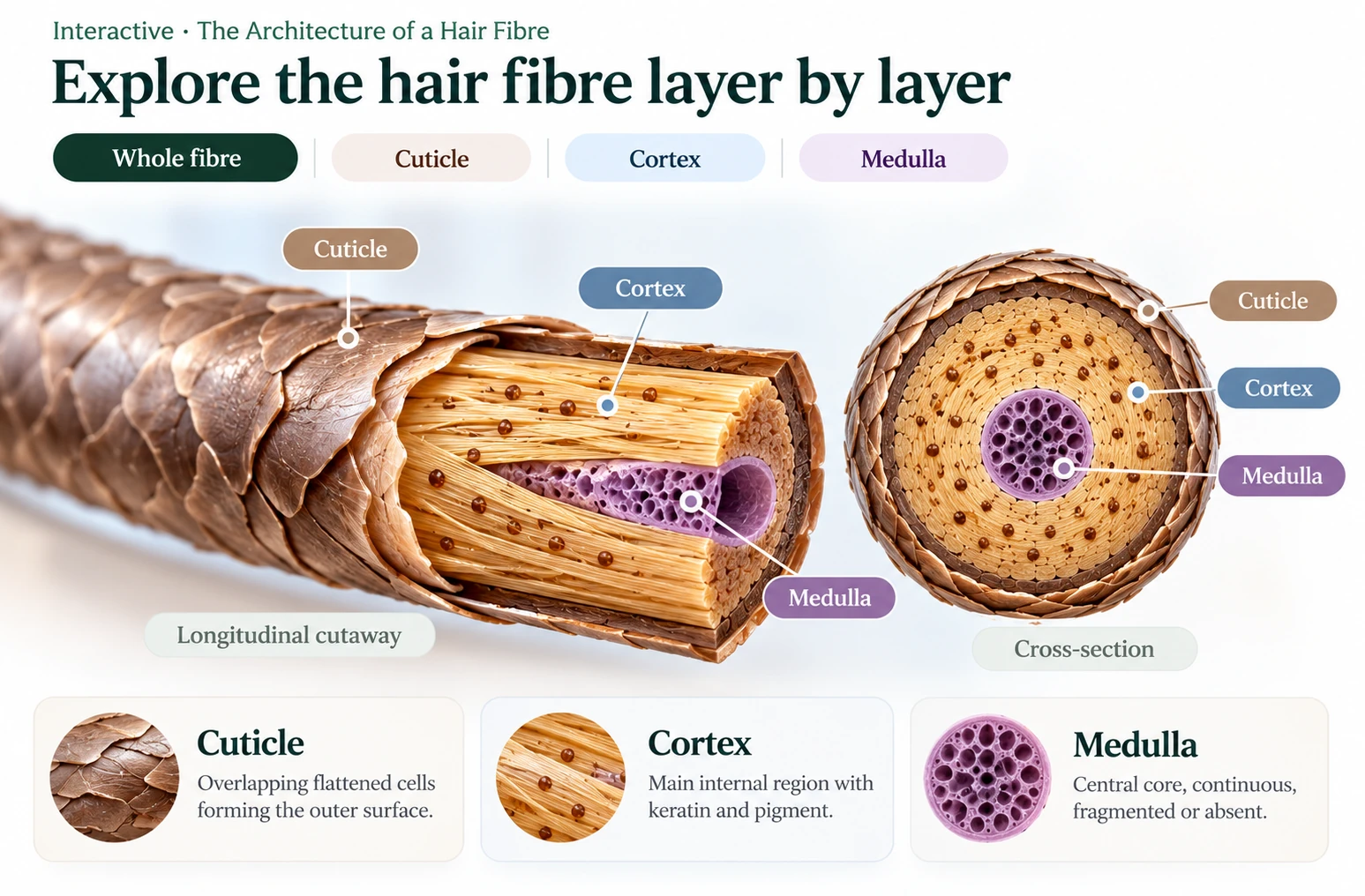
Each visible hair fibre is built from specialised structural regions. The cuticle forms its outer protective surface, the cortex provides most of its strength and pigment, and the medulla — when present — occupies the centre.
Educational content. This page explains fibre anatomy; it does not diagnose hair loss or scalp disease.
Quick Clinical Answer
Hair anatomy refers to the structural organisation of the hair fibre and the follicle that produces it. The visible shaft is primarily composed of keratinised cells arranged into an outer cuticle, a central cortex and, in some fibres, an inner medulla. Most of the hair's strength, elasticity and pigment are associated with the cortex, while the cuticle helps protect the fibre's surface.
Medically reviewed by Dr. Amit S. Agarkar — MBBS, MD Dermatology, FCPS, DDV · Reviewed 26 July 2026 · Next review July 2027
Overview
The part of hair seen above the scalp is a keratinised fibre built mainly from specialised proteins. It cannot heal in the way living skin can, but its surface condition, friction, flexibility, water behaviour and appearance can be temporarily improved through appropriate haircare.
That single distinction does more work than any other idea in haircare. Living tissue repairs itself; a finished fibre does not. Everything below follows from it — why conditioning is renewable rather than cumulative, why split ends can only be cut, why a treatment that genuinely changes growth takes months to become visible, and why two claims that sound identical can describe completely different things.
This page works from the outside inward: the protective surface first, then the load-bearing interior, then the variable core. Once the three regions are clear, the rest of the page uses them as a diagnostic tool — for reading damage, for judging porosity, and for translating marketing language back into biology.
Understand the fibre, and many “repair,” “rebuild” and “deep nourishment” claims become easier to evaluate. The premise of this guide
Related reading: Keratin and hair proteins · The deep dive on bond chemistry and damage mapping · The hair follicle
Interactive · The Architecture of a Hair Fibre
Choose a region to isolate it in the diagram and read what it does, what damages it, and what products can and cannot change about it. Every region is also explained in full in the sections that follow.
Proportions are drawn for clarity. In a real fibre the cuticle is a much thinner shell, the cortex accounts for the great majority of the cross-section, and the medulla — where present — is narrower still.
Whole fibre
A finished hair fibre: an outer cuticle protecting a load-bearing cortex, with a variable medulla at the centre. No living cells anywhere along it.
Region One
The cuticle is the outermost region of the hair shaft. It is formed from overlapping, flattened cells arranged somewhat like roof tiles. These layers reduce friction, protect the internal cortex and influence smoothness, shine, detangling and moisture movement.
Because the scales overlap in one direction — from root towards tip — the fibre behaves differently depending on which way you move against it. Combing with the direction of the scales is smooth; working against them lifts edges. That asymmetry is why detangling from the ends upward causes less damage than dragging a comb from the roots down.
These act cumulatively rather than dramatically. No single wash or styling session accounts for the condition of your ends; the total across years does.
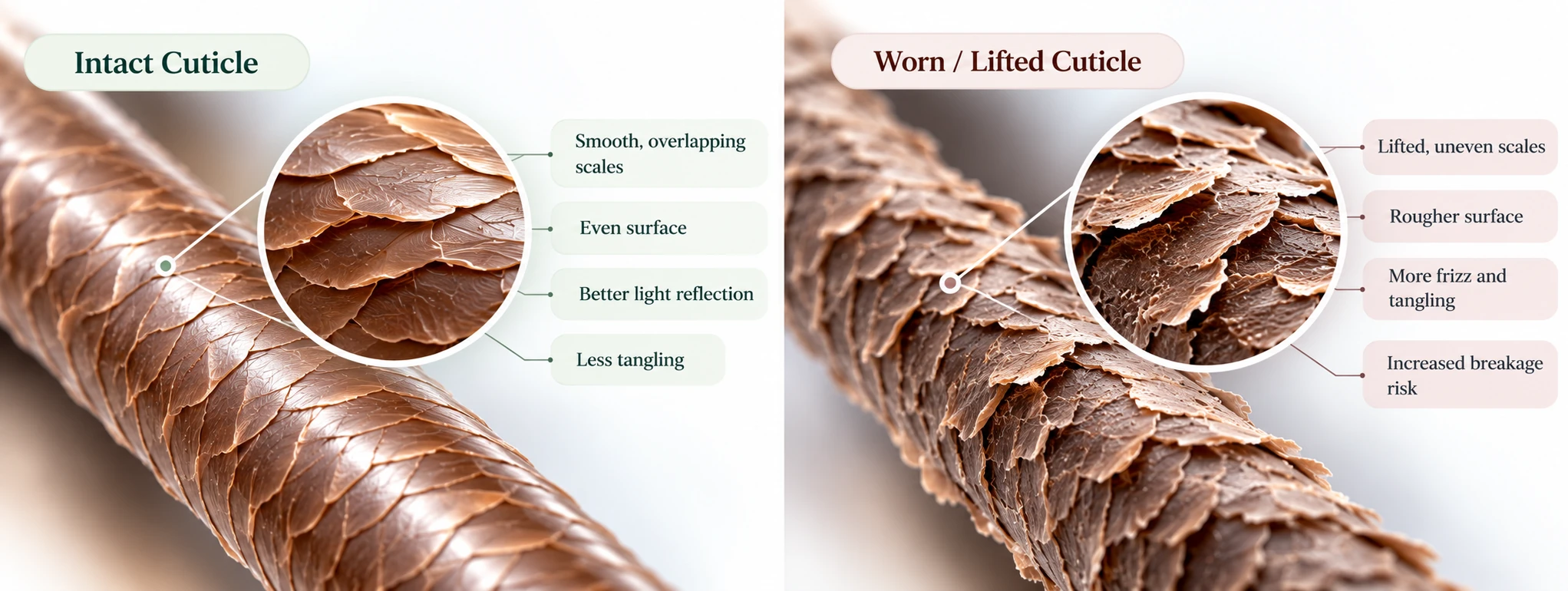
What conditioning honestly achievesConditioners, masks, silicones, cationic agents, oils and film-forming ingredients may reduce friction, improve lubrication and temporarily smooth the hair surface. They do not recreate the original biological cuticle once it has been significantly lost. That is not a criticism of the products — reduced friction genuinely means less breakage — it is simply a different claim from repair.
Claim: “repairs the cuticle permanently.” Most cosmetic products improve surface behaviour temporarily by coating, lubricating or filling irregularities. They do not regenerate cuticle cells, which contain no living material and cannot divide.
Region Two
The cortex forms most of the hair fibre and contributes substantially to its strength, elasticity, shape and colour. It contains organised keratin structures and pigment granules produced during hair formation inside the follicle.
Keratin filaments assemble into micro- and macrofibrillar bundles held in a protein matrix, and those bundles fill elongated cortical cells. The nesting is what allows a fibre this fine to carry real mechanical load.
Disulfide bonds are covalent and require chemistry to break. Hydrogen bonds break with water and heat, then reform on drying. Salt bonds depend on pH. Which bond a treatment touches decides whether the change lasts a day or a year.
Melanin granules sit within the cortex, placed there while the fibre was being built. Their type and quantity give you your natural shade — and nothing applied afterwards adds more.
The cortex bears much of the mechanical load placed on the hair fibre. Repeated chemical or thermal exposure may weaken the internal protein structure and reduce resistance to stretching and breakage. The practical sign is elasticity: hair that stretches a long way when wet and then snaps rather than recovering is telling you about its cortex, not its surface.
Fibre shape and internal organisation together contribute to whether hair appears straight, wavy, curly or coily. The cross-sectional shape of the fibre, the way cortical cells are distributed around it and the geometry of the follicle that produced it all play a part — curl is not reducible to any single anatomical factor.
Melanin granules are found primarily within the cortex. Eumelanin contributes brown-to-black tones and pheomelanin contributes yellow-to-red tones, and the balance between them accounts for most natural variation. Greying relates to reduced or absent pigment incorporation during fibre production — so colouring products modify or replace visible colour, but do not reverse the biological ageing of pigment-producing cells.
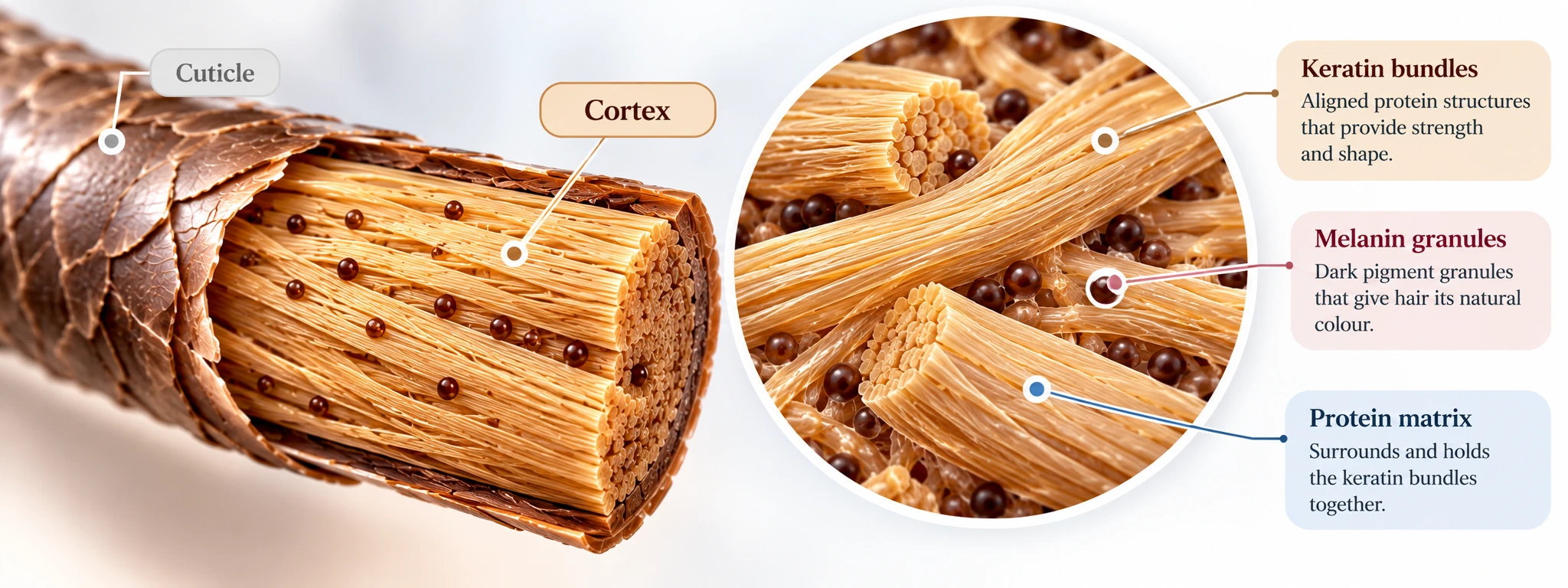
On protein and “rebuilding”: hydrolysed proteins and selected conditioning agents may temporarily improve feel or reinforce weak areas, but they do not permanently rebuild the cortex to its original biological state. Used well they reduce breakage; used indiscriminately on hair that does not need them, they can leave the fibre feeling stiff.
Region Three
The medulla is the innermost region of some hair fibres. It may be continuous, fragmented or completely absent, particularly in finer human hairs.
Runs without interruption along the fibre. More often seen in coarse, thick terminal hairs.
Present in stretches and absent in others, sometimes alternating along a single strand.
No medulla at all — common in finer hairs, and entirely normal.
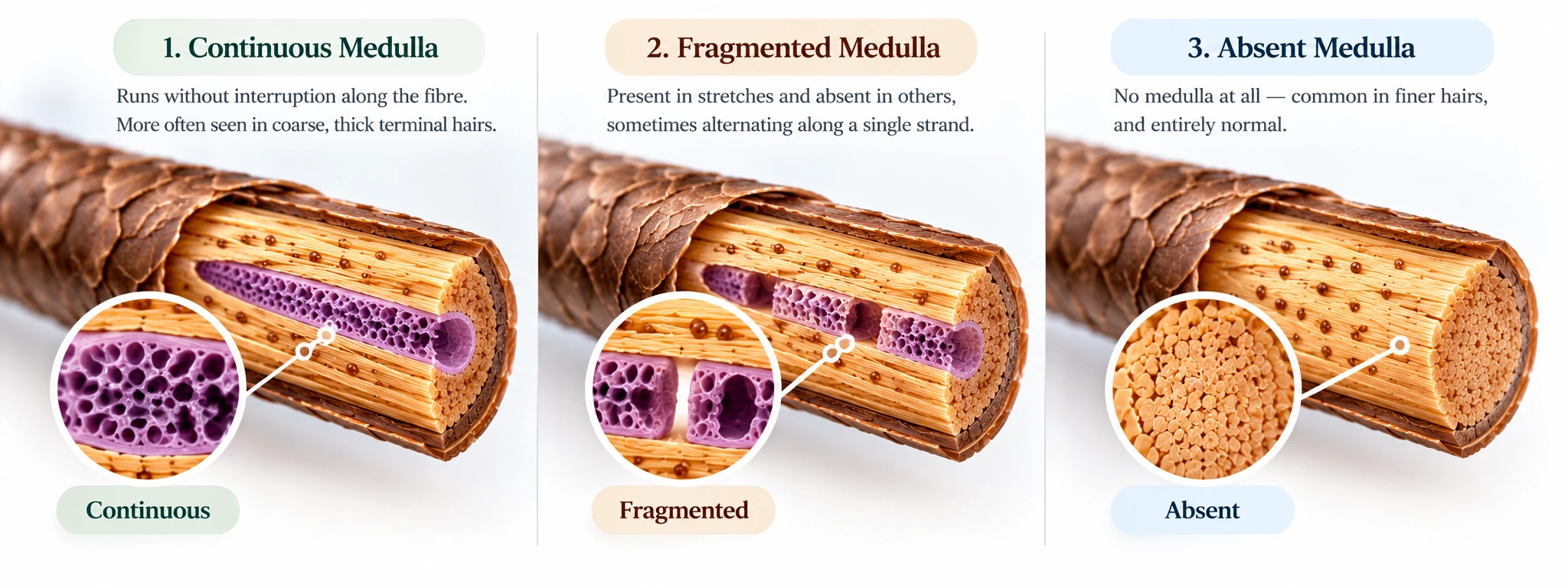
Scientific note: the exact contribution of the medulla to everyday cosmetic properties is less significant than the roles of the cuticle and cortex. Its presence tends to track with fibre thickness rather than with hair health, and it is not a routine cosmetic diagnosis.
A useful filter for product claimsMost mainstream haircare products do not specifically target the medulla, and claims suggesting precise medulla repair should be examined critically. It is a genuinely interesting structure in comparative and forensic work — and not a lever consumers have access to.
Comparison
The same three regions, set side by side — by location, character, contribution, damage relevance and how products interact with them.
| Layer | Location | Main characteristics | Major contribution | Common damage relevance | Product interaction |
|---|---|---|---|---|---|
| Cuticle | Outer surface | Overlapping flattened cells, root-to-tip orientation, bound by a lipid-rich intercellular material | Protection, friction control and surface behaviour | Roughness, tangling, loss of shine | Conditioning, lubrication and surface coating |
| Cortex | Main internal region | Organised keratin in a protein matrix, stabilising bonds, melanin granules | Strength, elasticity, colour and much of fibre shape | Weakness, loss of elasticity and breakage | Limited temporary reinforcement or film formation |
| Medulla | Central core when present | Loosely packed cells with air spaces; continuous, fragmented or absent | Variable and less cosmetically significant | Limited relevance in routine consumer haircare | Rarely a meaningful direct target |
The Dividing Line
Living at the root, not along the shaft. Cells inside the follicle are biologically active and divide rapidly; the fibre becomes keratinised as it forms, and what emerges above the scalp contains no living cells at all.
Below the scalp
Metabolically demanding, richly supplied with blood, and sensitive to hormones, nutrition, illness and inflammation.
Above the scalp
Durable, workable and improvable — but permanent in its damage, because nothing in it can rebuild itself.
The consequence people find surprisingNutrients reach hair through the circulation, at the base of the follicle, beneath the skin. Nothing applied to the shaft travels down it to feed the root, and nothing the root receives travels up to mend the shaft. The two halves of hair care are genuinely separate projects.
Accumulation
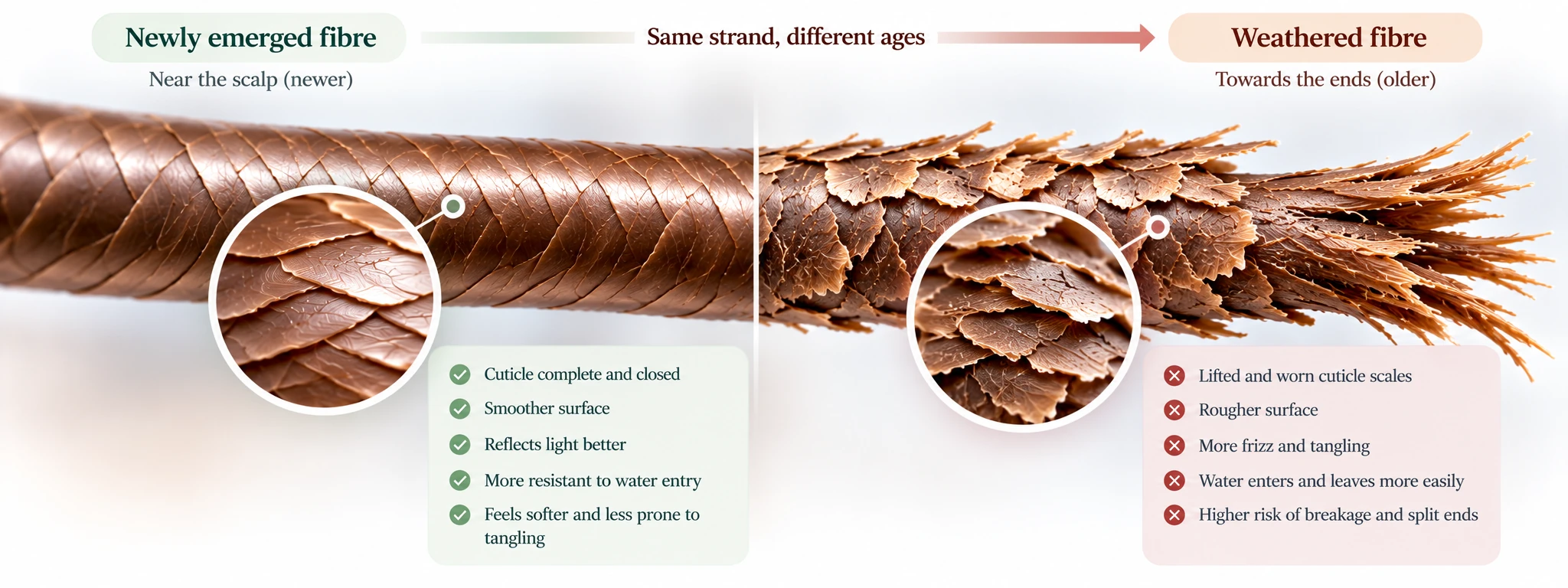
Damage is not an event; it is a running total. The tip of a long hair fibre may be several years older than the portion near the scalp, which is why ends usually show more weathering than newly emerged roots.
Cuticle complete and closed, surface lipids intact, water resisted rather than absorbed. This is the reference point everything is measured against.
Each wet-and-dry cycle swells and contracts the fibre. Scale edges begin to lift; the innermost, softer cuticle layers take the strain.
Brushing, towelling, pillow contact and fastenings abrade the surface. Scale edges chip and are gradually worn away rather than merely raised.
Alkaline and oxidising chemistry lifts the cuticle to reach the cortex. High temperatures, especially on wet hair, act on internal protein structure.
Scale layers thin. Water enters and leaves more readily, conditioning wears off faster, and the fibre feels rough between washes.
With little protective sheath remaining, the internal structure is directly exposed. Elasticity falls and colour holds unevenly.
Exposed internal structures separate along the fibre, or the strand fractures across it. Neither can be rejoined; the affected length has to be cut.
Because all of this accumulates, one head of hair can honestly need two approaches — protective handling for the ends, ordinary care near the scalp.
Critical Distinction
One is a fibre problem you can often address yourself. The other happens at the follicle and may need a doctor. Telling them apart is the most useful thing this page can teach you.
Usually involves damage or fracture of the visible hair shaft.
Usually involves release or reduced production of hair at the follicle.
Important medical note: breakage and hair loss may occur together, and one can mask the other. Persistent density change, patchy loss, scalp symptoms such as pain, burning, scaling or redness, or sudden shedding may require professional assessment. Appearance alone cannot identify the cause.
Behaviour
Porosity describes how readily the hair fibre interacts with and retains water or applied substances. It is governed largely by the condition of the cuticle surface — which means it is a description of your hair right now, not a fixed category you belong to.
Because cuticle condition varies along a strand, porosity varies along it too. Hair near the scalp is usually more resistant than hair at the ends, and a single bleaching service can change the behaviour of the lengths without touching the roots. Natural variation between individuals exists as well, but processing and fibre history account for much of what people notice.
Cuticle relatively intact and closed.
Cuticle lifted or partly eroded.
On the floating-hair test: whether a strand floats in a glass of water depends heavily on surface tension, residual oils and product, and how the hair was handled — not primarily on porosity. Treat it as unreliable. How quickly your hair wets, how long it takes to dry and how fast conditioning wears off are far more informative, and porosity is better read as a current state than a permanent diagnostic category.
Product Science
Five categories, each with an honest ceiling. Every "can" below is a real, worthwhile benefit; every "cannot" is where a claim would be overstating the biology.
| Category | Acts on | Can | Cannot |
|---|---|---|---|
| Shampoo | Surface | Remove oil, debris and styling residue; cleanse the scalp and fibre surface; influence friction depending on formulation | Regrow missing cuticle cells, permanently rebuild the cortex, or treat every cause of hair loss |
| Conditioner | Cuticle | Improve lubrication, reduce static, improve detangling, smooth surface irregularities and reduce friction | Biologically heal a fibre with no living cells, or permanently reverse severe structural loss |
| Hair mask | Cuticle | Provide more intensive conditioning, improve feel and manageability, temporarily reduce roughness | Restore the fibre to a completely undamaged state |
| Protein treatment | Cuticle, some ingress | Temporarily improve feel, form films, reinforce weak areas in some formulations | Permanently replace the original internal protein architecture |
| Heat protectant | Cuticle | Reduce some heat-related damage, improve lubrication, distribute heat more evenly in some formulations | Make unlimited heat exposure safe |
The question worth asking before any purchaseWhich region does this act on, and is that where my problem actually sits? Roughness and tangling are surface complaints with straightforward answers. Loss of elasticity is structural, and the honest response is protective handling plus a trim. Changing density is follicular, and belongs in a consultation. Most disappointment in haircare is a targeting error rather than a product failure.
Claim Translator · Interactive
Seven phrases you will meet on almost every shelf. Open each one to see what it usually describes in structural terms. None of these are automatically dishonest — they are simply narrower than they sound.
Usually refers to temporary improvements in surface smoothness, lubrication, film formation or reduced breakage during combing. Those are measurable and worth having. Structural repair of a keratinised fibre is not possible, so read “repair” as “performs better while the product is on the hair”.
Some small molecules may enter parts of the fibre, usually travelling through the lipid-rich material between cuticle cells. Penetration does not automatically mean permanent structural repair — entering the fibre and rebuilding it are different achievements.
Often means reducing surface friction or coating irregularities so that scale edges lie flatter and catch on each other less. Nothing is being closed shut, and no living structure is involved — the effect lasts until the coating is washed away.
Usually refers to temporary protein deposition or reinforcement of weakened areas, not biological regeneration. Keratin in the cortex was assembled inside the follicle and cannot be re-assembled from the outside. Deposited protein can still reduce breakage, which is a genuine benefit.
Products applied to the shaft can condition the fibre along its whole length, which is presumably the intent. But nutrient delivery to living follicular tissue occurs through the body's circulation, not through the visible shaft. Nothing travels down a hair to feed its root.
Some products temporarily bind or coat split areas so they look and feel smoother and split less further. The physical split remains until the affected length is trimmed — there is no mechanism by which a separated fibre rejoins.
This one is often accurate — and that is the point to be careful about. Chemical procedures can create long-lasting structural alteration in the treated fibre. New hair still grows according to the follicle's biology, so the change applies only to the lengths already present, and it cannot be undone on them.

"This guide explains the anatomy of the visible hair shaft and how its structure relates to cosmetic damage, conditioning and breakage. It does not diagnose hair loss or scalp disease — and the distinction matters, because the two are treated in completely different ways."
Faculty 01 · Hair Biology
Hair Anatomy is the first of five subjects. The rest move below the scalp, where the fibre is made.
02 / Origin
Bulb, matrix and dermal papilla — where growth begins and the fibre is built.
Understand the hair follicle →
03 / Rhythm
Anagen, catagen and telogen — why hair grows, pauses and sheds at different times.
Follow the hair growth cycle →
04 / Environment
Barrier, sebum and microbiome — the environment every follicle sits in.
Learn about scalp biology →
05 / Supply
How oxygen and circulating nutrients reach the cells of the hair bulb.
Trace blood supply to the hair bulb →
Independent medical resources covering hair structure and care. Detailed cosmetic-science material on cuticle sublayers and bond chemistry is drawn from dermatology and hair-science reference texts.
External links open in a new tab and lead to independent organisations whose content HairsnCares does not control, and no link implies endorsement or partnership. [ADD APPROVED TEXTBOOK CITATIONS — hair shaft ultrastructure, cuticle sublayers]
FAQs · Curated Answers
Short, consumer-friendly answers about the cuticle, cortex, medulla and what can realistically be done about each.
Working from the outside in: the cuticle, an outer sheath of overlapping flattened cells; the cortex, the main internal region that forms most of the fibre; and the medulla, a central core that is present in some hairs and absent in others.
The cuticle is the outermost region of the hair shaft, formed from flattened cells that overlap somewhat like roof tiles. It reduces friction, protects the cortex beneath, and influences smoothness, shine, detangling and how water moves in and out of the fibre.
The cortex forms most of the hair fibre. It contains organised keratin structures, the bonds that stabilise them, and the pigment granules produced during hair formation. It contributes substantially to strength, elasticity, colour and much of the fibre's shape.
The medulla is the innermost region of some hair fibres, made of loosely packed cells with air spaces. It may be continuous, fragmented or completely absent, and its contribution to everyday cosmetic properties is less significant than that of the cuticle and cortex.
No. A medulla is often continuous in coarse hairs, fragmented in medium hairs and frequently absent in finer hairs. Its presence tends to vary with fibre thickness and can change along the length of a single strand.
Melanin granules are found primarily within the cortex, deposited while the fibre was being formed inside the follicle. Eumelanin contributes brown-to-black tones and pheomelanin contributes yellow-to-red tones.
The cortex bears much of the mechanical load placed on a hair fibre, so it accounts for most of its strength and elasticity. The cuticle protects that structure, and losing cuticle makes the cortex more exposed to further damage.
No. Cells inside the follicle are biologically active, but the fibre becomes keratinised as it forms, and the shaft above the scalp contains no living cells. It has no direct blood supply and cannot heal through cellular regeneration, though its condition and appearance can be improved cosmetically.
Not biologically. Because the shaft is not living tissue, structural loss is permanent for that fibre. Appropriate products can temporarily improve smoothness, lubrication, manageability and resistance to breakage, and undamaged structure arrives only with new growth.
Repeated heat exposure, bleaching, permanent colouring, chemical straightening, excessive brushing, towel friction, UV exposure, environmental weathering and repeated wetting and drying all contribute. Damage accumulates, so older lengths usually show more of it than hair near the scalp.
Conditioners improve lubrication, reduce friction and static, help scales lie flatter and make hair easier to detangle. Those benefits are real but temporary, and they do not recreate cuticle cells that have already been lost.
Breakage is a fracture of the visible shaft, so you find short broken pieces, uneven lengths and split ends. Hair loss involves release or reduced production of hair at the follicle, so you find full-length shed hairs and changes in density. They can occur together, and persistent density change, patchy loss or scalp symptoms deserve professional assessment.
Bleaching lifts the cuticle in order to reach the cortex, where it removes or alters melanin by oxidation. The same chemistry acts on structural proteins there, which is why heavily bleached hair tends to lose strength and elasticity rather than simply looking lighter.
No. Hydrolysed proteins and similar agents can deposit on and within damaged areas, temporarily improving feel and reducing breakage. They do not restore the original internal protein architecture, and the effect diminishes with washing.
A split forms where the cuticle has been worn away and the exposed internal structures separate along the fibre. Products can temporarily bind or coat the area and reduce further splitting, but the physical split remains until the affected length is trimmed.
Porosity describes how readily a fibre interacts with and retains water or applied substances, and it is governed largely by the condition of the cuticle surface. It varies along a single strand and changes with processing, so it is better treated as a current description than a permanent hair type. Home float tests are unreliable.
Roughness, breakage and shedding can look alike in a mirror and need completely different answers. A structured assessment separates them quickly.
Your Next Step
Hair products interact with specific parts of the fibre in specific ways. Understanding the cuticle, cortex and medulla helps you separate realistic conditioning benefits from claims that overstate what cosmetic products can achieve.
Looking for products for damaged hair? Start with the damaged-hair concern page.
Medical Disclaimer: This page provides general educational information about hair-fibre anatomy. It does not diagnose hair loss, scalp disease or structural disorders. Cosmetic products cannot regenerate lost cuticle cells or permanently rebuild the cortex, and no product referenced on HairsnCares is presented as a treatment for hair loss. Persistent breakage, sudden shedding, patchy loss or scalp symptoms should be assessed by a qualified professional. Individual results vary.
Your cart is empty