Scalp Biology: Barrier, Sebum and Microbiome Explained
The scalp is a specialised skin environment where barrier cells, natural lipids, sebum, follicles and resident microorganisms interact. Understanding this ecosystem helps explain oiliness, dryness, itching, flaking and the role of scalp-care products.
Educational content. This page explains scalp biology; it does not diagnose dandruff, dermatitis, psoriasis, infection or allergy.
Surface microbes, barrier bricks and mortar, sebaceous glands feeding the canal, and moisture leaving the skin.
Reviewed by Dr. Amit S. Agarkar
Regulated, not sterile
Quick Clinical Answer
What is scalp biology?
Scalp biology describes how the scalp's skin barrier, sebaceous glands, hair follicles, immune system and resident microorganisms function together. The barrier limits excessive water loss and entry of irritants, sebum contributes surface lipids, and the microbiome forms part of the scalp's normal ecological environment. The scalp is a living ecosystem — not merely a surface beneath the hair.
Living skinUnlike the hair shaft, the scalp is living tissue with a barrier, immune activity and blood supply.
Sebum is normalIt is a biological secretion, not dirt. Removing all surface lipid is neither realistic nor desirable.
Not sterileBacteria and fungi live on every healthy scalp. Their presence alone does not cause symptoms.
Oily and irritated coexistSurface oil says nothing about water content. A greasy scalp can still have a stressed barrier.
AA
Medically reviewed by Dr. Amit S. Agarkar — MBBS, MD Dermatology, FCPS, DDV · Reviewed 26 July 2026 · Next review July 2027
What you'll learn on this page
What makes scalp skin biologically distinct from the hair it produces
How the barrier works — corneocytes, lipids, and the limits of the brick-and-mortar analogy
What transepidermal water loss is, and why oily does not mean hydrated
What sebum is, where it comes from, and why it is not dirt
How oily, dry-feeling and irritated scalp states differ and overlap
What the scalp microbiome actually is, and why a healthy scalp is not germ-free
How Malassezia relates to dandruff — without oversimplifying either
Why dandruff is not simply dry skin
What scalp pH means, and why low pH alone does not make a product gentle
How cleansing, oiling and exfoliation each affect the ecosystem
Why “scalp detox” is a marketing term rather than a biological process
Ten common scalp ingredients, read against the biology
Which symptoms deserve professional review rather than another product
01
Overview
The scalp is a living ecosystem — not merely a surface beneath the hair
Scalp health depends on the interaction between the skin barrier, sebaceous lipids, sweat, immune activity, hair follicles and resident microorganisms. Discomfort or scaling may arise when this ecosystem becomes disrupted — but "balance" does not mean removing all oil or all microbes.
Nearly all scalp-care marketing rests on one unexamined assumption: that oil, microbes and dead cells are problems to be eliminated. The biology says otherwise. Each of those is a normal component of functioning skin, and the most common way people make a scalp worse is by attacking it — stripping lipids, scrubbing scale, or reaching for something stronger when the last strong thing caused irritation.
This page treats the scalp as three interacting systems: a barrier that regulates what enters and leaves, sebum that supplies lipids to the surface and the follicular canal, and a microbial community that lives on both. Understanding how they interact is what makes the difference between choosing a product that fits the problem and cycling through products that never could.
A healthy scalp is not sterile, oil-free or aggressively exfoliated. It is regulated, resilient and biologically balanced. The premise of this guide
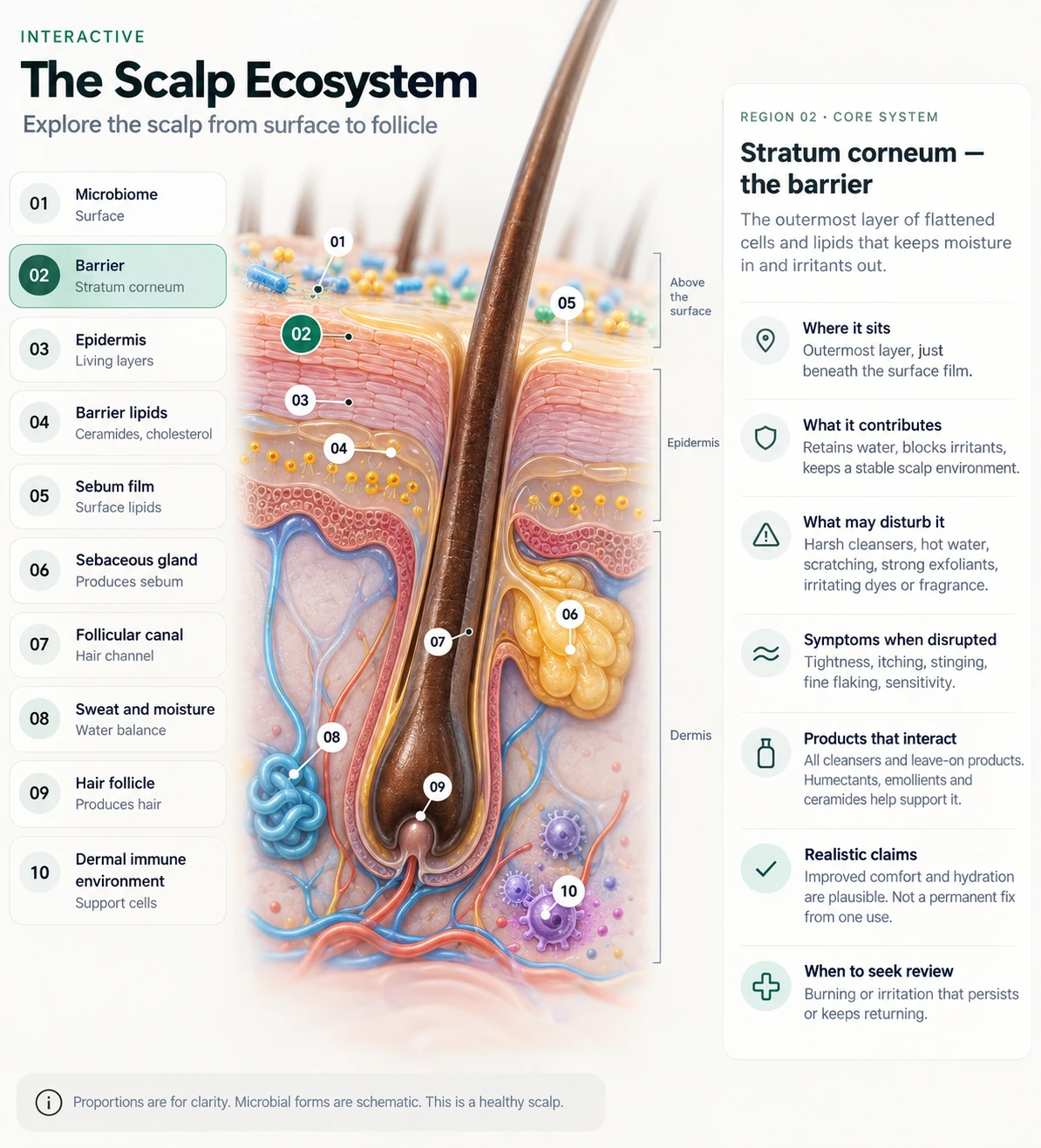
Ten regions, selectable from the list. Choosing one highlights it in the cross-section and reports where it sits, what it contributes, what disturbs it, which symptoms follow disruption, which products interact with it, which claims are realistic, and when a symptom needs medical review.
The three core systems
Surrounding structures
Use Tab to move through the list and Enter or Space to select. Nothing is hidden by the interaction — every region is also described in the list below the readout.
Proportions are drawn for clarity, and the microbial forms are schematic rather than to scale. This is a healthy scalp: no inflammation, no disease.
Region 02 · core system
Stratum corneum — the barrier
Flattened corneocytes organised within a lipid-rich environment. This is the layer that limits excessive water loss and reduces the entry of irritants, allergens and microorganisms.
Where it sits
The outermost layer of the epidermis, immediately beneath the surface lipid film.
What it contributes
Controlled water retention, reduced irritant penetration, orderly shedding of surface cells and a stable environment for resident microorganisms.
What may disturb it
Harsh or unsuitable cleansers, very hot water, aggressive scratching, strong exfoliants, irritating dyes, fragrance allergens and inflammatory scalp disease.
Symptoms when disrupted
Tightness, stinging, burning, itching, heightened sensitivity, fine flaking and discomfort after products. None of these point to one diagnosis.
Products that interact
Every cleanser and leave-on scalp product. Humectants, emollients and ceramide-containing formulas are positioned for barrier support.
Realistic claims
Improved comfort and hydration measurements are plausible. Permanent restoration from one application is not.
When to seek review
Burning or stinging that persists, or irritation that keeps returning despite gentler care.
01 Surface microbiome — resident bacteria and fungi living on the scalp surface and in follicular openings.
02 Stratum corneum — the outermost barrier layer of corneocytes and lipids.
03 Epidermis — the living layers beneath, continuously renewing the barrier above.
04 Barrier lipids — ceramides, cholesterol and free fatty acids between corneocytes.
05 Sebum film — the lipid layer spread across the surface and emerging fibres.
06 Sebaceous gland — the gland producing sebum and releasing it into the canal.
07 Follicular canal — the channel through which the fibre emerges and sebum reaches the surface.
08 Sweat and moisture — water reaching the surface, and water leaving through the barrier.
09 Hair follicle — the living organ producing the fibre, covered in depth on its own page.
10 Dermal immune environment — immune cells and signalling in the tissue around the follicles.
The outermost scalp barrier is centred on the stratum corneum, where flattened corneocytes are organised within a lipid-rich environment. Together, these structures help limit excessive water loss and reduce the entry of irritants, allergens and microorganisms.
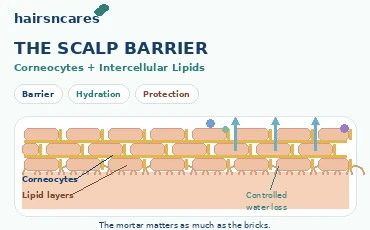
Bricks and mortar — with a caveat. Corneocytes are often described as bricks and the intercellular lipids as mortar, and the picture is genuinely useful. But it undersells what is happening: the barrier is dynamic and biologically regulated, constantly renewed from below, and its lipids are actively synthesised rather than passively spread. A wall does not repair itself. This does.
What the barrier is made of
Corneocytes — flattened cells forming the outer layer
Intercellular lipids: ceramides, cholesterol and free fatty acids
Natural moisturising factors that help retain water
A mildly acidic surface pH
Immune signalling and orderly desquamation
What a well-functioning barrier supports
Comfortable hydration and controlled water loss
Lower irritant penetration
Normal shedding of surface cells
Resilience against environmental exposure
A stable environment for resident microorganisms
The mortar matters as much as the bricks. Most barrier problems are lipid problems.
Signs that may accompany barrier disruption
These symptoms are not specific to one diagnosis. They indicate that something is irritating or stressing the scalp — not what that something is.
Tightness, stinging or burning
Itching and heightened sensitivity
Fine flaking and redness
Irritation after applying products
Discomfort after frequent washing
Greater reactivity to fragrances or active ingredients
Common barrier stressors
Harsh or unsuitable cleansers
Repeated exposure to very hot water
Aggressive scratching
Frequent chemical services and irritating dyes
Fragrance allergens
Overuse of strong exfoliants
Environmental dryness and repeated friction
Inadequately rinsed product residue
Inflammatory scalp disease itself
AA
The clarification I make most oftenA disrupted barrier does not always mean the scalp is visibly dry. An oily scalp can still experience barrier stress, irritation and increased water loss — and people in that situation often reach for stronger clarifying products, which makes the irritation worse while the oiliness stays exactly the same.
Water naturally moves from deeper skin layers towards the environment. The barrier slows this process but does not eliminate it, and transepidermal water loss may increase when the barrier is disrupted.
How much water leaves depends on the barrier's condition, environmental humidity, how the scalp has recently been cleansed, whether inflammation is present, whether anything occlusive is sitting on the surface, the formulation of what you apply, and individual variation. It is a rate, not a state — which is why hydration responds to what you do rather than being fixed.
Surface oil does not prove the scalp holds enough water. Sebum and hydration are related but not interchangeable: one is lipid produced by glands, the other is water retained within the skin. This is the single most useful distinction on this page, and it explains why "oily but tight and itchy" is a real and common combination rather than a contradiction.
Claim evaluation
“Hydrating”
The word covers at least five different mechanisms. A product described as hydrating should make clear which of these it actually does — because they behave very differently on a scalp, and not all oils are moisturisers in the same way.
Attracts water into the surface (humectant)
Reduces evaporation from the surface
Adds emollient lipids that improve feel
Forms an occlusive film over the skin
Improves comfort without changing measurements
Has evidence specifically for barrier support
Only the last of these is a barrier claim. The others are real benefits and worth having — they are simply narrower than the word suggests.
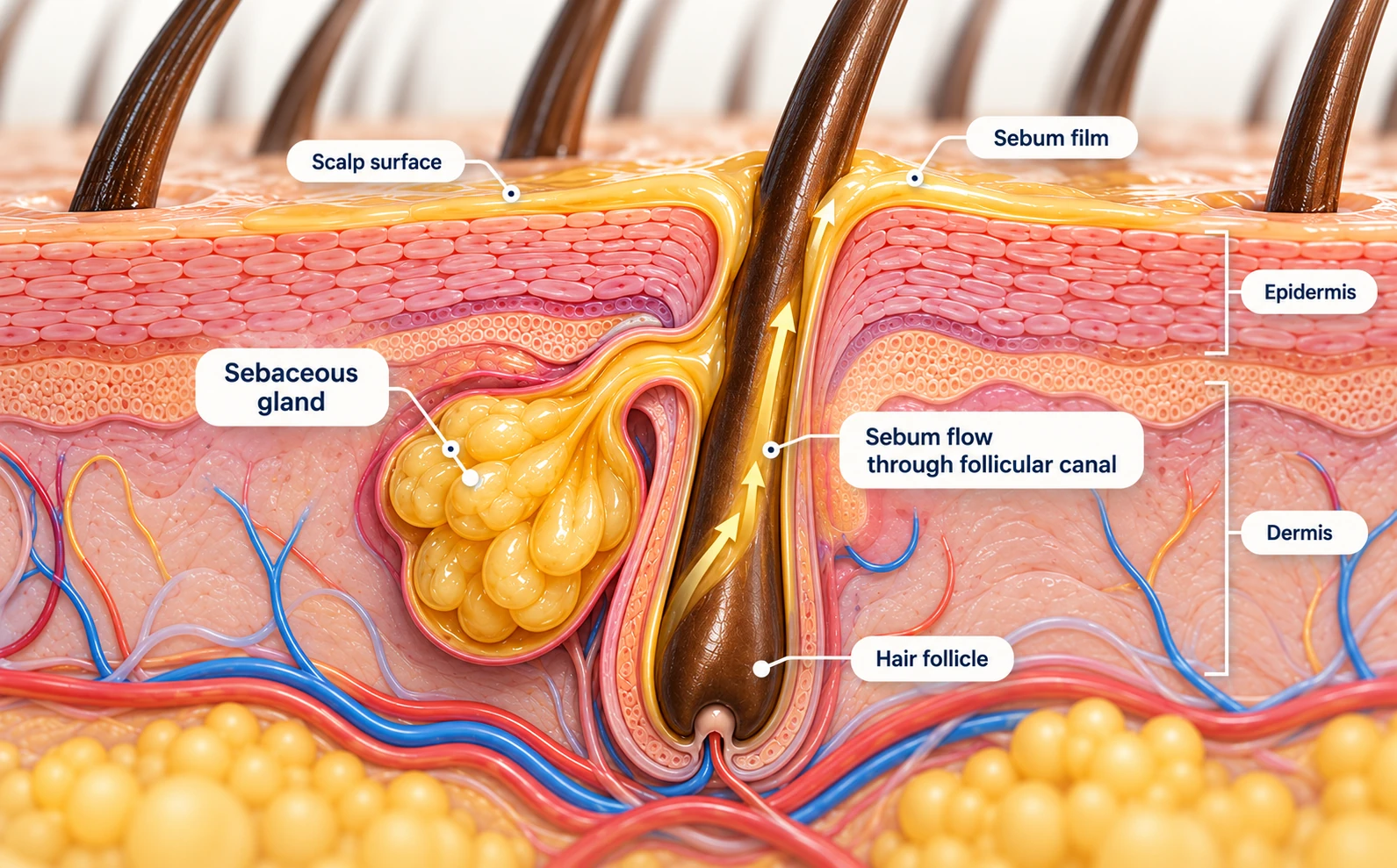
Sebum is an oily substance produced by sebaceous glands and released into the upper hair follicle. It spreads across the scalp and emerging hair fibre, contributing to lubrication and the surface lipid environment.
Sebum is not the same thing as sweat, product residue, dirt, pus, follicular fluid, or hair oil applied from a bottle. Those get conflated constantly, and the conflation drives most of the anxiety about scalp oil. Sebum is a secretion your skin makes on purpose.
Sebum reaches the surface through the follicle, not through the skin between hairs.
What sebum may contribute
Surface lubrication and reduced friction
Lipid transport along emerging fibres
Support for parts of the microbial ecosystem
Interaction with the scalp's acid mantle
Contribution to the feel and appearance of hair at the roots
Why some scalps become oilier
Genetics and individual sebaceous-gland activity
Androgen activity and age
Climate and humidity
Washing interval and hair density
Styling products and occlusive headwear
AA
Sebum is not inherently harmfulThe scalp normally produces it, and removing all surface lipid is neither realistic nor necessarily desirable. Heavy accumulation may contribute to a greasy appearance, odour, residue and changes in the microbial environment — but the ideal cleansing frequency varies between people, oiliness is not proof of poor hygiene, and frequent cleansing is not automatically harmful when the cleanser suits you.
On the idea that shampoo “trains” the glands: the claim that washing less will teach sebaceous glands to produce less oil is widely repeated and not well supported. Output is driven largely by genetics, hormones and age. What does change with a longer interval is how much sebum has accumulated by the time you look — which is a different thing from production.
Can an oily scalp still be dehydrated or irritated?
Yes. Sebum describes surface lipid production, while hydration refers to water content and water retention within the skin. A scalp may produce substantial sebum while also experiencing barrier disruption, irritation or increased water loss.
Pattern one
Oily scalp
A surface-lipid observation.
Visible greasiness
Root clumping
A short interval before hair looks oily again
Product build-up
Odour
Increased adherence of scale
Pattern two
Dry-feeling scalp
A water-retention and comfort observation.
Tightness
Fine flaking
Roughness
Sensitivity
Stinging
Reduced comfort generally
Pattern three
Irritated scalp
An inflammatory or reactive observation.
Itching
Burning
Redness
Tenderness
Reactivity after products
Damage from scratching
These patterns overlap freely, and most people who are struggling have more than one at once. None of them identifies a diagnosis: dandruff, dermatitis, psoriasis and allergy cannot be distinguished from appearance alone, and treating a guess is how routines get worse rather than better.
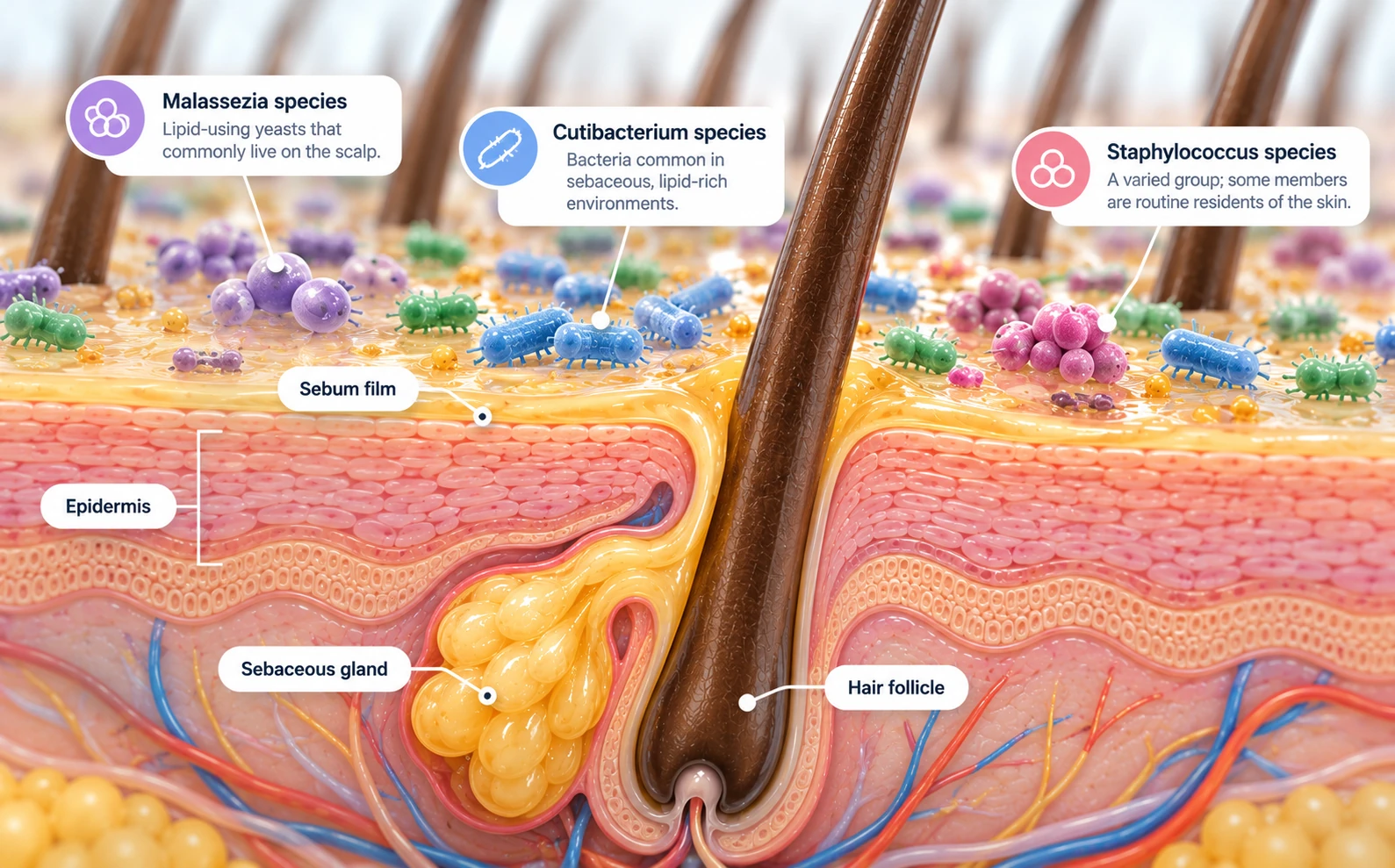
The scalp microbiome is the community of microorganisms living on the scalp surface and within follicular environments. It may include bacteria, fungi and other microbes that interact with sebum, moisture, pH, immunity and one another.
A healthy scalp microbiome is not a germ-free scalp.
Malassezia species
Lipid-using yeasts that commonly live on human skin. Their presence is normal, and it does not by itself mean symptoms will follow.
Cutibacterium species
Bacteria commonly found in sebaceous, lipid-rich environments including the follicular canal.
Staphylococcus species
A varied group; some members are routine residents of skin. Species and strain matter enormously here.
Residents, not invaders. This is what every healthy scalp looks like at this scale.
Five things worth holding onto
The presence of these organisms may be entirely normal
Effects depend on species, strain, abundance, host response and local environment
Detecting a microorganism does not prove it caused a symptom
Microbiome research is still evolving, and consumer testing has real limitations
Describing organisms as simply good or bad flattens all of the above
What is the relationship between Malassezia and dandruff?
Malassezia yeasts commonly live on human skin and use lipids within the scalp environment. In susceptible individuals, interactions among microbial activity, sebum components, barrier function and immune response may contribute to dandruff or seborrhoeic dermatitis.
The key word is susceptible. Malassezia is present on the great majority of adult scalps, including scalps with no symptoms whatsoever. So its presence cannot be the whole explanation — susceptibility, barrier condition, sebum composition and individual immune response all participate. This is why the same organism produces flaking in one person and nothing at all in another, and why "kill the fungus" is an incomplete model of the problem.
Dandruff is not simply
A dirty scalp
A dry scalp
A fungal infection in the same sense as ringworm
Proof of poor hygiene
A condition permanently cured by one wash
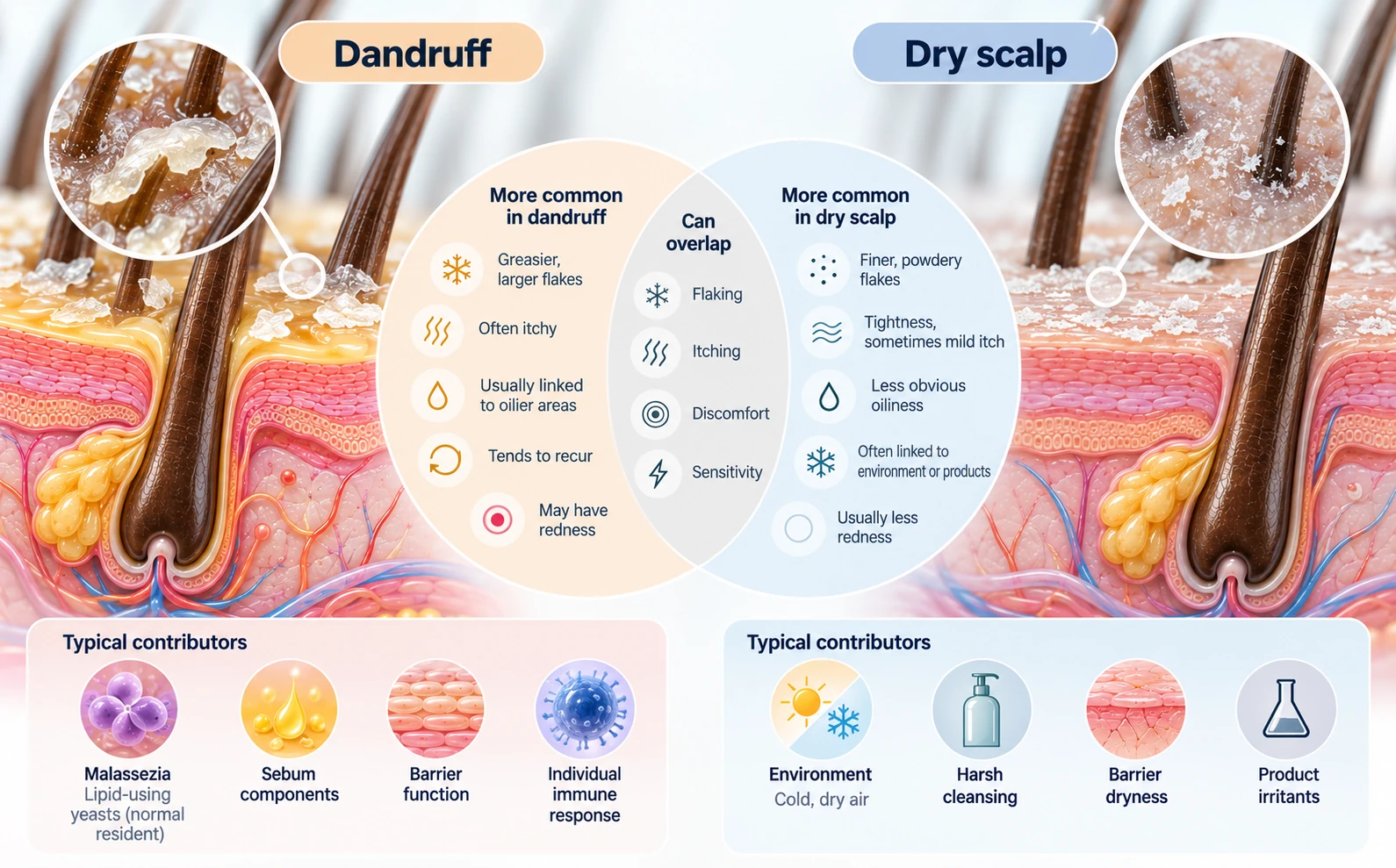
Dandruff versus a dry-feeling scalp
Features That Tend To Differ — Not A Diagnostic Test
Commonly reported differences between dandruff and a dry-feeling scalp
Feature
Dandruff may involve
Dry scalp may involve
Scale
More visible, greasier or adherent flakes
Fine, powdery flaking
Sensation
Itching, sometimes marked
Tightness, sometimes mild itch
Oiliness
Often associated with sebaceous areas
Less obvious oiliness
Course
Tends to recur
Often tracks environment or products
Inflammation
Variable, sometimes visible redness
Usually less prominent
Typical triggers
Sebum, microbial and immune interaction
Cold dry air, harsh cleansing, irritants
The features overlap in practice, which is exactly why self-labelling goes wrong so often.
These features overlap, and persistent symptoms require professional diagnosis. Seborrhoeic dermatitis, psoriasis, contact dermatitis and other conditions can all present with scale and itch. This section is here to make you a better-informed patient, not to replace the consultation.
Why scalp pH matters — and why it is not the whole story
The scalp surface generally maintains a mildly acidic environment that contributes to barrier function, enzyme activity and microbial ecology. Sweat and sebum both interact with it, and cleansing can shift it temporarily.
Skin has buffering capacity, so a well-formulated product causes a shift that is temporary rather than permanent. That is worth knowing because it cuts both ways: pH is real and worth attending to, and it is also not the fragile knife-edge that some marketing implies.
A low-pH product is not automatically gentle. Tolerability also depends on the surfactant system, concentration, fragrance, preservatives, solvents, contact time, frequency of use and individual sensitivity. A product can sit at an ideal pH and still irritate you, and a product at a higher pH can be perfectly comfortable.
Claim evaluation
“pH balanced”
Balanced against what? The claim is meaningful only when it specifies the intended pH range and confirms that the complete formulation — not just its pH — has been tested for scalp compatibility. On its own, the phrase tells you almost nothing about how a product will feel on your scalp.
pH is one input among many. Judge a cleanser by how your scalp feels over a few weeks, not by a number on the label.
Shampoo is designed primarily to remove excess sebum, sweat, environmental debris, microbial by-products and styling residue. A well-designed routine cleans sufficiently without causing unnecessary irritation.
What actually determines cleansing intensity
Not the brand, and not the price. These are the variables that decide how a wash feels — and most of them are under your control.
Surfactant type and concentration
Formula pH
Water hardness and temperature
How much shampoo you use
Massage intensity and contact time
Washing frequency and number of repeated washes
Dry-shampoo use and product residue
The current condition of your scalp
Too little cleansing may contribute to
Greasy accumulation and residue
Odour
Adherent scale
Reduced styling performance
Discomfort in some individuals
Overly aggressive cleansing may contribute to
Tightness and irritation
Increased friction on the fibre
Barrier stress
Colour fading
Dry-feeling lengths
Sensitivity in susceptible users
AA
There is no universally correct wash frequencyAppropriate frequency depends on sebum production, hair texture, scalp condition, exercise, climate, styling-product use, any medical treatment you are on, and your own comfort. Someone training daily in Mumbai humidity and someone with fine dry hair in an air-conditioned office do not need the same routine, and neither of them is doing it wrong.
Cleansing can temporarily alter surface oil, microbial abundance and environmental conditions. That is not the same as permanently destroying the microbiome, and the evidence does not support either extreme position.
Temporary ecological shifts
Washing removes surface lipid and reduces microbial numbers for a period. Both then recover, because the conditions that supported that community — sebum production, moisture, skin surface — are still there.
Formulation and frequency matter
A mild cleanser used sensibly and a strong antimicrobial shampoo used daily are very different interventions. Products containing antimicrobial actives are designed to shift the ecology, which is precisely why they help in some conditions and are not meant for indefinite daily use without reason.
Evidence has limits
Microbiome measurement is technically demanding and results vary with method, site and timing. Confident claims in either direction — that shampoo devastates the microbiome, or that a product restores it — are ahead of what the evidence supports.
Claims to be sceptical of on both sides: that shampoo removes all beneficial microbes; that no-shampoo routines are universally healthier; that microbiome products permanently rebalance every scalp; that preservatives automatically damage the scalp microbiome; and that natural products are inherently microbiome-safe. None of these hold up as stated.
The practical goal is not to preserve every microorganism unchanged. It is to maintain scalp comfort, cleanliness and disease control while avoiding unnecessary irritation.
12
Practice
What does scalp oiling actually do?
A long-standing practice with real and limited effects. What it does depends on the oil, the amount, how long it stays on, and the condition of the scalp receiving it.
It may
Reduce friction during massage
Provide temporary emollience
Reduce water penetration into the hair shaft
Improve the feel of dry lengths
Help loosen some adherent scale before cleansing
Increase occlusion at the surface
Alter the scalp's lipid environment
It may also
Increase greasiness
Trap residue
Worsen discomfort in some users
Complicate dandruff or seborrhoeic symptoms
Cause contact allergy or irritation
Be difficult to remove without stronger cleansing
Scalp oil does not automatically repair the skin barrier, feed the follicle, restore the microbiome, cure dandruff, increase blood supply, treat inflammatory scalp disease or regrow hair. Oiling can be a pleasant and useful ritual with genuine emollient benefits — and it is not a treatment for any of the above.
AA
Essential oils deserve particular cautionThey can irritate skin and cause allergic contact dermatitis, concentration matters a great deal, and "natural" does not mean non-irritating. I see reactions to undiluted essential oils applied to an already-inflamed scalp fairly regularly, and they are entirely avoidable.
"Scalp detox" is usually a marketing term rather than a precise biological process. The products are not useless — they simply do something narrower and more ordinary than the name suggests.
What "detoxifying" products may actually do
Remove oil and styling residue
Exfoliate surface scale
Absorb grease
Provide a cooling sensation
Clarify mineral build-up from hard water
All of these are legitimate. None of them is toxin removal.
On "clogged follicles"
Follicular openings genuinely can accumulate sebum, keratin, scale, product residue and environmental debris. But:
Not every oily opening is pathologically blocked
Hair loss should not be blamed on clogged pores by default
Aggressive scrubbing can worsen inflammation
True folliculitis or inflammatory disease needs diagnosis
Claim evaluation
“Unclogs follicles and restores growth”
The first half may be broadly true — the product may clean the surface and remove residue from follicular openings. The second half is a separate claim requiring separate evidence: restored growth would need proof that the product changes the underlying follicular process, which surface cleaning does not by itself demonstrate.
Two claims joined by "and" still need two pieces of evidence.
When is scalp exfoliation helpful — and when is it too much?
Two quite different approaches get called the same thing, and they carry different risks. Neither has a universal schedule.
Physical exfoliation
Scrubs, brushes, abrasive particles and manual scale removal. Immediate and satisfying, and the easiest way to overdo things — particularly on a scalp that is already inflamed.
Chemical or keratolytic exfoliation
Salicylic acid, urea, selected hydroxy acids and other medically appropriate scale-modifying ingredients. Works by softening and loosening scale rather than abrading it away.
Potential benefits
Loosening adherent scale
Improving residue removal
Supporting selected dandruff routines
Improving cosmetic cleanliness
Potential risks
Irritation and barrier disruption
Scratching damage
Increased inflammation
Contact dermatitis
Excessive use alongside medicated products
There is no universal exfoliation schedule to recommend. If you are already using a medicated shampoo, adding an exfoliant on top is a decision worth discussing rather than assuming — combined keratolytic exposure is a common cause of avoidable irritation.
The barrier controls water loss and interaction with external substances. Sebum contributes lipids and shapes the follicular and surface environment. The microbiome interacts with lipids, pH, immunity and environmental conditions. Disturb one and the others shift.
Every side of the triangle runs both ways. There is no single system to "fix".
Increased barrier permeability may increase irritation and reactivity to products.
Sebum composition may influence microbial metabolism, since some organisms depend on those lipids.
Microbial by-products may affect susceptible skin, contributing to itch or scaling in some people.
Inflammation may in turn alter barrier function, which is how a cycle establishes itself.
Cleansing changes surface lipids and microbial conditions together — never one without the other.
Occlusion from headwear or heavy products changes humidity and residue accumulation at the surface.
A note on the word "balance": it is useful shorthand and it is not a measurable single score. Any product or service claiming to quantify your scalp balance should be able to say what was measured, with what method, and against what reference — otherwise the number is decoration.
16
Non-Diagnostic Interpretation
What different scalp patterns may mean
A guide to reading your own scalp more carefully — and to recognising the point at which a product decision becomes a medical one. None of this identifies a diagnosis.
Oily, without major symptoms
High sebaceous activity
Climate and humidity
Exercise
Hair density
Washing interval
Styling habits
Often simply how your scalp is. A suitable routine matters more than reducing oil.
Oily, with flakes and itching
Dandruff
Seborrhoeic dermatitis
Product accumulation
Irritation
Other scalp conditions
Worth a proper look, especially if it keeps returning after treatment.
Dry-feeling, with fine flakes
Environmental dryness
Frequent harsh cleansing
Irritant exposure
Barrier disruption
Eczema or other conditions
Often improves with gentler cleansing before anything medicated is needed.
Red, painful or burning
Contact dermatitis
Inflammatory disease
Infection
Folliculitis
Psoriasis
Scarring processes
Reaction to a treatment
Needs evaluation rather than another product.
Localised pustules or crusting
Should not be treated as simple oiliness
Should not be scrubbed or picked
Needs medical assessment
Do not wait to see whether it settles on its own.
Seek professional review for: persistent itching, burning or pain; pustules; bleeding; thick or crusted scale; patchy hair loss; visible scarring; or any symptom that keeps returning despite reasonable care. Also for anything that began after a new product or a new medicine.
Which products act on which part of the ecosystem?
Eight categories, mapped to what they primarily act on and where their limits sit. The commonest routine error is a category mismatch rather than a bad product.
Category, Primary Target And Honest Caveat
Scalp-product categories and the part of the ecosystem each primarily addresses
Ten ingredients you will meet on scalp products, read against the systems above. Availability, concentration limits and regulatory status differ by market — always follow the product's own directions and your clinician's advice.
Ketoconazole
Pharmaceutical
An antifungal used in selected dandruff and seborrhoeic contexts, acting on relevant yeast activity.
Follow the specified directions and duration rather than treating it as a daily cosmetic. Dryness or irritation can occur, and prescription status varies by market.
Selenium sulphide
Medicated
A long-established anti-dandruff active affecting relevant yeast and the rate of scale turnover.
Formulation and usage precautions matter, and thorough rinsing is important. Read the label for contact time.
Piroctone olamine
Cosmetic / medicated
An antimicrobial used in anti-dandruff products, positioned as cosmetic or medicated depending on market and formula.
As with any active, the meaningful evidence is human evidence generated with the finished formulation.
Zinc pyrithione
Medicated
Historically one of the most widely used anti-dandruff actives.
Regulatory status varies by jurisdiction and has changed in some markets — never assume universal availability or approval. Check what is permitted where you are.
Salicylic acid
Keratolytic
Loosens and helps remove adherent scale rather than acting on microorganisms.
It is not primarily an antifungal, and it can irritate — particularly when layered with other exfoliating or medicated products.
Urea
Humectant / keratolytic
Behaves differently depending on concentration: humectant at lower levels, increasingly keratolytic at higher ones.
May have a barrier-support role in appropriate formulations. Read the percentage, not just the name.
Niacinamide
Cosmetic
Studied for barrier support and sebum-related effects, mostly on facial skin.
Facial-skin data does not automatically transfer to scalp outcomes — the scalp differs in glands, hair and how products are applied and removed.
Ceramides
Barrier lipid
Structurally relevant to the barrier's lipid layers, which makes them a rational inclusion.
Delivery and formulation limits apply, and no topical claims to permanently replace all natural scalp lipids should be taken at face value.
Panthenol and glycerin
Humectant
Well-established humectant and conditioning agents that can support scalp comfort.
Their effect depends on the complete formulation, and on whether the product stays on the scalp or rinses off.
Pre-, pro- and postbiotics
Evolving
The three terms mean different things, and topical viability varies considerably between them.
Microbiome claims need product-specific evidence. A "microbiome-friendly" label does not by itself demonstrate clinical benefit.
These descriptions are educational and are not directions for use. Concentrations, contact times, permitted uses and regulatory status differ between countries and between products, and combining actives without guidance is a common route to irritation.
Nine phrases that appear on scalp products. Open each one for what it can legitimately mean, and what would have to be shown for it to mean more than that.
Microbial communities can genuinely shift in response to products, so the claim is not empty. It is just very hard to substantiate well, and "balance" needs defining before it can be measured.
What exactly was measured, and by what method?
Which organisms changed, and in which direction?
Was the study performed on the final product?
Did symptoms improve, or only the measurements?
How long did the change last after use stopped?
Was there a control group?
A product may genuinely improve hydration, comfort and water-loss measurements — those are real, measurable outcomes worth having. Permanent restoration should not be assumed from one application, and a barrier under continuing stress will not stay restored while the stressor remains.
Almost always this means the product removes oil, absorbs oil or reduces greasy appearance. That is not the same as lowering sebaceous-gland output, which is driven largely by genetics, hormones and age. Reducing the appearance of oil is a legitimate cosmetic benefit — it is simply a different claim.
Usually refers to cleansing, clarifying or exfoliating rather than biological toxin removal. There is no defined scalp toxin being extracted. If the product removes residue and your hair feels lighter afterwards, that is the actual mechanism, and it is enough of a reason to use it.
Microbial communities are complex, and broad elimination is not automatically desirable. "Bad" should be defined precisely: which organisms, at what abundance, in whom, and causing what? Antimicrobial actives have a real place in specific conditions — that is a targeted use, not a general hygiene goal.
A prebiotic claim should identify the substrate, the target organisms and evidence from the final formulation. Without those three, it is a mechanism story rather than a demonstrated effect — and the scalp is a harder environment to influence this way than the gut.
A product may well remove surface residue or keratin from follicular openings. This does not prove it reverses follicular hair loss, and the two are frequently bundled together as though the first implied the second.
Comfort and surface hydration can improve quickly, and that improvement is real. But biological barrier recovery and the resolution of inflammation depend on the cause and take longer than a night. Feeling better by morning is not the same as being repaired.
All ingredients are chemicals — water included. The meaningful questions are identity, concentration, formulation, safety and evidence. Framing safety as natural-versus-chemical replaces those questions rather than answering them, and it has no bearing on whether a product will irritate your scalp.
Most of these come from treating normal components of skin — oil, microbes, shed cells — as contaminants to be eliminated.
Myth
“Sebum is dirt.”
Reality
Sebum is a normal lipid secretion produced by sebaceous glands. It is not sweat, product residue or grime, and your skin makes it on purpose.
Myth
“An oily scalp cannot be dehydrated.”
Reality
Surface lipid production and skin water retention are different biological properties. A scalp can be visibly greasy and still feel tight, itchy and reactive.
Myth
“A healthy scalp has no microorganisms.”
Reality
Resident bacteria and fungi are normal parts of the scalp ecosystem. Sterility is neither achievable nor a goal.
Myth
“Dandruff is always caused by dryness.”
Reality
Dandruff commonly involves interactions among sebum, microorganisms, barrier function and host response — which is why moisturising alone often does not settle it.
Myth
“Not washing allows the scalp to heal itself.”
Reality
Some scalps tolerate longer wash intervals comfortably; others accumulate uncomfortable oil, scale or residue. There is no universal benefit to washing less.
Myth
“Daily washing always damages the scalp.”
Reality
Tolerance depends on the cleanser, technique, scalp biology and individual needs. Frequent washing with a suitable product is not inherently harmful.
Myth
“Oil cures dandruff.”
Reality
Oil may worsen symptoms in some individuals and is not a substitute for appropriate treatment. It can help soften scale before cleansing, which is a different and narrower benefit.
Myth
“Scratching removes dandruff safely.”
Reality
Scratching injures the barrier and can worsen inflammation, which tends to increase both scaling and itch — the opposite of the intended effect.
Myth
“Scalp tingling proves a product is working.”
Reality
Tingling may reflect cooling ingredients, irritation or sensory stimulation rather than therapeutic action. Stinging in particular is a reason to reconsider a product.
Myth
“Microbiome products permanently add good bacteria.”
Reality
Topical microbiome claims are formulation-specific and scientifically complex. Permanent colonisation from a rinse-off or leave-on cosmetic should not be assumed.
Myth
“Clarifying shampoo detoxifies the blood or follicles.”
Reality
It removes surface residue and oil. It does not perform systemic detoxification, and there is no follicular toxin for it to extract.
Myth
“Natural ingredients cannot irritate the scalp.”
Reality
Plant extracts and essential oils may cause irritation or allergic contact dermatitis. Natural origin says nothing about tolerability or concentration.
Myth
“Visible flakes always mean dandruff.”
Reality
Flaking can arise from multiple inflammatory, irritant and environmental causes, including psoriasis, eczema, contact reactions and simple dryness.
Myth
“A clean scalp must feel squeaky.”
Reality
A squeaky sensation may reflect high friction and extensive lipid removal rather than superior scalp health. Clean does not have to mean stripped.
"This guide explains how the scalp barrier, sebum and resident microorganisms interact. It is designed to improve understanding of scalp comfort, cleansing and product claims — but it cannot diagnose dandruff, dermatitis, infection, psoriasis or another scalp condition. In clinic, the commonest problem I see is not an untreated disease but an over-treated scalp."
Reviewed: 26 July 2026 · Last updated: 26 July 2026 · Next scheduled review: July 2027
Independent medical resources covering dandruff, seborrhoeic dermatitis and scalp care. Detailed barrier and microbiome material is drawn from dermatology reference texts.
External links open in a new tab and lead to independent organisations whose content HairsnCares does not control, and no link implies endorsement or partnership. [ADD APPROVED TEXTBOOK CITATIONS — stratum corneum lipid composition, sebaceous physiology, scalp microbiome methodology]
Short, medically responsible answers about the barrier, sebum, the microbiome, cleansing, oiling and the claims made about all of them.
Scalp biology describes how the scalp's skin barrier, sebaceous glands, hair follicles, immune system and resident microorganisms function together. The barrier limits excessive water loss and the entry of irritants, sebum contributes surface lipids, and the microbiome forms part of the scalp's normal ecological environment.
The scalp barrier is the outermost part of scalp skin, centred on the stratum corneum, where flattened corneocytes sit within a lipid-rich environment. It helps limit excessive water loss and reduces the entry of irritants, allergens and microorganisms.
The stratum corneum is the outermost layer of the epidermis, made of flattened corneocytes surrounded by intercellular lipids including ceramides, cholesterol and free fatty acids. It is often described as bricks and mortar, though the real structure is dynamic and biologically regulated.
Water naturally moves from deeper skin layers towards the environment. The barrier slows this process but does not eliminate it. When the barrier is disrupted, this water loss may increase, which can accompany feelings of tightness, sensitivity or fine flaking.
Sebum is an oily substance produced by sebaceous glands and released into the upper hair follicle. It spreads across the scalp and the emerging hair fibre, contributing to lubrication and the surface lipid environment. It is not sweat, dirt or product residue.
Sebaceous glands are a normal part of skin, and the scalp has a generous supply of them. The sebum they produce lubricates the surface, reduces friction on emerging fibres and forms part of the scalp's lipid environment. Output varies with genetics, hormones, age, climate and other factors.
No. Sebum is a normal secretion, and removing all surface lipid is neither realistic nor necessarily desirable. Heavy accumulation may contribute to a greasy appearance, odour, residue and changes in the microbial environment, but oiliness is not proof of poor hygiene.
Yes. Sebum describes surface lipid production, while hydration refers to water content and water retention within the skin. A scalp may produce substantial sebum while also experiencing barrier disruption, irritation or increased water loss.
The scalp microbiome is the community of microorganisms living on the scalp surface and within follicular environments. It may include bacteria, fungi and other microbes that interact with sebum, moisture, pH, immune activity and one another.
The scalp naturally carries resident bacteria and fungi, and a healthy scalp is not sterile. Labelling organisms simply good or bad oversimplifies things: effects depend on species, strain, abundance, host response and the local environment.
Malassezia is a group of yeasts that commonly live on human skin and use lipids in the scalp environment. Their presence is normal, and carrying them does not by itself mean a person will develop symptoms.
No. Malassezia is commonly present on skin without causing problems. In susceptible individuals, interactions among microbial activity, sebum components, barrier function and immune response may contribute to dandruff or seborrhoeic dermatitis, but detecting an organism does not prove it caused a symptom.
They are different, though features overlap. Dandruff commonly involves more visible, greasier or adherent scale with itching and recurrence, and it is associated with sebaceous areas. A dry-feeling scalp more often involves fine powdery flaking with tightness. Persistent symptoms need professional diagnosis rather than self-labelling.
Not automatically. Tolerance depends on the cleanser, technique, water temperature, scalp condition and individual biology. Aggressive or unsuitable cleansing may contribute to tightness and irritation in susceptible people, while suitable cleansing at a suitable frequency is not inherently harmful.
Some scalps tolerate longer intervals between washes comfortably, while others accumulate oil, residue, odour or adherent scale. There is no evidence that avoiding shampoo universally improves scalp health, and the goal is comfort and disease control rather than preserving every microorganism unchanged.
The scalp surface generally maintains a mildly acidic environment, and the claim implies a formula chosen to sit near it. A low pH alone does not make a product gentle: tolerability also depends on the surfactant system, concentration, fragrance, preservatives, contact time and individual sensitivity.
It can in some people, depending on the active ingredient, the rest of the formulation and how often it is used. Following the product's directions, rinsing thoroughly and pairing it with a suitable conditioner for the lengths often helps, and persistent irritation is worth raising with a clinician.
Follicular openings can accumulate sebum, keratin, scale and product residue, and heavy oils may add to that in some people. But not every oily opening is pathologically blocked, and hair loss should not be attributed to clogged pores by default.
Malassezia yeasts use lipids, so applied oils change the lipid environment they live in. Whether that matters in practice varies between individuals, and some people with dandruff or seborrhoeic symptoms find oiling makes them worse. Oil is not a treatment for those conditions.
Oiling may provide temporary emollience, reduce friction during massage and help soften adherent scale before cleansing. It does not by itself repair the skin barrier, feed the follicle, restore the microbiome, cure dandruff or regrow hair.
Barrier disruption is commonly accompanied by itching, tightness, stinging, sensitivity and fine flaking. Those symptoms are not specific to one diagnosis, though — they can arise from irritation, inflammatory conditions, allergy or environmental factors, which is why persistent symptoms deserve assessment.
Not for everyone. It may help loosen adherent scale and improve residue removal in some routines. Overuse, abrasive scrubbing or combining it carelessly with medicated products can cause irritation and barrier disruption, and no universal schedule applies.
Build-up generally refers to accumulated sebum, shed skin cells, styling residue and sometimes mineral deposits from water. It is a surface phenomenon that responds to appropriate cleansing, and it is distinct from inflammatory scalp disease.
It removes heavier residue, oils and styling polymers, which can make hair feel noticeably lighter. It does not remove undefined toxins from the body or the follicle, and frequent use may be drying or irritating for some people.
Definitions of prebiotic, probiotic and postbiotic differ, and topical viability varies considerably. Any microbiome claim needs evidence generated with the final formulation, and a microbiome-friendly label does not by itself demonstrate clinical benefit.
No. Tingling commonly reflects cooling or sensory ingredients such as menthol, or in some cases irritation. It is not a measure of therapeutic action, and a stinging or burning sensation is a reason to reconsider a product rather than to trust it.
Most conditioners are formulated for the hair shaft rather than as scalp treatments. Applying them at the roots is not dangerous, but it may feel heavy or leave residue for some people. Products intended for scalp use are formulated and tested differently.
Persistent itching, pain, burning, pustules, thick or crusted scale, bleeding, scarring, marked redness or associated hair loss all warrant professional review. Symptoms that keep returning despite reasonable care, or that appeared after a new product or medicine, are also worth assessing.
No matching question yetTry a different word, or clear the filter to see all 28 answers. If your question isn't here, ask it directly.
Itching, burning or flaking that keeps coming back?
Recurrence usually means the routine is aimed at the wrong thing. That needs examination rather than another shampoo.
Understand the scalp ecosystem before choosing the treatment
Scalp comfort depends on more than removing oil or flakes. The barrier, sebum and microbiome interact continuously, so effective care must match the underlying concern without unnecessarily disrupting the living scalp environment.
Medical Disclaimer: This page provides general educational information about scalp biology. It does not diagnose dandruff, dermatitis, psoriasis, infection, allergy or another scalp disorder. Ingredient descriptions are educational rather than directions for use, and regulatory status, permitted concentrations and availability differ between countries and products. Persistent itching, pain, burning, pustules, thick scale, bleeding, scarring or associated hair loss should be assessed by a qualified medical professional. Individual results vary.
Hair Loss Treatment India — Free AI Hair Diagnosis & Dermatologist-Recommended Products
Minoxidil India — CDSCO-Approved Hair Regrowth Treatment
Free AI Hair Loss Diagnosis by Qualified Dermatologists
Best Anti Hair Fall Shampoo, Oil & Supplements in India
Male Pattern Baldness Treatment — Minoxidil & DHT Blocker Protocol