Dermatologist Reviewed✨ Shine & Conditioning Support⚠️ Not a Hair Regrowth Medicine
Amla Oil for Hair Shine, Scalp Massage & Traditional Haircare Support
A dermatologist-guided guide to using amla oil safely in hair routines — including traditional benefits, shine support, scalp suitability, side effects, product selection, safe usage, and when hair fall needs medical evaluation.
⚠️Patch Test Recommended. Amla oil may not suit oily, acne-prone, dandruff-prone, inflamed, infected or very sensitive scalps. Stop if itching, redness, rash, burning, dandruff flare or increased shedding occurs.
🌿 Traditional Indian Haircare Oil✨ Shine & Conditioning Support⚖️ Patch Test Recommended🚫 Not a Minoxidil Replacement⚠️ Cannot Reverse Grey Hair🤖 AI-Guided Routine Matching
Dermatologist Reviewed
Reviewed by Dr. Amit Agarkar, MD Dermatology
Amla oil is a traditional Indian botanical hair oil derived from the Indian gooseberry (Phyllanthus emblica / Emblica officinalis), widely used in Indian haircare routines for scalp massage, hair conditioning, shine support, dryness support and pre-wash oiling. It may improve hair feel, softness and manageability, but it is not a proven medical treatment for progressive hair loss, androgenetic alopecia, alopecia areata, PCOS-related hair fall, thyroid-related hair fall, postpartum shedding, nutritional deficiency hair fall or premature greying. Commercial amla oil products vary widely in formulation and quality. Traditional use in Indian haircare should be clearly distinguished from clinical proof of medical hair regrowth or permanent grey hair reversal. People with sensitive scalp, oily scalp, active dandruff, seborrheic dermatitis, folliculitis, scalp acne, eczema, psoriasis, painful scalp, sudden shedding, recent scalp procedures or recent hair transplant should consult a dermatologist before applying oils to the scalp.
What You’ll Learn on This Page
What amla oil can and cannot do for your hair and scalp
Traditional Ayurvedic uses vs modern dermatological evidence
How to use amla oil safely for scalp massage routines
Which hair types benefit most from amla oil
Amla oil vs bhringraj, coconut, and other Ayurvedic oils
Vitamin C content claims — what actually reaches your hair
Safe dilution and patch-testing protocols
When amla oil may irritate — sensitive scalps and allergies
Quick Answer
Is amla oil good for hair?
Amla oil has deep roots in Indian traditional haircare, particularly within Ayurvedic and household practices. The amla fruit (Phyllanthus emblica) is rich in vitamin C and polyphenols, and amla-infused oils have long been used for scalp massage, shine support, dryness conditioning and pre-wash oiling. It remains one of the most trusted hair oils in Indian households across generations.
However, the evidence for amla oil's direct medical hair regrowth in humans is limited. It is a traditional cosmetic oil, not a clinically validated treatment for pattern hair loss or premature greying. Amla oil is most accurately framed as a supportive conditioning and shine oil for the hair shaft and scalp massage routine — not as a guaranteed hair growth or grey-reversal medicine. Its benefits are cosmetic, not clinical.
Verdict: Amla oil is a valued traditional Indian hair oil suitable for some users as part of a conditioning, shine and scalp massage routine. It requires a patch test and is not appropriate for all scalp types. It does not treat the medical causes of hair loss, cannot reverse greying, and should not replace professional evaluation for significant shedding or thinning.
Amla (Indian gooseberry) oil is a traditional Ayurvedic hair oil used for scalp massage and conditioning. It may help add shine and softness to dry hair. Clinical evidence for hair regrowth is limited. It does not cure hair loss, reverse greying, or treat medical scalp conditions. Always patch-test, and avoid use on broken or inflamed scalp skin.
Those who enjoy traditional oil massage rituals and want a conditioning treatment for dry or dull hair. Works well as a pre-wash hair mask.
Not a Substitute For
Clinically proven hair loss treatments like minoxidil or finasteride. Amla oil is a cosmetic conditioner, not a medical intervention.
See a Dermatologist If
You have persistent hair thinning, scalp flaking that does not improve, or develop irritation after applying amla oil. Greying is genetic — no oil reverses it.
Traditional Benefits
What Amla Oil May Do for Your Hair Routine
All benefits are cosmetic and supportive. Traditional use should not be conflated with proven medical hair regrowth or grey hair reversal. Patch test required before scalp use.
🌿
Traditional Haircare Support
Amla oil is a staple in Indian traditional haircare routines, especially in Ayurvedic practice. Its use as a pre-wash conditioning oil supports routine consistency — but it is not a standalone cure for medically diagnosed hair loss conditions such as androgenetic alopecia or alopecia areata.
✨
Shine & Gloss Support
As a conditioning oil, amla oil can add a reflective coating to the hair shaft, improving its visual shine and gloss. This is a cosmetic surface benefit and does not indicate follicular stimulation, new hair growth, or reversal of any hair condition.
💧
Dry Hair Conditioning
Amla oil can help add a conditioning layer to dry, rough or coarse hair lengths, improving softness and reducing brittleness when used as a pre-wash treatment. Apply mainly to lengths and ends for best conditioning results.
💆
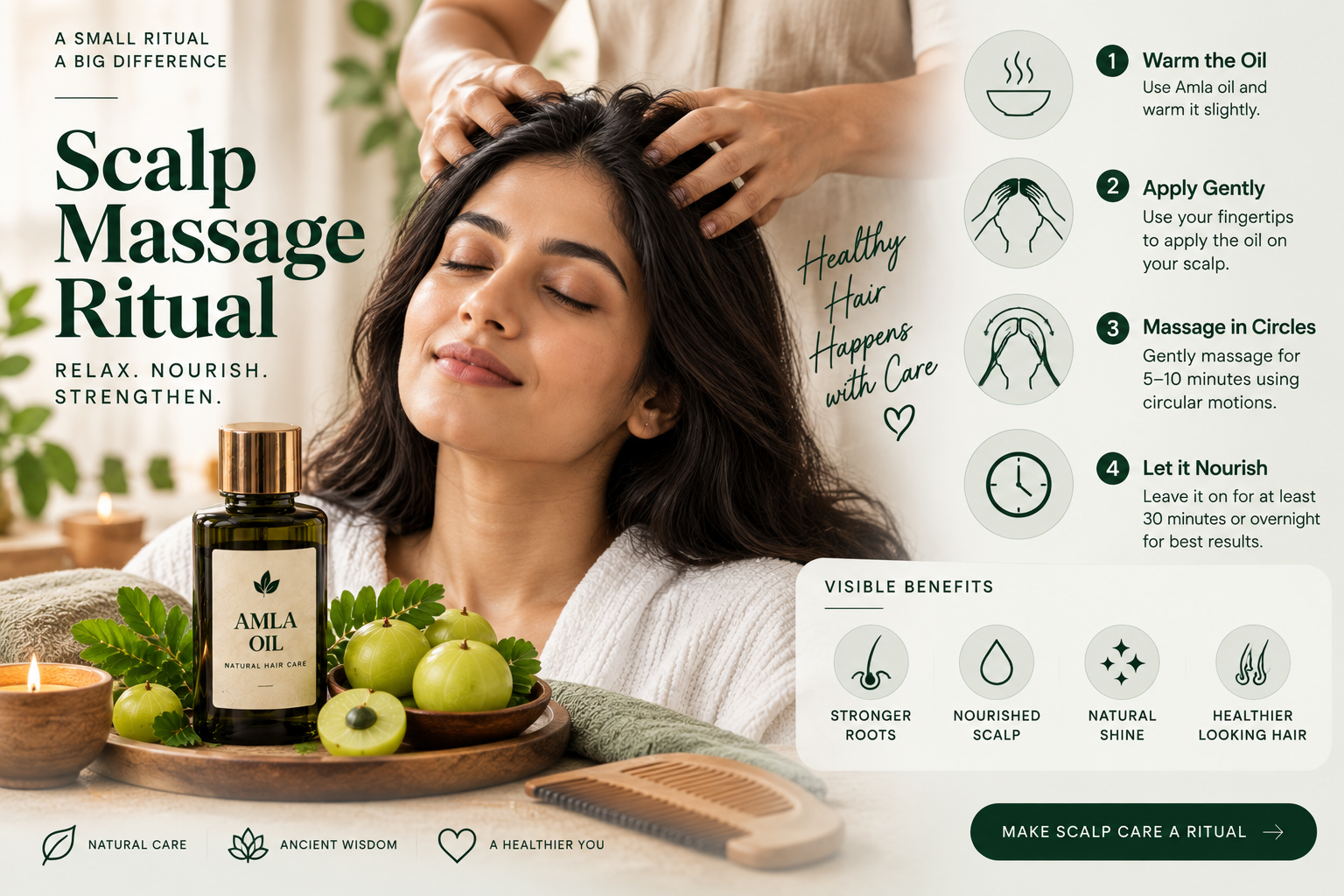
Scalp Massage Ritual
Gentle scalp massage with amla oil may improve relaxation and routine adherence. Use gentle circular fingertip movements only. Aggressive rubbing or scratching can worsen shedding in people with active hair fall and should always be avoided.
🛡️
Pre-Wash Nourishment
Short-contact pre-wash use — 30 to 60 minutes before shampooing — is generally better tolerated than heavy overnight application, reducing oil buildup and irritation risk, particularly for those whose scalps are not well-suited to heavy oiling.
🤖
AI Routine Pairing
Because scalp response to amla oil varies between individuals, our AI Hair Test identifies whether amla oil is appropriate for your specific scalp type, dandruff status, hair fall pattern, sensitivity history, and greying concerns before you begin a routine.
If your scalp is non-oily and non-inflamed with no sensitivity history, amla oil may be trialled as a pre-wash routine after successful patch testing.
May Trial — Patch Test First💧
Dry Hair & Coarse Hair
Good for dry or coarse hair lengths as a pre-wash conditioning treatment. Apply to lengths, not scalp, if scalp is oily or dandruff-prone.
Good Match — Lengths✨
Dull Hair Needing Shine
Suitable for adding cosmetic shine and gloss to dull, dry or rough hair lengths. Use as a pre-wash or small-quantity leave-on finishing treatment on ends only.
Good Match💦
Oily Scalp
Not recommended on the scalp. Amla oil on an oily scalp can worsen sebum buildup, clog follicles and aggravate seborrheic conditions. Apply to lengths only.
Avoid on Scalp❄️
Active Dandruff / Seborrheic Dermatitis
Avoid. Oil on a dandruff-prone scalp worsens flaking and irritation. Active dandruff requires antifungal treatment, not cosmetic oiling.
Do Not Use🔴
Sensitive / Fragrance-Reactive Scalp
High risk. Amla oil may contain botanical compounds and fragrance that cause contact dermatitis on sensitive scalps. Patch test is non-negotiable.
Patch Test — Consult First🔥
Scalp Acne / Folliculitis
Do not apply amla oil to an acne-prone or infected scalp. Heavy oil can worsen follicular occlusion and delay healing of active scalp conditions.
Do Not Use💉
Post-Transplant Scalp
Never apply any oil to a post-transplant scalp without explicit clearance from your hair transplant surgeon. Graft survival can be compromised.
Surgeon Clearance Required🚨
Progressive Hair Thinning
Amla oil does not treat medical hair loss. Progressive thinning, patchy loss or sudden shedding requires dermatologist evaluation and diagnosis.
If you are applying amla oil and notice increased itching, redness, pimples on the scalp, or worsening dandruff — stop immediately. These are not signs of “detox” or “purging.” They may indicate irritation, allergy, folliculitis or worsening of an existing scalp condition. Consult a dermatologist before resuming any oil application on an irritated scalp.
Ritual Guide
How to Use Amla Oil for Hair Safely
Amla oil is a botanical oil that benefits from careful application. Follow these dermatologist-guided steps for a safe and effective traditional hair oil routine.
⚠️ Important: Do not layer amla oil with minoxidil, medicated anti-dandruff treatments, scalp acids, steroid lotions, prescription serums or multiple active oils without dermatologist guidance. Combining active ingredients increases irritation and unpredictable scalp reaction risk significantly.
1
Patch Test — 24 Hours
Apply a small amount behind the ear or on the inner arm. Wait 24 hours. Do not proceed if redness, burning, itching or rash appears. Amla oil contains botanical compounds that can cause contact dermatitis in sensitive individuals.
2
Start With Small Quantity
Use a small amount — less than you think you need. Heavy oiling causes scalp buildup, greasiness and potential irritation. A small quantity is sufficient for scalp massage and pre-wash conditioning.
3
Apply as Pre-Wash — 30 to 60 Minutes
Start with a 30–60 minute pre-wash application. Shorter contact time reduces irritation and buildup risk while still allowing the oil to coat the scalp and hair. Avoid overnight use until your scalp is confirmed tolerant over several sessions.
4
Massage Gently With Fingertips
Use gentle circular fingertip movements. Do not scratch, pull, or rub vigorously. Aggressive scalp manipulation can worsen shedding in people with active hair fall and is counterproductive to a supportive routine.
5
Focus on Lengths If Scalp Is Sensitive
If your scalp is oily, dandruff-prone or acne-prone, apply amla oil mainly to dry hair lengths and avoid heavy scalp coating. The conditioning and shine benefits for the hair shaft still apply without the scalp risk.
6
Shampoo Thoroughly
Use a gentle, sulphate-free shampoo to remove oil and any botanical residue. Shampoo at least twice. Do not allow oil buildup on the scalp between applications, as this can worsen scalp conditions.
7
Track Your Scalp Response
Monitor your scalp and hair for 24–48 hours after each application. Stop immediately if burning, itching, redness, rash, dandruff flare, or increased shedding occurs after use.
8
Frequency — 1 to 2 Times Weekly
Use only 1–2 times per week as a pre-wash routine, and only if your scalp tolerates each application without irritation or buildup. Do not increase frequency without dermatologist guidance.
The most common mistake with hair oiling is leaving oil on for too long or sleeping with heavy oil overnight without proper washing the next morning. Prolonged scalp oil contact can clog follicles, attract dust and worsen dandruff in susceptible people. For most users, 30 minutes to 2 hours before washing is sufficient. Listen to your scalp, not social media trends.
Oil Comparison
Amla Oil vs Bhringraj Oil vs Rosemary Oil vs Coconut Oil vs Castor Oil
Oil
Best For
Evidence
Texture
Scalp Safety
Amla Oil
Traditional Indian haircare, shine, conditioning, scalp massage, pre-wash, dryness support
Traditional use; limited human evidence for regrowth; cannot reverse grey hair
Medium; botanical fragrance
Patch test required; avoid inflamed/oily/dandruff scalp
All oils listed are cosmetic supportive options. Medical hair loss requires proper diagnosis, investigation, and individualised treatment planning by a qualified dermatologist.
Before starting an amla oil routine, our AI Hair Test assesses your scalp type, dandruff status, hair fall pattern, oiliness, sensitivity history, greying concerns, recent procedures, current treatment, and medical red flags — to identify whether amla oil is appropriate for your specific profile or likely to cause problems.
This tool provides screening and product-direction guidance only. It does not diagnose, prescribe, or replace dermatologist advice.
Shop the Collection
Shop Amla Hair Oil Formulas
All products are cosmetic hair oils. Patch test required before first use. Amla oil products are not hair loss treatments and cannot permanently reverse grey hair.
Products for this guide are being curated. Take the AI Hair Test for personalised picks meanwhile.
Amla oil is widely used in Indian traditional haircare for scalp massage, pre-wash oiling, shine support, dryness support and hair conditioning. It may help improve hair feel, softness and manageability. However, it is not a proven cure for pattern hair loss or medically diagnosed hair conditions. Patch testing is recommended before use.
Amla oil is not a proven hair regrowth treatment. It is a traditional cosmetic oil with strong cultural relevance in Indian haircare, but clinical evidence for direct medical hair regrowth in humans is limited and should not be overstated. Progressive hair loss requires medical evaluation.
Amla oil may support routine consistency as part of a hair fall-support plan, but it cannot treat underlying causes of hair fall such as androgenetic alopecia, thyroid disorders, PCOS, nutritional deficiency, or medication-induced hair loss. Consult a dermatologist for significant or progressive hair fall.
Evidence for amla oil's medical hair regrowth in humans is limited. While amla fruit contains vitamin C and polyphenols that have been studied, these findings cannot be directly applied to commercial amla hair oil products or guaranteed hair regrowth outcomes. Amla oil is best framed as a traditional cosmetic hair oil.
No. Amla oil does not permanently reverse grey hair. Grey hair results from the gradual reduction of melanocyte activity in hair follicles, which is a biological process. While amla is traditionally associated with hair health, commercial amla oil products cannot reverse established greying. Any temporary cosmetic darkening effect is not a reversal of the greying process.
Amla oil can help improve the feel of dry hair by adding a conditioning layer to the hair shaft. It is most useful as a pre-wash treatment on dry, rough or coarse hair lengths. Avoid heavy scalp application if your scalp is oily or prone to dandruff.
Yes. Amla oil can cause scalp irritation, redness, itching or contact dermatitis in sensitive individuals, particularly those with fragrance sensitivity or botanical oil allergies. People with seborrheic dermatitis, scalp acne, folliculitis, eczema or inflamed scalp should consult a dermatologist before use. A 24-hour patch test is mandatory.
Amla oil is not recommended for active dandruff or seborrheic dermatitis. Heavy oil on a dandruff-prone scalp can worsen flaking and irritation. Active dandruff requires antifungal treatment, not cosmetic oiling. Consult a dermatologist before starting any oiling routine if you have dandruff.
Daily amla oil use is not recommended. Its botanical composition can cause scalp buildup and potential irritation with frequent application. Use 1-2 times weekly as a pre-wash treatment only if your scalp tolerates it without burning, itching or redness.
Overnight amla oil application is not recommended for first-time users or sensitive scalps. Start with a 30-60 minute pre-wash application and monitor your scalp's response before considering longer contact times. Overnight use on oily or dandruff-prone scalp can significantly worsen conditions.
Do not combine amla oil with minoxidil without dermatologist guidance. Oils can interfere with minoxidil absorption and combining multiple active scalp products increases irritation risk. Consult your dermatologist before adding any hair oil to a routine that includes prescription treatment.
Amla oil is generally not suitable for oily scalps. Heavy oil on an oily scalp can worsen sebum buildup, clog follicles and aggravate seborrheic dermatitis. If your scalp is oily, apply to hair lengths only and avoid scalp application.
Do not use amla oil or any cosmetic hair oil on a post-transplant scalp without explicit clearance from your hair transplant surgeon. Any topical product on a post-transplant scalp requires surgeon approval, as inappropriate products can compromise graft survival and healing.
Stop amla oil use immediately if you experience burning, redness, rash, increased scalp itching, dandruff flare, folliculitis, oil buildup, or increased hair shedding. Consult a dermatologist before resuming any hair oiling routine.
Consult a dermatologist if you experience progressive hair thinning, patchy hair loss, sudden heavy shedding, scalp pain, folliculitis, severe dandruff, PCOS-related hair fall, thyroid-related hair fall, postpartum hair loss, medication-related shedding, premature greying, or if cosmetic routines have not helped after consistent use.
Still unsure whether amla oil is right for your scalp?
Amla oil has deep roots in traditional Indian and Ayurvedic haircare. Commercial amla oil products vary widely in formulation and quality. Evidence for direct medical hair regrowth or permanent grey hair reversal in humans is limited and should not be exaggerated. Traditional use and clinical evidence are different categories. All external links open in a new tab.
Amla oil is a cosmetic supportive hair oil used in traditional Indian haircare routines. It does not diagnose, treat, cure or prevent any medical hair loss condition. It does not permanently reverse grey hair and should not replace minoxidil, finasteride, dutasteride, anti-dandruff treatment, prescription hair loss therapy, PRP, GFC, hair transplant care, nutritional correction, supplements, or dermatologist consultation. Traditional use in Indian haircare should not be conflated with clinical proof of medical hair regrowth or permanent grey hair reversal. This guide has been reviewed by Dr. Amit Agarkar, MD Dermatology. Consult a qualified dermatologist if you experience progressive hair thinning, bald patches, sudden shedding, painful scalp, scalp infection, severe dandruff, PCOS-related hair loss, thyroid-related hair loss, postpartum hair fall, medication-related shedding, nutritional deficiency, premature greying or suspected alopecia. A patch test is required before any scalp application. Do not substitute traditional hair oil routines for medically prescribed treatment.
Hair Loss Treatment India — Free AI Hair Diagnosis & Dermatologist-Recommended Products
Minoxidil India — CDSCO-Approved Hair Regrowth Treatment
Free AI Hair Loss Diagnosis by Qualified Dermatologists
Best Anti Hair Fall Shampoo, Oil & Supplements in India
Male Pattern Baldness Treatment — Minoxidil & DHT Blocker Protocol