Dermatologist Reviewed🌑 Kalonji / Black Seed Oil⚠️ Not a Hair Regrowth Medicine
Black Seed Oil for Scalp Massage, Hair Fall-Support Routines & Dry Hair Care
A dermatologist-guided guide to using black seed oil or kalonji oil safely in hair routines — including traditional benefits, scalp suitability, side effects, product selection, safe usage, and when hair fall needs medical evaluation.
⚠️Patch Test Recommended. Black seed oil may not suit oily, acne-prone, dandruff-prone, inflamed, infected or very sensitive scalps. Stop if itching, redness, rash, burning, dandruff flare or increased shedding occurs.
🌑 Black Seed / Kalonji Oil🌿 Traditional Haircare Oil⚖️ Patch Test Recommended🚫 Not a Minoxidil Replacement⚠️ Limited Regrowth Evidence🤖 AI-Guided Routine Matching
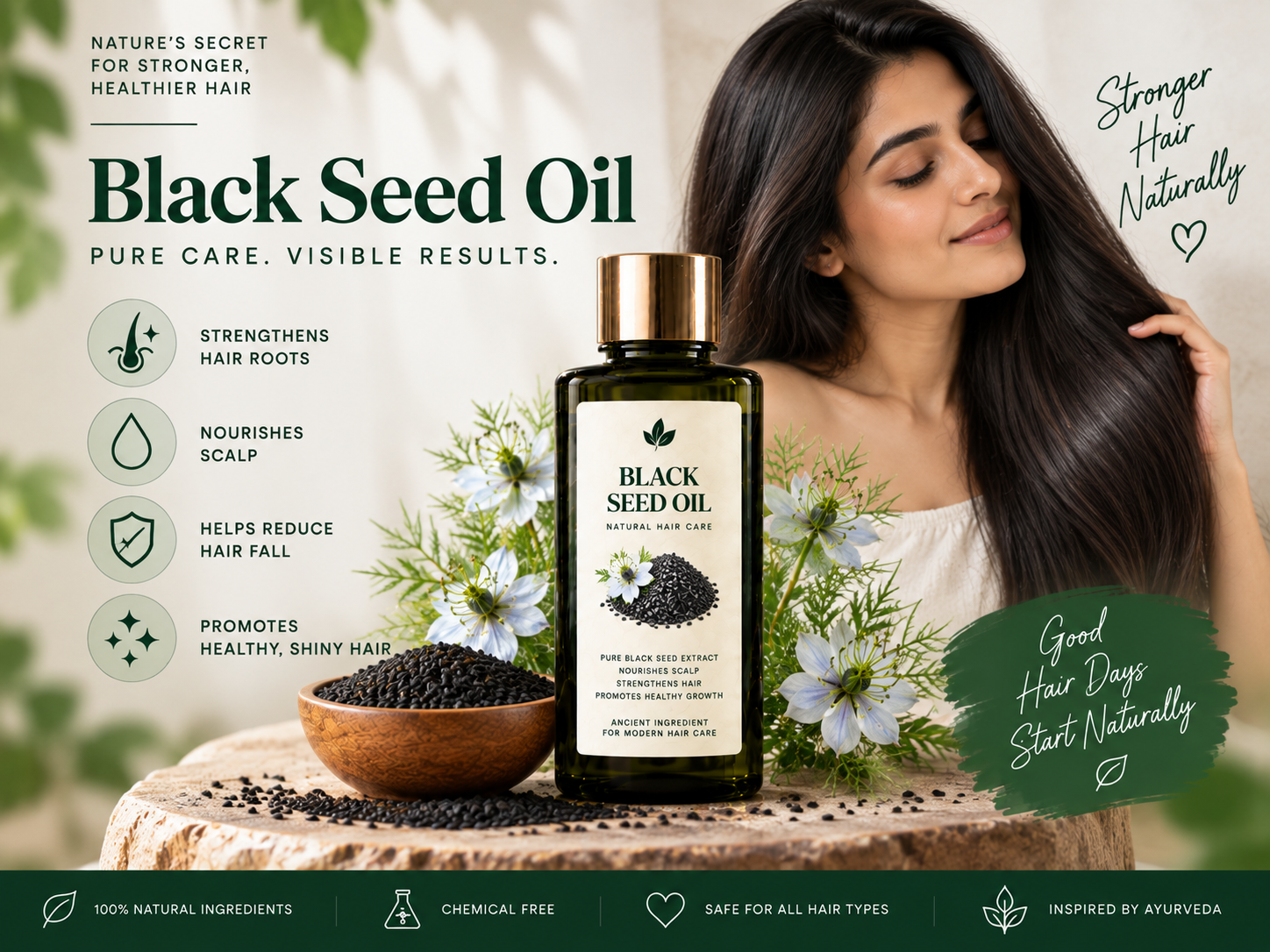
Black Seed Oil Hero · 720×540 · WebP
Dermatologist Reviewed
Reviewed by Dr. Amit Agarkar, MD Dermatology
Black seed oil, also known as kalonji oil, is derived from the seeds of Nigella sativa, a flowering plant with a long history of traditional use across South Asia, the Middle East and North Africa. It is commonly used in traditional haircare for scalp massage, hair shaft conditioning, dryness support, pre-wash oiling and hair fall-support routines. It may improve hair feel, scalp massage experience and routine consistency, but it is not a proven medical treatment for progressive hair loss, androgenetic alopecia, alopecia areata, PCOS-related hair fall, thyroid-related hair fall, postpartum shedding, nutritional deficiency hair fall, severe dandruff or scalp infection. People with sensitive scalp, oily scalp, active dandruff, seborrheic dermatitis, folliculitis, scalp acne, eczema, psoriasis, painful scalp, sudden shedding, recent scalp procedures or recent hair transplant should consult a dermatologist before applying oils to the scalp.
What You’ll Learn on This Page
What black seed (kalonji) oil can and cannot do for hair
Scientific evidence for Nigella sativa on hair and scalp
How to safely apply black seed oil — dilution is key
Scalp massage techniques using black seed oil blends
Potential side effects — staining, irritation, and allergies
When to see a dermatologist instead of using home oils
Quick Answer
Is black seed oil good for hair?
Black seed oil — known as kalonji oil in Hindi and Urdu — has been part of traditional haircare practices across South Asia, the Middle East and North Africa for centuries. Nigella sativa seeds contain thymoquinone and various fatty acids, and the oil extracted from them is used in both culinary and topical haircare contexts. Its popularity in hair fall-support routines is significant across Indian and Middle Eastern households.
However, the clinical evidence for black seed oil's direct medical hair regrowth in humans is limited. Like many traditional botanical oils, its benefits are better understood as cosmetic — supporting scalp massage routines, hair conditioning, dryness support and shine — rather than as proven treatments for pattern hair loss, alopecia, or scalp disease. It should not replace dermatologist evaluation for progressive or significant hair fall.
Verdict: Black seed oil is a valued traditional hair oil suitable for some users as part of a scalp massage or pre-wash oiling routine. It requires a patch test, is not appropriate for all scalp types, and does not treat the medical causes of hair loss. Significant or progressive hair fall needs dermatologist evaluation.
Black seed (Nigella sativa / kalonji) oil has some preliminary research suggesting anti-inflammatory and antioxidant properties that may support scalp health. It does not cure hair loss, regrow hair, or treat medical conditions. Always dilute before scalp application, patch-test first, and be aware it can stain light-coloured hair and fabrics.
People looking for a traditional anti-inflammatory scalp massage oil. May suit those with dry, itchy scalps when properly diluted.
Not a Substitute For
Dermatologist-prescribed treatment for alopecia, seborrheic dermatitis, or psoriasis. Black seed oil is a cosmetic adjunct, not a medicine.
See a Dermatologist If
Scalp itching persists beyond 2 weeks, you notice patchy hair loss, or develop contact dermatitis after application. Do not use on broken skin or open wounds.
Traditional Benefits
What Black Seed Oil May Do for Your Hair Routine
All benefits are cosmetic and supportive. Traditional use should not be conflated with proven medical hair regrowth. Patch test required before scalp use.
🌑
Traditional Kalonji Haircare Support
Black seed oil has been used in traditional haircare routines across South Asia and the Middle East for generations. Routine consistency itself is valuable, but black seed oil is not a standalone cure for medically diagnosed hair loss conditions such as androgenetic alopecia or alopecia areata.
💆
Scalp Massage Ritual
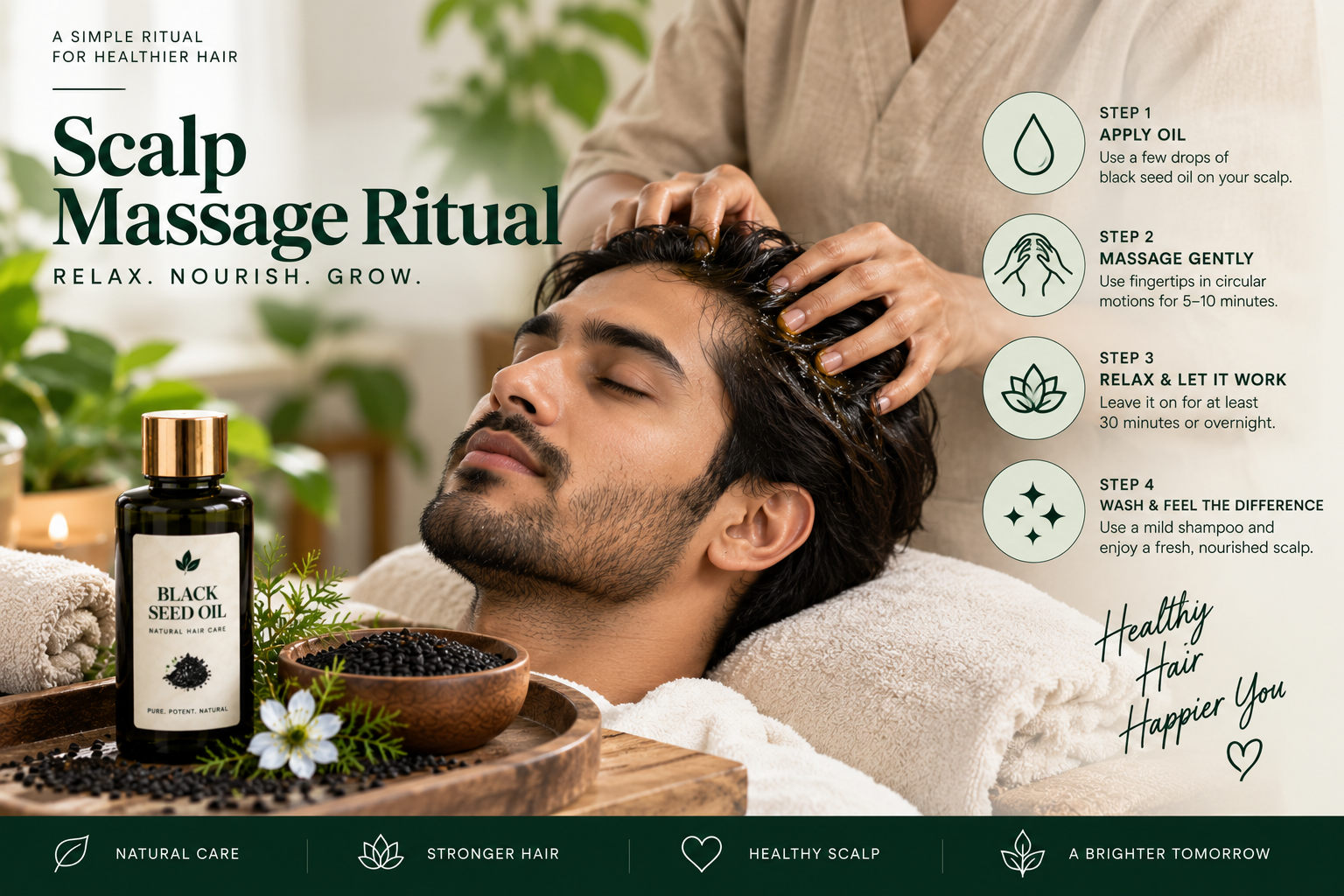
Gentle scalp massage with kalonji oil may support relaxation and routine adherence. Use gentle circular fingertip movements only — aggressive rubbing or scratching can worsen shedding in people with active hair fall and should always be avoided.
💧
Dry Hair Conditioning
Black seed oil can add a conditioning layer to dry, rough or coarse hair lengths, improving softness and reducing brittleness when used as a pre-wash treatment. Apply mainly to lengths and ends for best conditioning results.
✨
Shine & Hair Feel
Like most botanical oils, black seed oil can temporarily coat the hair shaft and improve surface shine and manageability. This is a cosmetic surface benefit and does not indicate follicular stimulation or new hair growth.
🛡️
Pre-Wash Nourishment
Short-contact pre-wash use — 30 to 60 minutes before shampooing — is generally safer than heavy overnight application, reducing oil buildup and irritation risk, particularly for scalps that are not well-suited to prolonged heavy oiling.
🤖
AI Routine Pairing
Because scalp response to black seed oil varies between individuals, our AI Hair Test identifies whether kalonji oil is appropriate for your specific scalp type, dandruff status, hair fall pattern, and sensitivity history before you begin a routine.
If your scalp is non-oily and non-inflamed with no history of sensitivity, black seed oil may be trialled as a pre-wash routine after a successful 24-hour patch test.
May Trial — Patch Test First💧
Dry Hair & Coarse Hair
Suitable for dry or coarse hair lengths as a pre-wash conditioning treatment. Apply to lengths, not scalp, if your scalp is oily or dandruff-prone.
Good Match — Lengths💦
Oily Scalp
Not recommended on the scalp. Black seed oil on an oily scalp can worsen sebum buildup, clog follicles and aggravate seborrheic conditions. Apply to lengths only.
Avoid on Scalp❄️
Active Dandruff / Seborrheic Dermatitis
Avoid. Oil on a dandruff-prone scalp worsens flaking and irritation. Active dandruff requires antifungal treatment, not cosmetic oiling.
Do Not Use🔴
Sensitive / Fragrance-Reactive Scalp
High risk. Black seed oil may contain compounds that cause contact dermatitis or fragrance reactions on sensitive scalps. Patch test is non-negotiable.
Patch Test — Consult First🔥
Scalp Acne / Folliculitis
Do not apply black seed oil to an acne-prone or infected scalp. Heavy oil can worsen follicular occlusion and delay healing of active scalp conditions.
Do Not Use🪶
Fine or Limp Hair
Black seed oil can weigh fine hair down. Use very sparingly on ends only, or avoid altogether. Avoid scalp application entirely for fine hair types.
Use Very Sparingly💉
Post-Transplant Scalp
Never apply any oil to a post-transplant scalp without explicit clearance from your hair transplant surgeon. Graft survival can be compromised by inappropriate topicals.
Surgeon Clearance Required🚨
Progressive Hair Thinning
Black seed oil does not treat medical hair loss. Progressive thinning, patchy loss or sudden shedding requires dermatologist evaluation and diagnosis.
If you are applying black seed oil and notice increased itching, redness, pimples on the scalp, or worsening dandruff — stop immediately. These are not signs of “detox” or “purging.” They may indicate irritation, allergy, folliculitis or worsening of an existing scalp condition. Consult a dermatologist before resuming any oil application on an irritated scalp.
Ritual Guide
How to Use Black Seed Oil for Hair Safely
Black seed oil has a strong smell and notable botanical potency. Follow these dermatologist-guided steps carefully, especially for first use.
⚠️ Important: Do not layer black seed oil with minoxidil, medicated anti-dandruff treatments, scalp acids, steroid lotions, prescription serums or multiple active oils without dermatologist guidance. Combining active ingredients significantly increases irritation and unpredictable scalp reaction risk.
1
Patch Test — 24 Hours
Apply a small amount behind the ear or on the inner arm. Wait 24 hours. Do not proceed if redness, burning, itching or rash appears. Black seed oil has a notably strong scent and botanical potency — allergy is possible.
2
Start With Small Quantity
Use a small amount — less than you think you need. Heavy oiling with black seed oil causes scalp buildup, greasiness and potential irritation. A small quantity is sufficient for scalp massage and pre-wash conditioning.
3
Apply as Pre-Wash — 30 to 60 Minutes
Start with a 30–60 minute pre-wash application. Shorter contact time reduces irritation and buildup risk. Avoid overnight use until your scalp is confirmed tolerant over several sessions.
4
Massage Gently With Fingertips
Use gentle circular fingertip movements. Do not scratch, pull, or rub vigorously. Aggressive scalp manipulation can worsen shedding in people with active hair fall and is counterproductive to a supportive routine.
5
Focus on Lengths If Scalp Is Sensitive
If your scalp is oily, dandruff-prone or acne-prone, apply black seed oil mainly to dry hair lengths and avoid heavy scalp coating. Conditioning benefits apply to the hair shaft without the scalp risk.
6
Shampoo Thoroughly
Use a gentle, sulphate-free shampoo to remove the oil and its odour. Shampoo at least twice. Do not allow oil buildup on the scalp between applications.
7
Track Your Scalp Response
Monitor your scalp and hair for 24–48 hours after each application. Stop immediately if burning, itching, redness, rash, dandruff flare, or increased shedding occurs after use.
8
Frequency — 1 to 2 Times Weekly
Use only 1–2 times per week as a pre-wash routine, and only if your scalp tolerates each application without irritation or buildup. Do not increase frequency without dermatologist guidance.
Burning, redness, rash, worsening itching, dandruff flare, folliculitis, oil buildup, or increased hair shedding occurs after black seed oil use. Consult a dermatologist before resuming any scalp oiling routine.
Expert Note
The most common mistake with hair oiling is leaving oil on for too long or sleeping with heavy oil overnight without proper washing the next morning. Prolonged scalp oil contact can clog follicles, attract dust and worsen dandruff in susceptible people. For most users, 30 minutes to 2 hours before washing is sufficient. Listen to your scalp, not social media trends.
Oil Comparison
Black Seed Oil vs Amla Oil vs Bhringraj Oil vs Rosemary Oil vs Coconut Oil vs Castor Oil
Oil
Best For
Evidence
Texture
Scalp Safety
Black Seed Oil
Traditional kalonji haircare; scalp massage; pre-wash routine; dryness support; shine
Traditional use; limited human evidence for regrowth
Medium; strong botanical smell
Patch test required; avoid inflamed/oily/dandruff scalp
All oils listed are cosmetic supportive options. Medical hair loss requires proper diagnosis, investigation, and individualised treatment planning by a qualified dermatologist.
Before starting a black seed oil routine, our AI Hair Test assesses your scalp type, dandruff status, hair fall pattern, oiliness, sensitivity history, recent procedures, current treatment, and medical red flags — to identify whether kalonji oil is appropriate for your specific profile or likely to cause problems.
Black seed oil (kalonji oil) is widely used in traditional haircare for scalp massage, pre-wash oiling, dryness support and hair conditioning. It may help improve hair feel and routine consistency. However, it is not a proven cure for pattern hair loss or medically diagnosed hair conditions. Patch testing is mandatory before use.
Yes. Kalonji oil and black seed oil are the same oil, extracted from the seeds of Nigella sativa. It is known as kalonji in Hindi and Urdu, black seed oil in English, and habbatus sauda in Arabic contexts. All names refer to the same traditional botanical oil.
Black seed oil is not a proven hair regrowth treatment. It has strong traditional relevance in haircare across South Asia and the Middle East, but clinical evidence for direct medical hair regrowth in humans is limited and should not be overstated. Progressive hair loss requires medical evaluation.
Black seed oil may support routine consistency as part of a hair fall-support plan, but it cannot treat underlying causes of hair fall such as androgenetic alopecia, thyroid disorders, PCOS, nutritional deficiency, or medication-induced hair loss. Consult a dermatologist for significant or progressive hair fall.
Evidence for black seed oil's medical hair regrowth in humans is limited. While Nigella sativa has been studied for various properties, these findings cannot be directly applied to commercial black seed hair oil products or guaranteed regrowth outcomes. Black seed oil is best framed as a traditional supportive cosmetic oil.
Black seed oil can help improve the feel of dry hair by adding a conditioning layer to the hair shaft. It is most useful as a pre-wash treatment on dry, rough or coarse hair lengths. Avoid heavy scalp application if your scalp is oily or prone to dandruff.
Yes. Black seed oil can cause scalp irritation, redness, itching or contact dermatitis in sensitive individuals, particularly those with fragrance sensitivity or botanical oil allergies. People with seborrheic dermatitis, scalp acne, folliculitis, eczema or inflamed scalp should consult a dermatologist before use. A 24-hour patch test is mandatory.
Black seed oil is not a treatment for dandruff or seborrheic dermatitis. Heavy oil on a dandruff-prone scalp can worsen flaking and irritation. Active dandruff requires antifungal treatment. Consult a dermatologist rather than relying on cosmetic oiling for dandruff management.
Daily black seed oil use is not recommended. Its strong smell and botanical compounds can cause scalp buildup and irritation with frequent application. Use 1-2 times weekly as a pre-wash treatment only if your scalp tolerates it without burning, itching or redness.
Overnight black seed oil application is not recommended for first-time users or sensitive scalps. Start with a 30-60 minute pre-wash application and monitor your scalp's response before considering longer contact times. Overnight use on oily or dandruff-prone scalp can significantly worsen conditions.
Do not combine black seed oil with minoxidil without dermatologist guidance. Oils can interfere with minoxidil absorption and combining multiple active scalp products increases irritation risk. Consult your dermatologist before adding any hair oil to a routine that includes prescription treatment.
Black seed oil is generally not suitable for oily scalps. Heavy oil on an oily scalp can worsen sebum buildup, clog follicles and aggravate seborrheic dermatitis. If your scalp is oily, apply to hair lengths only and avoid direct scalp application.
Do not use black seed oil or any cosmetic hair oil on a post-transplant scalp without explicit clearance from your hair transplant surgeon. Any topical product on a post-transplant scalp requires surgeon approval, as inappropriate products can compromise graft survival.
Stop black seed oil use immediately if you experience burning, redness, rash, increased scalp itching, dandruff flare, folliculitis, oil buildup, or increased hair shedding. Consult a dermatologist before resuming any hair oiling routine.
Consult a dermatologist if you experience progressive hair thinning, patchy hair loss, sudden heavy shedding, scalp pain, folliculitis, severe dandruff, PCOS-related hair fall, thyroid-related hair fall, postpartum hair loss, medication-related shedding, premature greying, or if cosmetic routines have not helped after consistent use.
Still unsure whether black seed oil is right for your scalp?
Black seed oil or kalonji oil has traditional haircare relevance across South Asia, the Middle East and North Africa. Commercial products vary widely. Evidence for direct medical hair regrowth in humans is limited and should not be exaggerated. All external links open in a new tab.
Black seed oil, also called kalonji oil, is a cosmetic supportive hair oil used in traditional haircare routines. It does not diagnose, treat, cure or prevent any medical hair loss condition. It does not permanently reverse grey hair and should not replace minoxidil, finasteride, dutasteride, anti-dandruff treatment, prescription hair loss therapy, PRP, GFC, hair transplant care, nutritional correction, or dermatologist consultation. This guide has been reviewed by Dr. Amit Agarkar, MD Dermatology. Consult a qualified dermatologist if you experience progressive hair thinning, bald patches, sudden shedding, painful scalp, scalp infection, severe dandruff, PCOS-related hair loss, thyroid-related hair loss, postpartum hair fall, medication-related shedding, nutritional deficiency, premature greying or suspected alopecia. A patch test is required before any scalp application. Do not substitute traditional hair oil routines for medically prescribed treatment.
Hair Loss Treatment India — Free AI Hair Diagnosis & Dermatologist-Recommended Products
Minoxidil India — CDSCO-Approved Hair Regrowth Treatment
Free AI Hair Loss Diagnosis by Qualified Dermatologists
Best Anti Hair Fall Shampoo, Oil & Supplements in India
Male Pattern Baldness Treatment — Minoxidil & DHT Blocker Protocol