Myth
"Shea Butter directly grows new hair."
Fact
Shea Butter is a conditioning lipid, not a hair-growth medicine.
HairsnCares Ingredient Intelligence · Botanical Lipid Science
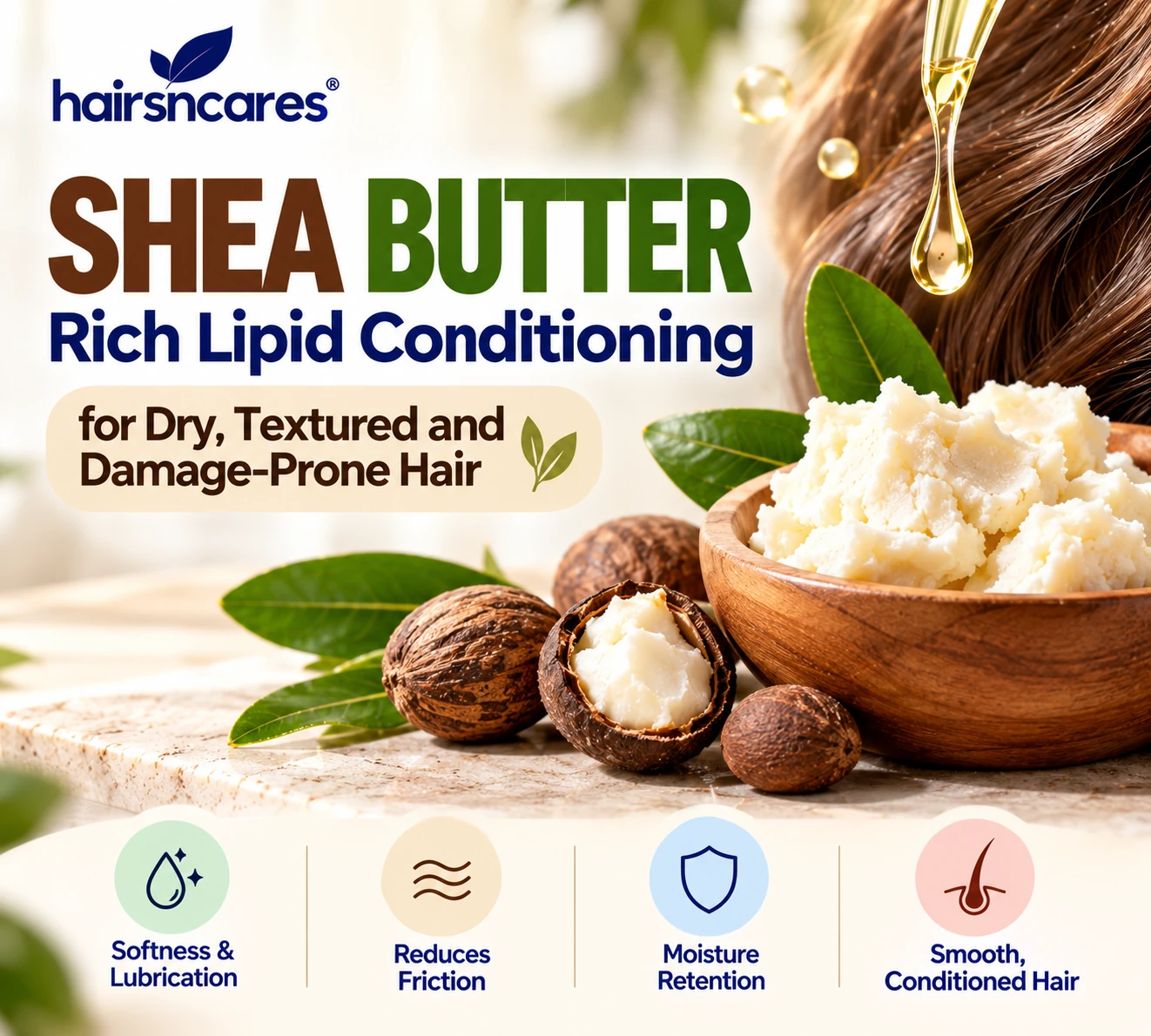
Shea Butter — botanically Vitellaria paradoxa, INCI: Butyrospermum Parkii (Shea) Butter — is a complex plant-derived fat used in conditioners, masks, curl creams, balms and leave-in products to support lubrication, softness, reduced friction and moisture retention.
Shea Butter does not add water to hair by itself — humectants and water-based products are still needed. It may be too heavy for fine or low-porosity hair. Refined and unrefined forms differ in sensory character and formulation behaviour. It is not a direct hair-growth treatment. Persistent scalp symptoms require evaluation.
Shop Shea Butter Hair Products →
Quick Ingredient Answer
Shea Butter is a complex plant-derived fat from the shea tree (Vitellaria paradoxa), INCI: Butyrospermum Parkii (Shea) Butter. In haircare it works as an emollient — lubricating the fibre, improving softness and reducing roughness, and helping to limit water loss from the surface. What it cannot do: add water to hair by itself, permanently repair the fibre, regrow hair or treat scalp disease. Thick, curly, coily, porous and chemically treated hair often tolerates richer Shea formulas well; fine and low-porosity hair may find them too heavy. Concentration, product format and the complete formula decide the result.
Medically reviewed by Dr. Amit S. Agarkar — MBBS, MD Dermatology, FCPS, DDV · Reviewed 24 July 2026 · Next review July 2027 · Evidence-led review methodology
Overview
A semi-solid botanical fat from the kernels of the shea tree, containing a mixture of triglycerides, fatty acids and other lipid constituents. Its composition can vary by geographic source, extraction and refining. It softens or melts on contact with warmth and creates a rich emollient film on the hair surface.
| Shea Butter | Shea Oil | Shea Butter Extract |
|---|---|---|
| Semi-solid botanical fat | More fluid shea-derived fraction | Extract from Shea Butter |
| Adds richness and structure | Lighter spreading profile | Used at formula-specific levels |
| Common in masks, creams and balms | Common in oils and lighter formulas | Function depends on extract type |
| May feel heavy on fine hair | May offer a lighter alternative | Not interchangeable with whole butter |
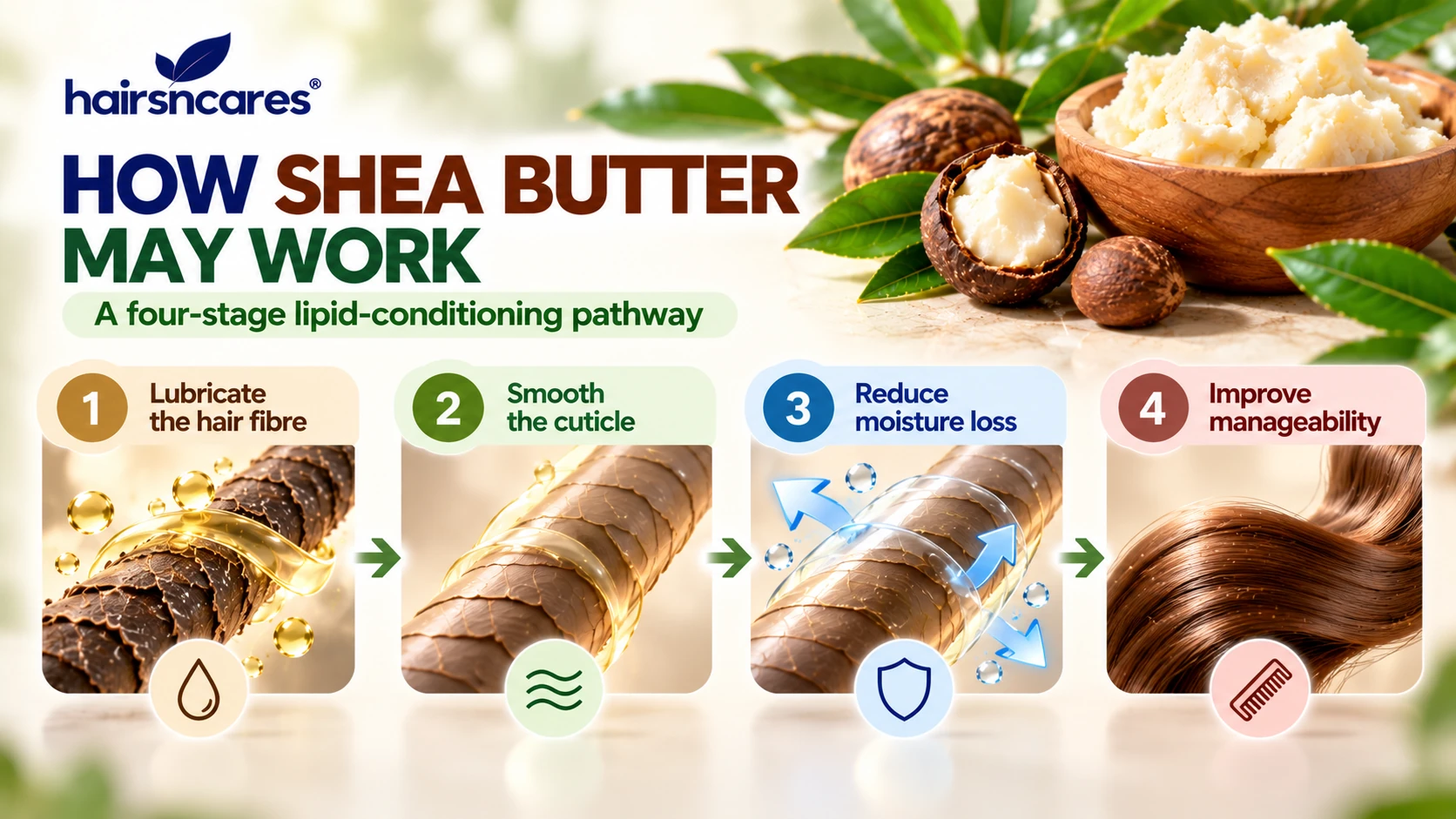
How Shea Butter May Work
What a well-formulated Shea Butter product may do at the hair fibre surface.
Lipid-rich formulations may reduce surface friction between fibres, making combing and detangling gentler.
Emollient films may smooth the cuticle surface, reduce rough feel and improve softness.
Shea Butter may help slow water loss from the hair surface — but it does not act as a humectant. It seals rather than delivers.
Reduced friction and improved lubrication may support easier detangling, curl definition and reduced mechanical breakage.
Shea Types & Refining
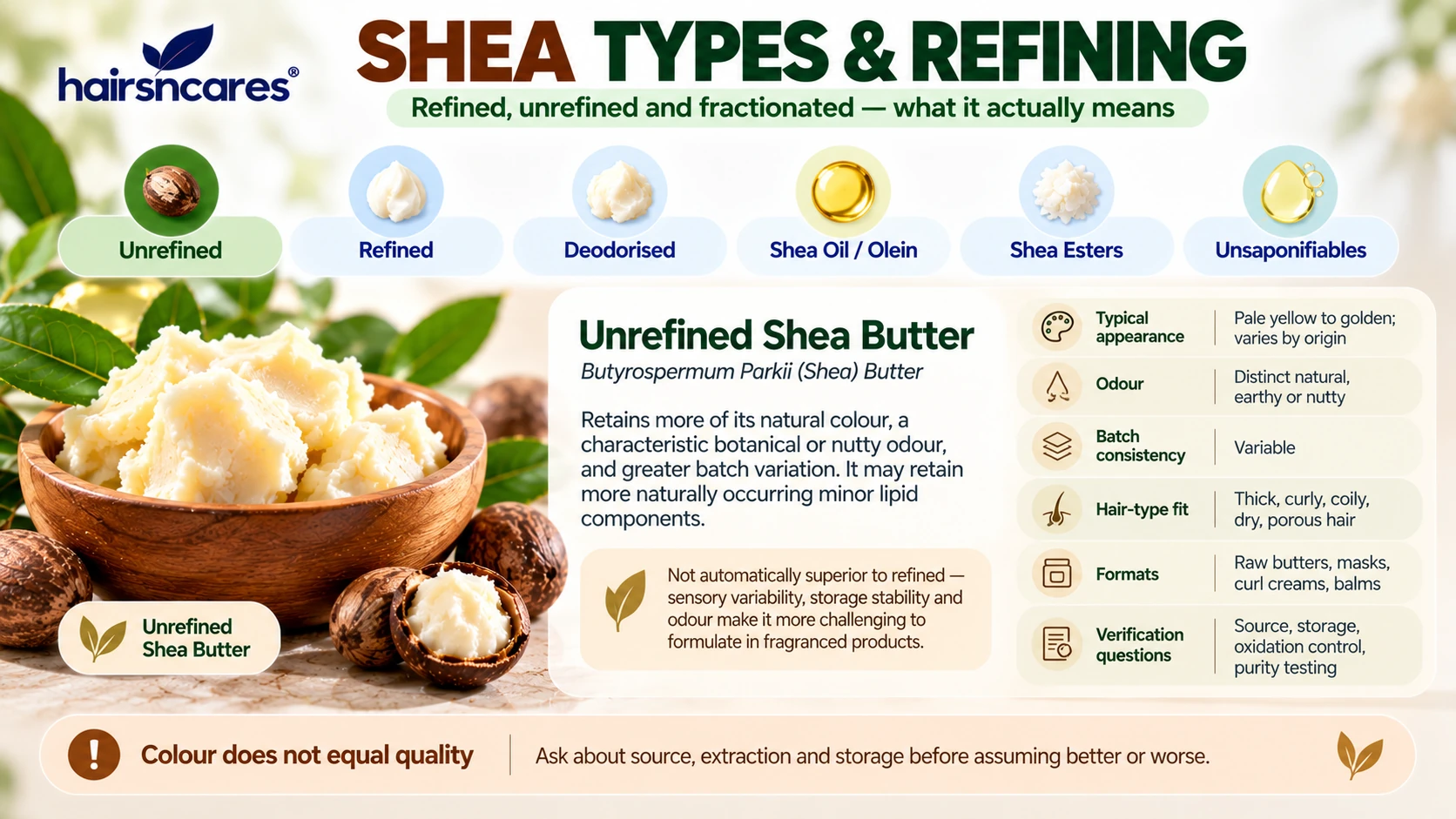
Choose a form to see its characteristics, formulation role and the questions you should ask about any product claiming it.
Butyrospermum Parkii (Shea) Butter
Retains more of its natural colour (pale yellow to deeper gold depending on source), a characteristic botanical or nutty odour, and greater batch variation. It may retain more naturally occurring minor lipid components. Not automatically superior to refined — sensory variability, storage stability and odour make it more challenging to formulate in fragranced or colour-sensitive products.
Butyrospermum Parkii (Shea) Butter
Processing removes most colour and reduces odour, producing a more consistent, white-to-off-white material. Easier to formulate in fragranced or colour-sensitive products. Not ineffective — the refining process reduces sensory variance without eliminating the lipid character. Processing methods and extent vary significantly by supplier.
Butyrospermum Parkii (Shea) Butter
Deodorisation targets odour reduction and does not alone define the quality of the whole material. A deodorised butter may still retain much of the lipid character of the original fat. Understanding the full processing chain matters more than the deodorisation step alone.
Butyrospermum Parkii (Shea) Oil
The more fluid olein fraction of Shea, offering lighter spreadability and a less occlusive feel than whole butter. Often used in products where a lighter texture is required. Not interchangeable with Shea Butter — different sensory character and typically a lower waxy-stearin content.
Shea Butter GlyceridesShea Butter Esters
Esterified shea-derived ingredients used to achieve lighter textures, improved spreadability or specific formulation properties such as enhanced compatibility with other ingredients. Behaviour depends on the specific ester.
Shea Butter Unsaponifiables
The non-glyceride fraction that remains when saponification is performed. May include minor lipid components. Used in specific formulations. Do not attribute cosmetic-dermatology properties to unsaponifiables without verified, ingredient-specific evidence.
Shea Butter is primarily sourced from West and Central Africa. Sourcing quality, ethical practices and sustainability vary significantly between suppliers. Claims such as fair-trade, women's cooperative, organic and hand-extracted must each be verified through the specific product's documentation — a label description is not a certification.
Origin significantly influences fatty-acid profile, colour, odour and texture. Verify for the specific product batch, not just a country name.
Check: {{SHEA_ORIGIN}}Cold-pressed, expeller-pressed, solvent-extracted — methods differ. Ask for a processing disclosure from the supplier.
Check: {{EXTRACTION_METHOD}}, {{REFINING_STATUS}}Not every cooperative source is certified, and not every certified product supports women-led cooperatives. Verify the certification body and scope.
Check: {{FAIR_TRADE_STATUS}}, {{COOPERATIVE_SOURCE}}, {{ORGANIC_CERTIFICATION}}Hair Benefits · Who May Benefit
Ten hair profiles — each with a product-format direction, buildup consideration and the honest point where something else serves you better.
Lubrication and moisture-retention support — most effective when paired with water-based humectants.
Conditioner / maskButter alone won't fix dehydration. Glycerin →
Richer formulations suit higher fibre volume and may provide thorough even conditioning.
Rich mask / curl creamDistribute evenly to all lengths. Hair masks →
Reduced friction, improved slip and curl manageability. Heavy application may flatten curls.
Curl cream / leave-inLipid-rich coatings may support moisture retention and reduce rough feel in porous fibres.
Mask + leave-inPair with protein and humectants. Ceramides →
Surface smoothing and humidity-management support — within a formula that includes appropriate polymers.
Curl cream / serumFrizz also driven by porosity and climate. Frizz care →
Improved softness and slip — cannot reverse the structural chemical alteration bleaching causes.
Rich mask + leave-inPair with hydrolysed protein. Protein →
Gentle conditioning and reduced friction support colour-care routines without aggressive stripping.
Conditioner / serumTemporary cosmetic support for damaged lengths from perms or straightening — not a reversal of structural change.
Mask / leave-inTemporary smoothing and reduced roughness at the tips — split ends still require trimming for permanent removal.
Balm / serum (ends only)Rich Shea formulas can weigh fine hair down. Lightweight Shea-oil or ester formats may suit some fine-hair users better.
Light Shea oil / esterLess is more — test on ends first. Light conditioners →
Expert notePatients often assume Shea Butter is universally moisturising because it's described as a natural butter. It's primarily a lubricant and sealant — excellent at improving texture and manageability in dry, thick or porous hair, but it can create real buildup problems on an already-oily scalp or on fine hair used too richly. Start with a formulated product at the ends, assess the response, and build from there.
Interactive · Educational only
Ten questions. An educational pathway — never a diagnosis, mandatory routine or allergy clearance.
This checker provides educational ingredient guidance only. It does not diagnose scalp disease, assess allergy safety or replace dermatologist consultation.
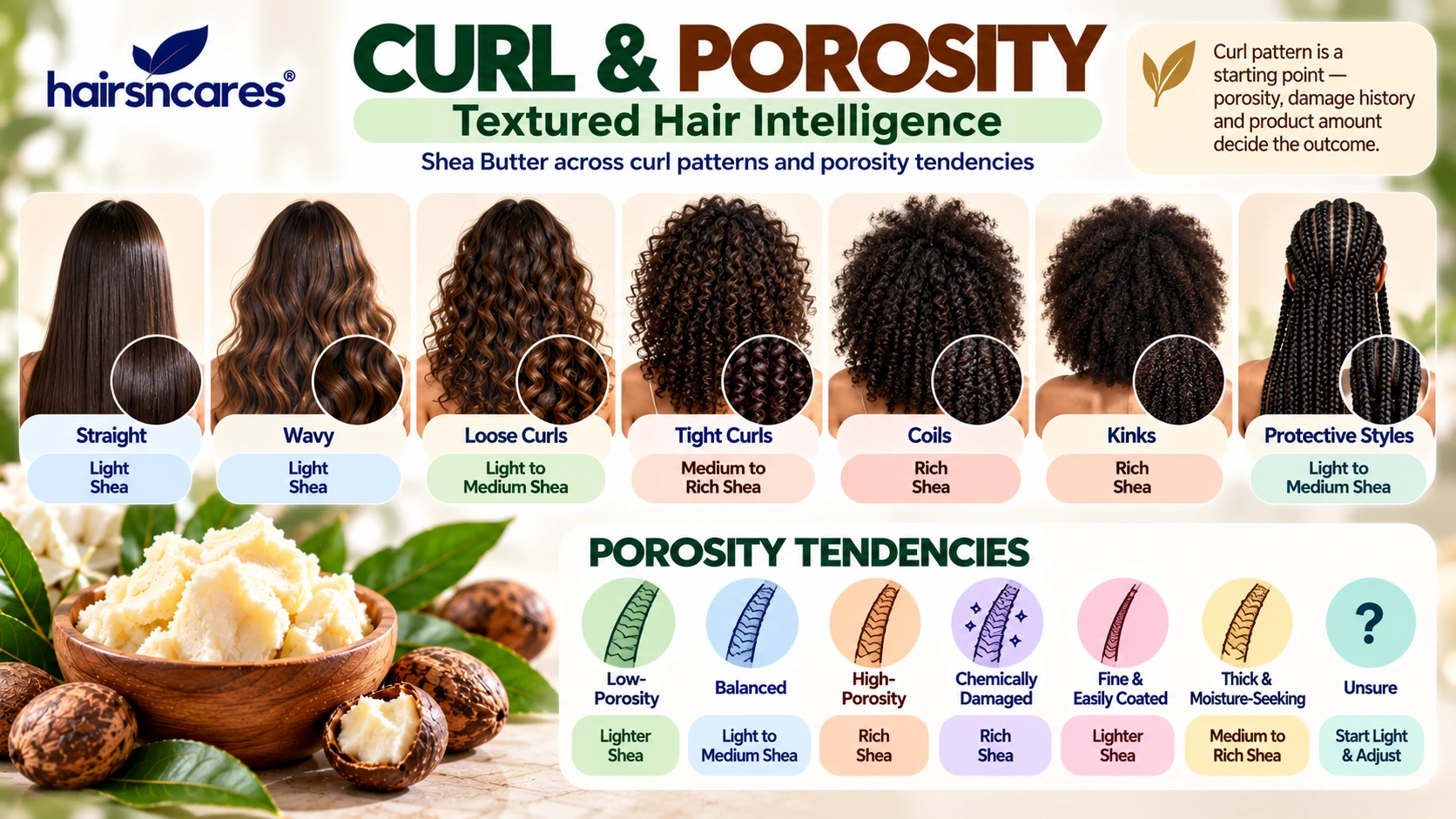
Curl & Porosity · Textured Hair Intelligence
Texture and porosity matter more than any single ingredient — use the selectors to understand where Shea Butter fits in your routine.
| Profile | Main need | Shea direction | Placement | Common mistake |
|---|---|---|---|---|
| Fine hair | Hydration without weight | Shea oil or ester; minimal whole butter | Ends only | Applying mask to roots |
| Medium hair | Balanced conditioning | Light to medium Shea conditioner | Mid-lengths and ends | Over-applying on scalp |
| Thick hair | Rich even conditioning | Rich mask or curl cream | Full length | Insufficient product to reach all strands |
| Straight hair | Smoothness without grease | Light conditioner or serum | Ends | Too much on mid-lengths causing flatness |
| Wavy hair | Definition and slip | Light curl cream | Mid-lengths and ends | Weighing down the wave pattern |
| Curly hair | Lubrication and curl definition | Curl cream or leave-in | Full length after water | Applying butter without wetting first |
| Coily hair | Maximum lubrication and retention | Rich balm or curl butter | Full length; scalp with care | Expecting butter to hydrate without water |
| Low-porosity hair | Avoid buildup | Shea oil or ester; infrequent whole butter | Ends only | Repeated layering without clarifying |
| High-porosity hair | Seal and condition | Rich mask + leave-in | Full length | Butter without prior water-based conditioning |
| Colour-treated hair | Colour-friendly conditioning | Conditioner or serum | Mid-lengths and ends | Harsh clarifying to remove buildup |
| Bleached hair | Softness and retention | Rich mask + leave-in | Lengths | Expecting structural restoration |
| Heat-damaged hair | Lubrication, reduced friction | Serum or mask | Damaged lengths | Skipping heat protection going forward |
| Oily scalp, dry ends | Length-only conditioning | Serum or light leave-in at ends | Ends only | Applying curl cream to oily scalp |
| Dry scalp, thick hair | Scalp comfort + length conditioning | Scalp serum + rich length mask (separate) | Scalp product first; length product separately | One product for both scalp and lengths |
Curl type is a starting point, not a fixed formula rule. Select the texture that currently describes your hair to see where different Shea-richness levels tend to sit:
Scalp Use
The scalp is not the same as the hair fibre, and the same rule of "richer is better" does not apply.
Key requirement: the product must be designed for scalp application — not a lengths conditioner applied to the scalp.
| Dry-Feeling Scalp | Dandruff-Prone Scalp |
|---|---|
| May benefit from a suitable moisturising formula | Often needs targeted cleansing or anti-dandruff care |
| Tightness may improve with barrier support | Greasy flakes may worsen with heavy buildup |
| Persistent symptoms still need assessment | Do not rely on butter alone — seek assessment when recurrent |
| Use scalp-specific products | Antimicrobial or antifungal treatment may be indicated |
Comparisons · Interactive Lab
Pick any two of sixteen ingredients for a side-by-side profile. No fake nourishment scores, no universal winner, no permanent-repair claims.
Select exactly two:
Descriptions reflect typical cosmetic roles, not rankings or scores. Performance depends on concentration, product format and supporting ingredients. Never use raw or unverified material without appropriate formulation knowledge.
Different plant-derived lipids with different compositions and sensory profiles. Coconut Oil is liquid or semi-solid depending on temperature, has a distinct fatty-acid profile and a lighter initial spreading feel. Shea Butter provides a richer emollient surface film. Neither is universally better — hair type, concentration and the complete formula decide.
Argan Oil is a liquid plant oil with lighter spreadability and common use in serums and conditioners. Shea Butter is semi-solid, richer and creates a more occlusive surface feel. Fine hair may prefer Argan Oil's lighter profile; thick or coily hair may tolerate richer Shea formulas. Product concentration matters more than origin alone.
Not interchangeable. Shea Butter provides emollience, lubrication and moisture-loss reduction. Ceramides are lipid-family conditioning ingredients used in barrier and surface-conditioning systems. Products may contain both. Shea Butter does not naturally deliver every cosmetic ceramide function.
Hydration and sealing are different jobs. Glycerin is a humectant that helps attract and retain water within a formula; Shea Butter is an emollient that lubricates and helps limit moisture loss. Butter alone may not correct dehydrated-feeling hair — a balanced curl cream often contains both.
"Shea Butter directly grows new hair."
Shea Butter is a conditioning lipid, not a hair-growth medicine.
"Shea Butter permanently repairs damaged hair."
It may improve softness and manageability but cannot biologically regenerate the hair fibre.
"Natural Shea Butter cannot cause irritation."
Natural ingredients and complete formulations may still cause irritation or allergy.
"Unrefined Shea Butter is always better."
Refined and unrefined forms have different sensory and formulation characteristics — neither is universally superior.
"Yellow Shea Butter is always more authentic."
Colour varies with source, processing and added botanical materials.
"Shea Butter hydrates hair by itself."
It mainly conditions and limits moisture loss; water and humectants are still required.
"More Shea Butter means softer hair."
Excessive use can cause heaviness, coating and buildup.
"Shea Butter suits every curl type."
Hair thickness, porosity and preferred volume affect suitability.
"Shea Butter is always too heavy for fine hair."
Lightweight Shea derivatives or low-level formulas may suit some fine-hair users.
"Shea Butter cures dandruff."
Dandruff may require targeted cleansing or medicated treatment.
"Shea Butter is the same as Shea Oil."
Shea Oil is a more fluid fraction with lighter spreadability and different sensory properties.
"Every Shea Butter product is sustainable and fair trade."
Sourcing and certification claims must be verified for each supplier and product.
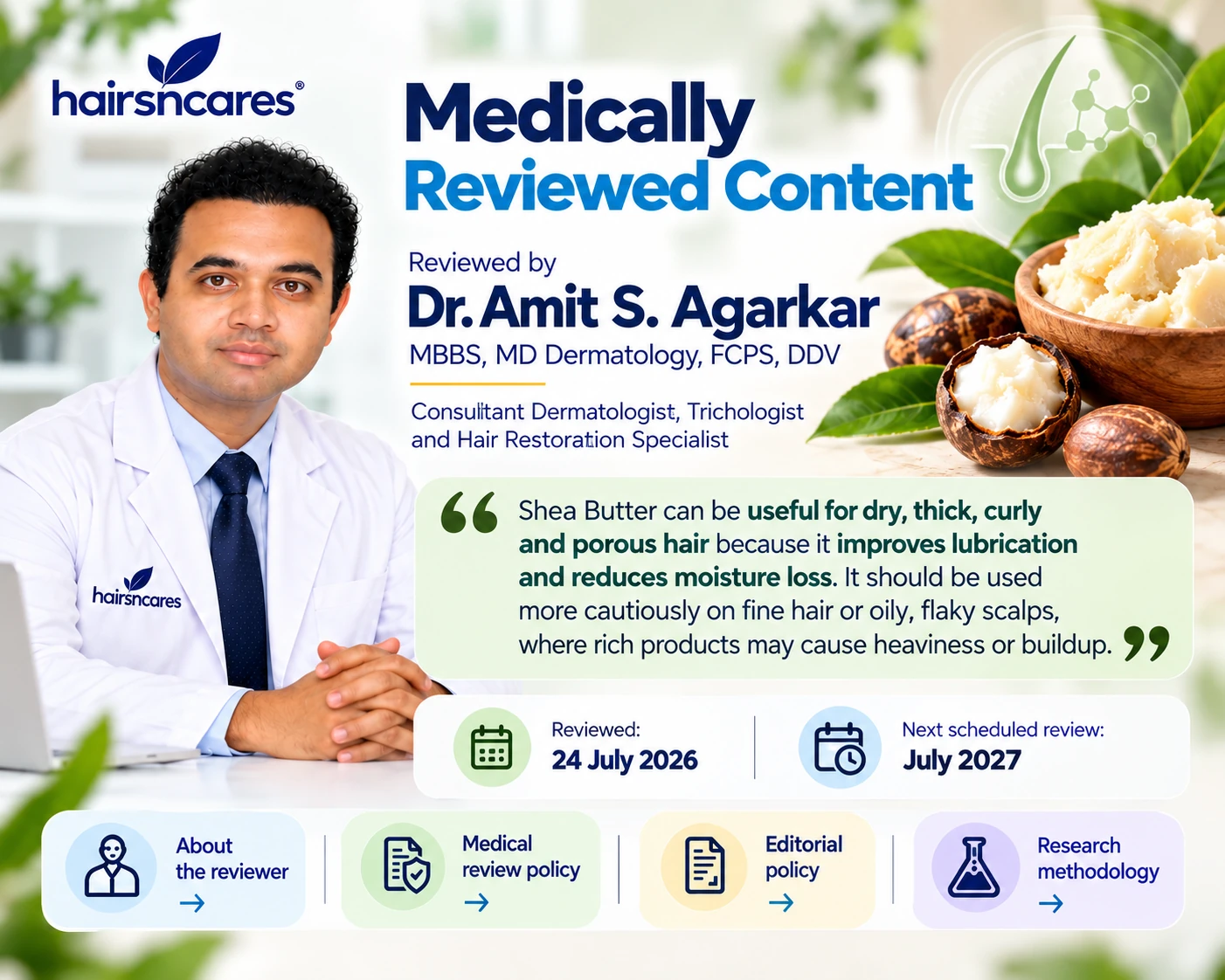
"Shea Butter can be useful for dry, thick, curly and porous hair because it improves lubrication and reduces moisture loss. It should be used more cautiously on fine hair or oily, flaky scalps, where rich products may cause heaviness or buildup."
Product Finder · Doctor-Curated
Filters for format, Shea type, refining status, curl pattern, porosity, sourcing and more. Product data loads from the live catalogue.
{{PRICE}} MRP {{MRP}} · {{DISCOUNT}}
{{STOCK_STATUS}} · {{RATING}} ({{REVIEW_COUNT}} reviews)
{{PRICE}} MRP {{MRP}} · {{DISCOUNT}}
{{STOCK_STATUS}} · {{RATING}} ({{REVIEW_COUNT}} reviews)
{{PRICE}} MRP {{MRP}} · {{DISCOUNT}}
{{STOCK_STATUS}} · {{RATING}} ({{REVIEW_COUNT}} reviews)
Sourcing status, vegan declarations and ethical certifications load from verified supplier data. Nothing on this page is invented — verify before purchase if sourcing matters to you.
Botanical butter · emollient conditioning
Explore →
Botanical butter · rich emollient
Explore →
Plant oil · lubrication and conditioning
Explore →
Plant oil · lighter lubrication and shine
Explore →
Barrier lipids · surface conditioning
Explore →
Humectant · water-binding support
Explore →
Provitamin B5 · conditioning and hydration
Explore →
Protein-derived · temporary reinforcement
Explore →
Emollient lipid · lightweight softness
Explore →
Liquid wax · scalp and length conditioning
Explore →
Safety · Use & Expectations
Application technique, allergy awareness, buildup management and the reaction ladder.
Review amount, placement, cleansing and frequency.
Stop use and seek professional guidance.
Seek urgent medical attention.
Improved slip, softer feel, reduced roughness, easier detangling, smoother curl clumping, reduced static.
Better manageability, reduced friction-related breakage, improved moisture retention, more controlled frizz in a suitable formula.
Pattern hair loss, nutritional deficiency, inflammatory scalp conditions, dandruff, scarring alopecia, permanently split ends, structural chemical damage or root shedding.
Products may temporarily smooth their appearance. Permanent removal requires trimming.
FAQs · Curated Answers
Honest answers about Shea Butter — without overpromising on sourcing, allergy safety or hair growth.
Shea Butter is a plant-derived fat obtained from the shea tree (Vitellaria paradoxa), with the cosmetic INCI name Butyrospermum Parkii (Shea) Butter. It is a complex mixture of triglycerides, fatty acids and other lipid constituents rather than a single molecule. Geographic origin, extraction method and refining level affect its colour, odour, texture and formulation behaviour.
In suitable formulations, Shea Butter may lubricate the hair fibre, improve smoothness and softness, reduce roughness and friction, and support moisture retention by helping to limit water loss from the surface. These are cosmetic conditioning effects — real and maintained by continued use, but not biological regeneration. The complete product formula, application amount and hair type shape the result.
It is commonly used in dry-hair formulations because of its emollient and moisture-retention support. Very dry hair often benefits from combining Shea Butter with water-based humectants — Shea Butter seals but does not directly add water to the hair.
It may improve the feel, softness and manageability of damaged lengths. It cannot reverse the structural changes chemical or heat damage causes. Pairing it with appropriate proteins, ceramides and humectants often gives a better balanced result than Shea Butter alone.
It is widely used in curly and coily-hair routines because it can improve lubrication, reduce friction and support curl definition. The best result usually combines Shea Butter with water-based conditioning and humectant ingredients — butter alone may leave hair feeling soft but not adequately hydrated. Amount matters: too much can flatten curls or create buildup.
Rich Shea Butter formulas can weigh fine hair down and reduce volume. Lightweight Shea-derived ingredients, esters or low-concentration formulas may suit some fine-hair users better. Format, concentration and the rest of the formula are the deciding factors.
High-porosity hair — often from bleaching, chemical processing or heat damage — may respond well to the moisture-retention support of Shea Butter. Pairing it with humectants and proteins in a balanced formula usually gives better results than heavy butter alone.
Low-porosity hair is prone to buildup when layered with heavy emollients. Lighter Shea-derived formats or low concentrations, used infrequently, suit low-porosity hair better. Appropriate clarifying cleansing helps manage accumulation.
Within a well-balanced formula, Shea Butter may reduce surface roughness and help manage frizz by improving lubrication and moisture retention. Frizz is also influenced by porosity, humidity, product concentration and the styling-polymer system. Heavy application may reduce curl volume and produce a different kind of undesirable result.
Generally yes — gentle conditioning and reduced friction are useful for colour-treated lengths. Wash frequency, water temperature and heat use also influence colour longevity. Very heavy Shea products may require regular gentle cleansing to prevent buildup.
With care and in an appropriate format. Lightweight scalp-specific formulas may support comfort on a dry-feeling scalp. Heavy creams or raw butter applied heavily to the scalp may worsen buildup, block follicular openings or feel uncomfortable — particularly on an oily or flaky scalp. Never use Shea Butter as a treatment for a medical scalp condition without professional guidance.
It may support a dry, tight-feeling scalp within an appropriate product, but dry scalp is not always a simple shortage of oil. Flaking can represent dandruff, seborrheic dermatitis, psoriasis, eczema or contact dermatitis, all of which need proper assessment rather than a heavy butter application.
No. Shea Butter is a conditioning lipid ingredient, not a hair-growth medicine. It does not stimulate dormant follicles, treat androgenetic alopecia or replace medically indicated therapy. By improving lubrication and reducing friction it may help limit avoidable mechanical breakage — that is different from stimulating hair growth.
Yes, particularly when applied heavily or repeatedly without adequate clarifying cleansing. Buildup appears as a coating, dullness, weight or reduced curl definition that does not wash out with regular conditioning shampoo. Adjust amount, application area and cleansing frequency if buildup occurs.
Heavy or repeated Shea application on the scalp may occlude follicular openings and contribute to congestion or discomfort in some users. The scalp is not equivalent to non-follicle-bearing skin. Use scalp-appropriate products, not lengths-conditioners, for scalp application. Comedogenicity scales from facial skincare should not be directly applied to scalp care.
Unrefined Shea Butter retains more of its natural colour and odour, shows greater batch variation and may retain more naturally occurring minor lipid components. Refined Shea Butter is lighter in colour, reduced in odour and more consistent, making it easier to formulate into fragranced or colour-sensitive products. Neither form is universally superior — the refining level influences sensory characteristics and formulation behaviour rather than determining quality in a simple hierarchy.
Shea Oil (or Shea Olein) is a more fluid fraction derived from Shea Butter. It offers lighter spreadability and is commonly used in formulas where a lighter texture is preferred. They are not interchangeable — Shea Oil generally creates a less occlusive, less waxy feel than whole Shea Butter.
This cannot be answered with a blanket assurance. Shea Butter is obtained from shea kernels, which are commonly described as nuts or seeds. Published cosmetic safety assessments have generally found the reviewed shea-derived cosmetic ingredients safe under established use conditions. However, a history of nut or seed allergy must not automatically be interpreted as proving either tolerance or intolerance to a topical Shea Butter product. Users with significant allergy histories should verify the complete product formula and consult their allergist or dermatologist.
They are different plant-derived lipids with different compositions and sensory profiles. Coconut Oil is liquid or semi-solid depending on temperature, has a lighter immediate spreading feel in some formulas and a different fatty-acid composition. Shea Butter is semi-solid, provides a richer emollient feel and generally creates a more occlusive surface film. Neither is universally better — hair type, product concentration and the complete formula decide.
Seek professional assessment for sudden or unexplained shedding from the root, patchy hair loss, scalp pain, persistent burning, broken or oozing skin, thick scale or plaques, pustules, crusting, scalp swelling or suspected infection. Also seek advice for hives or swelling after product use, a known severe allergy to nuts or seeds, symptoms in children, or when scalp symptoms continue despite changing products.
Generic answers end where your individual hair, scalp and allergy history begin. Get a personalised assessment in minutes.
Your Next Step
Hair thickness, curl pattern, porosity, dryness, chemical damage, heat exposure, frizz, scalp condition, product weight, existing buildup, climate and routine compatibility all decide which products serve your hair.
Medical Disclaimer: This HairsnCares ingredient guide is intended for general education and product discovery. It does not replace diagnosis, allergy assessment, prescription or personalised advice from a qualified dermatologist. Shea Butter products differ in botanical source, refining method, concentration, product format, supporting ingredients and sourcing quality. Cosmetic products may improve lubrication, softness, moisture retention and manageability but cannot biologically regenerate non-living hair fibres or directly treat most forms of hair loss. Heavy Shea-rich products may create buildup or discomfort on fine, oily or flaky scalps. Users with significant allergy histories should verify the complete product formula and seek appropriate professional guidance. Stop use and seek medical advice if significant irritation, hives, swelling, breathing difficulty, broken skin, severe burning, persistent scalp symptoms or unusual hair shedding occurs.
Your cart is empty