AI-POWERED WOMEN'S HAIR DIAGNOSIS FOR INDIA

Hormonal Hair Loss in Women: Causes, Signs and Doctor-Guided Help

"Is it my hormones?" is one of the most common questions about women's hair loss — and often the answer is yes, at least in part. Hormonal hair loss is an umbrella for shedding linked to androgens, PCOS, thyroid problems, menopause, pregnancy and starting or stopping the pill. Depending on the cause it can look like pattern thinning over the crown or diffuse shedding. Some types settle once the cause is treated; pattern-type loss is manageable rather than curable. The key is finding which hormone is involved — hormones and prescription options are always doctor decisions. Hairsncares helps you map the clues and act safely.
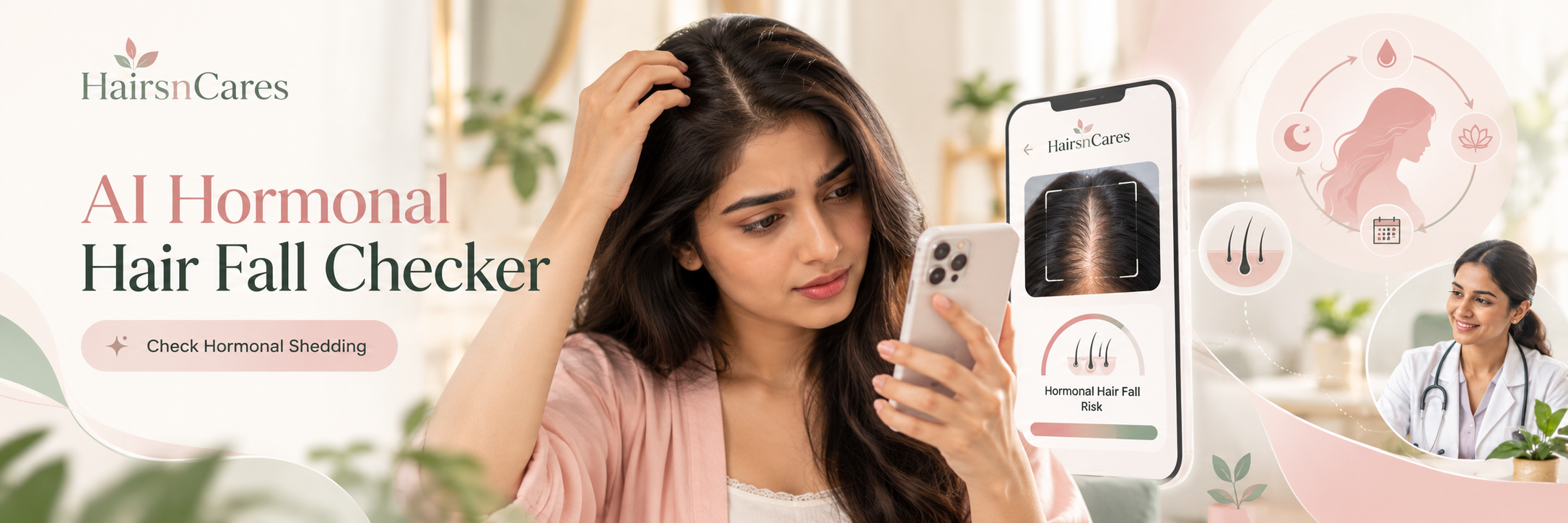
  • AI hormonal hair fall checker
  • Which hormones affect hair
  • PCOS, thyroid & menopause
  • Pregnancy & pill changes
  • Tests to ask your doctor for
  • Hormones are doctor-guided
Hero image
📷
Hero visualalt: "Woman using the AI hormonal hair fall checker — Hairsncares" · 520×150 WebP
Your Hormonal Hair CheckAI Checker — sample preview
Shedding typePattern or diffuse
Possible causesPCOS, thyroid, menopause
Key testsHormones, thyroid, ferritin
TreatmentDoctor-guided only
OutlookDepends on cause; varies

Illustrative sample only. AI screening helps guide decisions and does not replace a doctor's diagnosis, hormone evaluation or gynaecologist review.

AndrogensPattern
ThyroidDiffuse
PCOSAssess
MenopauseMidlife
AI hormone-clue checkin 90 seconds
🩺
Doctor-reviewedwomen's hair guidance
Cause-mappingPCOS to menopause
👩‍⚕️
Doctor-guidedhormones never DIY
🚚
India-widedelivery
Quick Answer

What is hormonal hair loss, and can it be fixed?

Hormonal hair loss is an umbrella term for shedding and thinning linked to hormonal changes or imbalances. It includes female pattern hair loss (androgen-sensitive follicles) and shedding tied to PCOS, thyroid disorders, menopause, pregnancy and the postpartum period, and starting or stopping hormonal contraception. Depending on the cause it can look like pattern thinning over the crown or diffuse shedding across the scalp — and some women have a mix. Can it be fixed? It depends on the cause: shedding from a temporary or treatable shift (thyroid, post-pregnancy, post-pill) often settles or improves once treated, while pattern-type loss is manageable, not curable. The reliable path is to find which hormone is involved — usually with hormone and thyroid tests — and treat the cause under medical guidance. Hormones, anti-androgens and contraceptives are always doctor decisions. Results vary.

Doctor-Reviewed Women's Hair Loss GuideHormonal Hair Loss

Hormonal hair loss can involve PCOS, thyroid, menopause, pregnancy, post-pill shedding or androgen-related thinning. Medical evaluation is important.

AI Summary

Hormonal Hair Loss in Simple Terms

Hormonal Hair Lossis part of the women's hair-loss spectrum. It may overlap with shedding, thinning, hormonal changes, nutritional gaps, scalp symptoms, female pattern loss or life-stage triggers.

The correct next step depends on pattern, duration, age, periods, pregnancy or breastfeeding status, weight changes, stress, scalp symptoms, medical history, current medicines and previous product use.

Bottom line: use this page for education and screening direction — it does not diagnose or prescribe. Take the AI Hair Test for structured screening and consult a dermatologist when symptoms are progressive, severe, patchy, painful or medically complex. Results vary.
The Basics

What Is Hormonal Hair Loss?

Section image
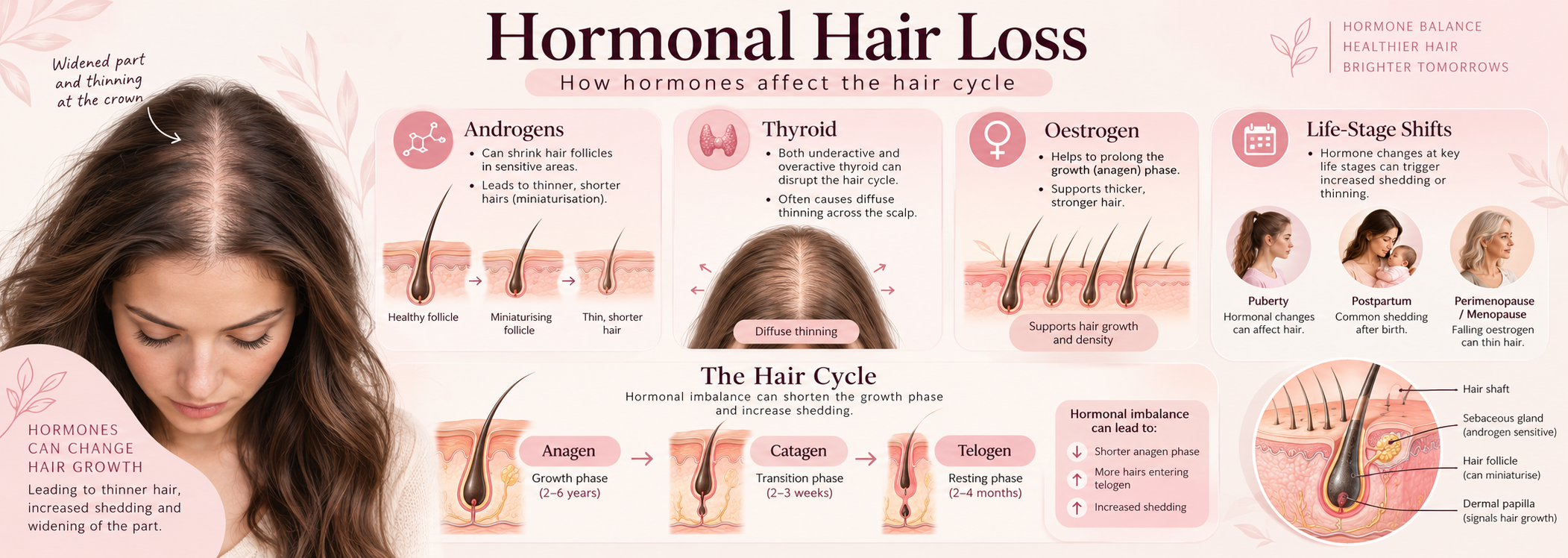
Hormonal hair loss — explainer diagramalt: "Androgens, thyroid, oestrogen and life-stage shifts affecting the hair cycle" · 900×320 WebP

Hormonal hair loss is an umbrella term for shedding and thinning in women linked to hormonal changes or imbalances. It includes female pattern hair loss (where follicles are sensitive to androgens) and shedding associated with PCOS, thyroid disorders, menopause, pregnancy and the postpartum period, and starting or stopping hormonal contraception.

Because several different hormones can be involved, it doesn't look the same in everyone. Androgen-related loss tends to show as pattern thinning over the crown with a widening parting, while shifts like post-pregnancy, menopause or post-pill more often cause diffuse shedding. Some women have a mix.

The honest message depends on the cause: shedding from a temporary or treatable hormonal shift often settles or improvesonce it's addressed, while pattern-type loss is manageable rather than curable. Either way, the reliable first step is finding out which hormone is involved — usually with hormone and thyroid tests. Hormones, anti-androgens and contraceptives are always doctor decisions, often with gynaecology or endocrinology input.

Wondering if hormones are behind it? Map the clues in 90 seconds.

Check My Hormones
What to Notice

Signs & Symptoms

Hormonal hair loss often comes with other clues. These help point to a hormonal cause worth assessing.

1

Thinning over the crown / widening parting

2

Or diffuse shedding across the scalp

3

Irregular or absent periods

4

Acne or oily skin

5

Excess facial or body hair

6

Shedding after pregnancy or stopping the pill

7

Menopausal changes (hot flushes, midlife)

8

Thyroid signs (fatigue, weight, temperature)

9

No bald patches or scarring (reassuring)

Recognise these clues? Screen them and see which hormones to check.

Screen My Symptoms
The Mechanism

Which Hormones Affect Hair

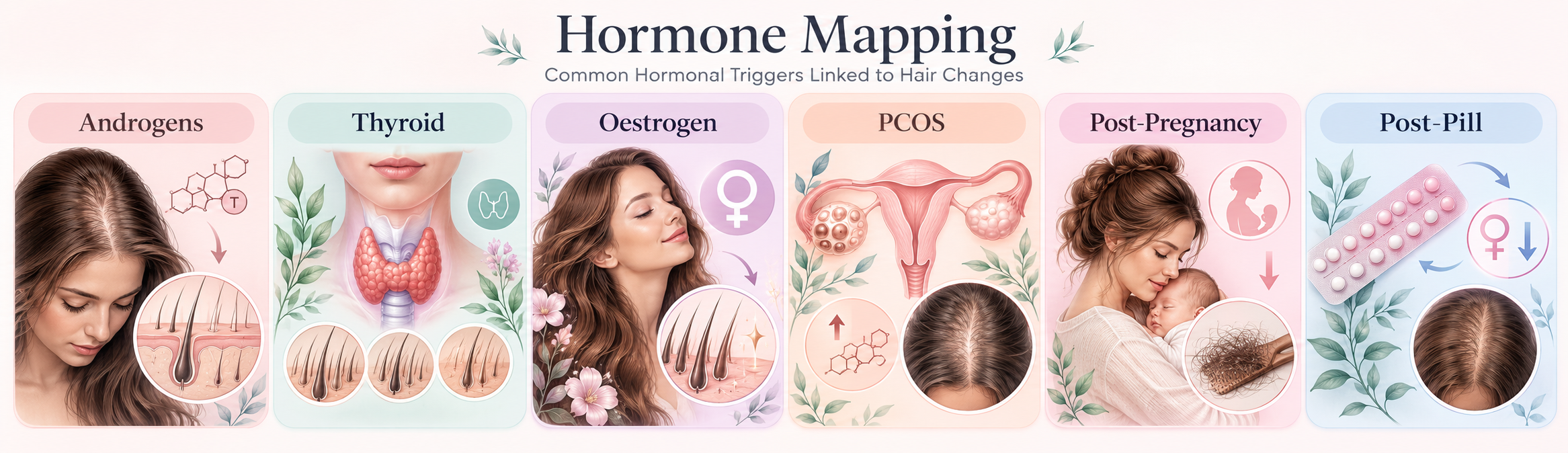
This map shows the main hormonal causes of hair loss in women and what each points to. Mapping them guides the right tests.
Section image
📋
Hormone mapping — illustrated gridalt: "Androgens, thyroid, oestrogen, PCOS, post-pregnancy, post-pill" · 900×260 WebP

Androgens

Susceptible follicles miniaturise, causing pattern thinning.

Type: pattern

🥽 PCOS

Higher androgen activity; often with irregular periods, acne.

Action: assess & manage

🩸 Thyroid

Under- or over-active thyroid disturbs the hair cycle.

Type: diffuse

🌿 Menopause

Falling oestrogen brings out pattern thinning.

Stage: midlife

🫂Pregnancy & postpartum

Hormone shifts trigger temporary diffuse shedding.

Often: reversible

💊 Stopping the pill

Hormonal change can trigger a shedding phase.

Often: temporary

Want your hormonal clues mapped? The checker highlights what to test.

Map My Hormones
Compare

Pattern vs Diffuse Hormonal Loss

Hormonal hair loss shows up in two main ways. Telling them apart helps point to the cause and what helps.

FeaturePattern-type (androgen)Diffuse-type (shift)
WhereCrown / top, widening partingEvenly across the whole scalp
Typical causesFemale pattern loss, PCOSThyroid, post-pregnancy, post-pill
OnsetGradual, progressiveAfter a trigger or shift
HairlineUsually preservedUsually preserved
OutlookManageable, not usually curedOften improves once treated
Best stepDermatologist + hormone reviewTests + treat the cause

Many women have both— for example pattern thinning with a layer of post-pregnancy or thyroid shedding on top. That's why a proper assessment with hormone, thyroid and iron tests is so useful: it clarifies which factor dominates and what will help most.

Not sure which fits you? Screen your hair loss for a clearer picture.

Screen Now
The Picture Over Time

What Recovery Looks Like

The arc depends on the cause. Knowing the type sets realistic expectations.

1
Assess
Find the cause

Examination and hormone, thyroid and iron tests identify which hormonal factor (or combination) is driving the loss.

2
Treat the cause
Doctor-guided

For treatable causes such as thyroid problems, treatment under medical guidance settles the hormonal driver, which the hair follows.

3
Diffuse types
Often recover

Shedding from temporary shifts (post-pregnancy, post-pill) or a corrected thyroid usually improves over several months as things settle.

Pattern types
Managed steadily

Androgen-related pattern loss is managed rather than cured: doctor-guided care and supportive haircare help protect density. Results vary; regrowth isn't guaranteed.

Want to track changes objectively? Set a photo baseline today.

Start Tracking
Be Thorough

Causes to Map & Rule Out

Hormonal hair loss has several possible drivers, and non-hormonal causes can coexist. A doctor maps these with you.

🥽

PCOS

Why
Higher androgen activity drives pattern thinning.
Clue
Irregular periods, acne, excess hair.
🩸

Thyroid disorders

Why
Under- or over-active thyroid causes shedding.
Clue
Fatigue, weight or temperature changes.
🌿

Menopause

Why
Falling oestrogen brings out pattern thinning.
Clue
Midlife, hot flushes.
🫂

Postpartum shedding

Why
Hormone drop after birth triggers diffuse shedding.
Clue
Shedding a few months post-birth.
💊

Stopping the pill

Why
Hormonal change can trigger a shedding phase.
Clue
Shedding 2–4 months after stopping.
🥩

Iron deficiency

Why
A common non-hormonal cause that coexists.
Clue
Fatigue, pale skin, heavy periods.

Want these mapped properly? A doctor can check hormones, thyroid and iron.

See a DoctorScreen First
Self-Assessment

Screen Your Hormonal Hair Loss

Section image
📱
Hormonal Hair Fall Checker — app screen previewalt: "Hormonal hair loss self-assessment on a smartphone" · 900×150 WebP
  1. 1 Is your thinning over the crown or diffuse?
  2. 2 Are your periods irregular or absent?
  3. 3 Do you have acne or oily skin?
  4. 4 Any excess facial or body hair?
  5. 5 Did shedding follow pregnancy or stopping the pill?
  6. 6 Are you peri- or post-menopausal?
  7. 7 Any thyroid signs (fatigue, weight, cold)?
  8. 8 Is there a family history of thinning?
  9. 9 Any known low iron or heavy periods?
  10. 10 Any bald patches or scalp symptoms?
Your AI check gives you
  • Likely hormonal cause map
  • Pattern vs diffuse read
  • Hormone & thyroid tests to discuss
  • What to raise with a gynae if needed
  • Red-flag / urgency flags
  • Doctor referral pointers
  • Progress tracker baseline
Start Checker
Medical Safety

When to See a Doctor

Hormonal hair loss often has a treatable cause, but it needs proper assessment. Hormones, anti-androgens and contraceptives are always doctor decisions — never self-start them.

Section image
Red-flag symptoms — when to see a doctoralt: "Irregular periods, acne, excess hair, rapid shedding" · 900×240 WebP
  • Irregular or absent periods
  • Acne, excess facial or body hair, or voice change
  • Rapid or heavy shedding
  • Any bald patches or scalp scarring
  • Thyroid signs (fatigue, weight, temperature changes)
  • Signs of low iron (fatigue, pale, breathlessness)
  • Before starting any hormone, anti-androgen or pill
  • Pregnancy, breastfeeding or trying to conceive
  • Suspected PCOS or another hormonal condition
  • Hair loss that is causing distress
Consult a Doctor
Shop by Need

Best Product Categories for Supportive Care

Supportive care for the hair and scalp while the hormonal cause is assessed and treated. These do not treat the hormonal cause or replace medical assessment. Prescription items are doctor-guided.
Section image
🛍
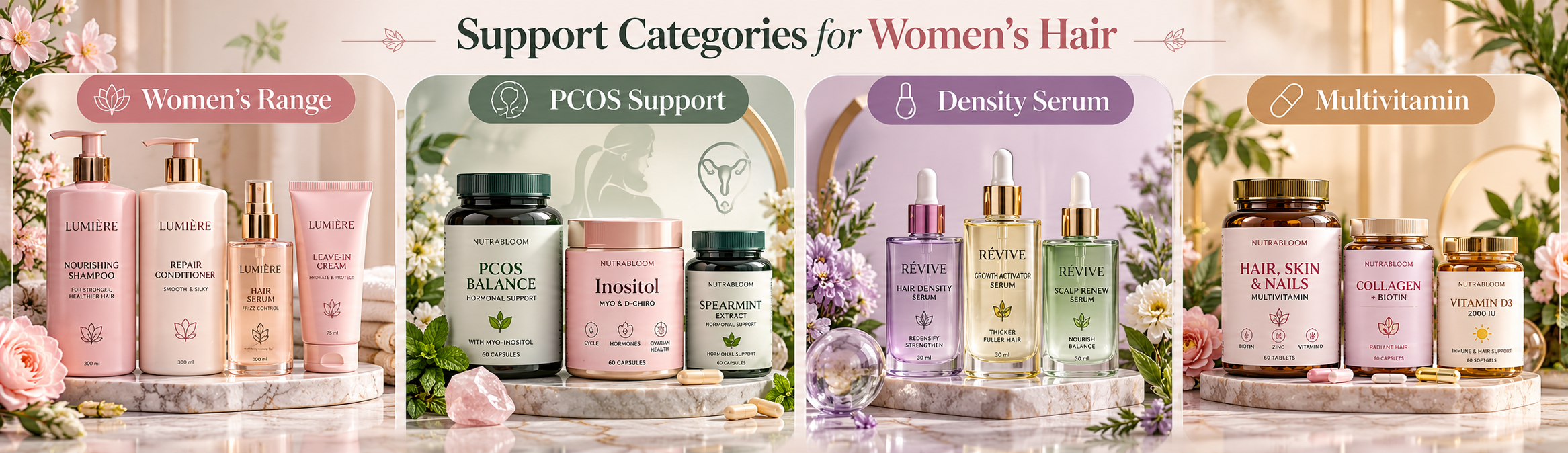
Support categories — shelf overviewalt: "Women's range, PCOS support, density serum, multivitamin" · 900×260 WebP
👩

Women's hair fall range

Gentle supportive care for thinning and shedding.

Best for: women's hair loss
Shop
🥽

PCOS hair support

Supportive care where androgen-related thinning is involved.

Best for: PCOS-related
Shop
💧

Density support serums

Supportive leave-on serums for thinning.

Best for: crown thinning
Shop
🩸

Hair multivitamins

Broad nutrition support for hair health.

Best for: general support
Shop
🥩

Iron & vitamin support

Where deficiency is confirmed, under medical advice.

Best for: tested deficiency
Shop
🌿

Scalp care

Maintain a healthy scalp environment.

Best for: scalp health
Shop

Not sure which fits you? The Product Finder matches support to your result.

Open Product FinderBrowse Women's
Featured

Supportive Products for Hormonal Hair Loss

Sample selection. Prices, ratings and availability shown are placeholders.

Products coming soon

We're curating the right supportive products for this concern. In the meantime, browse the full Hairsncares shop or take the AI Hair Test for a tailored match.

Browse all products

These products offer gentle, supportive care for the hair and scalp during hormone-related shedding and thinning, used alongside doctor-guided care. They support hair and scalp health; they do not treat the hormonal cause, do not balance hormones, and do not replace medical assessment, hormone evaluation, blood tests or diagnosis. No product or supplement is guaranteed to regrow hair. Hormones, anti-androgens, oral contraceptives and prescription medicines are doctor decisions and must not be self-started; some are avoided in pregnancy or breastfeeding. Iron and vitamin products should be used only when deficiency is suspected or confirmed and under medical guidance. Pregnancy, breastfeeding, trying to conceive and chronic medical conditions need doctor review. Prescription (Rx) items require a valid prescription. Prices, ratings and availability are placeholders to be populated dynamically. Results vary.

Before adding to cart, map which hormonal cause is likely.

Check FirstShop Women's
Ecommerce Pathways

Recommended Hairsncares Product Pathways

Where to go next for supportive care — matched to women's hair-loss needs. These categories support hair and scalp health; they do not treat the hormonal cause or replace medical assessment and hormone evaluation.

For Women

Choose Your Support Pathway

Hormonal hair loss is best managed by finding and treating the cause under medical guidance, but supportive haircare helps the hair you have. Pick the pathway that fits your situation — and remember iron and vitamin products should be used only when deficiency is suspected or confirmed, under medical guidance.

👩

Women's Hair Fall Support

/products/women-hair-fall/

The main gateway for female shedding, thinning, a widening parting, chronic hair fall and hair strength support — the core pathway for supportive care across hormonal hair loss types.

Explore ›
🥽

PCOS Hair Loss Support

/products/pcos-hair-loss/

The key related pathway for hormonal, androgen-related hair loss — for women with irregular periods, acne, facial hair, androgen sensitivity or PCOS-like symptoms, alongside doctor-guided management.

Explore ›
🫂

Postpartum Hair Support

/products/postpartum-hair-support/

A related life-stage pathway for postpartum shedding and women's diffuse hair fall comparison — relevant for the pregnancy and post-pregnancy hormonal shift. Choose pregnancy- and breastfeeding-safe options under medical advice.

Explore ›
🥩

Iron & Vitamin Hair Support

/products/iron-vitamin-hair-support/

An important pathway when a deficiency adds to hormonal shedding — low iron, low ferritin, low vitamin D, low B12 or fatigue-related shedding. Use only after doctor evaluation confirms a need.

Explore ›

Medical safety: These products support hair and scalp health. They do not treat the hormonal cause, balance hormones, or replace medical assessment, hormone evaluation, blood tests or diagnosis, and hormones, anti-androgens and contraceptives are doctor decisions. Iron and vitamin products should be used only when deficiency is suspected or confirmed and under appropriate medical guidance. Pregnancy, lactation, trying to conceive, thyroid disease and chronic medical conditions need doctor review. Results vary.

Build a Habit

Supportive Hair Routine

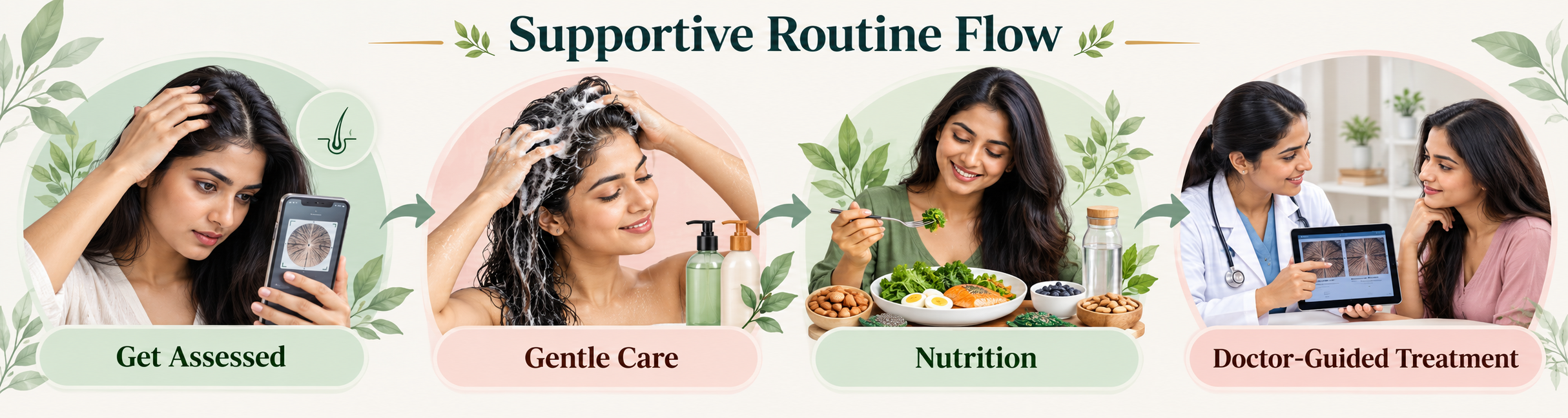
A gentle routine that supports your hair while the hormonal cause is assessed and treated. Use active or prescription items only under medical guidance, and avoid them in pregnancy or breastfeeding unless a doctor advises.
Section image
📝
Supportive routine flow — illustrated stepsalt: "Get assessed, gentle care, nutrition, doctor-guided treatment" · 900×240 WebP
Screen

Use the AI checker to map likely hormonal causes.

Tests

Ask your doctor about hormones, thyroid and ferritin.

Examine

A dermatologist confirms the type of hair loss.

Refer

Gynae or endocrine input if PCOS or hormones suspected.

Wash

Gentle or volumising shampoo; don't over-wash.

Condition

Lightweight conditioner on lengths, not roots.

Serum

Supportive serum as directed.

Style

Gentle handling; avoid tight styles and excess heat.

Protein

Adequate protein supports the hair cycle.

Iron

Correct confirmed low iron under medical advice.

Balance

A varied diet supports overall hormone and hair health.

Test first

Supplement deficiencies you've actually confirmed.

Diagnose

Let your doctor identify the hormonal driver.

Treat

Treat PCOS, thyroid or other cause under guidance.

Rx?

Any hormone, anti-androgen or pill decision is your doctor's.

Track

Photograph density monthly to monitor progress.

Want a routine built around your result? Generate a personalised plan in minutes.

Build My Routine
Know Your Actives

Ingredient & Treatment Guide

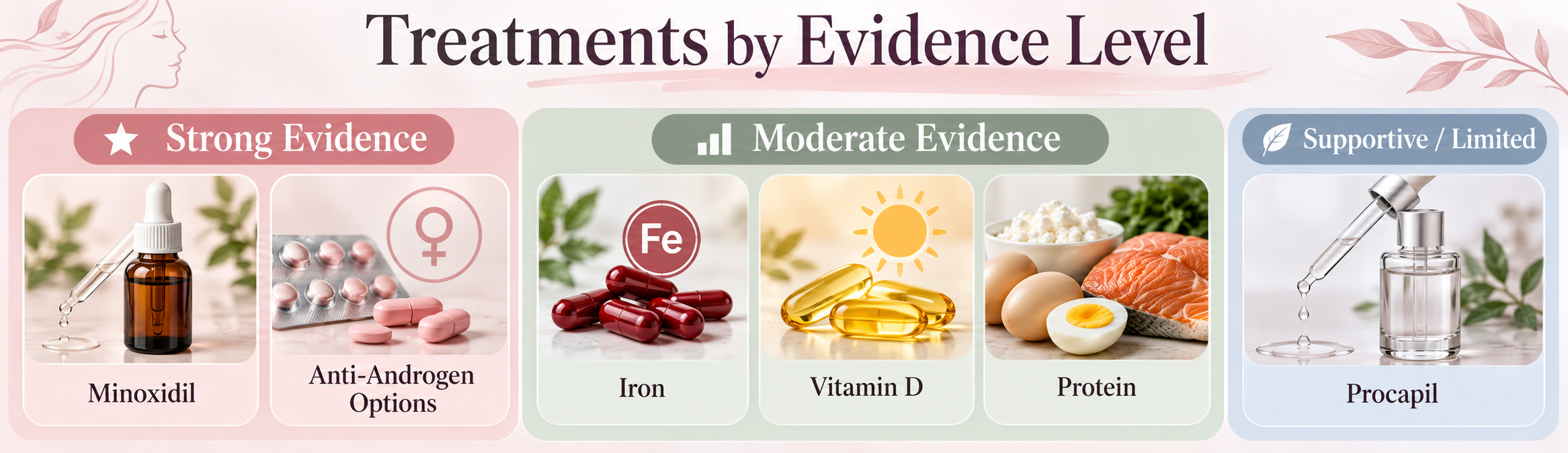
Evidence labels are a simple guide: strong, moderate, supportive or mainly cosmetic. Rx marks prescription items; the rose tag flags pregnancy/lactation caution. None of these balance hormones.
Section image
🧪
Treatments by evidence level — visual guidealt: "Minoxidil, anti-androgen options, iron, vitamin D, protein, procapil with evidence levels" · 900×260 WebP
🫂

Hormone, pregnancy & breastfeeding note: Hormones, anti-androgens, oral contraceptives, Minoxidil and other prescription options are doctor decisions and several are avoided in pregnancy or breastfeeding. Never start, stop or change a hormonal treatment for hair without your doctor, and discuss any plans for pregnancy first.

Treating the cause Rx

Strong (cause-specific)

Correcting thyroid, PCOS or other hormonal drivers under medical care is the most important step.

Best for: identified hormonal cause.

Caution: diagnosis and treatment are doctor-led.

Discuss with a doctor

Minoxidil Rx Preg caution

Strong (pattern)

An option a dermatologist may discuss for pattern-type hormonal loss; supports density.

Best for: confirmed pattern loss.

Caution: prescription/doctor-guided; not in pregnancy/breastfeeding.

Related products

Anti-androgen options Rx

Moderate (selected)

Considered by doctors in selected women with androgen-related loss.

Best for: doctor-selected cases.

Caution: prescription only; pregnancy caution; supervision needed.

Discuss with a doctor

Iron

Strong (if low)

Correcting confirmed low iron helps an overlapping cause.

Best for: confirmed low ferritin.

Caution: take only after testing; excess is harmful.

Related products

Vitamin D

Strong (if low)

Deficiency is linked to increased shedding.

Best for: confirmed deficiency.

Caution: correct after testing; avoid excess.

Related products

Protein / amino acids

Moderate

Hair is largely protein; adequate intake supports growth.

Best for: low intake.

Caution: aim for a balanced diet first.

Related products

Vitamin B12

Moderate (if low)

Low B12 can contribute to shedding.

Best for: confirmed low B12.

Caution: test before supplementing.

Related products

Zinc

Supportive

A mineral involved in hair tissue health.

Best for: confirmed low zinc.

Caution: excess can be harmful; test first.

Related products

Biotin

Supportive

A B-vitamin involved in hair structure.

Best for: confirmed deficiency.

Caution: limited benefit without deficiency; can affect lab tests.

Related products

Procapil

Moderate

A cosmetic complex studied for follicle support.

Best for: supportive density.

Caution: supportive, not a cure.

Related products

Redensyl

Moderate

A cosmetic active marketed for density.

Best for: supportive density.

Caution: evidence is limited.

Related products

Rosemary oil

Supportive

A botanical with some small-study interest.

Best for: supportive cosmetic use.

Caution: patch test; dilute; can irritate.

Related products

Considering hormonal options? Get assessed and discuss what suits you.

Ask a DoctorAll Ingredients
🩺
Doctor's Note

Find the Hormone, Then Treat It

"When a woman tells me she thinks her hair loss is hormonal, she's often right — but 'hormonal' covers a lot of ground. My job is to narrow it down: is this androgen-driven pattern thinning, a thyroid problem, the shift after a pregnancy or stopping the pill, or PCOS? The history and a few blood tests usually tell the story, and I'll bring in a gynaecologist or endocrinologist when it's needed. What I won't do is hand out hormones or anti-androgens on a hunch — those are careful, individual decisions, especially around pregnancy. Find the hormone, treat the cause, support the hair."

Reviewed by Dr. Amit Agarkar, MD DermatologyDermatologist & Hair Specialist · Last reviewed 1 June 2026

Think it's hormonal? Book an assessment and the right tests.

Consult Dr. Amit's Team
Bundles

Supportive Hair Kits

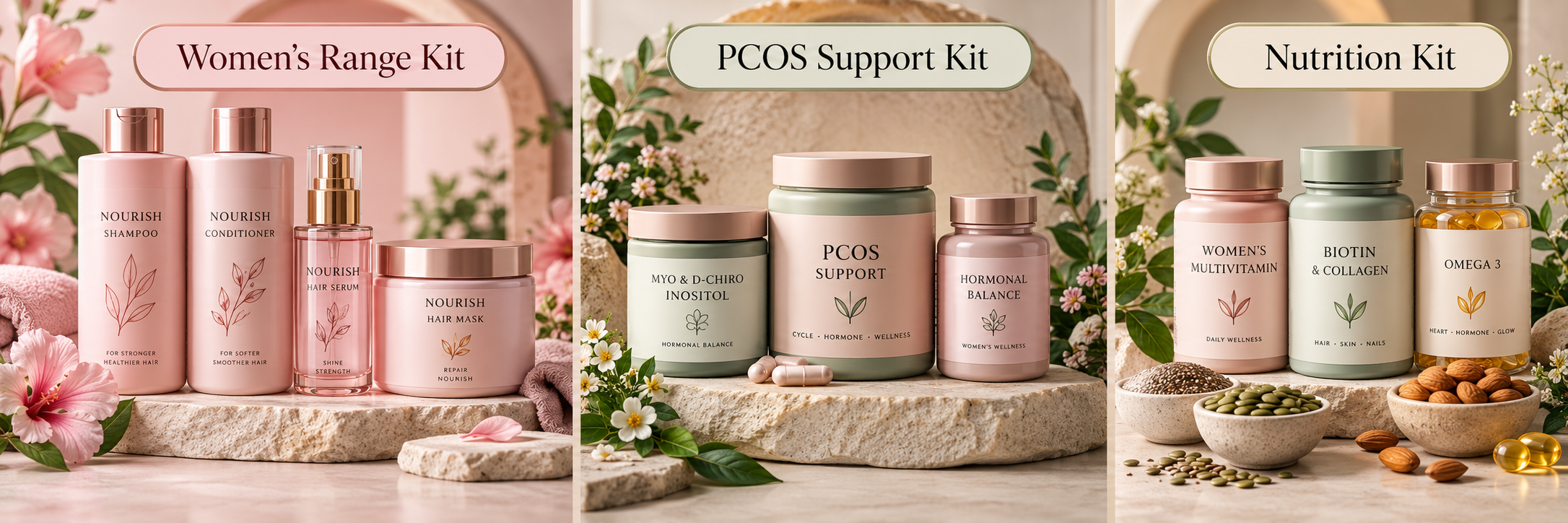
Curated supportive combinations to use alongside doctor-guided care. Timelines are general estimates; results vary and are not guaranteed.
Section image
🎁
Kits & bundles — product flat-layalt: "Supportive kits: women's range, PCOS support, nutrition" · 900×260 WebP

Kits coming soon

Curated kits for this concern aren't ready just yet. Browse the full Hairsncares shop to build the routine that fits your needs.

Browse all products

Prefer a kit tailored to you? Build a custom plan from your screening result.

Build a Custom KitTake the Checker
Stay Consistent

Track Hair & Hormonal Markers

Tracking your shedding and density alongside hormonal markers and treatment shows whether addressing the cause is working — and keeps expectations realistic.
Section image
📈
Tracking — hair alongside hormonal markersalt: "Tracking shedding, density and hormonal markers over months" · 900×200 WebP
Shedding amountDaily/weekly
Crown densityTop-down photos
Parting widthIf pattern-type
Cycle regularityIf relevant
Thyroid statusIf tested
Hormone reviewWith doctor
Iron statusIf tested
Treatment adherenceAs advised
Doctor review triggerIf not improving
Start Progress Tracker
Evidence & Safety

Medical References Behind This Guidance

These references are provided for patient education and do not replace a dermatologist’s diagnosis or individual medical advice.

AAD

Hair Loss: Causes & Treatment

Dermatologist-led overview of how hair loss is evaluated and the evidence behind common treatments.

View AAD reference ›
NIH / MedlinePlus

Hair Loss Overview

Patient-education summary of common causes of hair loss and when to seek medical care.

View MedlinePlus reference ›
PubMed

Peer-Reviewed Literature

Searchable index of peer-reviewed research on hormone-related hair loss.

Search PubMed ›
Cochrane Library

Systematic Reviews

Independent systematic reviews assessing the evidence behind hair-loss interventions.

View Cochrane Library ›
Red Flags

When Should Women See a Dermatologist?

Monitor

Mild, Recent Shedding

Short-term shedding without pain, patches or rapid thinning can be tracked with photos and routine consistency.

Screen

Take the AI Hair Test

Use the AI Hair Test to organise symptoms, triggers, pattern and next-step direction. It does not diagnose or prescribe.

Doctor Review

Medical Cause Possible

PCOS, thyroid symptoms, heavy periods, postpartum shedding, menopause thinning, deficiency signs or medication-related shedding need medical context.

Urgent

Do Not Delay

Patchy loss, pain, pus, crusting, bleeding, a scarring-looking scalp, sudden severe shedding, or teenage hair loss with illness needs prompt evaluation.

Test-Guided Care

Do Not Guess Deficiencies or Hormones

Iron / Ferritin

Iron should be taken only if testing confirms deficiency. Excess iron can be harmful.

Vitamin D

Vitamin D should be corrected based on a 25-OH-D test. High-dose vitamin D can be unsafe without medical guidance.

Thyroid

Thyroid hair loss improves through thyroid management, not hair supplements alone.

PCOS / Hormones

Hormonal treatment, anti-androgens or contraceptive decisions must be doctor-led.

Pregnancy & Breastfeeding Safety

Extra Caution for Pregnancy, Breastfeeding or Trying to Conceive

If you are pregnant, breastfeeding or trying to conceive, do not self-start Minoxidil, hormonal medicines, anti-androgens, Finasteride, Dutasteride or high-dose supplements. Product and medicine safety must be reviewed by a qualified doctor.

Postpartum shedding is often temporary, but severe, persistent, patchy or painful hair loss should be checked.
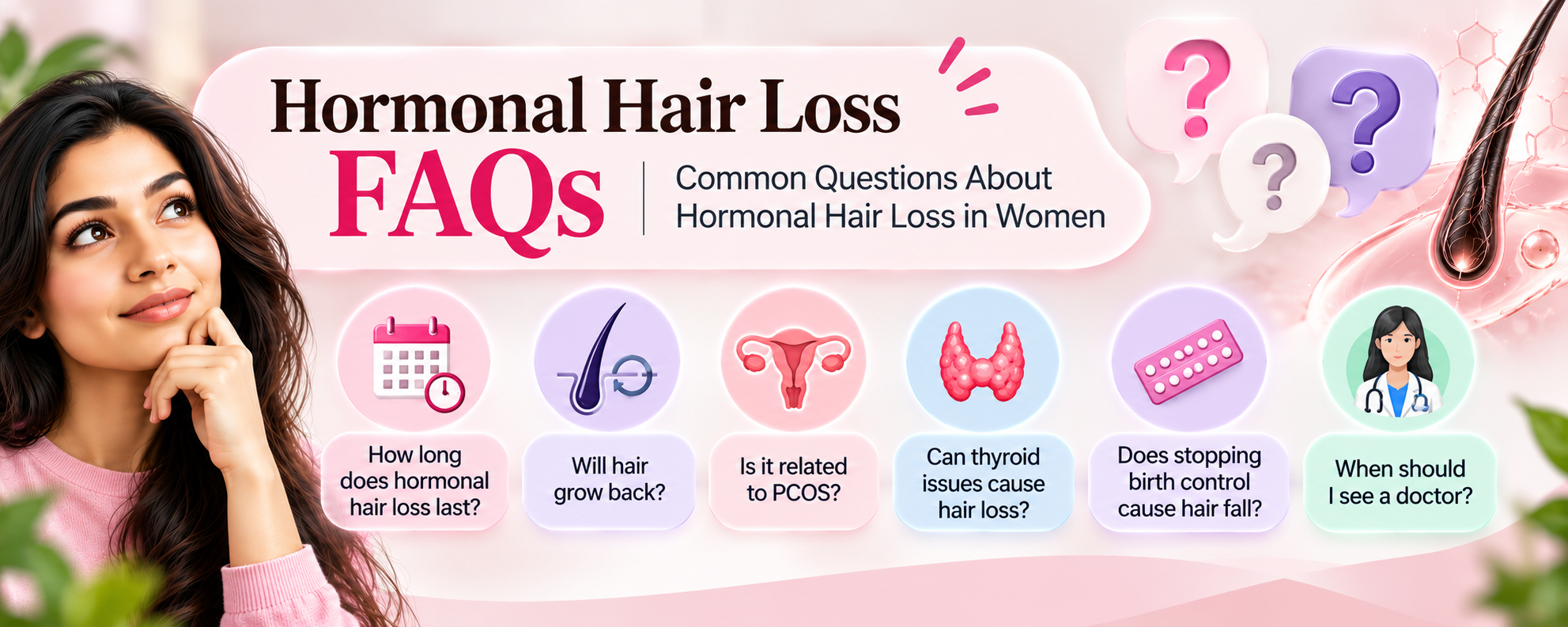
Questions

Frequently Asked Questions

Section image
Hormonal hair loss FAQs — banneralt: "Frequently asked questions about hormonal hair loss in women" · 900×160 WebP
What is hormonal hair loss in women?
Hormonal hair loss is an umbrella term for shedding and thinning in women linked to hormonal changes or imbalances. It includes female pattern hair loss, where follicles are sensitive to androgens, and shedding associated with PCOS, thyroid disorders, menopause, pregnancy and the postpartum period, and starting or stopping hormonal contraception. Depending on the cause it can look like pattern thinning over the crown or diffuse shedding across the scalp. Some types are reversible once the hormonal issue is treated, while pattern-type loss is manageable rather than curable. Assessment with hormone and thyroid tests guides treatment, and results vary.
What hormones affect hair loss?
Several hormones influence hair. Androgens, present in both sexes, can cause susceptible follicles to miniaturise, leading to pattern thinning. Thyroid hormones affect the hair cycle, so both underactive and overactive thyroid can cause shedding. Oestrogen, which helps keep hair growing, falls at menopause and after pregnancy, which can trigger shedding. Conditions such as PCOS raise androgen activity. Because more than one hormone can be involved, doctors often check thyroid function and relevant hormones, along with iron, to work out what is contributing.
What does hormonal hair loss look like?
It varies with the cause. Androgen-related hormonal loss, including female pattern hair loss and PCOS-related thinning, tends to show as gradual thinning over the crown with a widening parting while the hairline is kept. Hormonal shifts such as after pregnancy, at menopause or after stopping the pill more often cause diffuse shedding across the whole scalp. Some women have a mix. Because the appearance overlaps with non-hormonal causes like iron deficiency, examination and tests help confirm what is driving it.
Can PCOS cause hair loss?
Yes. PCOS, polycystic ovary syndrome, is associated with higher androgen activity, which can cause hair thinning in a female pattern over the crown, often alongside other features such as irregular periods, acne, or excess facial or body hair. Managing PCOS under medical guidance, which may include lifestyle measures and treatments your doctor advises, is central, and a dermatologist can address the hair side. Because PCOS needs proper diagnosis and management, anyone with these features should be assessed by a doctor rather than self-treating.
Can thyroid problems cause hormonal hair loss?
Yes. Both an underactive thyroid and an overactive thyroid can disturb the hair cycle and cause diffuse shedding across the scalp, and thyroid disorders are common in women. Thyroid-related shedding often improves once the thyroid is properly treated and levels are stable, though it can take some months. Because the symptoms overlap with other causes, a simple thyroid function blood test is a key part of assessing hormonal hair loss, and treatment of any thyroid problem is guided by a doctor.
Is hormonal hair loss reversible?
It depends on the cause. Shedding from a temporary or treatable hormonal shift, such as after pregnancy, after stopping the pill, or from a thyroid problem, is often reversible once things settle or the cause is treated, although recovery takes months. Pattern-type hormonal loss driven by androgen-sensitive follicles is progressive and manageable rather than fully curable. This is why assessment matters, since it identifies which type you have and therefore whether the realistic goal is recovery or careful, doctor-guided management. Results vary.
How is hormonal hair loss diagnosed?
A doctor or dermatologist takes a history, including your periods, any acne or excess hair, life stage and contraception, and examines the scalp, sometimes with dermatoscopy. Blood tests often include thyroid function, relevant hormones and ferritin, because iron deficiency commonly coexists. If PCOS or another hormonal condition is suspected, further assessment or a gynaecology or endocrinology referral may be advised. This process distinguishes hormonal causes from other types of hair loss and guides safe, appropriate treatment rather than guesswork.
Can supplements treat hormonal hair loss?
Supplements do not treat the underlying hormonal cause of hormonal hair loss and are not a cure. They help mainly where there is a genuine deficiency, such as low iron or vitamin D, which is best confirmed by testing, and a hair multivitamin may offer general supportive nutrition. The most effective approach is to identify and treat the hormonal cause under medical guidance, correct any deficiency, and use supportive haircare, rather than relying on supplements to fix a hormonal problem they cannot address.
Do birth control pills cause or stop hair loss?
Hormonal contraception can affect hair in different ways depending on the person and the type. Some women notice shedding when starting or, more commonly, after stopping the pill, as hormone levels shift, while certain pills are sometimes used by doctors to help androgen-related hair loss. Because the effect varies and contraception is a medical decision, you should never start, stop or change a pill for hair reasons without your doctor. A doctor can advise what is appropriate for both your contraception and your hair.
Does menopause cause hormonal hair loss?
Yes. At menopause, oestrogen falls and its balance with androgens shifts, which commonly brings out or accelerates female pattern thinning, with a widening parting and reduced crown volume. Some women also notice more diffuse shedding. Menopausal hair thinning is manageable with supportive care and doctor-guided options, but it is generally gradual and not simply reversed. Hormone therapy is a whole-body medical decision for your own doctor and is never recommended for hair reasons alone. Thyroid and iron should also be checked.
Can I take hormones or anti-androgens for hair loss?
Only under medical supervision. Hormones, anti-androgens and hormonal contraceptives are prescription treatments that doctors sometimes use for androgen-related hair loss in selected women, but they have risks and are not suitable for everyone, particularly around pregnancy. Hairsncares does not recommend these medicines without doctor supervision. The right approach is assessment by a doctor or dermatologist, who can weigh the benefits and risks for your situation, arrange any monitoring, and coordinate with a gynaecologist or endocrinologist if needed.
What helps hormonal hair loss day to day?
Day to day, gentle, supportive haircare helps the hair you have: a mild or volumising shampoo, a supportive serum, careful handling and avoiding harsh chemicals and excessive heat. Balanced nutrition with adequate protein supports the hair cycle, and any confirmed iron or vitamin D deficiency should be corrected under medical advice. Managing stress and general health helps too. These measures support hair health and appearance while the hormonal cause is assessed and treated; they do not fix the hormones themselves, and results vary.
Can thyroid or iron problems make it worse?
Yes. Thyroid problems are themselves a hormonal cause of shedding, and iron deficiency is a very common non-hormonal cause that frequently coexists, so both can add to hormonal hair loss and make it look worse. This is why assessment usually includes thyroid function tests and ferritin alongside any hormone tests. Correcting a thyroid or iron problem can improve the overall picture even when another hormonal factor is also present, so addressing each contributing cause matters for the best result.
Should I take an AI check before buying products?
It helps. An AI checker can map whether your shedding fits a hormonal pattern and which hormonal causes, such as PCOS, thyroid, menopause or pill-related changes, are worth considering, and suggest the tests to discuss with your doctor, so you act sensibly rather than buying products blindly. It supports screening and education only and does not replace a doctor's diagnosis, hormone evaluation or gynaecologist review. Identifying and treating the cause is far more useful than guessing.
When should I see a doctor for hormonal hair loss?
See a doctor if your hair loss comes with signs of a hormonal issue such as irregular periods, acne, excess facial or body hair, or symptoms of a thyroid problem, or around life stages like menopause, pregnancy or stopping the pill. Also seek assessment if shedding is heavy or persistent, if there are bald patches or scalp symptoms, or before starting any hormonal treatment. Because hormonal hair loss often has a treatable cause, earlier assessment, sometimes with gynaecology input, helps both your hair and your health.
Is hormonal hair loss the same as female pattern hair loss?
Female pattern hair loss is one type of hormonal hair loss, the androgen-related, genetically influenced thinning over the crown, but hormonal hair loss is a broader umbrella. It also includes shedding from thyroid problems, menopause, pregnancy and the postpartum period, and starting or stopping hormonal contraception, which often cause diffuse shedding rather than a fixed pattern. So all female pattern hair loss is hormonal, but not all hormonal hair loss is female pattern hair loss. A dermatologist can identify which type or combination you have.

Question not answered here? Ask Dr Aria for instant guidance or book a consultation.

Ask Dr AriaConsult a Doctor

Could It Be Your Hormones?

From PCOS and thyroid to menopause, pregnancy and the pill, hormones are behind much of women's hair loss — and the type decides what helps. Use the Hairsncares AI Hormonal Hair Fall Checker to map the likely cause, see which tests to ask for, and support your hair gently. Hormones and prescription options are always doctor decisions, so see a doctor for proper assessment and care.

Medical disclaimer.Hairsncares provides educational and product guidance support. AI screening helps guide decisions but does not replace a doctor's diagnosis, blood tests, hormone evaluation or gynaecologist review. Hormonal hair loss is an umbrella term for shedding and thinning linked to androgens, PCOS, thyroid problems, menopause, pregnancy and the postpartum period, and starting or stopping hormonal contraception; whether it improves depends on the cause — temporary or treatable shifts often settle once treated, while pattern-type loss is manageable rather than cured, and results vary. No product or supplement is guaranteed to regrow hair, and supplements do not treat the hormonal cause. Hormones, anti-androgens, oral contraceptives, Minoxidil and other prescription medicines are doctor decisions, must not be self-started, and several are generally avoided in pregnancy or breastfeeding without medical advice. Thyroid problems and iron deficiency commonly coexist and should be assessed; iron and vitamin products should be used only when deficiency is suspected or confirmed and under medical guidance. Pregnancy, breastfeeding, trying to conceive and chronic medical conditions need doctor review. Prescription (Rx) items require a valid prescription and are doctor-guided. Results vary.
Doctor-Reviewed Hair-Loss Guide

Hormonal Hair Loss: Causes, Treatment Options & When to See a Doctor

A clear, dermatologist-reviewed overview of Hormonal Hair Loss — what it is, the evidence behind treatment options, and the red flags that mean a doctor should look first. No exaggerated regrowth claims.

Driven by hormonal changesCauses include PCOS, thyroid, pregnancy, menopauseTreat the cause, not just the hairDiagnosis and blood tests first

Results vary based on diagnosis, consistency, formulation and scalp condition.

🩺
Hormonal Hair Loss

Premium concern visual slot · 720×520 WebP

Quick Summary

Hormonal Hair Loss at a Glance

What it is

Hair loss linked to hormonal changes or imbalances — androgens, thyroid, pregnancy or menopause

Who it affects

People with hormonal shifts or conditions such as PCOS or thyroid disease

Treatment evidence

Treating the underlying hormonal cause is key, alongside doctor-guided hair treatment

Doctor guidance

Required — identify and treat the hormonal cause

Medical Review & Editorial Transparency

Reviewed for Safety, Evidence & Honest Claims

🩺

Reviewed by: Dr. Amit Agarkar, MD Dermatology

Medical focus: Dermatology, trichology, hair loss, scalp disorders and hair restoration.

Last reviewed: 1 June 2026

Editorial promise: This page explains causes, treatment evidence, limitations and safe next steps without exaggerating hair-growth claims.

Content Transparency

Who, How & Why This Guide Was Created

Who created this guide?

Prepared by the Hairsncares editorial team and medically reviewed by a dermatologist experienced in hair and scalp disorders.

How was it reviewed?

Checked for accuracy of causes, treatment evidence, safety warnings, limitations and suitability for Indian users.

Why was it created?

To help you understand this concern and choose safe next steps, and to know when a dermatologist diagnosis matters most.

Treatment & Evidence

Treatment & Evidence Overview for Hormonal Hair Loss

ParameterAssessmentWhat it means
What it isHair loss linked to hormonal changes or imbalances — androgens, thyroid, pregnancy or menopauseThe nature of this concern in plain terms.
Who it affectsPeople with hormonal shifts or conditions such as PCOS or thyroid diseaseThe people in whom it is most commonly seen.
Best-evidence optionsTreating the underlying hormonal cause is key, alongside doctor-guided hair treatmentWhere the strongest support lies — most are doctor-guided.
When to see a doctorSelf-treating without identifying the hormonal causeSituations needing diagnosis before any treatment.
Expected timelineVaries with the cause; often improves once the hormonal issue is managedResults vary based on diagnosis, consistency, formulation and scalp condition.
Next Steps & Safety

Sensible Next Steps vs See a Doctor First

Sensible next steps

  • Screen the likely cause with the AI Hair Test before buying products
  • Use doctor-guided, evidence-based options with realistic expectations
  • Track monthly photos and review progress with a clinician

See a doctor first if

  • Hair loss is sudden, severe, patchy, painful or with scalp infection.
  • You are pregnant, breastfeeding, a teenager, or using prescription medicines.
  • You have an unclear diagnosis, scarring hair loss, fungal infection or active scalp disease.

Hormonal hair loss needs the underlying cause identified (e.g. PCOS, thyroid); do not self-start hormonal or DHT medicines.

Treatments & Ingredients

Treatments & Ingredients for Hormonal Hair Loss

Product Discovery

Explore Products for Hormonal Hair Loss

Product results should be selected based on diagnosis, scalp type, sensitivity, routine compatibility and dermatologist guidance where needed.

Find Products After AI Hair Test
Visual Guide

Hormonal Hair Loss Visual Guide

🧫
What Hormonal Hair Loss can look like and how it is assessed.
📊
Treatment options and where the evidence is strongest.
🛡️
Red flags that mean a dermatologist should look first.
Quick Answers

Quick Answers About Hormonal Hair Loss

What causes Hormonal Hair Loss?

Hair loss linked to hormonal changes or imbalances — androgens, thyroid, pregnancy or menopause. The exact cause should be confirmed, because look-alike conditions are treated differently.

Can Hormonal Hair Loss be treated?

Treating the underlying hormonal cause is key, alongside doctor-guided hair treatment. Most effective options are doctor-guided, and results depend on diagnosis, consistency and realistic expectations.

How long does treatment take?

Varies with the cause; often improves once the hormonal issue is managed.

Do I need a diagnosis first?

For sudden, patchy, painful or unexplained loss, yes — see a dermatologist before treating. A suitability screen helps you understand likely causes.

When should I see a doctor urgently?

Self-treating without identifying the hormonal cause — these need evaluation before any product or medicine.

💬 Ask Dr Aria
Your Cart (0)

Your cart is empty

Subtotal0
DeliveryFREE
Total0
🔒 Secure📦 Free above ₹499↩ Easy returns
💬 Hi! I'm Dr. Amit — your Hair Intelligence consultant
🌿
1
🌿
Dr. Amit
Virtual Dermatologist · Hairsncares.com
Online
What are you shopping for today?
Select a category to begin
AI-powered scalp diagnosis · Hairsncares.com
📸
Scalp Analyser
Upload scalp photo · Get conditions, root cause, and matched product protocol
📷
Drop scalp photo here or click to upload
JPG, PNG, WEBP · Clear, close-up, well-lit photo

Your image is processed privately by our AI engine and saved securely with your account.