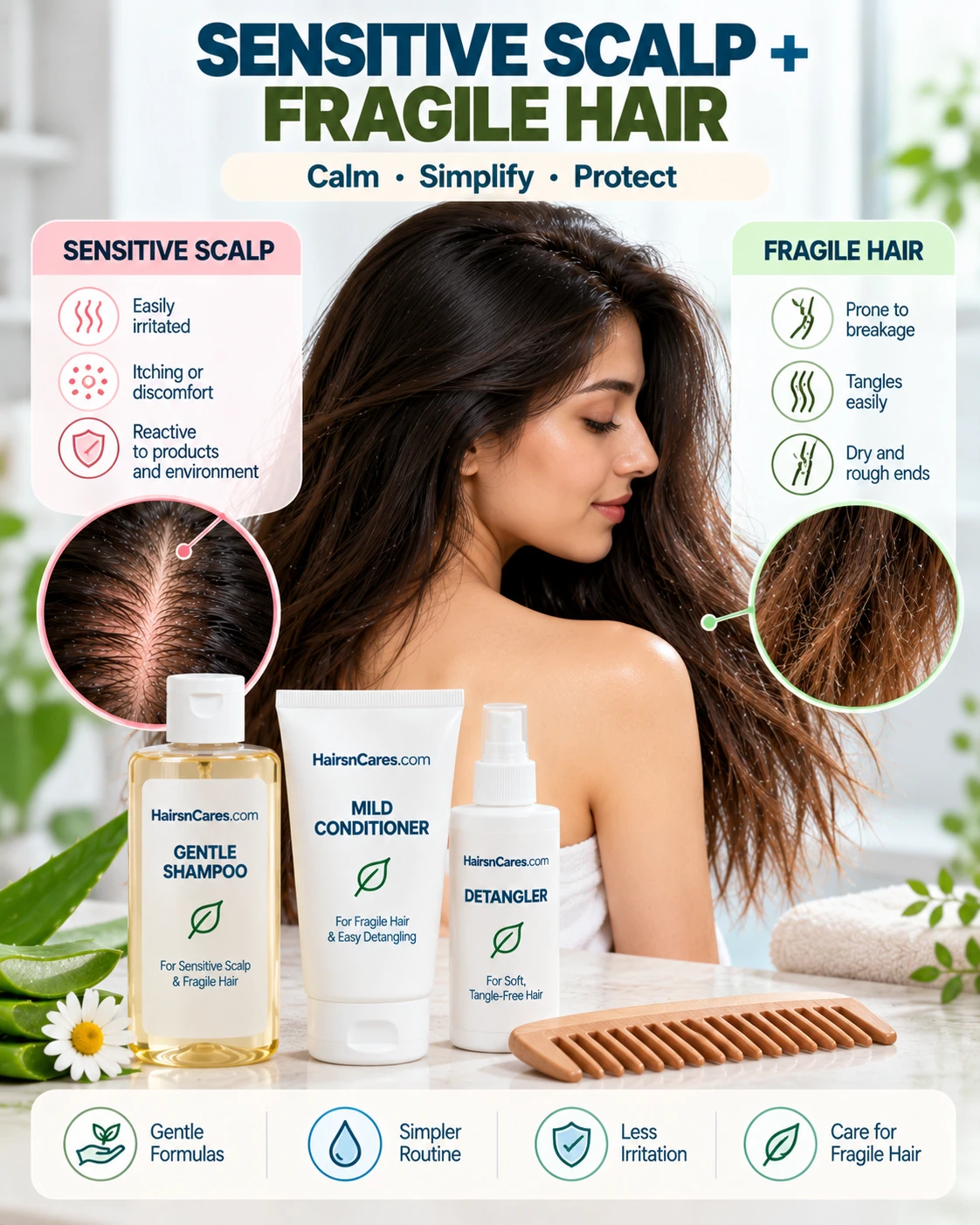
Above the Fold
Quick Answer: How Do You Care for Sensitive Scalp and Fragile Hair?
Use a simple routine with scalp-matched gentle shampoo, mild conditioner on lengths, careful detangling, low-friction drying, limited heat and cautious product introduction. Avoid adding too many actives at once. Stop products that burn, sting, swell or worsen symptoms, and seek dermatologist review for persistent or severe scalp signs.
Understanding the Basics
Two Problems Can Happen Together: Reactive Scalp and Weak Hair Shaft
Sensitive scalp may feel
- Itchy
- Tight
- Burning
- Stinging
- Sore or tender
- Flaky
- Oily but irritated
- Dry and uncomfortable
- Reactive after products, colour or heat
Fragile hair may appear as
- Weak strands
- Breakage, short snapped hairs
- Tangling
- Roughness
- Dryness
- Split ends
- Frizz
- Hairline breakage
- Breakage during brushing
"A gentle scalp routine and a fragile-hair routine should work together, but the scalp always needs safety priority."
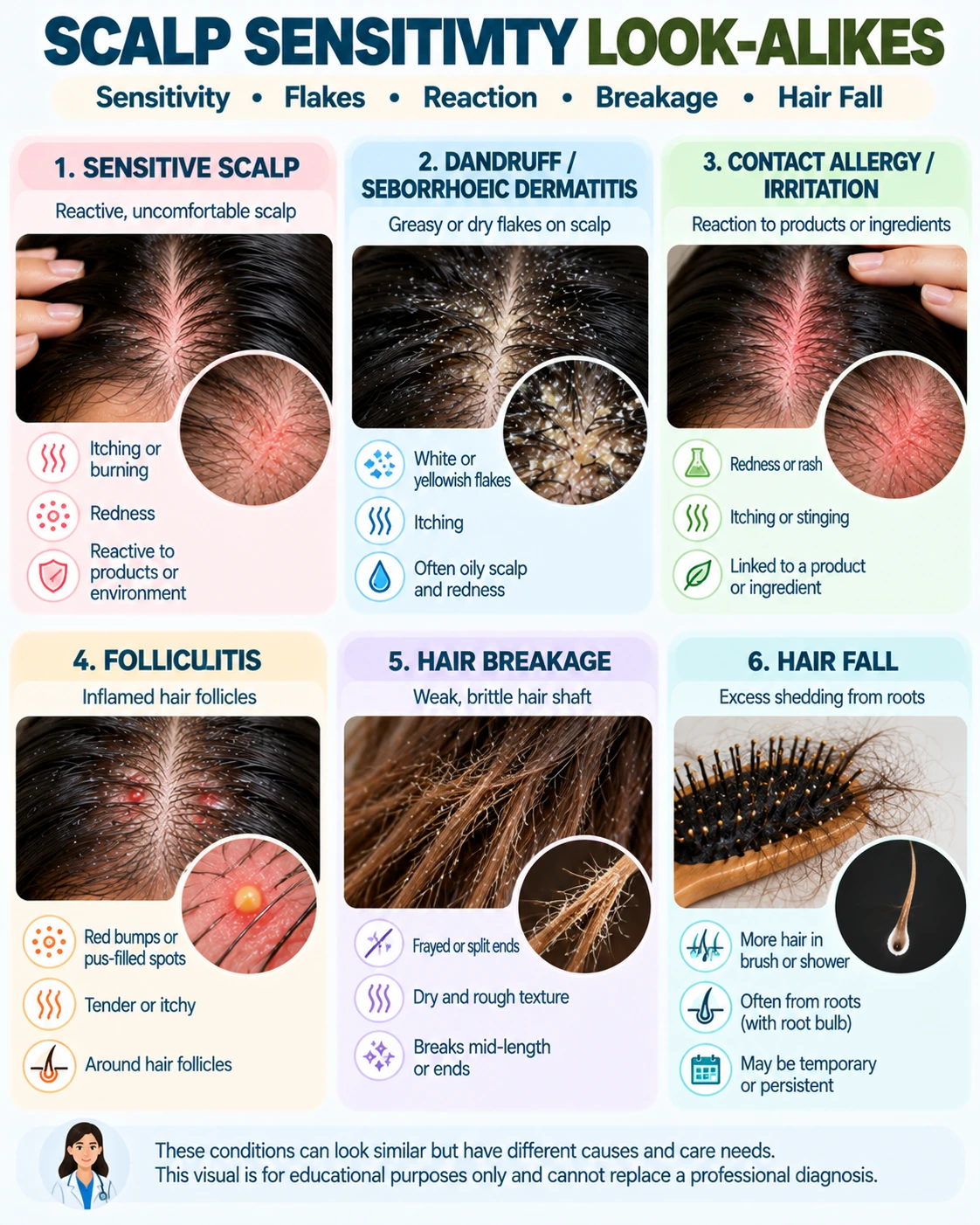
Know the Difference
Scalp Sensitivity Has Look-Alikes
| Concern | Common Clues | First Pathway |
|---|---|---|
| Sensitive Scalp | Burning, stinging, tightness, product discomfort | Simplify routine and check triggers |
| Dandruff / Seborrhoeic Dermatitis | Flakes, oiliness, itch, recurring scalp scale | Scalp condition pathway |
| Contact Allergy / Irritation | Redness, swelling, rash, burning after product | Stop trigger, seek review if severe |
| Folliculitis | Painful bumps, pus, tenderness | Dermatologist review |
| Hair Breakage | Short snapped pieces, fragile lengths | Breakage-control routine |
| Hair Fall | Full-length shedding, thinning, patches | Medical hair-loss assessment |
Interactive Selector
What Is Your Scalp Feeling?
Select the symptom closest to what you're experiencing to see likely pathways. This is a self-assessment guide, not a diagnosis.
Interactive Checklist
How Fragile Is Your Hair Shaft?
Tick the signs that match your hair to see a general pattern. This is a self-assessment guide, not a diagnosis.
Read This Before Trying New Products
Stop Cosmetic Experimenting if These Signs Appear
See a dermatologist for:
- Scalp pain
- Severe burning
- Swelling
- Blistering
- Pus
- Crusting
- Bleeding
- Severe redness
- Painful bumps
- Patchy hair loss
- Sudden heavy shedding
- Scalp wound
- Chemical burn
- Allergic reaction
- Fever with scalp symptoms
- Rapidly worsening flaking
- Hair coming out from root
- Eyebrow or body hair loss
"Sensitive scalp with red flags should not be managed only with over-the-counter cosmetic haircare."
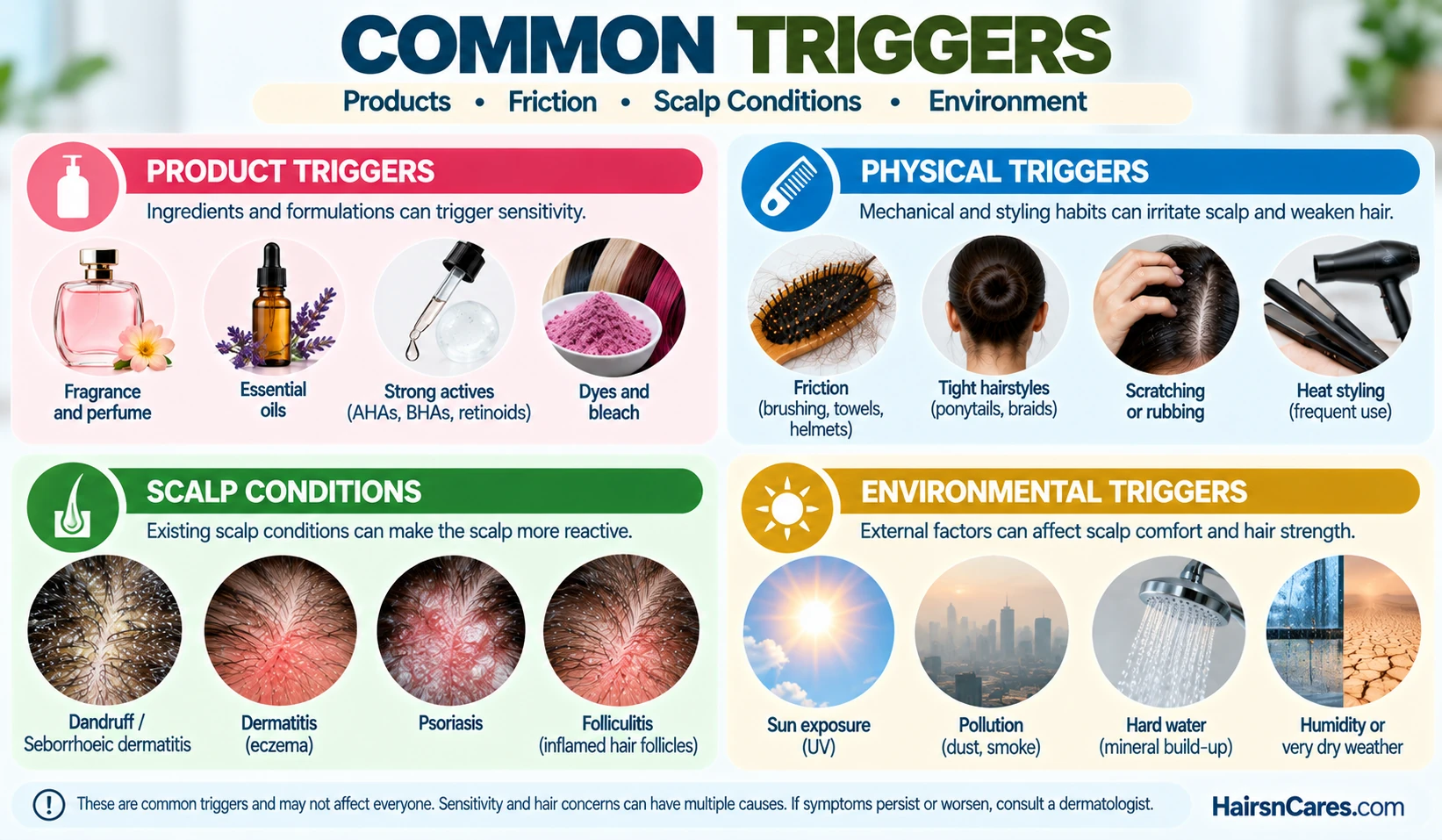
Understanding Triggers
What Can Trigger Sensitive Scalp and Fragile Hair?
Product Triggers
- Fragrance
- Essential oils
- Strong actives
- Harsh shampoo
- Alcohol-heavy styling products
- Hair dyes, bleach
- Chemical straightening
- Product layering
Physical Triggers
- Tight hairstyles
- Helmets
- Sweat
- Friction
- Rough towel drying
- Aggressive brushing
- Heat styling
- Scratching
Scalp Condition Triggers
- Dandruff
- Seborrhoeic dermatitis
- Eczema
- Psoriasis
- Folliculitis
- Contact dermatitis
- Post-procedure sensitivity
Environmental Triggers
- Sun
- Pollution
- Hard water
- Humidity
- Seasonal dryness
- Chlorinated water
"Trigger patterns vary. Do not assume one ingredient or product category is the cause without observing timing and response."
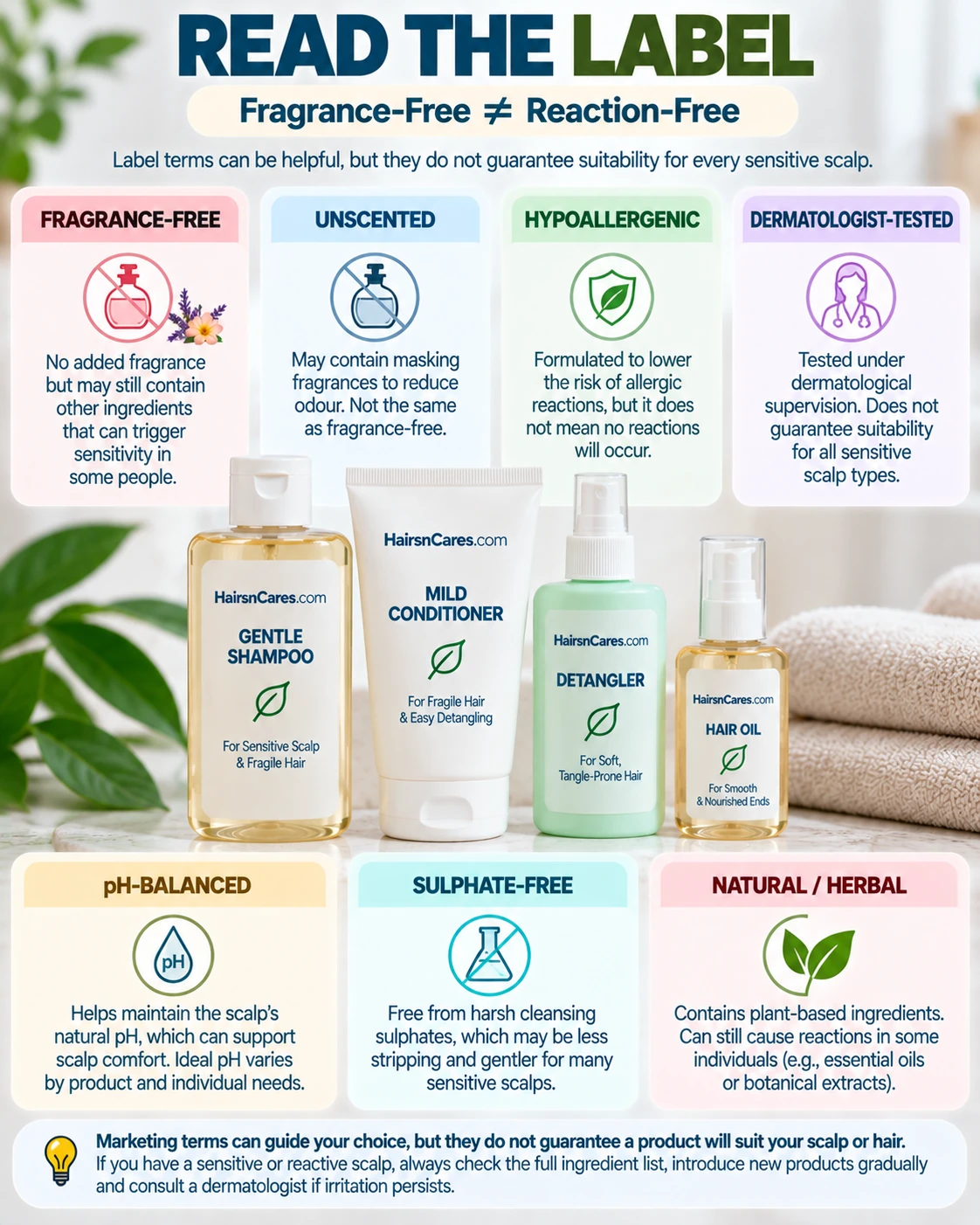
Read Before You Apply
Read Labels Before Applying to a Reactive Scalp
Fragrance-Free
Means no added fragrance, but not guaranteed allergy-proof.
Unscented
May still contain masking fragrance.
Hypoallergenic
Usually means designed to reduce allergy risk, not zero risk.
Dermatologist-Tested
Does not guarantee suitability for every sensitive scalp.
pH-Balanced
May support gentler cleansing, but the overall formula matters.
Sulphate-Free
May be gentler for some users, but not automatically non-irritating.
Essential Oil-Based
Can irritate some sensitive scalps despite being natural.
Natural / Herbal
Not automatically safer; patch testing still matters.
"Use verified product data. Do not display safety claims unless the label or approved product database confirms them."
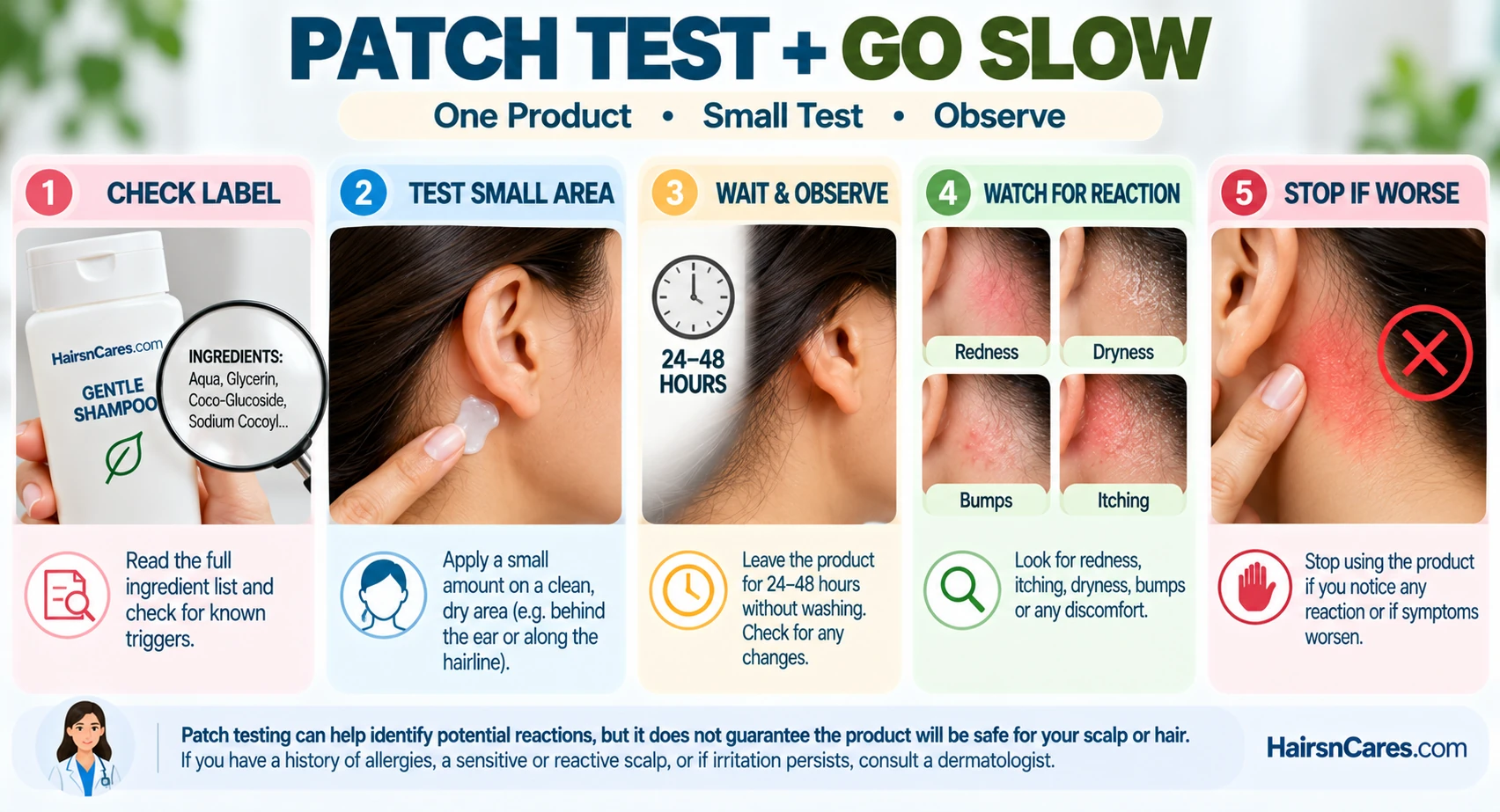
Introduce Products Safely
Introduce One New Product at a Time
Avoid Starting Multiple New Products Together
Introduce one at a time so any reaction can be traced.
Check the Ingredient List
Review for any ingredients you've reacted to before.
Patch Test Where Appropriate
Apply a small amount behind the ear or on the inner arm.
Apply a Small Amount First
Don't go straight to a full application on first use.
Avoid New Leave-On Products on Irritated Scalp
Wait until the scalp is calm before testing leave-on formulas.
Wait and Observe
Give it 24 to 48 hours before judging the result.
Track Itching, Burning, Redness or Flaking
Note timing and severity of any symptoms.
Stop if Symptoms Worsen
Discontinue immediately rather than waiting it out.
Seek Medical Review for Strong Reactions
Don't self-manage a severe reaction.
"Patch testing reduces risk but does not guarantee a product will be safe for everyone."
Cleansing by Symptom
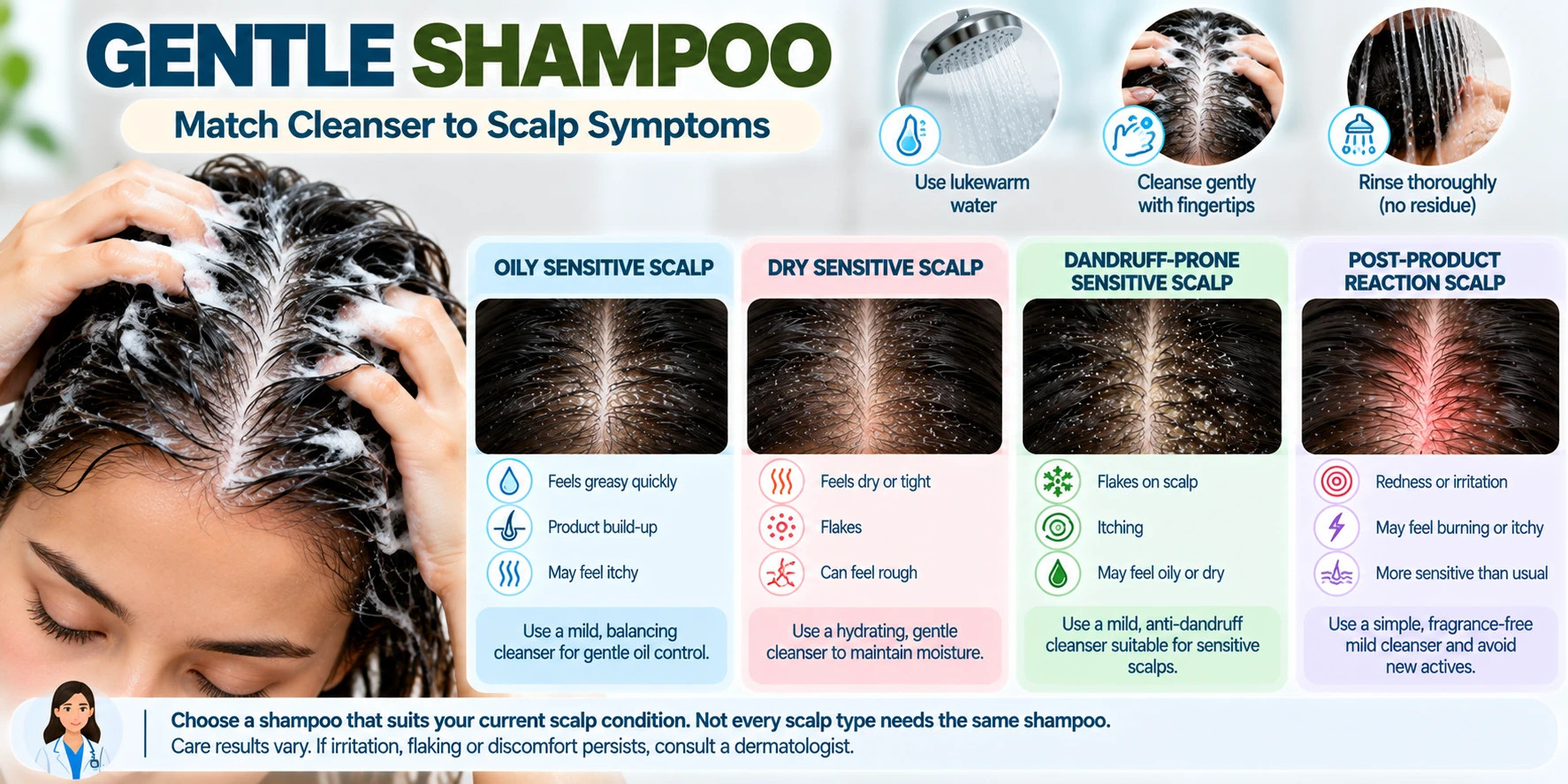
Choose Shampoo by Scalp Symptoms, Not Marketing Words Alone
Sensitive but Oily Scalp
Effective but gentle cleansing, non-heavy routine, avoid thick scalp oils.
Sensitive and Dry Scalp
Mild cleanser, avoid hot water and over-washing, avoid strong fragrance.
Sensitive With Dandruff
Dandruff-specific pathway, correct scalp contact, avoid heavy oiling if oily flakes.
Sensitive With Product Reaction
Stop suspected trigger, simplify routine, introduce products slowly.
Sensitive After Colour/Chemical Treatment
Stop irritants, avoid re-processing, gentle cleansing, doctor review if burning or crusting.
Slip Without Irritation
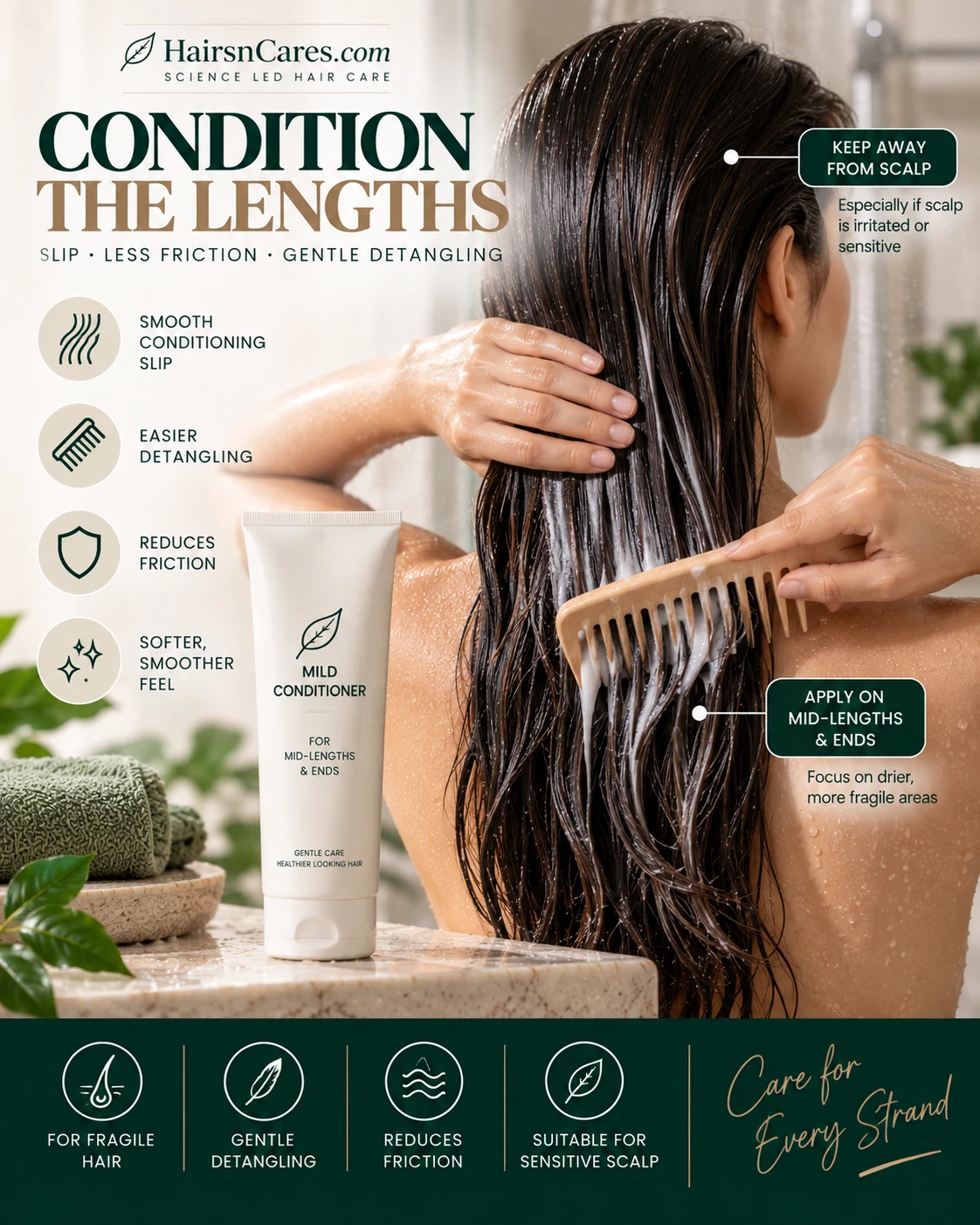
Condition Lengths Without Irritating the Scalp
Conditioner helps by
- Improving slip
- Reducing friction
- Making detangling easier
- Reducing breakage
- Improving softness
Rules
- Apply mainly mid-lengths and ends
- Avoid irritated or oily scalp unless designed for scalp use
- Rinse thoroughly
- Choose fragrance-free where suitable
- Lightweight for fine hair, richer for coarse/dense hair
Low-Irritation Layering
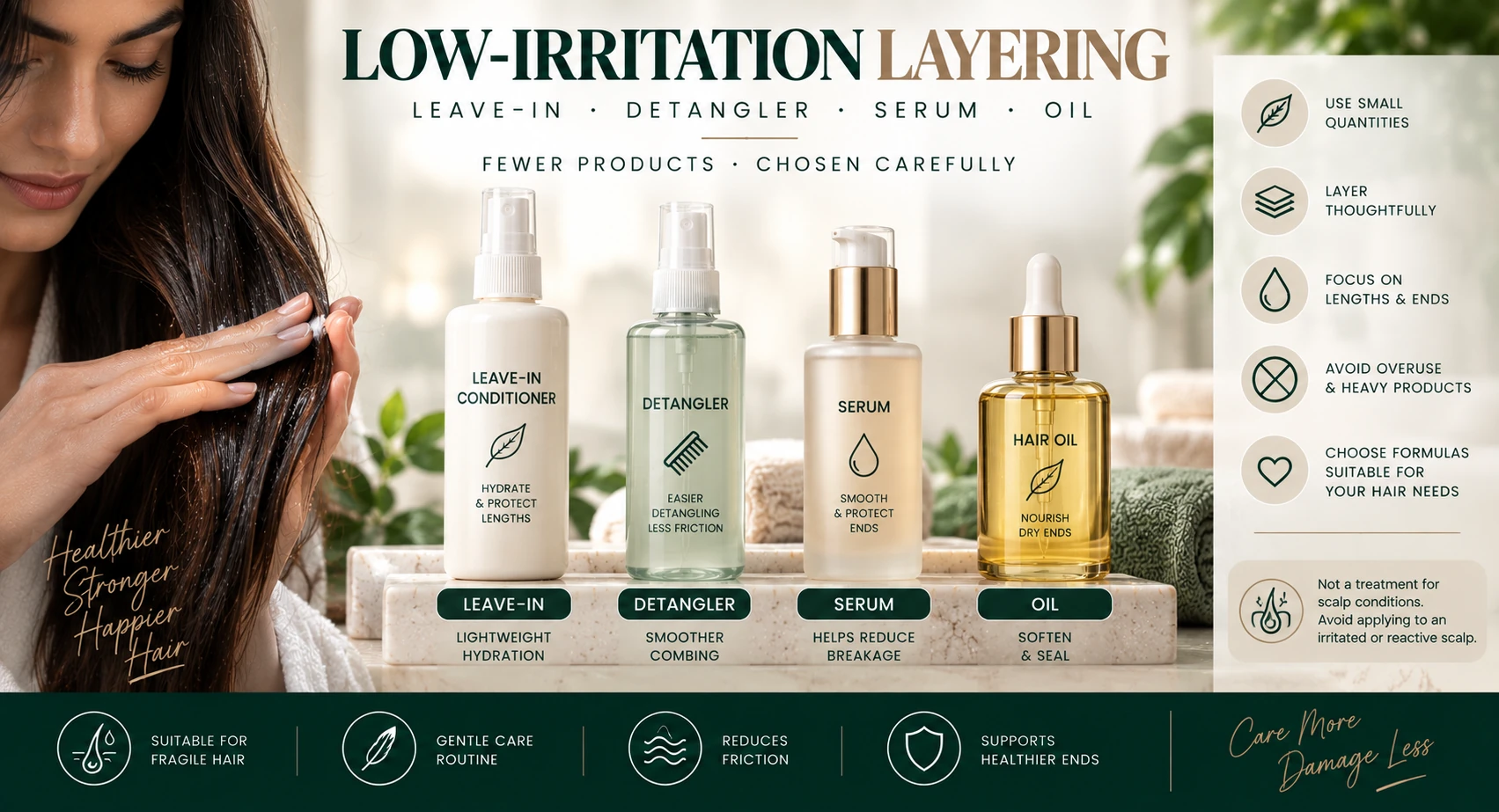
Protect Fragile Lengths With Low-Irritation Layering
Best for:
- Dry fragile lengths
- Tangles
- Curls, waves
- High porosity
Best for:
- Knots
- Fragile hair
- Dense or curly hair
- Wet detangling
Best for:
- Shine
- Frizz
- Flyaways
- Styling finish
Cautions: avoid heavy oil on oily, flaky or inflamed scalp; patch test oils and essential oils; oils do not treat scalp disease or regrow hair; avoid over-layering products on sensitive scalp.
Structured Routine
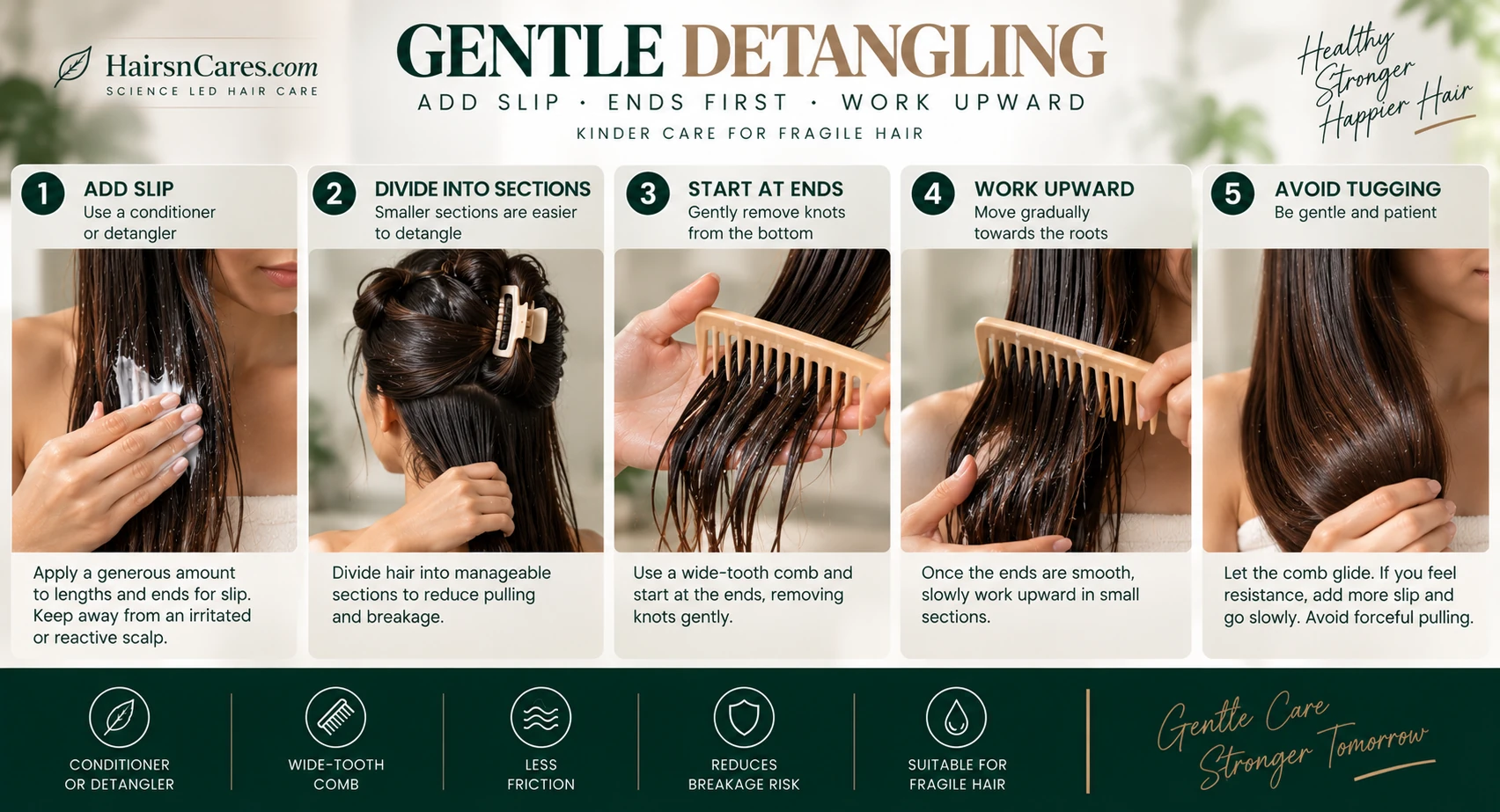
Fragile Hair Needs Slip, Less Friction and Less Heat
Gentle Scalp Cleansing
Match shampoo to scalp symptoms.
Conditioner on Lengths
Skip the scalp unless the product is designed for it.
Detangle From Ends Upward
Use slip from conditioner or detangler.
Leave-In or Detangler as Needed
For dry or knot-prone hair.
Avoid Rough Towel Drying
Use a microfiber towel or soft cotton.
Use Soft Hair Ties
Avoid tight hairstyles.
Reduce Heat Styling
Use heat protectant when heat is unavoidable.
Trim Split Ends if Breakage Persists
Track breakage and shedding separately.
Processing Safety
Sensitive Scalp + Fragile Hair Should Avoid Aggressive Processing
Bleach, hair colour, highlights, keratin treatment, smoothening, rebonding, relaxing, perming, straightener heat, curling iron heat, hot brush and repeated blow-dry all carry more risk when the scalp is sensitive or hair is fragile.
Safety rules
- Avoid chemical treatment during active scalp symptoms
- Avoid overlapping services
- Strand test and patch test where appropriate
- Stop if burning occurs
- Do not heat-style an irritated scalp
- Reduce high heat on fragile hair
- Consult a professional for chemical services
- Doctor review for chemical burns or swelling
Oily or Flaky Scalp
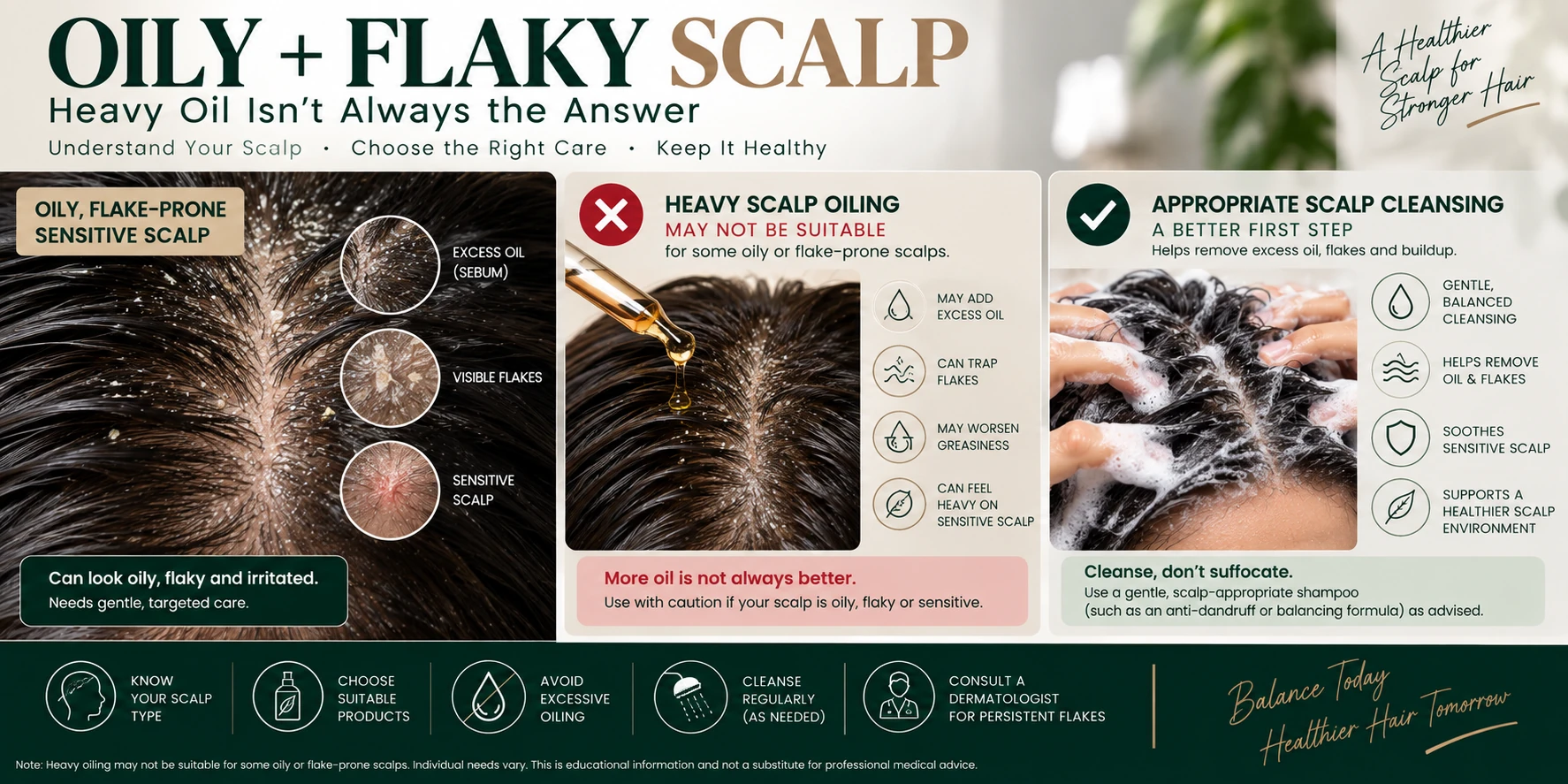
Do Not Calm Flakes With Heavy Oil by Default
Sensitive scalp with dandruff or oiliness may worsen with heavy oils, product buildup, infrequent scalp cleansing, heavy leave-on scalp products, scratching or wrong shampoo use.
Routine
- Scalp-focused cleansing
- Anti-dandruff pathway where appropriate
- Avoid heavy oiling during active oily flakes
- Rinse thoroughly
- Dry scalp properly
- Dermatologist review if persistent, severe or with hair fall
Dry or Tight Scalp
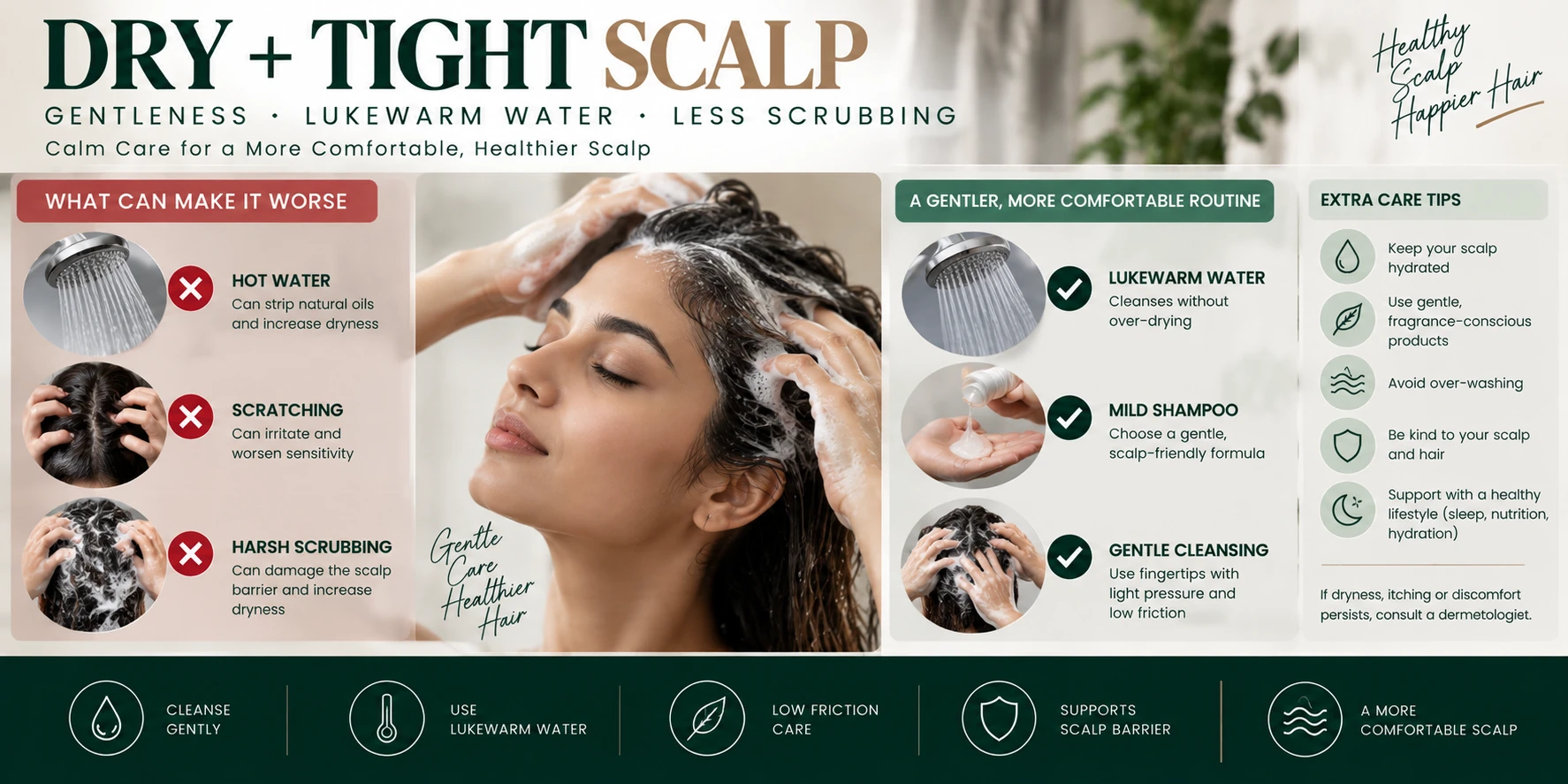
Dry, Tight Scalp Needs Gentleness — Not Scrubbing
Possible triggers
- Harsh shampoo
- Hot water
- Over-washing
- Dry weather
- Styling products
- Scalp actives
- Chemical treatments
Routine
- Mild shampoo
- Lukewarm water
- Avoid scratching
- Avoid strong fragrance
- Reduce product layering
- Doctor review if redness, pain, scaling or cracks occur
Post-Procedure Routing
Post-Procedure Scalp Needs Doctor-Specific Instructions
After hair transplant, PRP, GFC, microneedling, laser or scalp procedures, follow your clinic's aftercare instructions rather than general product advice. We do not recommend oils, scrubs, dyes, harsh shampoos, exfoliating actives, heat styling near healing areas, Minoxidil restart timing, microneedling or massage unless doctor-approved.
Build a Gentle Routine Based on Scalp Response and Hair Fragility
Answer a few questions to get a suggested cosmetic-care routine. This does not diagnose scalp disease, allergy, infection or hair loss.
The AI Sensitive Scalp + Fragile Hair Routine Builder provides educational and cosmetic routing only. It cannot diagnose scalp disease, allergy, infection, hair loss or prescribe treatment.
Ecommerce
Shop Sensitive Scalp and Fragile Hair Products by Symptom and Tolerance
Filter by scalp concern, hair concern and safety preferences.
*Claims are shown only when verified on the product database; unverified claims are not displayed.
Compare by Safety Signals
Compare Sensitive-Scalp Products by Safety Signals
Compare up to four products on fragrance status, scalp suitability and more. Products are never labelled "best" without verified criteria.
| Attribute | Product A | Product B |
|---|---|---|
| Product type | Gentle shampoo | Mild conditioner |
| Fragrance status | Product information not confirmed | Product information not confirmed |
| Rinse-off / leave-on | Rinse-off | Rinse-off |
| Scalp suitability | All types | Not intended for scalp |
AI Tool
Build a Gentle Routine Based on Scalp Response and Hair Fragility
The AI Sensitive Scalp + Fragile Hair Routine Builder above uses your inputs — main symptom, scalp type, recent reactions, fragility level and chemical history — to suggest routine categories and a doctor-review flag where relevant.
Track Realistically
Track Scalp Comfort and Hair Breakage Separately
Track itching, burning, stinging, tightness, flaking, redness, bumps, scalp pain, oiliness, dryness, product reaction timing, shampoo used, conditioner used, new product introduction, breakage, tangling, frizz, shedding, hair fall from root and heat/tight-hairstyle use.
Do Not Self-Manage These
Sensitive Scalp Should Not Be Ignored When Symptoms Persist
- Persistent itching, burning or stinging
- Scalp pain, redness or swelling
- Blisters, pus, crusting or bleeding
- Painful bumps or severe dandruff
- Patchy hair loss or sudden heavy shedding
- Hair coming out from the root
- Reaction after dye or bleach
- Scalp wound or chemical burn
- Symptoms after a procedure, or worsening with products
- No improvement after simplifying the routine
- Fragile hair with progressive thinning
Route to a dermatologist consultation, the AI Scalp Analyser, the AI Hair Test, or relevant scalp-condition pages.
Avoid These
Mistakes That Make Sensitive Scalp and Fragile Hair Worse
Who Helps With What
Who Helps With What?
Dermatologist
- Itching, burning, stinging
- Redness, dandruff
- Folliculitis, dermatitis
- Allergy, scalp pain
- Patchy loss, sudden shedding
Haircare Advisor
- Product simplification
- Gentle shampoo selection
- Conditioner placement
- Detangling routine
- Patch-test planning
Hair Stylist
- Low-tension styling
- Colour safety referral
- Avoiding chemical overlap
- Fragile-hair haircut
- Gentle blow-dry technique
Physician
- Systemic symptoms
- Fever, fatigue
- Anaemia risk
- Thyroid symptoms
- Medication-related reactions
Expert Note
Simplify First, Add Products Slowly
"Sensitive scalp and fragile hair usually respond best to a simplified, gentle routine — fewer products, low fragrance, careful introduction and reduced heat or chemical stress. Products can support comfort and manageability, but they don't replace medical care when symptoms are persistent, painful or accompanied by hair loss. When in doubt, patch test and go slow."
Reviewed by Dr. Amit Agarkar, MD Dermatology — Hairsncares
Suggested Medical References
Where to Read More From Trusted Sources
This page reflects general dermatology understanding. For deeper reading on contact dermatitis, scalp eczema, psoriasis and allergic reactions to hair products, these are reputable starting points — search each organisation's site directly for the most current article, since we don't want to point you to a guessed or outdated link.
- American Academy of Dermatology (AAD)Patient guides on sensitive skin, scalp conditions and contact dermatitis
- MedlinePlus (U.S. National Library of Medicine)Consumer-friendly overviews of allergic and irritant skin reactions
- PubMedPeer-reviewed research on cosmetic ingredient sensitisation and scalp dermatitis
- NHS (UK National Health Service)Condition overviews for eczema, psoriasis and contact dermatitis
These are reference categories, not endorsements of specific articles. Always check the publication date and consult a dermatologist for advice specific to you.
Frequently Asked Questions
Sensitive Scalp + Fragile Hair Guide: FAQs
Browse by category, or open any question directly — every answer stays cautious around safety, with medical questions pointed to a doctor.