Zinc Pyrithione for Dandruff in India: Benefits, Uses, Side Effects, Shampoo Guide & Doctor Advice
Moderate supportAnti-dandruff shampooScalp support
Zinc Pyrithione is a scalp-care ingredient commonly associated with anti-dandruff shampoos and flake-control products. It may support dandruff-prone scalp routines in selected users, but it is not needed for every scalp concern and should not replace dermatologist evaluation when symptoms are severe, recurrent, painful, patchy or unclear. It is not the same as Ketoconazole or Salicylic Acid, and availability and permitted use vary by product and market. Screen your scalp first with the AI Scalp Test. Results vary.
Doctor guidanceFor severe / recurrent / red-flag symptoms
Illustrative summary only. This is education, not a diagnosis or prescription; results vary and depend on your situation.
🩺
Doctor-reviewedMD Dermatology
⚡
AI Scalp Testfree
🧴
Scalp supportdandruff-prone
⚖️
Honest claimsmanage, not cure
🚚
India-widedelivery
Quick Answer
Is Zinc Pyrithione good for dandruff?
Zinc Pyrithione may support dandruff-prone scalp routines in suitable anti-dandruff products, especially for flakes and itching. However, not every scalp flake is dandruff: dry scalp, psoriasis, fungal infection, folliculitis and scarring scalp conditions can look similar and may need dermatologist evaluation. It is an anti-dandruff / scalp-care ingredient — used in some shampoos and scalp products for flake control and scalp comfort — with moderate scalp/dandruff support that depends on formulation, use frequency, scalp type and market availability. It is not the same as Ketoconazole or Salicylic Acid, is not a permanent cure, and does not treat every scalp disease. So it can be good for genuine dandruff-prone scalps as part of a routine, but if you are unsure what your flakes are, or symptoms are severe, recurrent, painful, patchy or unclear — or a child has scalp scaling — the priority is to get assessed. Screen with the AI Scalp Test, and see a doctor for red flags. Results vary.
Manages dandruff-prone scalp — it doesn't cure or diagnose. Zinc Pyrithione is an anti-dandruff ingredient, not a permanent cure and not the same as Ketoconazole or Salicylic Acid; availability varies by market. Not every flake is dandruff.See a doctor for severe scalp redness, pain, pus, crusting or bleeding, thick plaques, suspected psoriasis, tinea capitis or fungal infection, folliculitis, scarring alopecia suspicion, patchy hair loss, a child with scalp scaling, allergy/burning after shampoo, or dandruff that does not improve despite correct use. In pregnancy/breastfeeding, check with your doctor if unsure.
Zinc Pyrithione is an anti-dandruff / scalp-care ingredient used in some shampoos and scalp products, typically for a dandruff-prone scalp and flake control.
Its availability and permitted use may vary by product, formulation and market, so what you can buy depends on where you are and the specific product.
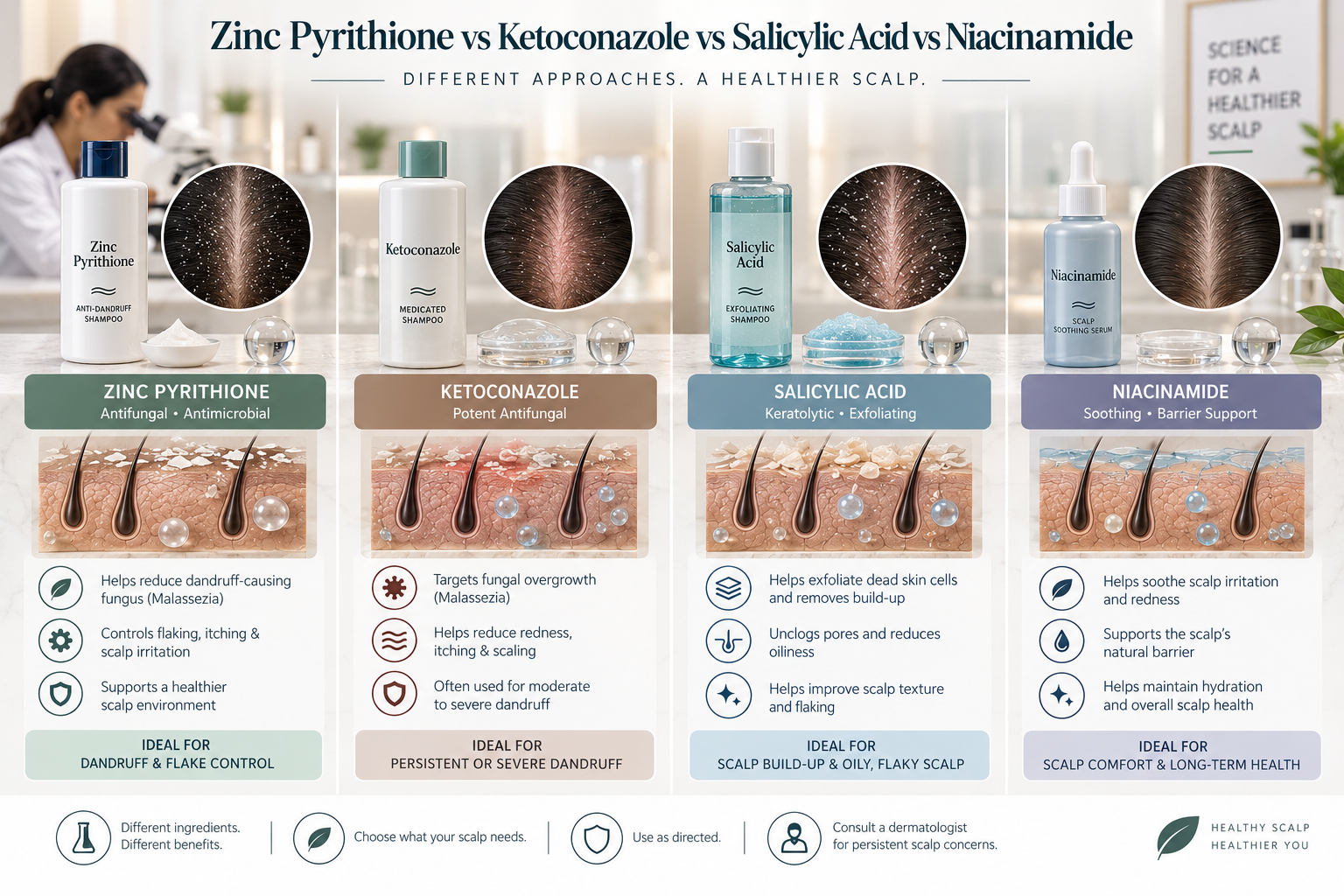
It is not the same as Ketoconazole (an antifungal) or Salicylic Acid (a keratolytic exfoliant), which work differently. So it sits at the moderate scalp/dandruff-support tier: helpful for dandruff-prone routines in suitable products, but not a cure-all or a treatment for every scalp problem.
Mechanism
How Zinc Pyrithione Works
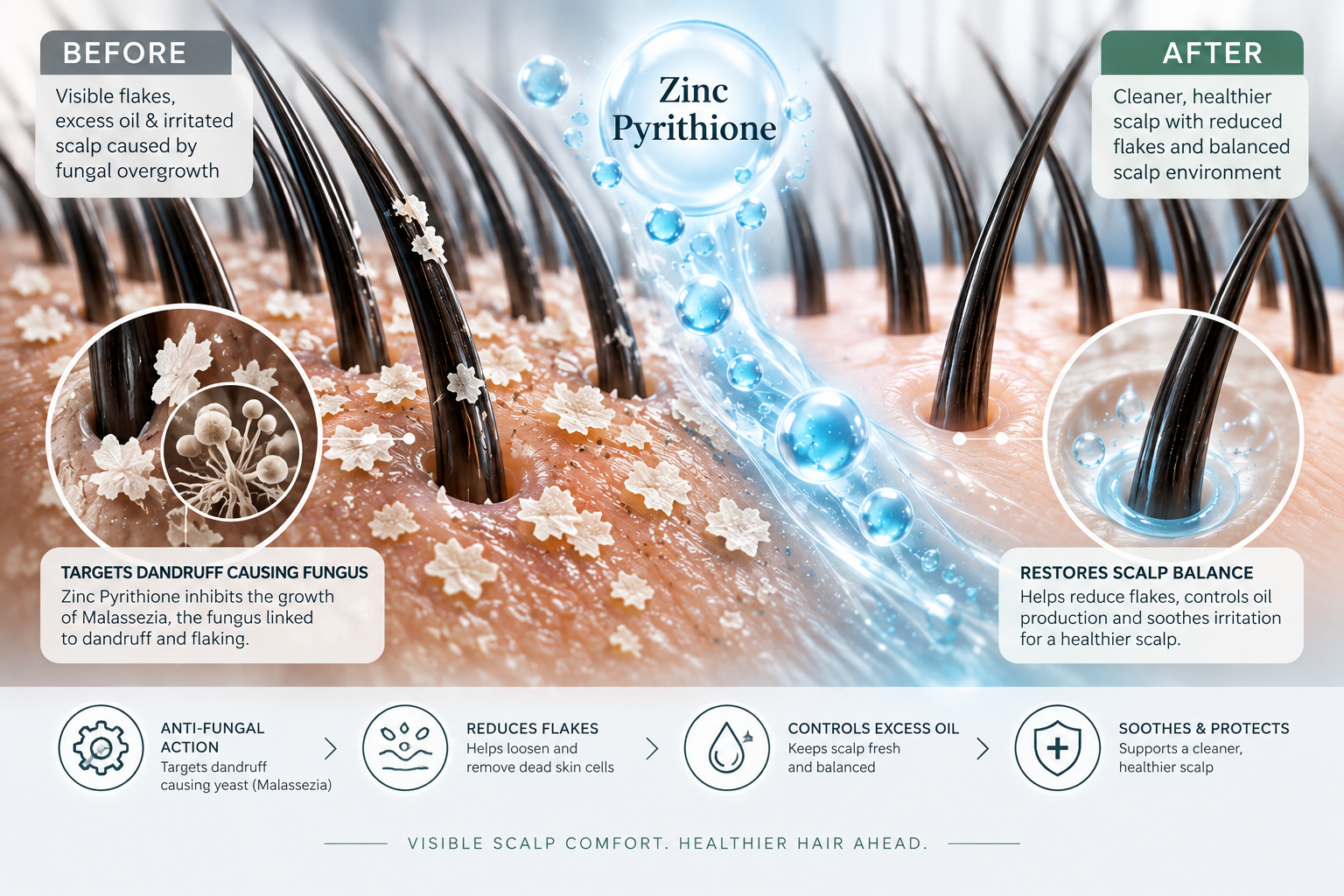
Dandruff is thought to involve a mix of scalp oil, a yeast-related imbalance and some inflammation, and Zinc Pyrithione is used in anti-dandruff products to support flake control and scalp comfort in suitable formulas.
It is applied to the scalp in a shampoo or product and used as directed. It does not treat every scalp disease.
It does not replace oral or topical medical treatment for infection or inflammatory scalp disease. So it works as a scalp-care, flake-control ingredient within a product, helpful for dandruff-prone scalps but not a substitute for medical care when a condition is more serious. Results vary.
Evidence
How Strong Is the Evidence?
Moderate support Zinc Pyrithione
Best supported for
Mild-to-moderate, genuine dandruff-prone scalp with flakes and itch, in a suitable anti-dandruff product used as directed, including oily, dandruff-prone scalps and maintenance routines.
Not proven to
It is not a permanent cure, not needed for every flake, not a hair-loss treatment, and not a substitute for diagnosis of psoriasis, tinea, folliculitis, scarring conditions or a child's scalp scaling.
Doctor guidance
For everyday dandruff, minimal. But severe, recurrent, painful or non-responding symptoms, thick plaques, patchy loss, pus/crusting or a child with scalp scaling need a doctor rather than shampoo alone.
Suitability
Best For
✅
Mild–moderate dandruff-prone scalp
For genuine, ordinary dandruff-prone scalps as part of a routine.
✅
Flaky scalp support
Flake-control support in a suitable anti-dandruff product.
Rotate with a gentle shampoo if needed and suitable
Stop if burning, rash or worsening occurs
Consult a doctor if symptoms are severe or recurrent
Usage
How to Use Zinc Pyrithione Shampoo Safely
Follow the product label, apply to the scalp rather than only the hair length, leave it as directed and rinse. Do not overuse it if your scalp becomes dry or irritated, and rotate with a gentle shampoo if needed and suitable. Many people use anti-dandruff shampoos a few times a week and reduce to maintenance once flakes settle. Stop if burning, a rash or worsening occurs, and consult a doctor if symptoms are severe, recurrent, painful, patchy or not improving rather than relying on shampoo alone.
Not sure if this ingredient fits your situation? Screen the cause first.
Zinc Pyrithione products are generally well tolerated, but local effects are possible, especially with overuse or on an already dry or irritated scalp.
DrynessItchingIrritationRednessBurningHair texture drynessAllergy to product formulaWorsened sensitivity if overusedEye irritation if misapplied
Most people tolerate suitable anti-dandruff products well, but dryness, irritation or sensitivity can occur, especially with overuse or on a dry scalp. Follow the label, avoid overusing it, support the hair with conditioner where helpful, and avoid broken or inflamed skin. Stop and seek advice if you get burning, a rash or worsening symptoms rather than continuing.
Shop
Zinc Pyrithione & Anti-Dandruff Products
Anti-dandruff shampoos and scalp products that may feature zinc pyrithione where available. Availability, concentration, prices, ratings and stock are dynamic placeholders from the database and official label.
Zinc Pyrithione is an anti-dandruff / scalp-care ingredient, not a permanent cure and not the same as Ketoconazole or Salicylic Acid; availability and permitted use vary by product, formulation and market. Judge a product by its label and suitability for your scalp. Severe, recurrent, painful, patchy or unclear symptoms, thick plaques, pus/crusting or a child with scalp scaling need a doctor — not shampoo alone. We do not fabricate prices, concentrations, ratings, stock or reviews; these are dynamic placeholders from the official label and database. Results vary.
Want products matched to you? Use the finder or screen first.
How this ingredient compares with similar options. It points to a pathway; it is not a diagnosis.
Feature
Zinc Pyrithione
Ketoconazole
Salicylic Acid
Category
Anti-dandruff
Antifungal
Keratolytic / exfoliant
Main role
Flake control / comfort
Targets Malassezia yeast
Loosens buildup / adherent flakes
Best for
Dandruff-prone scalp
Dandruff / seb-derm
Buildup / stuck-on flakes
Flake type
Oily / dandruff-type
Oily / dandruff-type
Adherent / buildup
Oily scalp relevance
Good
Good
Good
Dry scalp caution
Can dry
Can dry
Can dry / irritate
Use frequency
Per label (often 2–3x/wk)
Per label
Per label; avoid overuse
Sensitive scalp caution
Possible irritation
Possible irritation
Higher; use cautiously
Doctor guidance
Severe / recurrent → doctor
Tinea / severe → doctor
Dry / inflamed → caution
Pathway
Anti-dandruff shampoo
Ketoconazole shampoo
Scalp exfoliator
At a Glance
Zinc Pyrithione vs Salicylic Acid vs Ketoconazole vs Niacinamide vs Peptides: Which Ingredient Fits Your Concern?
Zinc Pyrithione, Ketoconazole and Salicylic Acid are more scalp-flake and dandruff/buildup focused. Niacinamide supports scalp comfort and barrier care. Peptides are more cosmetic hair/scalp support ingredients. The best ingredient depends on scalp type, symptoms, severity and whether red flags are present.
"As a dermatologist, I use dandruff ingredients based on scalp pattern. Zinc Pyrithione may be helpful in selected dandruff-prone routines, and it is a reasonable everyday option, but severe redness, thick plaques, patchy hair loss, child scalp scaling or pus-filled lesions should not be managed with shampoo alone. I would rather someone screen first and let me confirm what their flakes actually are — dandruff, seborrheic dermatitis, psoriasis, a fungal infection — than cycle through shampoos while a treatable condition persists. Use it for genuine dandruff, and bring me the red flags."
Reviewed by Dr. Amit Agarkar, MD DermatologyDermatologist & Hair Specialist · Last reviewed 1 June 2026
Severe, recurrent, painful or patchy scalp symptoms, thick plaques or a child with scalp scaling? See a doctor.
Zinc Pyrithione is an anti-dandruff and scalp-care ingredient used in some shampoos and scalp products, typically for a dandruff-prone scalp and flake control. Its availability and permitted use may vary by product, formulation and market. It is not the same as Ketoconazole or Salicylic Acid, which work differently. So Zinc Pyrithione is a scalp-care ingredient that may help dandruff-prone routines in suitable products, rather than a cure-all or a treatment for every scalp problem. Results vary.
Is Zinc Pyrithione good for dandruff?
Zinc Pyrithione may support dandruff-prone scalp routines in suitable anti-dandruff products, especially for flakes and itching. However, not every scalp flake is dandruff: dry scalp, psoriasis, fungal infection, folliculitis and scarring scalp conditions can look similar and may need dermatologist evaluation. So it can be good for genuine dandruff-prone scalps as part of a routine, but if you are unsure what your flakes are, or symptoms are severe or recurrent, it is worth getting assessed. Results vary.
How does Zinc Pyrithione work?
Dandruff is thought to involve a mix of scalp oil, a yeast-related imbalance on the scalp and some inflammation, and Zinc Pyrithione is used in anti-dandruff products to support flake control and scalp comfort in suitable formulas. It does not treat every scalp disease, and it does not replace oral or topical medical treatment for infection or inflammatory scalp disease. Results vary.
Is Zinc Pyrithione better than Ketoconazole?
Neither is simply better; Zinc Pyrithione and Ketoconazole are different anti-dandruff ingredients that can both help dandruff-prone scalps, and the better choice depends on your scalp, how you respond and the product. Ketoconazole is an antifungal often used for dandruff and seborrheic dermatitis, while Zinc Pyrithione is a scalp-care anti-dandruff ingredient. See a doctor if dandruff is severe, recurrent or not responding. Results vary.
Is Zinc Pyrithione better than Salicylic Acid?
They do different jobs, so neither is simply better. Zinc Pyrithione is an anti-dandruff ingredient aimed at dandruff-prone scalps, while Salicylic Acid is an exfoliating, keratolytic ingredient that helps loosen adherent flakes and buildup. The right pick depends on your flake type and scalp, and persistent, severe or unclear scalp problems are worth a doctor's assessment. Results vary.
Can Zinc Pyrithione reduce itching?
For an itchy, dandruff-prone scalp, a suitable Zinc Pyrithione anti-dandruff product may help reduce flaking and the associated itch. However, scalp itch has many possible causes and Zinc Pyrithione will not address all of them. Persistent, severe or spreading itch, especially with redness, pus, crusting or hair loss, needs a doctor. Results vary.
Can Zinc Pyrithione stop hair fall?
Zinc Pyrithione is a dandruff and scalp-flake support ingredient, not a hair-loss treatment, so it does not stop hair fall directly. If you are losing noticeable amounts of hair, especially suddenly, in patches or progressively, the priority is to find the cause with the AI Hair Test or AI Scalp Test and a doctor. Results vary.
Is Zinc Pyrithione safe for scalp?
Zinc Pyrithione in suitable anti-dandruff products is generally well tolerated, though like any scalp product it can cause local effects such as dryness, itching, irritation, redness or burning in some users, and overuse can make the scalp feel more sensitive. Stop and seek advice if you develop a marked reaction. Results vary.
Can Zinc Pyrithione cause dryness?
Yes, like many anti-dandruff products, Zinc Pyrithione shampoos can leave some people with a drier scalp or drier-feeling hair, especially with frequent use or on an already dry scalp. Using it only as often as needed and supporting the hair with a suitable conditioner can help. Results vary.
Can Zinc Pyrithione irritate scalp?
Zinc Pyrithione can irritate the scalp in some people, causing itching, redness, burning or sensitivity, particularly with overuse, on an already irritated scalp, or if you are sensitive to the overall formula. If your scalp burns or feels worse rather than better, stop and seek advice. Results vary.
How often should I use Zinc Pyrithione shampoo?
Use a Zinc Pyrithione shampoo as directed on its label, since recommended frequency varies by product, and many people use anti-dandruff shampoos a few times a week. You can often reduce frequency once dandruff is controlled, switching to maintenance use. Avoid overusing it if your scalp dries out. Results vary.
Can I use conditioner after Zinc Pyrithione shampoo?
Yes, you can usually use a conditioner after a Zinc Pyrithione shampoo, which can help with any dryness the anti-dandruff shampoo causes. Applying conditioner mainly to the lengths rather than the scalp is often sensible. Results vary.
Is it useful for oily scalp?
Zinc Pyrithione can be useful for an oily, dandruff-prone scalp, since oily scalps are often more prone to the kind of flaking it is used for. However, if oiliness comes with heavy flaking, redness or persistent symptoms, the picture may be seborrheic dermatitis or another condition worth assessing. Results vary.
Is it useful for dry scalp?
For a genuinely dry scalp, an anti-dandruff ingredient like Zinc Pyrithione is not always the answer, because dry-scalp flaking is different from dandruff and anti-dandruff shampoos can sometimes make a dry scalp feel drier. The AI Scalp Test or a doctor can help tell the difference. Results vary.
Is Zinc Pyrithione safe during pregnancy?
If you are pregnant or breastfeeding and unsure, check with your doctor before using a Zinc Pyrithione anti-dandruff product, who can advise based on the specific product and your situation. When in doubt during pregnancy or breastfeeding, confirm before use. Results vary.
Can teenagers use Zinc Pyrithione shampoo?
Teenagers can generally use a suitable Zinc Pyrithione anti-dandruff shampoo for a dandruff-prone scalp following the product label. However, a child with scalp scaling, patches of hair loss or unusual scalp symptoms should be assessed by a doctor, because conditions like tinea capitis need different treatment. Results vary.
What if dandruff keeps coming back?
Dandruff is often a recurring, manageable condition rather than something permanently cured, so flakes returning after you stop or reduce treatment is common. However, if dandruff keeps coming back despite correct use, is severe, very itchy, red or inflamed, or does not respond, it is worth seeing a doctor. Results vary.
Can the AI Scalp Test suggest Zinc Pyrithione?
The AI Scalp Test can help explore whether a dandruff-support ingredient like Zinc Pyrithione might suit a dandruff-prone scalp routine, or whether your flakes look more like dry scalp, psoriasis or another issue, and whether scalp red flags mean you should see a doctor instead. It is a screening and education aid, not a diagnosis. Results vary.
When should I consult a dermatologist?
You should consult a dermatologist if you have severe scalp redness, pain, pus, crusting or bleeding, thick plaques or suspected psoriasis, a possible fungal infection such as tinea capitis, folliculitis, suspected scarring alopecia, patchy hair loss, a child with scalp scaling, or dandruff that is severe, recurrent or not improving despite correct use. Results vary.
Which Zinc Pyrithione product should I choose?
Which Zinc Pyrithione product suits you depends on availability in your market, your scalp type and how your scalp tolerates it, since formulations and concentrations vary. An anti-dandruff shampoo suits regular flake control. Choose a product whose label matches your needs and adjust frequency to response. Availability, concentration, prices, ratings and stock on our pages are dynamic placeholders from the official label and database. Results vary.
Question not answered here? Ask Dr Aria for general guidance, or book a consultation.
Zinc Pyrithione is a useful anti-dandruff ingredient for genuine dandruff-prone scalps, used in a suitable shampoo as part of a routine. But not every flake is dandruff, it is not a permanent cure, it is not the same as Ketoconazole or Salicylic Acid, and its availability varies by market. The smart move is to confirm what your flakes are, use a suitable product sensibly, avoid overuse, and see a doctor for severe, recurrent, painful or patchy symptoms, thick plaques, pus, or a child with scalp scaling. Use the AI Scalp Test to clarify your scalp situation. Results vary.
Medical disclaimer. This is educational content reviewed by a dermatologist. The AI Scalp Test helps explore whether a dandruff-support ingredient may suit a routine and flags when a doctor is needed, but does not diagnose, prescribe, confirm a product is right for you, endorse a brand, or replace a dermatologist. Zinc Pyrithione is an anti-dandruff / scalp-care ingredient, not a permanent cure, not the same as Ketoconazole or Salicylic Acid, and not a hair-loss treatment; availability and permitted use vary by product, formulation and market.It should not be used as sole care for severe or recurrent dandruff, scalp psoriasis, tinea capitis, folliculitis, scarring alopecia, alopecia areata, patchy hair loss, severe scalp redness, pus, pain or crusting — these need diagnosis. See a doctor for these, for a child with scalp scaling, for no improvement despite correct use, or if unsure in pregnancy or breastfeeding. Side effects can include dryness, itching, irritation, redness and burning. Product availability, price, concentration, stock, ratings and reviews are dynamic placeholders from the official label and database. Results vary.
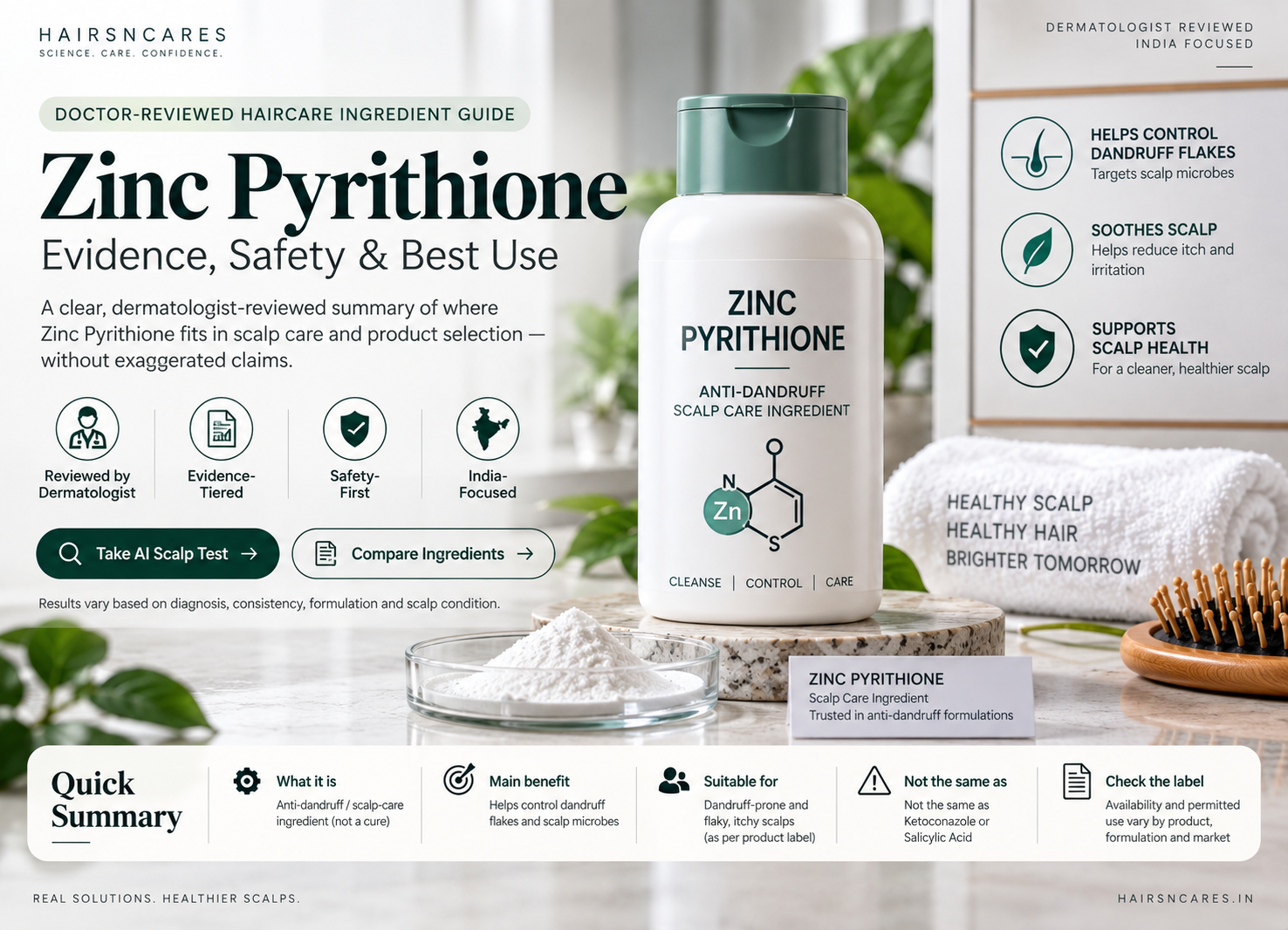
Doctor-Reviewed Haircare Ingredient Guide
Zinc Pyrithione: Evidence, Safety & Best Use
A clear, dermatologist-reviewed summary of where Zinc Pyrithione fits in hair fall, scalp care, hair-growth support or product selection — without exaggerated regrowth claims.
Reviewed by DermatologistEvidence-TieredSafety-FirstIndia-Focused
How Zinc Pyrithione may support hair or scalp care.
🛡️
Safety and suitability depend on diagnosis and user profile.
📋
Routine compatibility matters more than random product use.
Quick Answers
Quick Answers About Zinc Pyrithione
Is Zinc Pyrithione good for hair growth?
Zinc Pyrithione may help in selected situations depending on its evidence level, diagnosis, formulation and consistency. It should not be treated as a guaranteed regrowth solution for every type of hair loss.
How long does Zinc Pyrithione take to work?
Timelines vary. Medicines and deficiency-based treatments may take months, while cosmetic oils or hydration ingredients may mainly improve feel, shine or manageability sooner.
Can I use Zinc Pyrithione without a diagnosis?
Cosmetic ingredients may be used carefully, but medicines, persistent hair fall, patchy loss, scalp disease or sudden shedding need dermatologist evaluation.
Can Zinc Pyrithione be combined with other ingredients?
Combination depends on scalp sensitivity, diagnosis, product type and whether the ingredient is cosmetic, supplement-based or prescription-guided.
Who should avoid Zinc Pyrithione?
People with allergies, irritation, active scalp disease, unclear diagnosis, pregnancy, breastfeeding or prescription-medicine concerns should check suitability before use.
Scalp-support ingredient with use depending on formulation, scalp type and symptoms. Not a hair regrowth medicine.
AI Summary
Zinc Pyrithione for Hair and Scalp in Simple Terms
Zinc Pyrithione is a scalp-support ingredient.
It may help with selected dandruff and flaking control — but it should not be treated as a cure for every hair or scalp concern.
Bottom line: use this guide to understand evidence, safety and product suitability, then take the AI Scalp Test or consult a dermatologist. Results vary.
Ingredient Type
Is Zinc Pyrithione a Medicine or Scalp-Care Active?
Zinc Pyrithione is an anti-dandruff scalp-care ingredient. Suitability and availability depend on formulation and market rules.
Correcting sudden, patchy, scarring, fungal or medical loss without doctor care
Scalp Safety
Zinc Pyrithione Is an Anti-Dandruff Active, Not for Every Scalp Issue
Zinc Pyrithione supports selected dandruff and flaking, but it is not a fix for every scalp condition. Availability and permitted use can depend on formulation and local rules — check the product label.
Reduce or stop if dryness or irritation worsens.
Psoriasis, tinea, folliculitis or scarring need a doctor, not repeated shampoo switching.
Child scalp scaling or patchy loss needs medical review.
Active Comparison
Where Zinc Pyrithione Sits Among Anti-Dandruff Actives
Zinc Pyrithione is a long-standing anti-dandruff active that helps control the yeast and flaking behind common dandruff. It sits alongside other actives — ketoconazole (antifungal), salicylic acid (keratolytic) and others — and the best choice depends on your scalp and how it responds, not on one active being universally strongest. Availability and permitted concentrations can vary by formulation and market, so read the label.
This guide is educational. For sudden, patchy, progressive or unexplained hair loss, or scalp pain, pus, crusting or thick plaques, screen with an AI tool or see a dermatologist.

 Zinc Pyrithione