💧
Dry Hair Softness
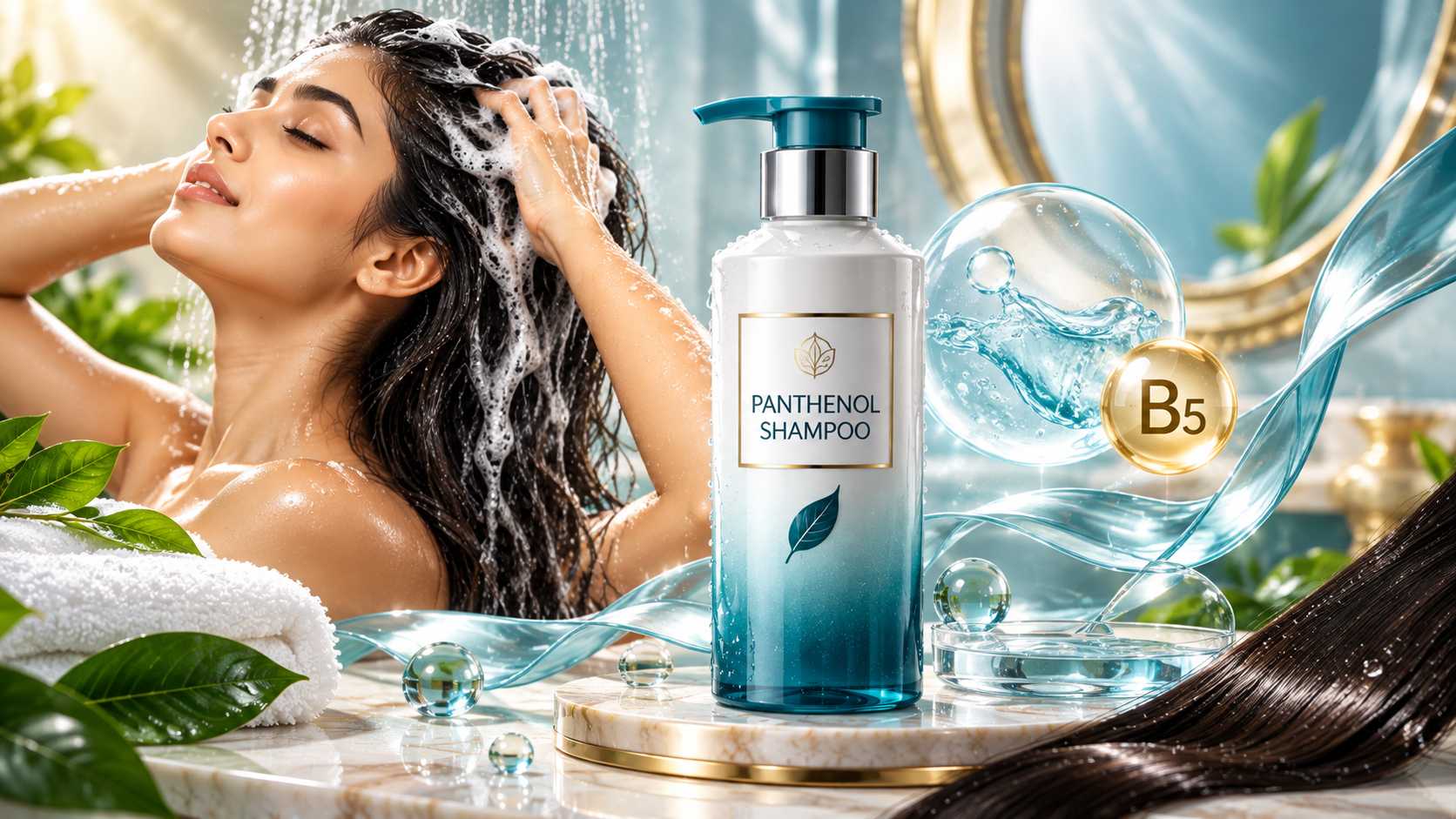
Panthenol shampoo's clearest benefit is for dry, brittle or rough-feeling hair. The humectant effect during washing deposits a moisture film that may improve softness and smoothness feel after drying.
A dermatologist-guided guide to using panthenol (Pro-Vitamin B5 / Vitamin B5) shampoo safely — including when it supports dry hair, frizz control, shine, scalp comfort, side effects, product selection, and when hair or scalp symptoms need medical evaluation.
What panthenol (provitamin B5) shampoo can and cannot do
How panthenol penetrates the hair shaft and retains moisture
Best hair types for panthenol shampoo — dry, damaged, or fine
Panthenol vs ceramide vs keratin shampoo compared
How often to use without making fine hair limp
Panthenol concentration — how much is enough in a shampoo
The humectant mechanism — why panthenol helps in dry climates
When dry, damaged hair needs professional assessment, not just panthenol
Panthenol is the alcohol form of pantothenic acid (vitamin B5). In haircare, it is labeled as panthenol, Pro-Vitamin B5 or Vitamin B5. When applied topically, panthenol is converted to pantothenic acid — it acts as a humectant, coating the hair shaft with a moisture film. All three names on product labels refer to the same ingredient. This is the only ingredient in our shampoo series with an open-chain (non-ring) structure, which explains its unique film-forming, moisture-trapping mechanism. See our full panthenol ingredient guide →
Frizz is usually a hair shaft condition — caused by dryness, humidity, heat damage, chemical treatment or cuticle roughness. It responds to conditioning routines, leave-in products and gentle handling. Panthenol shampoo is most relevant here. Not a medical condition.
Progressive thinning, shedding from roots (hair with white bulb), bald patches or hormonal symptoms are root-level medical concerns. Panthenol shampoo is not the primary treatment for any hair fall pattern. Learn the difference →
Panthenol shampoo (Pro-Vitamin B5 shampoo / Vitamin B5 shampoo) is commonly used in dry hair, frizzy hair, rough hair, dull hair and scalp comfort routines. It may support hair shaft smoothness, softness, hydration feel and shine depending on formulation. Its primary benefit domain is cosmetic hair shaft texture — not scalp disease treatment, dandruff management or medical hair loss. As a wash-off product, shampoo contact time is brief. For dry and frizzy hair, conditioner — a leave-on product — is actually more important than the shampoo choice for improving day-to-day hair texture and frizz. If scalp symptoms include persistent itching, redness, burning, severe dandruff, pus, crusting, painful scalp, bald patches or sudden shedding, dermatologist evaluation is more important than any shampoo change.
Panthenol (provitamin B5) shampoo is a well-studied humectant that penetrates the hair shaft to improve moisture retention, elasticity, and shine. It may reduce breakage in dry or damaged hair. It does not treat hair loss, cure dandruff, or repair permanently destroyed cuticle. Works best in dry climates. Fine or oily hair may feel weighed down with overuse.
People with dry, damaged, or brittle hair who need moisture and elasticity support. Excellent for heat-damaged or colour-treated hair. Works well in dry and cold climates.
Deep protein treatments for severely damaged hair, medicated shampoos for scalp conditions, or hair loss therapy. Panthenol is a conditioning humectant, not a treatment.
Hair remains dry and brittle despite consistent hydrating care, breakage is severe, or you notice thinning alongside dryness. Rule out thyroid issues, iron deficiency, or other systemic causes.
Panthenol (Pro-Vitamin B5) is an open-chain humectant — the only major ingredient in this series without a ring structure. It works by attracting and binding moisture to the hair shaft surface and is converted to pantothenic acid in the hair, supporting the hair's own moisture-retaining properties. This film-forming mechanism is distinct from all ring-compound actives in the series.
Panthenol may coat the hair cuticle during washing, temporarily smoothing lifted cuticle scales that contribute to frizz and roughness. The result is a softer, smoother tactile feel and improved light reflection (shine). This benefit is wash-off based — it is renewed each wash cycle, not permanent.
For dry and frizzy hair, conditioner — applied after shampoo and left for several minutes — is more impactful than panthenol shampoo alone. Conditioner has longer contact time, higher conditioning-agent concentration, and remains on hair through drying and styling. Panthenol shampoo is the gentle opening act; conditioner is the main event for dry hair management.
Panthenol shampoo's benefit depends heavily on hair type. Dry, coarse, curly and colour-treated hair types benefit most. Fine, oily or limp hair may find panthenol-rich formulations feel heavy or weighing. Matching formulation to hair type is more important than ingredient selection alone.
All benefits are cosmetic hair shaft improvements within the wash-off shampoo context. They are real but should be combined with conditioner for meaningful dry hair and frizz management.
Panthenol shampoo's clearest benefit is for dry, brittle or rough-feeling hair. The humectant effect during washing deposits a moisture film that may improve softness and smoothness feel after drying.
May help frizzy or coarse hair feel more manageable after washing — particularly when paired with conditioner and leave-in products. Shampoo alone addresses a fraction of frizz; the full routine matters more.
Smoother cuticle surface from panthenol's film-forming effect improves light reflection, contributing to the optical shine appearance. Also reduces tangling during detangling — practical manageability benefit.
Colour-treated hair is more porous and prone to dryness. Gentle panthenol formulations — particularly sulphate-free versions — may suit colour-treated hair better than harsh surfactant shampoos.
Can be part of a gentler scalp routine for some sensitive scalp users, particularly when scalp tightness from harsh cleansing is the concern. Not a treatment for active scalp disease.
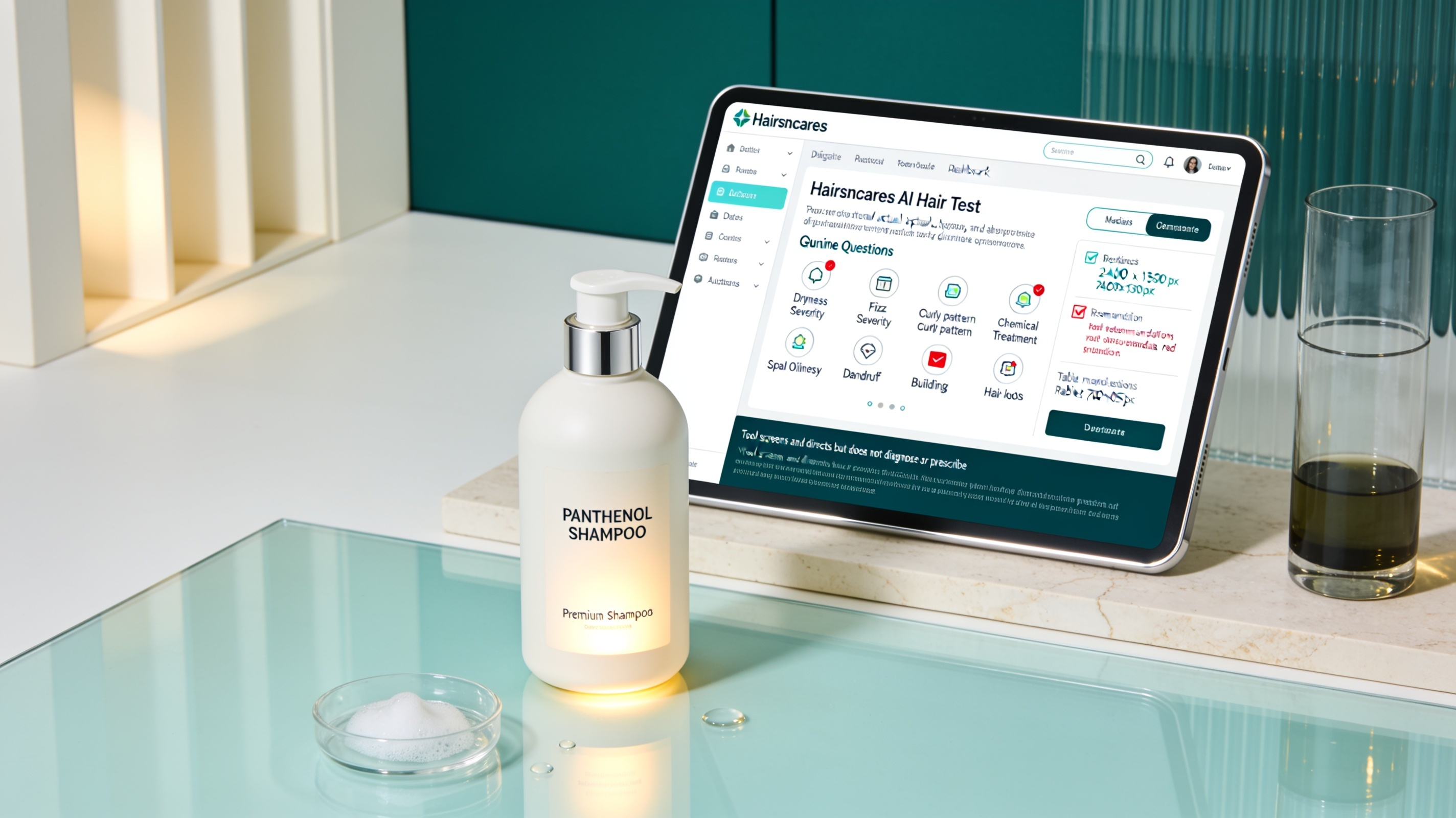
AI Hair Test assesses dryness level, frizz severity, scalp type, dandruff risk and product buildup tendency to determine whether panthenol, sulphate-free, niacinamide or anti-dandruff shampoo is the right foundation for your routine.
Many patients ask whether Panthenol Shampoo alone can solve their hair concerns. The honest answer: shampoo is a wash-off product that stays on the scalp for a short time. It can support scalp cleanliness, comfort and moisture and softness — but it cannot treat root-level hair loss, hormonal imbalance, nutritional deficiency or conditions that need prescription treatment. A good shampoo works best as part of a complete routine, not as a standalone cure.

Primary match. Dry hair is the clearest cosmetic indication for panthenol shampoo — the humectant film-forming mechanism directly addresses the moisture deficit that causes roughness and dullness.
Best MatchCoarse or frizzy hair types typically benefit from moisture-supporting ingredients. Panthenol shampoo combined with frizz-control conditioner and leave-in is a good routine foundation.
Good MatchColour-treated hair is more porous and tends to be drier. Gentle sulphate-free panthenol formulations suit colour-treated hair well — though confirm colour-safe label on specific products.
Good MatchCurly and wavy hair types are inherently drier because scalp oils travel less efficiently down the curl pattern. Panthenol shampoo as part of a curl-care routine may be a useful moisture-supporting base.
SuitablePanthenol-heavy or conditioning-rich formulations can weigh down fine or limp hair, reducing volume. Lightweight panthenol formulations exist — check product description for volume-safe labeling.
Choose LightweightRich conditioning shampoos may feel heavy on already-oily scalps. Panthenol is fine as a scalp ingredient in appropriate concentration, but a full conditioning-heavy formula may feel greasy if the scalp is oily.
Light Formula OnlyDandruff needs anti-dandruff actives (ketoconazole, zinc pyrithione) rather than a hydrating shampoo as the primary treatment. Panthenol can be a secondary ingredient or rotation wash.
Anti-Dandruff FirstMedical evaluation is needed. Panthenol shampoo cannot address alopecia areata, androgenetic alopecia, telogen effluvium or any root-level hair loss cause.
See DoctorNo shampoo change without explicit surgeon clearance on a post-transplant scalp.
Surgeon ClearancePanthenol shampoo's 9-step HowTo uniquely emphasises two steps not found in earlier pages: Step 3 (apply mainly to scalp and let rinse reach lengths) and Step 6 (conditioner is essential, not optional). These reflect the dry hair user's primary needs — less mechanical contact on fragile lengths, and a mandatory conditioning follow-up.
Check whether your hair is dry, frizzy, curly, colour-treated, fine, oily or dandruff-prone. Panthenol shampoo is most relevant for dry, rough and frizzy hair. For dandruff or medical scalp conditions, identify the primary active needed before choosing a hydrating shampoo.
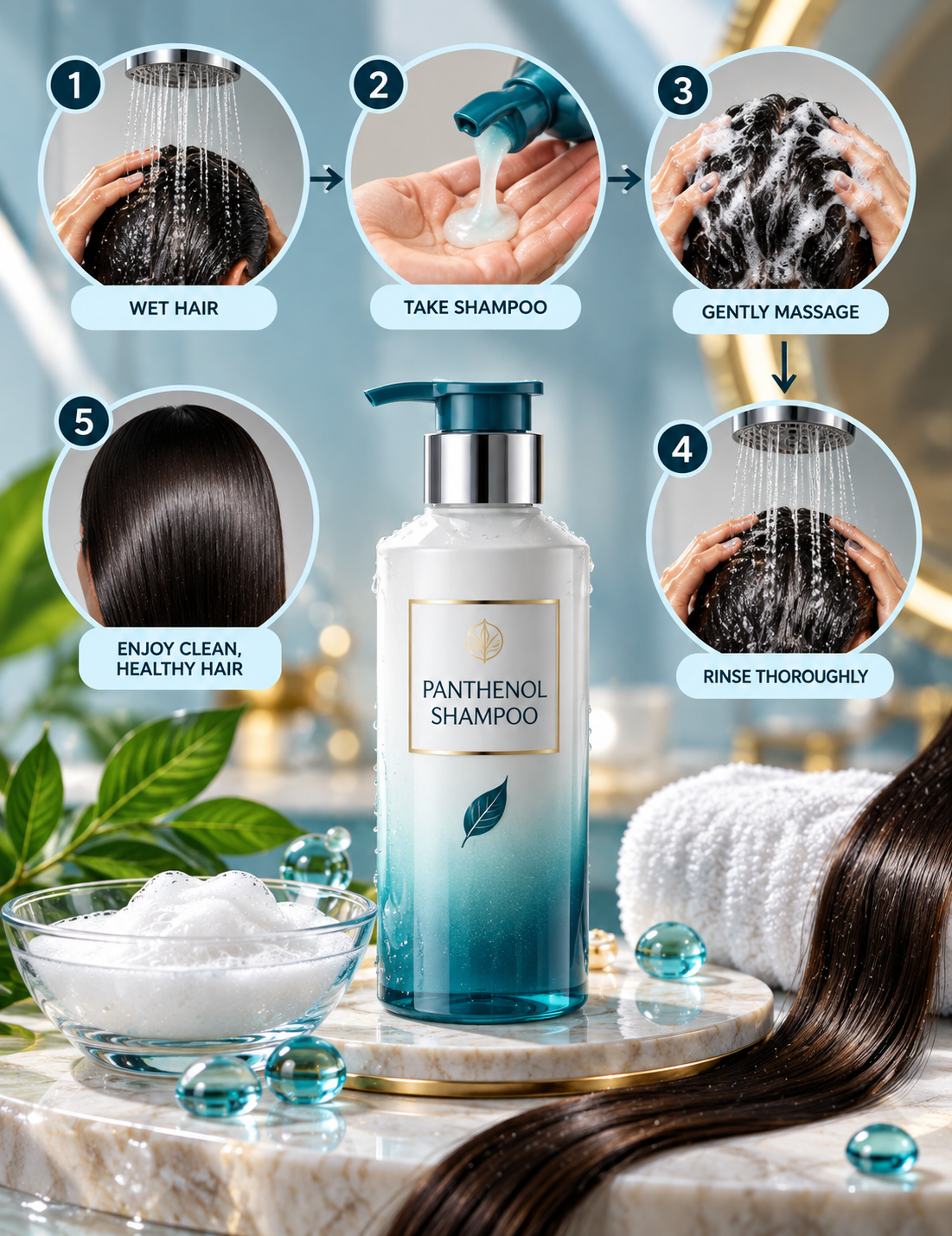
Use lukewarm water — never hot. Hot water lifts the cuticle and strips the natural oil barrier, worsening dryness and frizz for the rest of the wash. Fully wet both scalp and hair before applying shampoo.
Apply panthenol shampoo primarily to scalp and roots. For dry or fragile lengths, allow the shampoo rinse water to run down naturally rather than scrubbing shampoo aggressively through mid-lengths and ends. This reduces mechanical damage during the wash step.
Use fingertips, not nails. Avoid aggressive rubbing on fragile, brittle or dry lengths that worsens tangling and mechanical breakage.
Remove all shampoo residue. Product buildup on dry or frizzy hair can paradoxically create heaviness and roughness — defeating the purpose of a hydrating shampoo.
Apply conditioner to mid-lengths and ends after every wash. For dry, frizzy or colour-treated hair, conditioner is the most important step in the wash routine. It has longer contact time and higher conditioning-agent concentration than shampoo. A panthenol shampoo without conditioner follow-up leaves dry hair significantly rougher and frizzier than the full routine would achieve.
Overwashing dry hair is counterproductive — it removes natural oils that contribute to moisture. Frequency depends on scalp oiliness, sweat level, hair texture and product tolerance. Follow product label or dermatologist advice.
Panthenol shampoo is the start, not the finish. A complete dry hair routine also includes conditioner, weekly hair mask, leave-in cream or serum, heat protection before styling and gentle drying (microfibre towel, diffuser).
Monitor hair texture over 6–8 weeks. Stop and consult a doctor if burning, rash, scalp pimples, worsening hair fall or bald patches appear. If hair still feels very rough despite full routine, the issue may be water quality, damage severity or an underlying scalp/nutritional concern that needs evaluation.
Panthenol shampoo is not a 2-in-1 conditioner. It deposits a light moisture film during washing, but the conditioning benefit of a dedicated conditioner — applied after rinsing, left for 2–5 minutes, containing cationic agents that bond to hair — is far greater for dry or frizzy hair. Always use both.
Panthenol shampoo may temporarily improve the feel and appearance of split ends by coating frayed fibres. But split ends cannot be permanently sealed — the only solution is trimming. Products that claim permanent split end "repair" are referring to cosmetic fill effects that wash out.
Burning, rash, swelling, worsening hair fall, new bald patches, scalp pain or pus. Consult a dermatologist before resuming any shampoo.
The most common shampoo mistake is rushing the process. Apply to the scalp (not just hair lengths), massage gently with fingertips (never nails), follow the recommended contact time if it is a medicated shampoo, and rinse thoroughly. Incomplete rinsing is a leading cause of scalp irritation and product buildup that patients often blame on the shampoo itself.
Key principle: Follow your product label or dermatologist's advice. Frequency varies by scalp oiliness, hair texture and tolerance. Overwashing worsens dryness and frizz in already-dry hair. Track symptoms across 6–8 weeks before changing routine.
Dry hair, frizz, roughness and hydration feel. Wash-off humectant. Pair with conditioner always.
Scalp barrier, sensitive/oily scalp comfort. Scalp-focused. Not antifungal.
Hydration positioning, dry hair/scalp. Formula-dependent wash-off benefit.
Frequent washing, sensitive scalp. Non-medicated gentle cleansing.
Dry, curly, colour-treated hair. Low-irritation, low-stripping.
Dandruff/seborrheic dermatitis. Antifungal. Not a hydrating shampoo.
Medical hair loss treatment. Applied after rinsing. Not a shampoo.
The dry hair hierarchy: For dry and frizzy hair, the impact order is: conditioner > hair mask > leave-in serum > gentle heat protection > panthenol shampoo > everything else. Shampoo choice matters, but is the least impactful variable in a dry hair routine compared with conditioning and post-wash care.
| Option | Best For | Main Role | Evidence Position | Key Caution |
|---|---|---|---|---|
| Panthenol Shampoo | Dry hair, frizz, roughness, dull hair, hydration feel | Wash-off humectant and hair shaft smoothing | Established as conditioning ingredient in haircare; wash-off contact limits efficacy | May feel heavy on fine/oily hair; conditioner is more important than shampoo for dry lengths |
| Niacinamide Shampoo | Scalp barrier, sensitive scalp, oily scalp balance | Barrier-supportive gentle cleanser; scalp focused | Skincare positioning; wash-off scalp benefit | Not antifungal; scalp focused, not hair shaft focused |
| Hyaluronic Acid Shampoo | Hydration positioning, dry hair or scalp | Wash-off humectant; formula dependent | Newer positioning in haircare; limited rinse-off evidence vs panthenol | Formula and contact time determine actual benefit; may not outperform panthenol as wash-off |
| Biotin Shampoo | Weak-feeling hair, breakage-prone routine | Cosmetic hair shaft strength support | Consumer positioning; wash-off limitation | Not for deficiency correction; strength focus not hydration focus |
| Sulphate-Free Shampoo | Dry, curly, colour-treated hair | Gentle low-stripping cleansing | Good for preserving natural oils and colour | May not cleanse oily scalp sufficiently; no active conditioning ingredient |
| Conditioner / Hair Mask | Dry lengths, frizz, detangling — the core of dry hair routine | Longer contact, stronger conditioning effect than shampoo | Most evidence for improving dry hair texture and frizz | More important than shampoo for dry hair management; apply to lengths only, not scalp |
| Dermatologist | Scalp disease, hair loss, severe dandruff or dryness with underlying cause | Diagnosis and cause-based treatment | Gold standard when cosmetic approach fails or medical condition is suspected | Essential when dryness is associated with scalp disease or hair fall |
Unique series note: Panthenol is the most cosmetically focused page in the series — with no antifungal, keratolytic or medical comparators in the VS table. All comparisons are with other hydrating and supporting ingredients, reflecting that this page's benefit domain is hair texture rather than scalp disease or hair loss.
All products are supportive wash-off shampoos. Not standalone treatments for hair fall, dandruff, scalp disease or medical hair concerns. Prices on individual product pages.
Our AI Hair Test assesses hair dryness, frizz level, scalp type, dandruff risk, product buildup tendency and hair fall patterns to determine whether panthenol shampoo, sulphate-free shampoo, niacinamide shampoo, anti-dandruff shampoo or dermatologist evaluation is the most appropriate next step for your hair and scalp.
AI screening only. Does not diagnose, prescribe or replace dermatologist evaluation.
Stop immediately. May indicate contact reaction to fragrance, preservative or surfactant in the formulation. Consult before resuming any shampoo.
Swelling of scalp, face or eyes — stop and seek medical attention. May indicate allergic reaction to shampoo ingredients.
Worsening shedding after starting a new shampoo — the underlying cause needs evaluation. Do not switch shampoos repeatedly without investigating the cause of hair fall.
May indicate contact folliculitis or product reaction. Stop and consult a dermatologist before resuming.
If hair feels consistently heavy, flat or waxy after using panthenol shampoo, the formula may be too rich for your hair type. Switch to a lighter formulation or reduce frequency.
Rinse immediately with water. Seek medical attention if irritation persists.
If any of these patterns are present, a dermatologist is more important than any shampoo change.
Needs anti-dandruff actives — hydrating shampoo is not the treatment.
Possible scalp psoriasis — needs dermatologist diagnosis before any self-treatment.
Medical red flag requiring evaluation, not shampoo switching.
Medical evaluation needed urgently — alopecia areata, scarring or tinea.
Androgenetic alopecia or other pattern hair loss — needs medical assessment and treatment planning.
Scalp inflammation contributing to shedding — needs diagnosis and cause-based treatment.
Normal but needs timeline understanding — and evaluation if severe or prolonged.
Persistent dryness despite conditioner, mask and gentle handling may indicate hard water, nutritional issue or scalp condition needing evaluation.
If you notice increased itching, redness, burning, pimples on the scalp, or worsening flakes after using panthenol shampoo — stop immediately. These are not signs of “scalp detox” or “purging.” They may indicate irritation, allergy, contact dermatitis or worsening of an existing scalp condition. Consult a dermatologist before resuming.
Panthenol shampoo regrows hair.
Panthenol shampoo may improve hair feel and softness, but it is not a proven standalone hair-regrowth medicine. Hair growth requires the hair follicle to be active — a shampoo cannot restart dormant follicles.
Panthenol shampoo permanently repairs split ends.
No shampoo permanently repairs split ends. Panthenol may coat the fibre and temporarily improve the appearance of split ends, but the only permanent solution for split ends is trimming.
Dry hair only needs a hydrating shampoo.
Conditioner, hair mask, leave-in serum and heat protection contribute more to dry hair texture and frizz management than shampoo choice alone. Shampoo is the start of the routine, not the solution by itself.
Hydrating shampoo suits every hair type.
Fine or oily-scalp hair types may find panthenol-rich formulations heavy or flat. Matching formulation weight to hair type and scalp condition is as important as ingredient choice.
Frizz means hair fall.
Frizz is typically a hair shaft texture condition — caused by dryness, humidity, heat damage or cuticle roughness. Hair fall is root-level shedding. They are different conditions requiring different approaches.
Rough hair always means vitamin deficiency.
Rough hair texture most commonly results from dryness, heat styling damage, chemical treatment, hard water, harsh shampoos or mechanical damage — not nutritional deficiency. Deficiency-related hair changes typically involve shedding, not texture alone.
Doctor-Reviewed Resources
Still unsure whether panthenol shampoo is right for your hair?
Ask a Hair Doctor →Use real authority URLs only. All external links open in a new tab.
AAD guidance on hair shaft damage, heat styling, chemical treatment and breakage prevention — the clinical context for understanding where panthenol shampoo fits as a gentle, supportive element of dry or damaged hair care.
AAD guidance on frizzy hair — the primary concern addressed by panthenol shampoo. Establishes frizz as a hair shaft condition, not a medical diagnosis requiring prescription treatment.
AAD evidence on hair loss evaluation — establishing the framework for understanding that panthenol shampoo is not a hair loss treatment and when medical evaluation is needed.
Search PubMed for peer-reviewed literature on panthenol in haircare, humectants and hair shaft conditioning, frizz management evidence, scalp contact dermatitis and hair shaft damage from chemical and heat treatments.
Panthenol shampoo (Pro-Vitamin B5 shampoo, Vitamin B5 shampoo, hydrating shampoo) is a supportive wash-off shampoo used in dry hair, frizzy hair, rough hair, dull hair, colour-treated hair and hair shaft hydration routines. It does not diagnose, treat, cure or prevent dandruff, seborrheic dermatitis, eczema, psoriasis, scalp infection, medical hair loss, baldness, alopecia, PCOS-related hair fall, thyroid-related hair fall, postpartum shedding, nutritional deficiency hair fall or medication-related shedding. It should not replace conditioner, hair masks, leave-on treatment, ketoconazole, anti-dandruff actives, minoxidil, finasteride, PRP, GFC, nutritional correction, hair transplant care or dermatologist evaluation when indicated. It cannot permanently repair split ends or reverse chemical or heat damage. Use as per product label or doctor guidance. Stop if irritation, allergy symptoms or scalp worsening occurs. This guide has been reviewed by Dr. Amit Agarkar, MD Dermatology, Hairsncares.
The AI Hair Test identifies your hair type, dryness severity and scalp condition to recommend whether panthenol shampoo, sulphate-free, niacinamide or anti-dandruff actives are the right foundation for your routine.
Your cart is empty