Female pattern hair loss
Genetic, androgen-linked miniaturization along the central scalp — the most common cause. Learn more.
If your centre parting looks wider than it used to and more scalp shows through, you are noticing a widening hair partition. In women this can be an early sign of female pattern hair loss, but it can also follow PCOS, thyroid changes, postpartum shedding, nutritional gaps or a temporary shedding phase. The trend over months — not a single bad-light moment — is what tells the story.
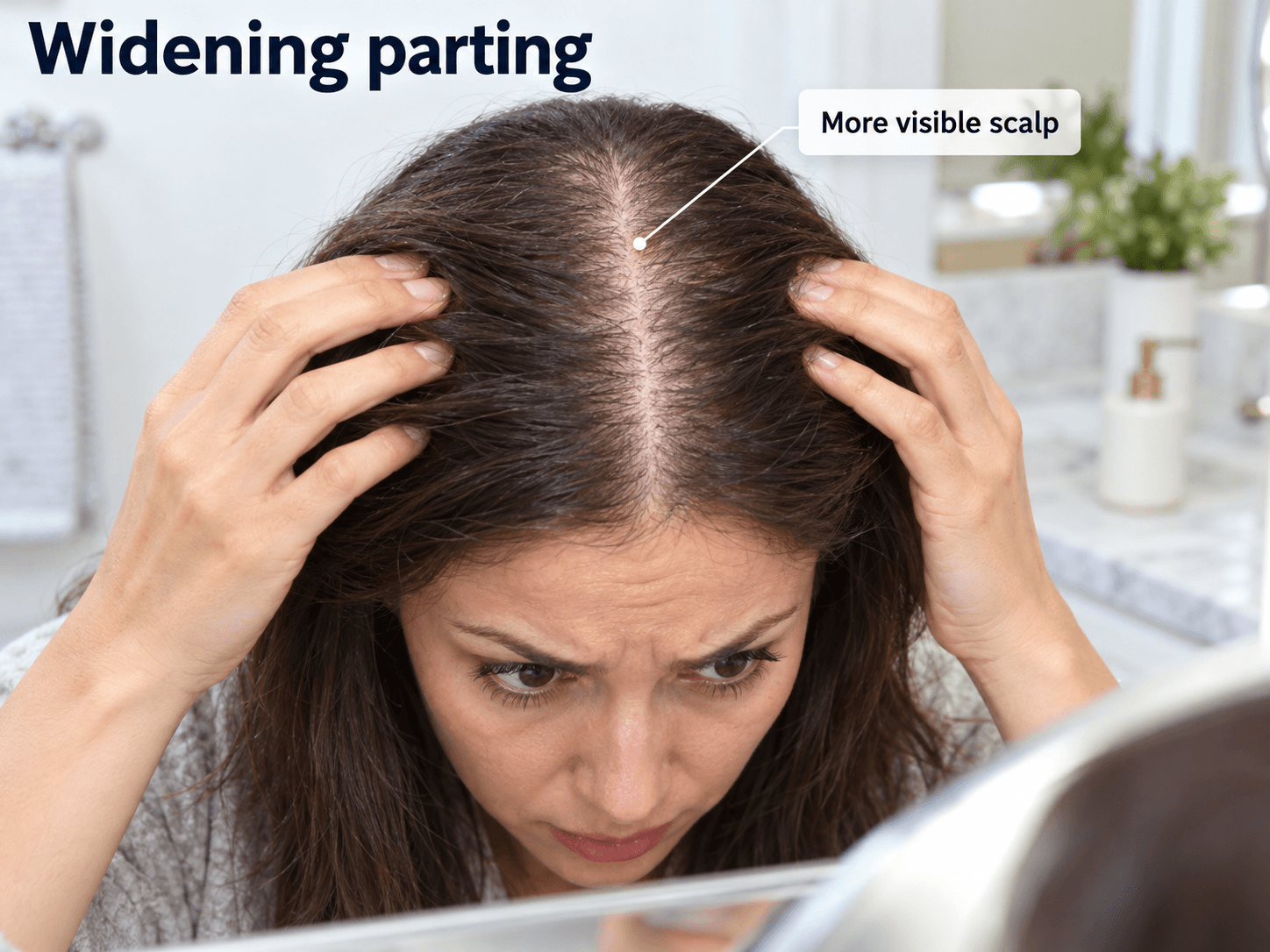
A widening hair partition may suggest female pattern loss, PCOS, thyroid, deficiency, postpartum or shedding causes.
Widening Hair Partition is a symptom, not a final diagnosis. It may be related to root shedding, hair-shaft breakage, scalp inflammation, pattern thinning, patchy hair loss, product irritation or medical triggers.
The right next step depends on amount, duration, pattern, scalp symptoms, hairline, crown or parting changes, medical history, stress, illness, diet, hormonal clues and current products.
Bottom line: use this page to understand what the symptom may mean, what to track and which red flags matter, then take the AI Hair Test or ask a dermatologist if it is severe, progressive or unclear. Results vary.
A widening hair partition means the scalp is becoming more visible along the parting line. In women, it can be an early sign of female pattern hair loss, but it may also happen with telogen effluvium, PCOS, thyroid imbalance, postpartum shedding, nutritional deficiency or scalp inflammation. Tracking parting photos over time helps identify whether it is temporary shedding or progressive thinning. The AI Hair Test can help map the likely cause.
The centre parting is the easiest place to spot reduced density, because the scalp is directly exposed there. As hairs along the part line become finer or fewer, the strip of visible scalp widens — often the first change a woman notices, before any overall thinning is obvious.
In female pattern hair loss, this widening is typically gradual and central, sometimes described as a "Christmas-tree" pattern. Temporary shedding, by contrast, tends to be diffuse and trigger-linked. Telling them apart guides what to do next.
Several factors can reduce partition density, and more than one often overlaps in women.
Genetic, androgen-linked miniaturization along the central scalp — the most common cause. Learn more.
Androgen sensitivity in PCOS can drive partition thinning, often with irregular periods or acne.
Under- or over-active thyroid can increase shedding and thinning along the part.
Hormonal shifts after delivery or around menopause can widen the partition temporarily or progressively.
Low iron, vitamin D or protein, or crash dieting, can weaken the hair cycle where deficiency exists.
Trigger-based diffuse shedding after fever, stress or illness can make the part look wider. More.
| Feature | Temporary shedding | Female pattern hair loss |
|---|---|---|
| Pattern | Diffuse shedding | Wider central partition / crown |
| Speed | Often sudden after a trigger | Gradual over months/years |
| Hair thickness | Usually similar shaft size | Finer, miniaturized strands |
| Triggers | Fever, stress, postpartum, diet | Genetics, hormones, androgen sensitivity |
| Next step | Trigger identification | Early pattern assessment |
Red-flag patterns should be examined by a dermatologist before trying any product — start with an online dermatologist consultation.
None of these confirm a diagnosis, but several "yes" answers make an assessment worthwhile.
Tip: photograph your parting in the same spot and light each month — comparison over time is the most reliable self-check.
Educational, category-level directions matched to this symptom — not a bestseller list. Product availability is populated dynamically from the Hairsncares catalogue.
Growth-supporting serums and actives for early partition thinning, where suitable.
Explore category →Where active shedding accompanies the widening partition.
Explore category →Procapil, redensyl, peptide and caffeine-based daily support.
Explore category →Biotin, iron and vitamin D support where deficiency exists.
Explore category →For suitable female pattern cases — used under medical guidance.
Explore category →Where dandruff or scalp inflammation coexists.
Explore category →Minoxidil may be considered in suitable pattern hair loss cases, but it is not suitable for everyone. Pregnancy, breastfeeding, heart/BP concerns, scalp irritation or other medicines require medical guidance. Minoxidil is a Schedule H medicine in India. Product category suggestions are educational; results vary.
Cautious, evidence-led language applies: "may support", "where suitable", "where deficiency exists". Results vary; doctor guidance is recommended.
The AI Hair Test (with a women-focused pathway) maps your partition change, history, cycle and scalp condition to a likely cause direction and a dermatologist-reviewed next step.
Parting width is hard to judge day to day. The progress tracker logs standardised parting photos so you can see real change over months.
A visual read helps separate widening from lighting or styling. Upload clear parting photos for a dermatologist-reviewed assessment.
"Women often tell me the parting "suddenly" looks wide, but when we compare older photos the change has been creeping for a year or more. That is the nature of female pattern hair loss — gradual, central, easy to miss until bright bathroom light makes it obvious. The useful questions are whether the crown is thinning too, whether periods, acne or facial hair suggest a hormonal driver, and whether a fever, delivery or diet a few months ago could explain temporary shedding instead. Those answers shape the plan far more than any single product."
A symptom needs context and does not confirm a diagnosis. Sudden, severe, patchy or progressive loss, or a painful, pus-filled, crusted or bleeding scalp, needs prompt medical review.
External links open in a new tab and are provided for general education; they are not endorsements and do not replace personalised medical advice.
A wider parting usually means reduced density along the centre scalp. In women this is often early female pattern hair loss, but telogen effluvium, PCOS, thyroid imbalance, postpartum changes or nutritional deficiency can also cause it. Comparing parting photos over time helps clarify.
It can be — a widening central part with finer strands is a classic female pattern sign. However, diffuse shedding from a temporary trigger can mimic it, so confirming the pattern through assessment matters before choosing treatment.
Yes. PCOS involves hormonal changes (including androgen sensitivity) that can drive female pattern–type thinning along the partition, often with irregular periods, acne or excess facial hair. Coordinated care with a gynaecologist or endocrinologist helps.
Thyroid imbalance can increase shedding and thinning, which may make the partition look wider. Treating the underlying thyroid issue, alongside hair-focused care, usually improves the situation over time.
Postpartum shedding (a form of telogen effluvium) can temporarily make the partition look wider in the months after delivery. It often recovers as hormones stabilise, though an underlying pattern tendency can persist.
Where follicles are miniaturizing rather than gone, suitable and consistent treatment may improve density over months. Temporary shedding often recovers once the trigger resolves. Long-standing pattern loss is harder to reverse. Results vary.
Category-level options include growth serums, hair fall control products and supplements where deficiency exists; minoxidil may be considered in suitable cases under guidance. The cause should be confirmed first — try the AI Hair Test.
Minoxidil is sometimes used for female pattern thinning, but it is not suitable for everyone and works best under medical guidance. Pregnancy, breastfeeding and certain conditions need caution. Use only as label-directed or doctor-directed.
Take a standardised parting photo in the same lighting and position every month and compare, ideally via a progress tracker. This is far more reliable than judging change in the mirror each day.
See a dermatologist if the partition keeps widening, the crown is thinning, shedding is heavy or persistent, or there are signs of a hormonal cause — especially before starting prescription treatments such as minoxidil.
A widening part is a classic early sign of pattern thinning, especially in women. Earlier review usually means more options. Some items here are doctor-guided — check suitability before starting.
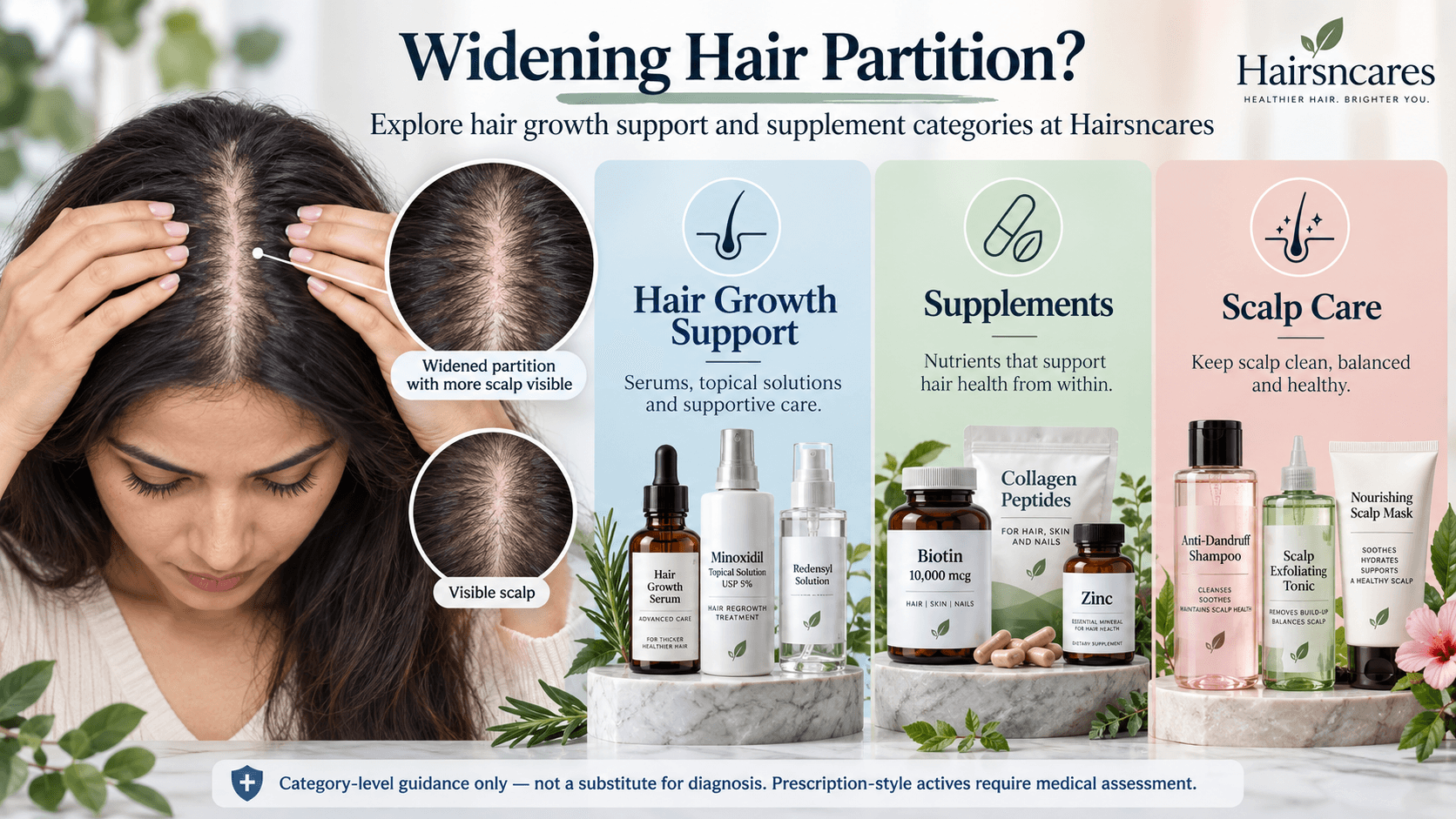
Category-level support and serums for a widening part and reduced density.
An evidence-based option for many, but suitability must be confirmed medically.
Doctor-guided supplementation where testing shows a deficiency.
Your cart is empty