Shedding symptoms
- Falling from root with white bulb
- More strands while combing or washing
- Excessive shedding after a trigger
- Often telogen effluvium — learn more
Hair fall symptoms rarely mean the same thing for everyone. Hair falling from root with a white bulb, extra strands while combing or washing, thinning at the crown, a widening hair partition, an itchy or flaky scalp, or hair coming out in clumps — each pattern points in a different direction. This dermatologist-reviewed guide helps you identify your symptom, understand what it may indicate, and take the right next step instead of guessing.
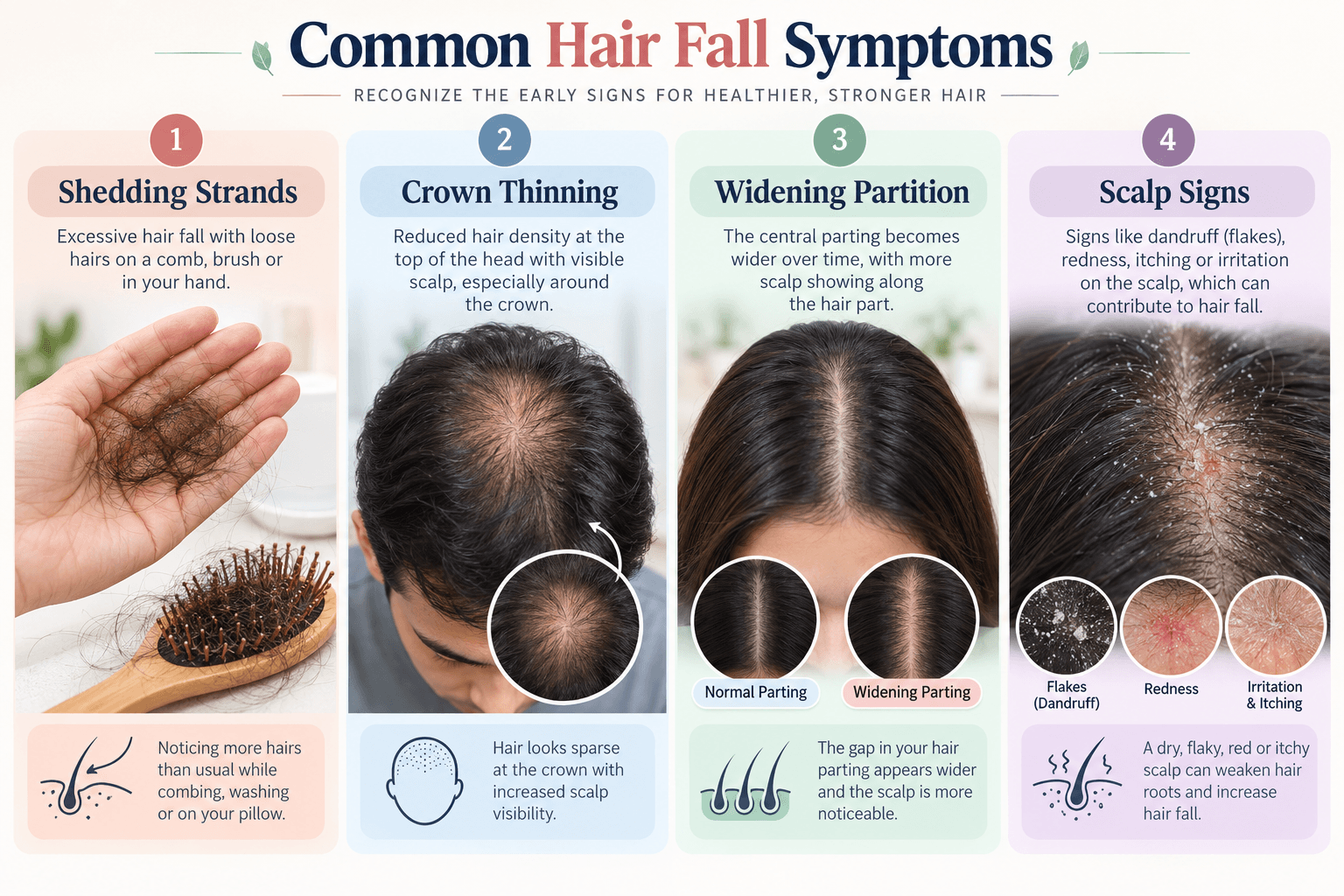
Doctor-reviewed symptom routing hub for shedding, breakage, scalp symptoms, pattern thinning and bald patches.
Hair Fall Symptoms cover shedding, breakage, scalp symptoms, pattern thinning and bald patches — each a symptom that points to a different next step rather than a single diagnosis.
The right next step depends on amount, duration, pattern, scalp symptoms, hairline, crown or parting changes, medical history, stress, illness, diet, hormonal clues and current products.
Bottom line: use this page to understand what the symptom may mean, what to track and which red flags matter, then take the AI Hair Test or ask a dermatologist if it is severe, progressive or unclear. Results vary.
Common hair fall symptoms include more strands on the pillow, comb or shower drain, hair falling from root with a small white bulb, thinning at the crown, a widening partition, visible scalp or see-through hair, itchy or flaky scalp with shedding, and hair coming out in clumps. Shedding around 50–100 strands a day is generally normal — the pattern, duration and accompanying scalp signs decide whether it needs attention.
Every symptom on this page connects to the same guided pathway: notice the symptom, take the AI Hair Test, identify the likely cause direction, match a product category, build a routine, track progress with the progress tracker, and consult a dermatologist where the pattern needs medical review.
Choose the pattern closest to what you see. Each guide explains causes, self-check signs, when to worry, and the right next step.
Full strands shedding with a small white bulb at the end — what the bulb means and when it matters.
Read guide →SheddingHow much hair fall while combing is normal, when it's excessive, and comb-care mistakes to avoid.
Read guide →SheddingShower shedding explained — normal wash-day fall versus a real increase, and shampoo mistakes.
Read guide →ThinningCrown thinning in men and women — pattern hair loss signs, miniaturization and why early action helps.
Read guide →ThinningA wider parting line — female pattern hair loss, PCOS, thyroid and deficiency links, with self-check steps.
Read guide →ScalpItching plus shedding — dandruff, dermatitis, allergy and infection signs, and when itching is serious.
Read guide →ScalpCan dandruff cause hair fall? Flakes, inflammation, ketoconazole guidance and severity signs.
Read guide →ScalpSebum, buildup, wash frequency and hormonal links — why oily scalp and shedding often pair up.
Read guide →BreakageWhite bulb or broken strand? A clear comparison so you fix the right problem first.
Read guide →Patchy LossRound or irregular bald patches — alopecia areata, fungal infection and traction signs that need a doctor.
Read guide →Symptoms cluster into families, and each family has its own usual causes and next steps. Find your family, then read the matching guide.
Twelve product category directions, indexed by symptom family the way a clinic formulary would arrange them. Start with the symptom you notice; for prescription-related products or unclear symptoms, take the AI Hair Test or consult a dermatologist before buying. Product availability is populated dynamically from the Hairsncares catalogue.
Directive before purchase: symptoms overlap. The AI Hair Test maps your symptom to a safer product direction, routine and doctor-review flag — the Product Finder then matches categories to your profile.
Identify the cause before buying — take the AI Hair Test if unsure.
Results vary — the pattern of loss matters. Patch-test sensitive scalps and track with monthly photos.
Dry scalp is not always dandruff — see the dry scalp guide. Pain, pus or crusting needs a doctor, not products.
Supplements work best where deficiency exists. Do not self-start iron, high-dose vitamin D or overlapping supplements blindly — lab-guided preferred.
Breakage is different from root hair fall — check breakage vs fall first.
Use as label-directed or doctor-directed. Severe scalp symptoms need dermatologist review.
12Minoxidil SolutionPattern hair loss · crown thinning · widening partition, where suitableminoxidil — Schedule H cautionMinoxidil is not suitable for everyone. Use only as label-directed or doctor-directed.
Hair fall is a sign, not a diagnosis. Most symptoms on this page trace back to a small set of underlying mechanisms — and the right plan depends on which one is driving yours.
Fever, illness, surgery, crash dieting, childbirth or intense stress can push many follicles into the resting phase at once — appearing 2–3 months later as excessive shedding or telogen effluvium.
DHT sensitivity in genetically prone follicles causes gradual miniaturization — seen as crown thinning in men and a widening partition in women. PCOS and thyroid imbalance can add to it.
Low iron, vitamin D, protein or B12 — common with restrictive diets — can weaken the hair cycle. Correction helps where deficiency exists, which is why testing beats guessing with supplements.
Dandruff, seborrheic dermatitis and fungal overgrowth inflame the follicle environment, worsening shedding and itching — scalp-first treatment often improves hair fall.
Heat styling, chemical treatments, tight hairstyles and rough handling cause breakage and traction — which mimic hair fall but need a repair-and-protect approach instead.
Alopecia areata, scarring alopecias, certain medicines and systemic illness can cause bald patches or rapid loss — these need dermatologist diagnosis before any product.
Symptom guides orient you; a structured, dermatologist-reviewed assessment narrows the cause. Here is how the Hairsncares pathway works.
Your shedding pattern, duration, triggers, family history, diet and medical background.
Parting, crown and scalp photos assessed for density, visibility, flakes and inflammation.
The AI Hair Test maps your inputs to a likely cause family — shedding, pattern, scalp or breakage.
Doctor-reviewed framework flags red-flag patterns for consultation instead of products.
Matched product categories, routine, progress tracking — and prescription guidance where appropriate.
A quick interpretation layer before you go deeper — each family maps to a different set of likely causes.
May indicate telogen effluvium, illness, stress, postpartum changes, nutritional deficiency, thyroid imbalance, PCOS or early pattern loss.
May indicate miniaturization or pattern hair loss — earlier assessment generally means better options.
May indicate dandruff, seborrheic dermatitis, infection, scalp acne or product irritation.
May indicate heat, friction, chemical treatments or poor conditioning — a repair-and-protect problem, not a root problem.
May require dermatologist diagnosis — alopecia areata, fungal infection, traction or scarring processes should be examined, not self-treated.
A crawlable, at-a-glance map from symptom to likely direction, category and next step. Always confirm direction before buying.
| Symptom | Possible direction | Suggested product category | Best next step |
|---|---|---|---|
| Hair falling from root | Shedding / telogen effluvium | Hair fall control + supplements where deficiency exists | AI Hair Test |
| Dandruff with hair fall | Scalp inflammation | Anti-dandruff + ketoconazole category | Scalp Analysis |
| Widening partition | Female pattern / hormonal / deficiency | Hair growth serum + doctor review | AI Hair Test |
| Thinning at crown | Pattern hair loss / miniaturization | Minoxidil where suitable + growth serums | Doctor consultation |
| Oily scalp with hair fall | Sebum / buildup / seborrheic scalp | Oily scalp shampoo + scalp serum | Scalp Analysis |
| Breakage-type strands | Damage / heat / chemical | Hair mask & repair + leave-in serum | Routine Builder |
| Bald patches | Alopecia / infection / traction | Doctor consultation before products | Upload scalp photos |
Bald patches, scalp pain, pus, crusting, scarring, rapidly spreading loss, eyebrow or body hair loss, or hair fall with fever or systemic symptoms should be examined by a dermatologist before trying any product. Start with an online dermatologist consultation.
Answer a short set of questions about your shedding pattern, scalp condition, history and triggers. The AI Hair Test points to a likely cause direction and routes you to a dermatologist-reviewed plan.
Flakes, oiliness, visible scalp or parting changes are easier to assess visually. Upload clear scalp and parting photos for an AI-assisted, dermatologist-reviewed scalp assessment.
Hairsncares recommends product categories based on your symptom and likely cause — not bestseller lists. Take the AI Hair Test for a matched selection.
Shampoos and serums for root shedding — suited to shedding-family symptoms.
Explore →Growth serums and actives that may support thinning-family concerns, where suitable.
Explore →Ketoconazole and zinc pyrithione options for flakes, itching and seborrheic scalp.
Explore →Scalp serums, exfoliators and barrier support for oily, itchy or sensitive scalps.
Explore →For pattern thinning where suitable — to be used under medical guidance.
Explore →Biotin, iron and vitamin D support where deficiency exists — guidance recommended.
Explore →Non-prescription actives that can be considered for early thinning support.
Explore →Browse the full dermatologist-guided Hairsncares range by concern and scalp type.
Explore →Prescription required where applicable. Use under medical supervision. Not suitable for everyone. Results vary. Minoxidil is a Schedule H medicine in India — caution: to be taken under medical supervision only.
Once you know your symptom family, the Routine Builder sequences cleansing, treatment and support steps into a simple weekly plan — including hair fall control and dandruff control routines.
Hair responds slowly. Shedding from a temporary trigger often settles over 3–6 months once the cause resolves; pattern thinning needs consistent, doctor-guided treatment before visible change. Monthly photos beat daily mirror checks — improvement usually progresses in stages rather than overnight.
"Most people who reach this page have already spent weeks worrying — counting strands on the pillow, checking the parting in every mirror. My advice is simple: don't treat the worry, identify the pattern. Shedding, thinning, scalp disease, breakage and patchy loss are different problems with different solutions. A symptom guide can orient you, and the AI Hair Test can narrow the direction — but if your pattern shows any red flags, see a dermatologist before buying anything. A cause-based plan almost always beats a cart full of guesses."
This symptom guide was written for patient education by the Hairsncares medical content team and reviewed by Dr. Amit Agarkar, MD Dermatology. It reflects established dermatology and trichology understanding of hair shedding, pattern hair loss, scalp disease and hair breakage.
Hairsncares educational pages are designed to be patient-friendly, but they should also connect to credible medical references for users who want deeper reading.
Useful for understanding common forms of hair loss and when to consult a board-certified dermatologist.
Read on aad.org ↗DermNetClinical overview of trigger-based shedding — the mechanism behind many sudden hair fall episodes.
Read on dermnetnz.org ↗NCBI / StatPearlsPeer-reviewed reference on pattern hair loss, DHT sensitivity and miniaturization in men and women.
Read on ncbi.nlm.nih.gov ↗DermNetBackground on widening partition, diffuse crown thinning and hormonal contributors in women.
Read on dermnetnz.org ↗DermNetClinical reference for dandruff-spectrum scalp inflammation linked to itching and shedding.
Read on dermnetnz.org ↗NCBI / StatPearlsPharmacology reference covering minoxidil use, expected response and safety considerations.
Read on ncbi.nlm.nih.gov ↗DermNetReference on patchy autoimmune hair loss — why bald patches need clinical diagnosis first.
Read on dermnetnz.org ↗Mayo ClinicPatient-friendly institutional overview of hair loss symptoms, causes and risk factors.
Read on mayoclinic.org ↗External references open in a new tab and are provided for deeper reading. They do not replace the Hairsncares doctor-reviewed guidance on this page or a personal consultation. Reviewed by Dr. Amit Agarkar, MD Dermatology — see how our content is reviewed.
A symptom needs context and does not confirm a diagnosis. Sudden, severe, patchy or progressive loss, or a painful, pus-filled, crusted or bleeding scalp, needs prompt medical review.
External links open in a new tab and are provided for general education; they are not endorsements and do not replace personalised medical advice.
Common hair fall symptoms include more strands on the pillow, comb or shower drain, hair falling from root with a white bulb, thinning at the crown, a widening hair partition, visible scalp, see-through hair, itchy or flaky scalp with shedding, and hair coming out in clumps. The pattern and duration matter more than any single bad hair day.
Shedding roughly 50–100 strands a day is generally considered normal, and slightly more on wash days. Hair fall becomes a concern when shedding stays high for weeks, density visibly reduces, the partition widens, or scalp symptoms like itching, flakes or pain appear alongside.
Hair fall from the root usually shows a full-length strand with a small white bulb at one end. Breakage produces shorter, uneven pieces without a bulb, often with split ends, frizz or rough texture. See the hair breakage vs hair fall guide for a full comparison.
A small white or translucent bulb usually means the strand completed its natural cycle and shed from the root — it is not your hair root being destroyed. Occasional bulb-tipped strands are normal; a sudden, sustained increase may suggest telogen effluvium or another shedding trigger worth evaluating.
A gradually widening partition is a common early sign of female pattern hair loss, and may also relate to PCOS, thyroid imbalance, iron deficiency or prolonged shedding. The widening hair partition guide covers self-check steps with parting photos.
Yes — scalp inflammation from dandruff or seborrheic dermatitis can worsen shedding, and repeated scratching adds breakage on top. Treating the scalp condition often improves hair fall, which is why scalp symptoms and shedding should be assessed together rather than separately.
Hair fall is often normal when it stays within the usual daily range, follows a known temporary trigger such as fever, illness, delivery or crash dieting, settles within a few months, and is not accompanied by bald patches, scalp disease signs or visible density loss. Temporary shedding usually recovers as the trigger resolves.
See a dermatologist promptly for bald patches, hair coming out in clumps, scalp pain, redness, pus, crusting or scarring, rapidly progressing thinning, eyebrow or body hair loss, or shedding that persists beyond a few months. These patterns need clinical examination rather than over-the-counter products alone.
Cause-first works better than product-first. Pattern hair loss, telogen effluvium, scalp disease and breakage each respond to different approaches, so randomly buying products can waste months. A short symptom check or AI Hair Test helps match the likely cause to a suitable category of products or care.
The AI Hair Test maps your symptoms, history, scalp condition and photos to a likely cause direction, then routes you to a dermatologist-reviewed plan — suitable product categories, a routine, progress tracking, and doctor consultation where the pattern needs medical review. It is a guidance tool, not a replacement for diagnosis.
Match your main symptom to dermatologist-reviewed product categories below. For active or prescription-style treatments, take the AI Hair Test or consult a dermatologist before buying — product suggestions here are category-level guidance only.
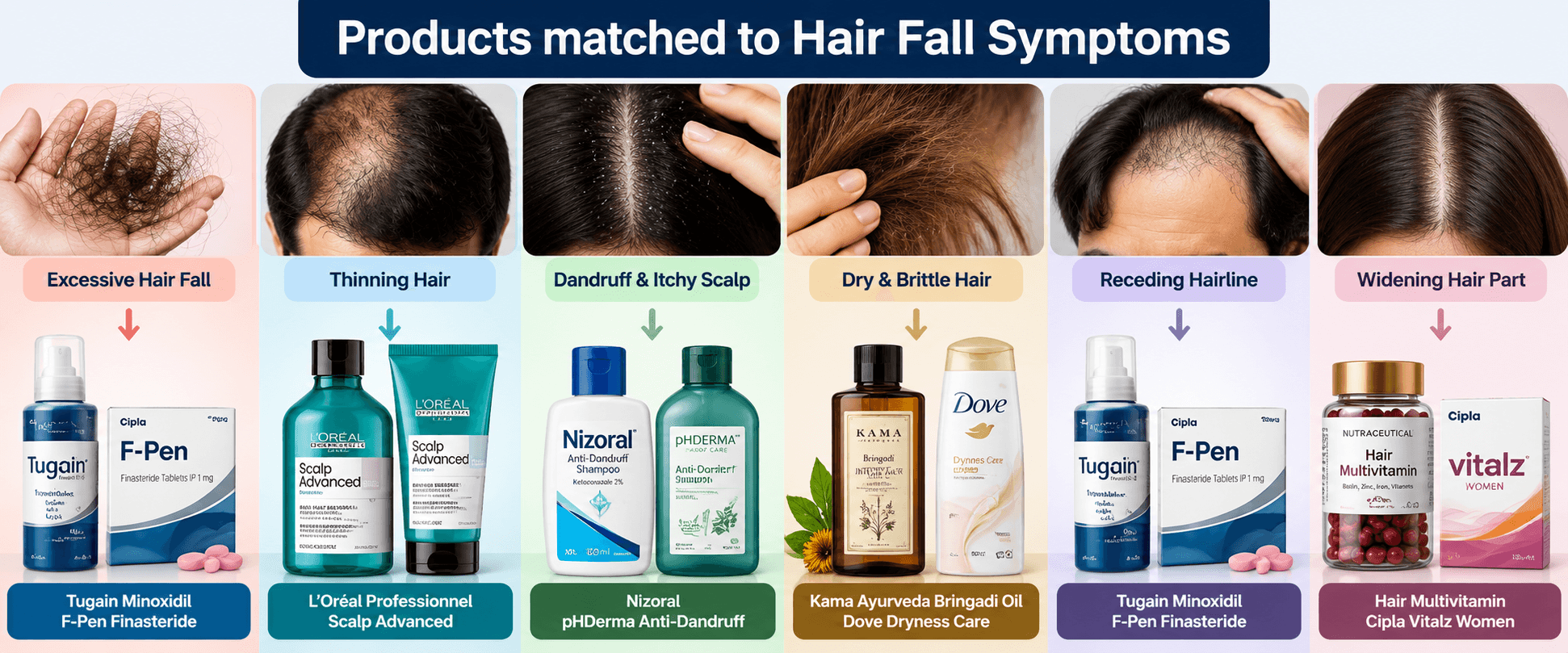
For root-level shedding, combing/washing fall and early thinning.
For itch, flaking, oily scalp and dandruff-linked shedding.
For mid-shaft snapping rather than root-level fall.
Hairsncares is a dermatologist-led AI hair intelligence clinic founded in Mumbai, Maharashtra by Dr. Amit Agarkar, MD Dermatology. Patients across India use the AI Hair Test, scalp analysis and online dermatologist consultation to understand their hair fall symptoms and follow a doctor-reviewed plan — without guesswork.
Identify your symptom, let the AI Hair Test map the likely cause, and follow a dermatologist-reviewed plan — products, routine, tracking and doctor care, in one place.
Your cart is empty