AI-POWERED WOMEN'S HAIR DIAGNOSIS FOR INDIA

Hair Fall After Dieting: Why It Happens and How to Recover Safely

Noticed more hair shedding a couple of months after a diet or rapid weight loss? First, some reassurance: this is common, it's usually temporary, and it's not your fault. When calories, protein and nutrients drop sharply, the hair cycle gets disrupted and many hairs shed together — a telogen-effluvium-type shedding that typically shows up two to three months later. The good news is that hair generally recoversonce balanced nutrition is restored. The real fix isn't a magic product — it's eating enough and eating well, correcting any deficiency like low iron, and being patient. Hairsncares helps you understand your shedding, flag what to check with a doctor, and support recovery gently. Supplements don't fix this on their own. Results vary.
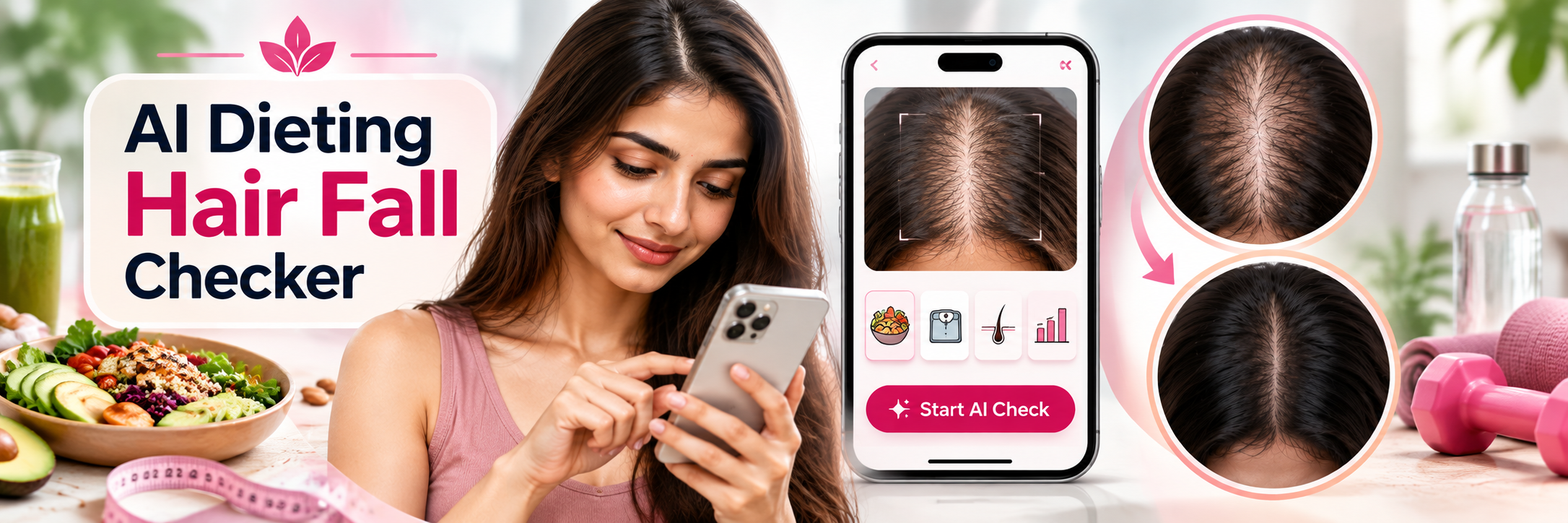
  • AI dieting hair fall checker
  • Why it appears 2–3 months later
  • Usually temporary & reversible
  • Restore nutrition (the real fix)
  • Check iron, protein & thyroid
  • Supportive, non-judgmental
Hero image
📷
Hero visualalt: "Woman using the AI dieting hair fall checker — Hairsncares" · 520×150 WebP
🥗
Dieting Hair Fall CheckAI Checker — sample preview
Likely patternTelogen effluvium
Onset2–3 months after
The real fixRestore nutrition
CheckIron, protein, thyroid
OutlookUsually recovers

Illustrative sample only. AI screening helps guide decisions and does not replace a doctor's diagnosis or blood tests. It does not promote dieting or weight-loss methods.

RefeedEat enough
ProteinBuild blocks
IronTest it
PatienceMonths
AI shedding checkdieting-aware
🩺
Doctor-reviewedwomen's hair guidance
🥗
Nutrition-firstthe real fix
💖
Non-judgmentalsupportive tone
🚚
India-widedelivery
Quick Answer

Why is my hair falling after dieting — and how do I fix it?

Hair fall after dieting is usually a temporary telogen effluvium — a diffuse shedding triggered when the body faces a sharp drop in calories, protein and nutrients. Many hairs shift into the shedding phase together, and the shedding typically appears two to three months afterthe diet, which is why people often don't connect the two. The reassuring part: it's usually reversible. The real fix is restoring adequate, balanced nutrition — enough calories, sufficient protein, and a varied diet supplying iron, zinc and vitamins — and stopping crash dieting and extreme restriction. Supplements don't fix this on their own; they help only where a deficiency like low iron is confirmed by testing, under medical advice. Recovery is gradual over months because hair grows slowly. See a doctor if shedding is severe or persistent, or if eating has become hard or distressing. Results vary.

Doctor-Reviewed Women's Hair Loss GuideDieting-Related Hair Fall

Crash dieting, rapid weight loss and low protein can trigger delayed shedding. Restoring nutrition safely matters more than quick fixes.

AI Summary

Hair Fall After Dieting in Simple Terms

Hair Fall After Dietingis part of the women's hair-loss spectrum. It may overlap with shedding, thinning, hormonal changes, nutritional gaps, scalp symptoms, female pattern loss or life-stage triggers.

The correct next step depends on pattern, duration, age, periods, pregnancy or breastfeeding status, weight changes, stress, scalp symptoms, medical history, current medicines and previous product use.

Bottom line: use this page for education and screening direction — it does not diagnose or prescribe. Take the AI Hair Test for structured screening and consult a dermatologist when symptoms are progressive, severe, patchy, painful or medically complex. Results vary.
The Basics

What Hair Fall After Dieting Really Is

Section image
🥗
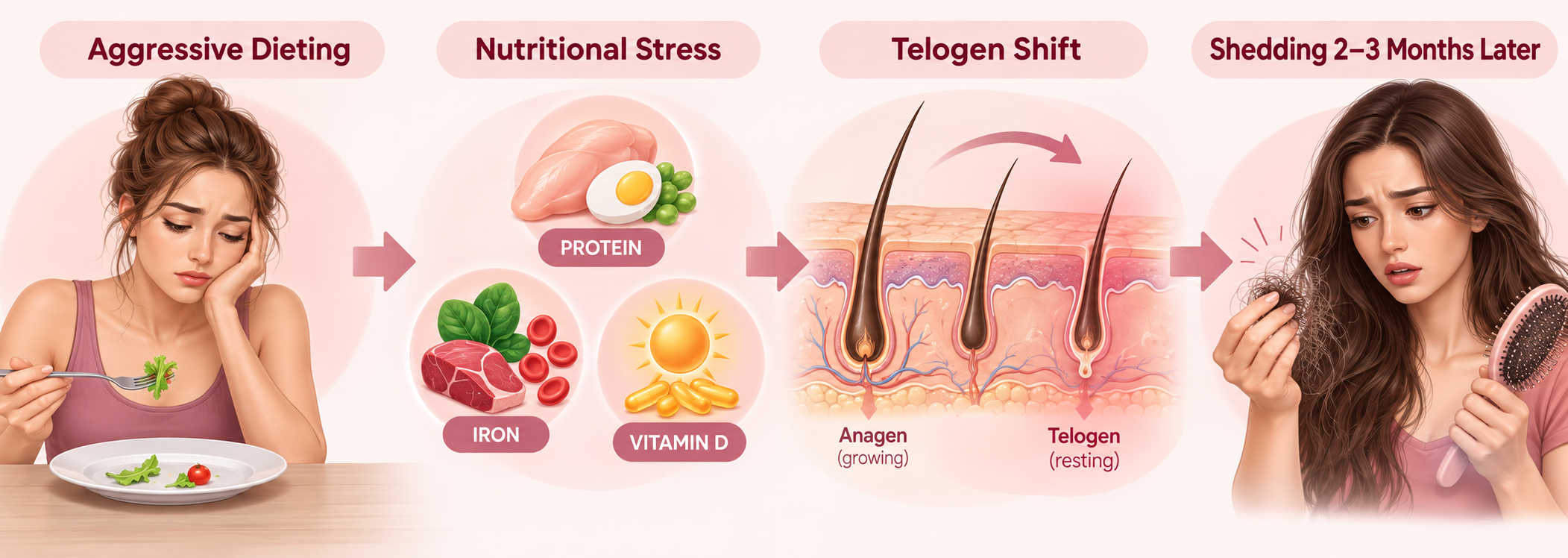
Dieting hair fall — explainer diagramalt: "Nutritional stress triggers telogen effluvium 2–3 months later" · 900×320 WebP

Hair fall after dieting is, in most cases, a telogen effluvium — the medical term for a diffuse shedding that happens when many hairs are pushed into the resting phase at once and then shed together. The trigger here is nutritional stress: a sharp drop in calories, protein or key nutrients during dieting or rapid weight loss.

Because of how the hair cycle works, the shedding usually appears two to three months after the diet, not during it — so it can feel like it came out of nowhere. This delay is completely typical and, once you know it, actually reassuring: it points clearly to restoring nutrition as the way forward.

The most important thing to understand is that this is usually temporary and reversible, not permanent damage. The hair generally recovers once you're eating enough and well again, though it takes months because hair grows slowly. No product or supplement fixes this on its own — the real solution is adequate, balanced nutrition, with any deficiency corrected under medical advice. Results vary.

Wondering if this is what's happening? A quick check can help you understand it.

Check My Shedding
What to Notice

Signs of Dieting-Related Shedding

Dieting hair fall has a recognisable picture. These are the things people most often notice.

1

More shedding 2–3 months after a diet

2

Handfuls of hair when washing or brushing

3

Even, all-over thinning (not patches)

4

A thinner ponytail or less volume

5

Followed crash dieting or rapid weight loss

6

Low protein or very restricted eating

7

Fatigue or signs of low iron

8

Shedding after fasting or very low-calorie plans

9

Shedding that's distressing but diffuse

Recognise these? The checker helps confirm the likely pattern.

Check the Pattern
The Mechanism

Why Dieting Triggers Shedding

It comes down to nutritional stress on the hair cycle. These are the main contributors worth flagging.
Section image
📋
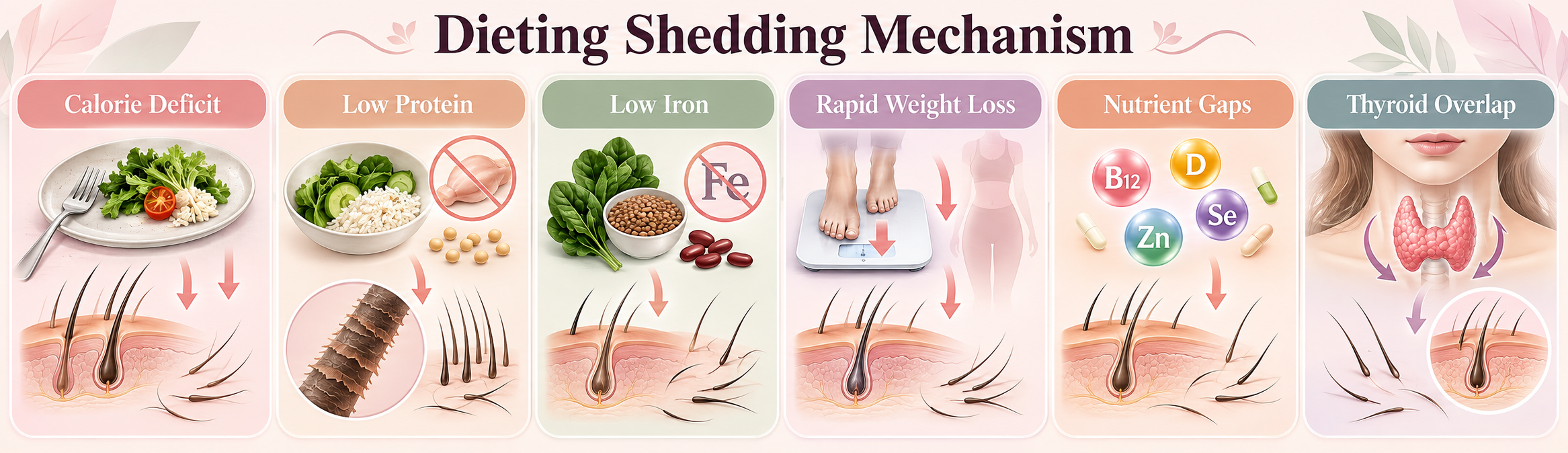
Dieting shedding mechanism — illustrated gridalt: "Calorie deficit, low protein, low iron, rapid weight loss, nutrient gaps, thyroid overlap" · 900×260 WebP

📉 Calorie deficit

A sharp energy shortfall disrupts the hair cycle.

Fix: eat enough

🥩 Low protein

Hair is largely protein; low intake stresses growth.

Fix: add protein

🩸 Low iron

Dieting lowers iron; a common shedding cause.

Action: test it

Rapid weight loss

Fast loss is a strong telogen effluvium trigger.

Better: go gradual

🍲 Nutrient gaps

Low zinc, vitamins and variety affect hair.

Fix: eat varied

🧬 Thyroid overlap

Thyroid problems can coexist and add shedding.

Action: check it

Want your likely contributors flagged? The checker highlights what to address.

Flag My Contributors
Tell Them Apart

Temporary Shedding vs Needs a Doctor

Most dieting hair fall is temporary and improves with nutrition. Here's how to tell what can be supported gently from what should be checked.

FeatureTemporary dieting sheddingSee a doctor
Timing2–3 months after dietingNo clear link, or not improving
PatternEven, diffuse, all overPatches, or thinning over the crown
After refeedingSettles over monthsContinues despite restored nutrition
Other symptomsNoneFatigue, weight or temperature change
EatingBack to balancedStill very restricted or hard to manage
WellbeingCoping okayDistress around food, eating or body

If your shedding sits in the left column and you've restored balanced eating, gentle support and patience are usually enough. If anything's in the right column — especially difficulty eating or distress around food — please reach out to a doctor for caring, practical support. There's no judgment here.

Anything in the right column? A doctor can check and support you kindly.

See a DoctorCheck First
The Timeline

The Dieting Shedding Timeline

Understanding the arc makes it far less frightening — and shows why patience and nutrition matter.

0
The diet
Nutritional stress

Crash dieting, rapid weight loss or restriction creates a calorie, protein and nutrient shortfall that stresses the hair cycle — though hair looks normal for now.

2–3
Shedding starts
Months later

Hairs nudged into the resting phase shed together, so diffuse shedding appears two to three months after the diet — often when you've already stopped it.

3–5
Peak & refeed
Restore nutrition

Shedding peaks, then begins to settle once balanced, adequate nutrition is restored and any deficiency is corrected under advice. This is the turning point.

6+
Recovery
Gradual regrowth

New hair grows in and density gradually improves over the following months, since hair grows slowly. If shedding persists, see a doctor. Results vary.

Want to follow your recovery? Set a baseline and track month by month.

Start Tracking
Be Thorough

Causes to Rule Out

Dieting can lower several nutrients at once, and other causes can overlap. These are worth checking with a doctor if shedding is significant or persistent.

🥩

Iron deficiency

Why
Dieting lowers iron; a common shedding cause.
Clue
Fatigue, pale skin, heavy periods.
🍗

Low protein

Why
Hair is largely protein; low intake stresses growth.
Clue
Very restricted or low-protein diet.

Vitamin D deficiency

Why
Low vitamin D is linked to shedding.
Clue
Fatigue, low mood, aches.
🩸

Thyroid problems

Why
Thyroid issues cause diffuse shedding and can coexist.
Clue
Weight, energy or temperature changes.
🧠

General telogen effluvium

Why
Other stresses (illness, surgery) cause the same shedding.
Clue
Another trigger around the same time.
🧬

Female pattern loss

Why
Shedding can unmask an underlying tendency.
Clue
Widening parting, family history.

Significant or persistent shedding? A doctor can test and guide recovery.

See a DoctorCheck First
Check It

The AI Dieting Hair Fall Checker

Section image
📱
Dieting Hair Fall Checker — app screen previewalt: "Dieting hair fall checker questions on a smartphone" · 900×150 WebP
  1. 1 Did you diet or lose weight in the last few months?
  2. 2 Was it crash dieting or rapid weight loss?
  3. 3 Did shedding start about 2–3 months later?
  4. 4 Is the shedding even and all over (not patchy)?
  5. 5 Has your protein intake been low?
  6. 6 Any fatigue or signs of low iron?
  7. 7 Have you restored balanced eating yet?
  8. 8 Any thyroid signs (weight, temperature, energy)?
  9. 9 Is your parting widening (pattern thinning)?
  10. 10 Is eating or food causing you worry?
Your AI check suggests
  • Whether it fits dieting-related shedding
  • Likely deficiencies to discuss with a doctor
  • Nutrition steps to support recovery
  • Tests to consider (ferritin, thyroid)
  • A realistic recovery timeline
  • When to see a doctor
  • Caring support if eating feels hard
Start Checker
Medical Safety

When to See a Doctor

Most dieting shedding settles with restored nutrition, but some situations deserve a doctor — and if eating or body image has become difficult, please reach out for caring support. There's no judgment here.

Section image
Red-flag symptoms — when to see a doctoralt: "Persistent shedding, patches, fatigue, difficulty eating" · 900×240 WebP
  • Heavy or persistent shedding
  • Shedding that continues despite restored nutrition
  • Thinning over the crown / a widening parting
  • Any bald patches or scalp scarring
  • Fatigue, pale skin or heavy periods (possible low iron)
  • Weight, energy or temperature changes (thyroid)
  • Difficulty eating adequately, or rebuilding nutrition
  • Anxiety or distress around food, eating or body image
  • Repeated cycles of crash dieting
  • Hair loss causing significant distress
Consult a Doctor
Shop by Need

Best Product Categories for Recovery

Supportive care to use alongside the real fix — restoring balanced nutrition. These support hair and scalp health; they do not by themselves correct dieting-related shedding or replace eating well and medical assessment. Iron and vitamin products are for use only when deficiency is confirmed, under medical advice.
Section image
🛍
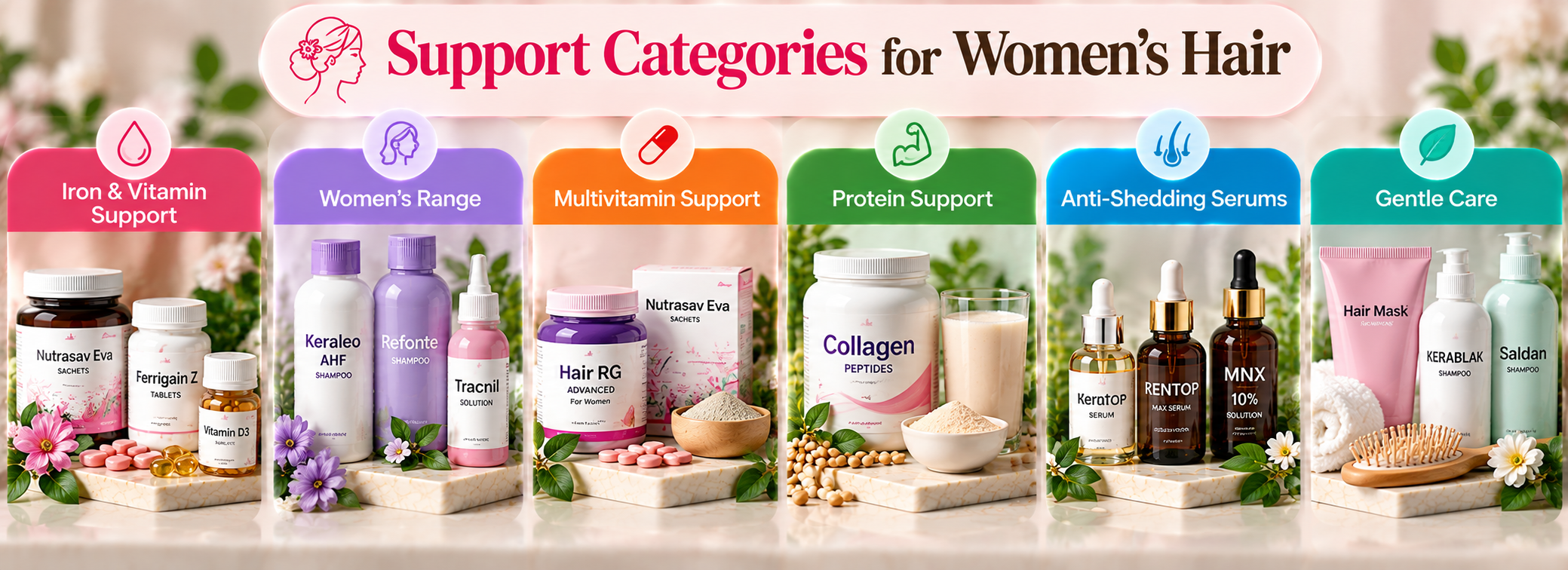
Support categories — shelf overviewalt: "Iron & vitamin support, women's range, multivitamin, protein support, anti-shedding serum, gentle care" · 900×260 WebP
🥩

Iron & vitamin support

For confirmed deficiency, after testing and doctor advice.

Best for: tested deficiency
Shop
👩

Women's hair fall range

Gentle supportive care for diffuse shedding.

Best for: dieting shedding
Shop
🩸

Hair multivitamins

Broad nutrition support alongside balanced meals.

Best for: general support
Shop
🍗

Protein support

Helps top up protein as part of refeeding.

Best for: low protein intake
Shop
💧

Anti-shedding serums

Supportive leave-on care during recovery.

Best for: active shedding
Shop
💊

Gentle shampoos & care

Kind cleansing while the hair recovers.

Best for: daily care
Shop

Not sure which fits you? The Product Finder matches support to your recovery.

Open Product FinderIron & Vitamin
Featured

Supportive Products for Recovery

Sample selection. Prices, ratings and availability shown are placeholders. The real fix is restored nutrition.

Products coming soon

We're curating the right supportive products for this concern. In the meantime, browse the full Hairsncares shop or take the AI Hair Test for a tailored match.

Browse all products

These products offer gentle, supportive care for the hair and scalp alongside the real fix for dieting-related shedding, which is restoring adequate, balanced nutrition. They do not by themselves correct dieting-related hair fall, do not replace eating well, and do not replace medical assessment, blood tests or diagnosis. Supplements do not cure dieting-related hair fall; they help only where a deficiency is confirmed. Iron and vitamin products should be used only when deficiency is suspected or confirmed and under medical guidance, and high-dose vitamins or iron should not be taken without testing. No product or supplement is guaranteed to regrow hair. Crash dieting and extreme restriction should be avoided. If eating has become difficult or distressing, please seek caring medical support. Prescription (Rx) items require a valid prescription. Prices, ratings and availability are placeholders to be populated dynamically. Results vary.

Before adding to cart, check your shedding so your spend supports real recovery.

Check FirstIron & Vitamin
Ecommerce Pathways

Recommended Hairsncares Product Pathways

Where to go next for supportive care — matched to women's hair-loss needs. These categories support hair and scalp health alongside restoring nutrition; they do not cure dieting-related shedding or replace medical assessment.

After Dieting

Choose Your Support Pathway

The real fix for dieting-related shedding is restoring adequate, balanced nutrition. These pathways support your hair gently while you do that — and iron and vitamin products should be used only when deficiency is suspected or confirmed, under medical guidance.

🥩

Iron & Vitamin Hair Support

/products/iron-vitamin-hair-support/

The most relevant pathway after dieting — for deficiency-related shedding from low iron, low ferritin, low vitamin D, low B12 or fatigue, which restriction and rapid weight loss commonly cause. Use only after a doctor confirms a need; iron should never be taken without testing.

Explore ›
👩

Women's Hair Fall Support

/products/women-hair-fall/

The main gateway for female shedding, thinning and weak hair, including dieting-related diffuse shedding — supportive, gentle care to use alongside rebuilding balanced nutrition.

Explore ›
🥽

PCOS Hair Loss Support

/products/pcos-hair-loss/

A related hormonal hair-loss pathway for women with irregular periods, acne, facial hair, androgen sensitivity or PCOS-like symptoms that may underlie thinning rather than dieting alone. Add a doctor evaluation note.

Explore ›
🫂

Postpartum Hair Support

/products/postpartum-hair-support/

A related women's life-stage pathway, useful as an internal comparison for diffuse shedding rather than a direct dieting match. Add pregnancy and breastfeeding caution; supplements on medical advice.

Explore ›

Medical safety: These products support hair and scalp health alongside good nutrition. They do not cure dieting-related hair fall, do not replace eating adequately and well, and do not replace medical assessment, blood tests or diagnosis. Supplements do not cure dieting-related shedding; they help only where a deficiency is confirmed. Avoid crash dieting and extreme restriction. Iron and vitamin products should be used only when deficiency is suspected or confirmed and under appropriate medical guidance; high-dose iron or vitamins should not be taken without testing. Pregnancy, lactation, thyroid disease and chronic medical conditions need doctor review. If eating has become difficult or distressing, please seek caring medical support. Results vary.

Build a Habit

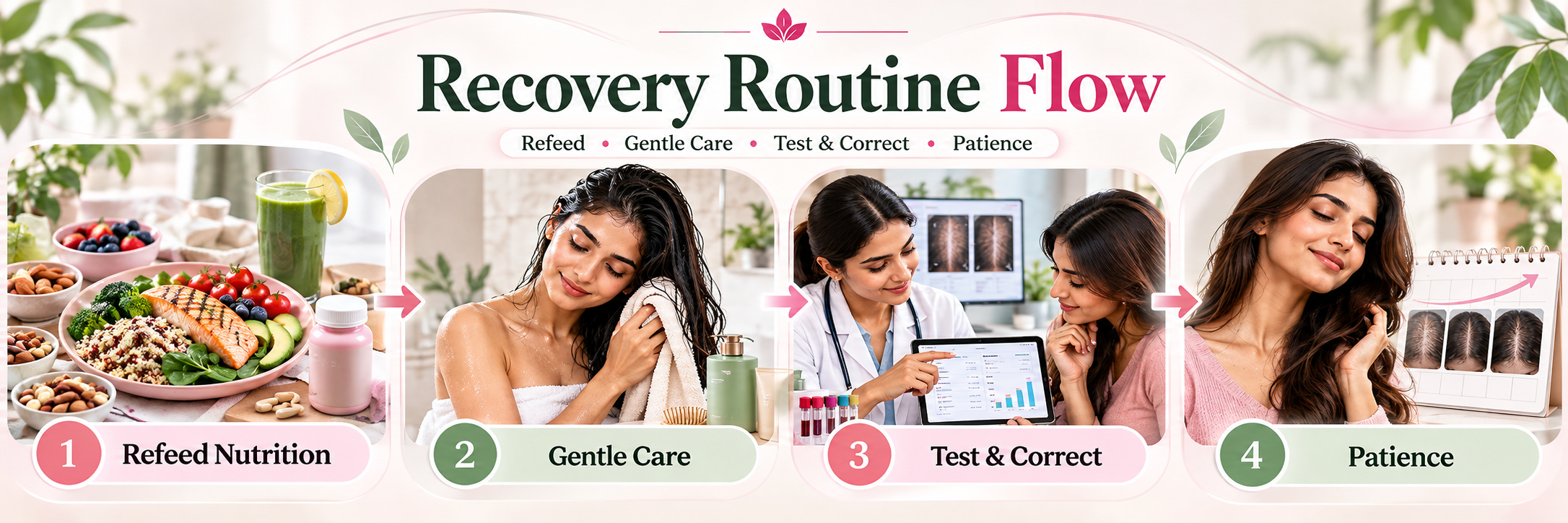
A Supportive Recovery Routine

Gentle, consistent care that supports your hair while nutrition is restored. Use active or prescription items only under medical guidance, and avoid them in pregnancy or breastfeeding unless a doctor advises.
Section image
📝
Recovery routine flow — illustrated stepsalt: "Refeed nutrition, gentle care, test & correct, patience" · 900×240 WebP
Eat enough

Restore adequate calories; stop crash dieting.

Protein

Hair is mostly protein — include it in meals.

Variety

Iron, zinc and vitamins from a varied diet.

Go gradual

Manage weight slowly and sustainably, if at all.

Wash

Gentle shampoo; don't over-wash or scrub.

Condition

Strengthening conditioner for slip and shine.

Detangle

Be gentle; avoid harsh brushing when wet.

Protect

Limit heat; avoid tight, pulling styles.

Test first

Ask a doctor about ferritin, vitamin D, thyroid.

Correct

Fix a confirmed deficiency under guidance.

No guessing

Don't take iron or high-dose vitamins blindly.

Support

A supportive serum can be used meanwhile.

Give it time

Recovery is gradual over several months.

Photograph

Track shedding and density monthly.

Stay steady

Avoid repeat crash diets that re-trigger it.

Review

See a doctor if there's no improvement.

Want a routine built around recovery? Generate a personalised, nutrition-aware plan.

Build My Routine
Know Your Actives

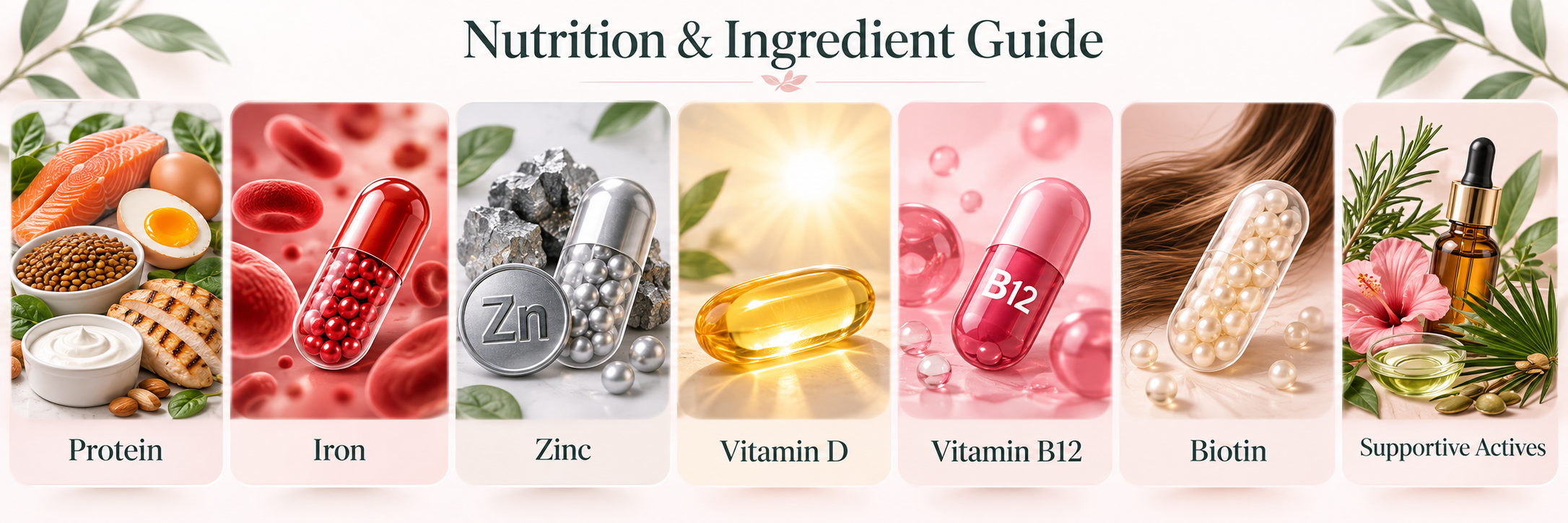
Ingredient & Nutrition Guide

Evidence labels are a simple guide: strong, moderate, supportive or mainly cosmetic. Rx marks prescription items; the rose tag flags pregnancy/lactation caution. None of these replace eating adequately.
Section image
🥩
Nutrition & ingredient guide — illustratedalt: "Protein, iron, zinc, vitamin D, B12, biotin and supportive actives" · 900×200 WebP

Adequate protein

Strong (foundation)

Hair is largely protein; enough protein is foundational to recovery.

Best for: everyone recovering from dieting shedding.

Caution: from food first; restriction undermines it.

Learn more

Iron (if low)

Strong (if deficient)

Low iron is a common cause of diffuse shedding, especially in women who diet.

Best for: confirmed low ferritin after testing.

Caution: test first; iron is harmful in excess — never take blindly.

Related products

Zinc (if low)

Moderate (if deficient)

Zinc supports the hair cycle and can be low with restricted eating.

Best for: confirmed shortfall under advice.

Caution: only if needed; excess zinc causes problems.

Learn more

Vitamin D (if low) Preg caution

Moderate (if deficient)

Low vitamin D is common and linked with shedding; correct only if confirmed low.

Best for: confirmed deficiency on a 25-OH-D test.

Caution: test first; high doses are harmful — doctor-guided.

Learn more

Vitamin B12 (if low)

Moderate (if deficient)

B12 can be low with restricted or plant-only eating and affects hair.

Best for: confirmed low B12, esp. restricted diets.

Caution: confirm by testing before supplementing.

Learn more

Hair multivitamin

Supportive

General nutritional support; helpful as a top-up, not a substitute for meals.

Best for: broad support alongside balanced eating.

Caution: not a cure; doesn't replace adequate food.

Related products

Biotin

Supportive

Popular, but only clearly helps true biotin deficiency, which is uncommon.

Best for: general support; can interfere with lab tests.

Caution: tell your doctor — biotin can skew blood tests.

Learn more

Supportive density serum

Supportive (cosmetic)

Helps the look and feel of hair while nutrition recovers.

Best for: appearance support during recovery.

Caution: cosmetic support; patch test new products.

Related products

Gentle shampoo & conditioner

Cosmetic (condition)

Protect fragile, shedding-prone hair and improve manageability.

Best for: daily gentle care during recovery.

Caution: cosmetic; avoid harsh, stripping products.

Related products

Minoxidil Rx Preg caution

Strong (pattern)

For pattern thinning, not for temporary dieting shedding, which recovers with nutrition.

Best for: confirmed pattern loss, doctor-guided.

Caution: prescription; not in pregnancy/breastfeeding; not for temporary shedding.

Related products

Not sure what you're low on? Ask a doctor about testing before buying supplements.

Ask a DoctorAll Ingredients
🩺
Doctor's Note

Feed Your Hair — and Be Kind to Yourself

"When someone comes to me shedding two or three months after a crash diet, the hair is almost always telling the same story: it didn't get enough to work with. The good news is that this kind of shedding usually recovers once eating is adequate and balanced again, and any real deficiency like low iron is corrected. So I rarely reach for medicines first — I reach for proper nutrition and patience. And I always say this gently: if dieting has started to feel difficult, or food and your body have become a source of distress, that matters just as much as the hair, and there's caring support for it. Please don't go through it alone."

Reviewed by Dr. Amit Agarkar, MD DermatologyDermatologist & Hair Specialist · Last reviewed 1 June 2026

Worried about your shedding or your eating? A caring assessment can help with both.

Consult Dr. Amit's Team
Bundles

Supportive Recovery Kits

Curated supportive combinations to use alongside restored nutrition. Timelines are general estimates; results vary and are not guaranteed, and kits do not replace eating well.

Section image
🎁
Kits & bundles — product flat-layalt: "Supportive kits: nutrition, iron & recovery, gentle care, density" · 900×260 WebP

Kits coming soon

Curated kits for this concern aren't ready just yet. Browse the full Hairsncares shop to build the routine that fits your needs.

Browse all products

Prefer a kit tailored to your recovery? Build a custom plan from your situation.

Build a Custom KitUse the Checker
Stay Consistent

Track Your Recovery

Tracking shedding, density and how well you're eating over the months shows whether recovery is on track — and reassures you that dieting-related shedding usually settles once nutrition is restored.
Section image
📈
Progress tracking — recovery over monthsalt: "Tracking shedding, density and nutrition recovery over months after dieting" · 900×200 WebP
Months trackedSince diet
Shedding amountDaily/weekly
Overall densityPhotos
Length gainedRoughly 1cm/mo
Eating wellEnough & balanced
Protein intakeDaily
Iron / vitamin DIf tested
Energy & moodWellbeing
Doctor reviewIf no improvement
Start Progress Tracker
Evidence & Safety

Medical References Behind This Guidance

These references are provided for patient education and do not replace a dermatologist’s diagnosis or individual medical advice.

AAD

Hair Loss: Causes & Treatment

Dermatologist-led overview of how hair loss is evaluated and the evidence behind common treatments.

View AAD reference ›
NIH / MedlinePlus

Hair Loss Overview

Patient-education summary of common causes of hair loss and when to seek medical care.

View MedlinePlus reference ›
PubMed

Peer-Reviewed Literature

Searchable index of peer-reviewed research on shedding after dieting or rapid weight loss.

Search PubMed ›
Cochrane Library

Systematic Reviews

Independent systematic reviews assessing the evidence behind hair-loss interventions.

View Cochrane Library ›
Red Flags

When Should Women See a Dermatologist?

Monitor

Mild, Recent Shedding

Short-term shedding without pain, patches or rapid thinning can be tracked with photos and routine consistency.

Screen

Take the AI Hair Test

Use the AI Hair Test to organise symptoms, triggers, pattern and next-step direction. It does not diagnose or prescribe.

Doctor Review

Medical Cause Possible

PCOS, thyroid symptoms, heavy periods, postpartum shedding, menopause thinning, deficiency signs or medication-related shedding need medical context.

Urgent

Do Not Delay

Patchy loss, pain, pus, crusting, bleeding, a scarring-looking scalp, sudden severe shedding, or teenage hair loss with illness needs prompt evaluation.

Test-Guided Care

Do Not Guess Deficiencies or Hormones

Iron / Ferritin

Iron should be taken only if testing confirms deficiency. Excess iron can be harmful.

Vitamin D

Vitamin D should be corrected based on a 25-OH-D test. High-dose vitamin D can be unsafe without medical guidance.

Thyroid

Thyroid hair loss improves through thyroid management, not hair supplements alone.

PCOS / Hormones

Hormonal treatment, anti-androgens or contraceptive decisions must be doctor-led.
Questions

Frequently Asked Questions

Section image
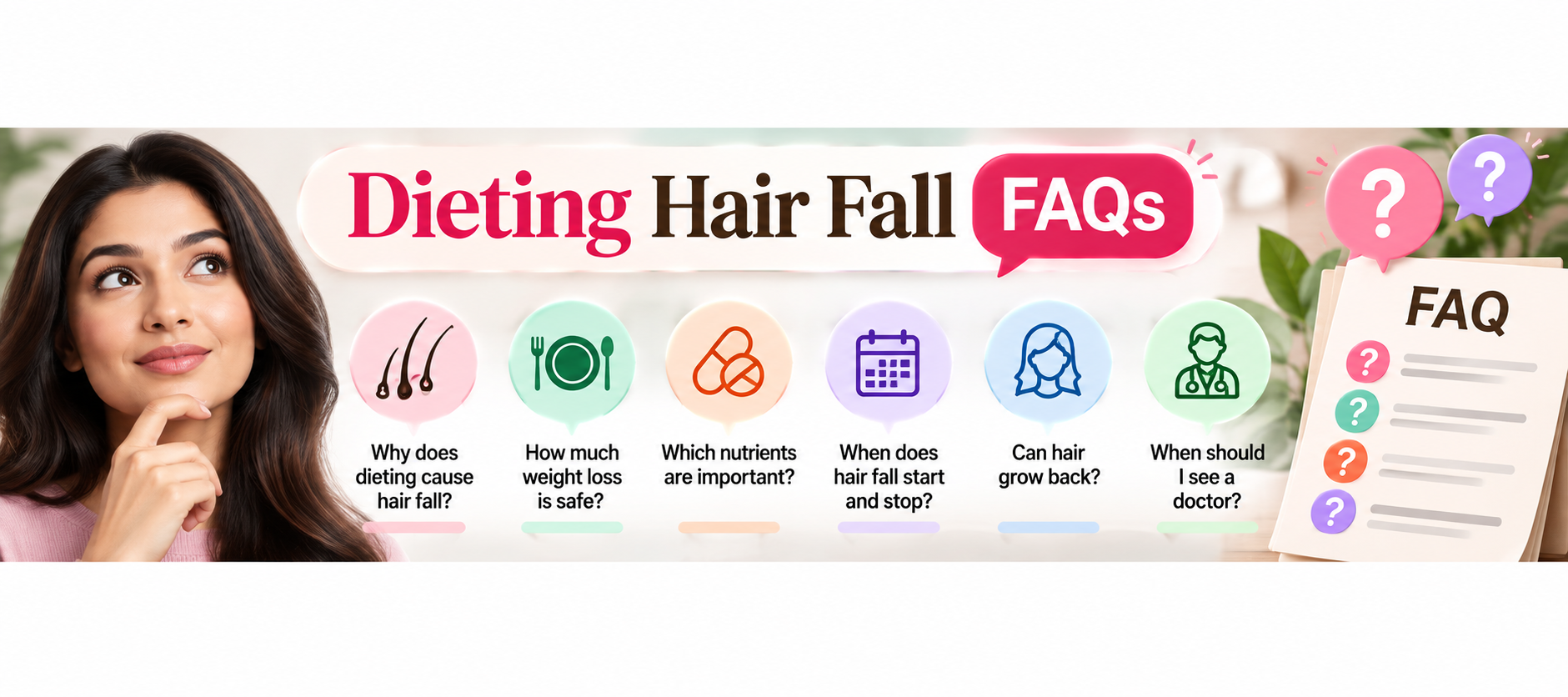
Dieting hair fall FAQs — banneralt: "Frequently asked questions about hair fall after dieting" · 900×160 WebP
Can dieting cause hair fall?
Yes. Dieting, especially crash dieting, very low-calorie plans and rapid weight loss, is a well-recognised trigger for telogen effluvium, a diffuse shedding across the whole scalp. Sharp drops in calories, protein and key nutrients stress the hair cycle and push many hairs into the resting and shedding phase. The shedding usually appears two to three months after the diet rather than straight away, which is why people often do not connect the two. The encouraging part is that it is usually temporary and recovers once balanced nutrition is restored, although recovery is gradual.
Why does hair fall happen after losing weight?
Hair growth needs a steady supply of energy, protein and nutrients, so when weight is lost quickly or intake is sharply restricted, the body prioritises essential functions and the hair cycle is disrupted. Many hairs shift into the shedding phase together, producing a telogen-effluvium-type diffuse shedding a couple of months later. Low protein and deficiencies such as low iron or zinc make this more likely. It reflects the nutritional stress of rapid or extreme weight loss rather than permanent damage, and it typically improves once eating is balanced and adequate again.
How long after dieting does hair fall start?
Usually about two to three months after the dieting or rapid weight loss, because of the way the hair cycle works. Hairs nudged into the resting phase by nutritional stress are shed a couple of months later, so the shedding often appears when you may already have stopped the diet, which can be confusing. This delay is typical of telogen effluvium. Recognising the link is helpful, because it points to restoring nutrition as the fix rather than searching for other causes, though a doctor can check for deficiencies that may be contributing.
Will my hair grow back after dieting hair loss?
Usually, yes. Dieting-related shedding is most often a temporary telogen effluvium rather than permanent loss, so once balanced, adequate nutrition is restored and any deficiency is corrected, the hair generally recovers, although it takes several months because hair grows slowly. Recovery can be slower or less complete if restriction continues, if a deficiency such as low iron is not addressed, or if there is an underlying tendency to pattern hair loss that the shedding has unmasked. If recovery stalls, a doctor can assess what else may be involved.
Is hair loss from dieting permanent?
It is usually not permanent. The shedding is typically a reversible telogen effluvium driven by nutritional stress, and it resolves once eating is adequate and balanced again. It is more likely to persist if dieting or restriction continues, if a deficiency is left uncorrected, or if it has unmasked an underlying female pattern hair loss. Repeated cycles of crash dieting can keep triggering shedding, so steady, sustainable nutrition matters. If shedding continues despite restored nutrition, or you notice a pattern of thinning, a dermatologist can assess the cause.
What should I eat to recover from dieting hair fall?
The foundation is returning to adequate, balanced nutrition: enough overall calories, sufficient protein, and a varied diet providing iron, zinc, and vitamins. Protein matters because hair is made largely of protein, and iron is a common shortfall, especially in women. This is not about a special hair diet but about eating enough and eating well, and stopping crash dieting and extreme restriction. If you want to manage weight, doing so gradually and sustainably protects your hair. A doctor or dietitian can help you rebuild nutrition safely if you are unsure.
Do supplements cure hair fall after dieting?
No. Supplements do not cure dieting-related hair fall, and the key is restoring adequate, balanced nutrition. Supplements help only where there is a genuine deficiency, such as low iron, which is best confirmed by testing, and a hair multivitamin may offer general supportive nutrition. They are not a substitute for eating enough, and high doses of vitamins or iron should not be taken without testing and medical advice, as excess can be harmful. So the realistic approach is to refeed and balance your diet, correct any confirmed deficiency under guidance, and treat supplements as support rather than a fix.
Could my hair fall be from low iron after dieting?
It is quite possible. Dieting and restricted eating commonly lower iron intake, and low iron is a frequent cause of diffuse hair shedding in women, so it can add to dieting-related telogen effluvium. The only reliable way to know is a blood test, usually ferritin, arranged through a doctor. If iron is confirmed low, correcting it through diet and, if needed, an appropriate supplement under medical advice can help the hair recover. Iron should not be taken without testing, because too much iron is harmful, so it is worth checking rather than guessing.
Is dieting hair fall the same as telogen effluvium?
Dieting-related hair fall is a type of telogen effluvium, which is the medical term for a diffuse shedding that happens when many hairs are pushed into the resting phase at once and shed together. The trigger here is the nutritional stress of dieting or rapid weight loss, but the same pattern can be caused by other stresses such as illness, childbirth or major stress. Recognising it as telogen effluvium is reassuring, because this type of shedding is usually temporary and recovers once the trigger, in this case inadequate nutrition, is addressed.
Can intermittent fasting or keto cause hair loss?
They can, if they lead to a sharp drop in calories or protein, or to nutrient gaps, since it is the nutritional shortfall rather than the specific plan that triggers shedding. Very low-calorie versions, rapid weight loss, or diets low in protein or variety are the main concern. If you follow such an approach, doing so in a balanced way with adequate protein and nutrients, ideally with proper guidance, reduces the risk to your hair. If you have noticed shedding a couple of months after starting a restrictive plan, restoring balanced nutrition is the sensible first step.
Should I stop my diet if my hair is falling?
If your diet has been a crash diet, very low in calories, or low in protein and nutrients, then yes, moving to adequate, balanced eating is important for both your hair and your overall health. This does not necessarily mean abandoning sensible weight goals, but it does mean avoiding extreme restriction and aiming for gradual, sustainable change instead. If you are unsure how to do this, a doctor or dietitian can help you adjust safely. Restoring nutrition is the main way to support recovery from dieting-related shedding, so it is worth prioritising.
How long does it take for dieting hair fall to recover?
Once balanced nutrition is restored, shedding usually settles over a few months, with visible recovery of density over several more, because hair grows slowly at around a centimetre a month. Many people see improvement within roughly six months, though results vary. Recovery can take longer if restriction continues or a deficiency is uncorrected. Patience matters, as there is no instant fix, and consistency with good nutrition is what helps most. If there is no improvement after several months, or shedding is severe, a doctor can check for other contributing factors.
Should I take an AI check before buying products?
It helps. The AI Dieting Hair Fall Checker can explore whether your shedding fits a dieting-related telogen effluvium, flag possible deficiencies such as low iron or protein to discuss with a doctor, and suggest sensible steps focused on restoring nutrition, so you act wisely rather than buying products blindly. It supports screening and education only, does not replace a doctor's diagnosis or blood tests, and does not promote dieting. Because the real fix is balanced nutrition, understanding your situation first matters far more than relying on products.
When should I see a doctor about hair fall after dieting?
See a doctor if shedding is heavy or persistent, if it continues despite restored balanced nutrition, if you notice a pattern of thinning over the crown, or if you have signs of a deficiency or thyroid problem such as fatigue, pale skin or weight and temperature changes. Also seek help if you are finding it hard to eat adequately, or if dieting has affected how you feel about food, eating or your body. A doctor can check for deficiencies, confirm the cause, and provide caring, practical support for recovery.
I'm worried about my eating and my hair — what should I do?
Please be kind to yourself, and consider reaching out for support. If dieting has become very restrictive, or if you feel anxious or distressed about food, eating, weight or your body, these feelings are important and deserve caring attention alongside the hair concern. Speaking to a doctor, or in some cases a professional who supports people with eating and body-image difficulties, can help with both your wellbeing and your hair, because restoring balanced nutrition supports recovery. You are not alone in this, and getting support is a positive, healthy step rather than something to feel embarrassed about.

Question not answered here? Ask Dr Aria for instant guidance or book a consultation.

Ask Dr AriaConsult a Doctor

Shedding After Dieting?

It's common, and it's usually temporary — a telogen-effluvium-type shed that shows up a couple of months after rapid weight loss or restriction, and recovers once you're eating enough and well again. Supplements don't cure it; balanced nutrition does. Use the Hairsncares AI Dieting Hair Fall Checker to understand your shedding, support your hair gently, and please reach out for caring help if eating has become hard.

Medical disclaimer.Hairsncares provides educational and product guidance support. AI screening helps guide decisions but does not replace a doctor's diagnosis, blood tests, hormone evaluation or dietitian assessment, and it does not promote dieting, fasting or weight loss. Hair shedding after dieting or rapid weight loss is usually a temporary telogen-effluvium-type reaction to nutritional stress, typically starting two to three months later and recovering once adequate, balanced nutrition is restored, though recovery is gradual and results vary. The real fix is restoring nutrition, not supplements: supplements do not cure dieting-related hair fall and help only where a deficiency is confirmed. Avoid crash dieting, very low-calorie plans and extreme restriction. Low iron, low vitamin D, low B12, low zinc and thyroid problems should be considered; iron and vitamin products should be used only when deficiency is suspected or confirmed and under medical guidance, and high-dose iron or vitamins should not be taken without testing, as excess can be harmful. Prescription (Rx) items such as Minoxidil require a valid prescription, are doctor-guided, and are generally avoided in pregnancy or breastfeeding unless a doctor advises. If dieting has become very restrictive, or if food, eating or your body have become a source of distress, please seek caring medical support — these feelings deserve attention alongside the hair concern, and support is available. Results vary.
Doctor-Reviewed Hair-Loss Guide

Hair Fall After Dieting: Causes, Treatment Options & When to See a Doctor

A clear, dermatologist-reviewed overview of Hair Fall After Dieting — what it is, the evidence behind treatment options, and the red flags that mean a doctor should look first. No exaggerated regrowth claims.

Often temporary (telogen effluvium)Linked to rapid or restrictive eatingUsually recovers with adequate nutritionCheck for deficiencies with a doctor

Results vary based on diagnosis, consistency, formulation and scalp condition.

🩺
Hair Fall After Dieting

Premium concern visual slot · 720×520 WebP

Quick Summary

Hair Fall After Dieting at a Glance

What it is

Temporary shedding (telogen effluvium) that can follow rapid or restrictive weight loss or low intake

Who it affects

People who have lost weight quickly or eaten too little

Treatment evidence

Usually recovers over months once balanced, adequate nutrition is restored; correct any deficiencies with a doctor

Doctor guidance

Recommended — restore balanced nutrition and check for deficiencies

Medical Review & Editorial Transparency

Reviewed for Safety, Evidence & Honest Claims

🩺

Reviewed by: Dr. Amit Agarkar, MD Dermatology

Medical focus: Dermatology, trichology, hair loss, scalp disorders and hair restoration.

Last reviewed: 1 June 2026

Editorial promise: This page explains causes, treatment evidence, limitations and safe next steps without exaggerating hair-growth claims.

Content Transparency

Who, How & Why This Guide Was Created

Who created this guide?

Prepared by the Hairsncares editorial team and medically reviewed by a dermatologist experienced in hair and scalp disorders.

How was it reviewed?

Checked for accuracy of causes, treatment evidence, safety warnings, limitations and suitability for Indian users.

Why was it created?

To help you understand this concern and choose safe next steps, and to know when a dermatologist diagnosis matters most.

Treatment & Evidence

Treatment & Evidence Overview for Hair Fall After Dieting

ParameterAssessmentWhat it means
What it isTemporary shedding (telogen effluvium) that can follow rapid or restrictive weight loss or low intakeThe nature of this concern in plain terms.
Who it affectsPeople who have lost weight quickly or eaten too littleThe people in whom it is most commonly seen.
Best-evidence optionsUsually recovers over months once balanced, adequate nutrition is restored; correct any deficiencies with a doctorWhere the strongest support lies — most are doctor-guided.
When to see a doctorOngoing restriction, very rapid loss, or shedding with other symptoms — see a doctorSituations needing diagnosis before any treatment.
Expected timelineOften improves over several months once nutrition is restoredResults vary based on diagnosis, consistency, formulation and scalp condition.
Next Steps & Safety

Sensible Next Steps vs See a Doctor First

Sensible next steps

  • Screen the likely cause with the AI Hair Test before buying products
  • Use doctor-guided, evidence-based options with realistic expectations
  • Track monthly photos and review progress with a clinician

See a doctor first if

  • Hair loss is sudden, severe, patchy, painful or with scalp infection.
  • You are pregnant, breastfeeding, a teenager, or using prescription medicines.
  • You have an unclear diagnosis, scarring hair loss, fungal infection or active scalp disease.

Restrictive or crash dieting can harm hair and overall health; if eating feels hard to control, please speak with a doctor. This page is general education, not a diet plan.

Treatments & Ingredients

Treatments & Ingredients for Hair Fall After Dieting

Product Discovery

Explore Products for Hair Fall After Dieting

Product results should be selected based on diagnosis, scalp type, sensitivity, routine compatibility and dermatologist guidance where needed.

Find Products After AI Hair Test
Visual Guide

Hair Fall After Dieting Visual Guide

🧫
What Hair Fall After Dieting can look like and how it is assessed.
📊
Treatment options and where the evidence is strongest.
🛡️
Red flags that mean a dermatologist should look first.
Quick Answers

Quick Answers About Hair Fall After Dieting

What causes Hair Fall After Dieting?

Temporary shedding (telogen effluvium) that can follow rapid or restrictive weight loss or low intake. The exact cause should be confirmed, because look-alike conditions are treated differently.

Can Hair Fall After Dieting be treated?

Usually recovers over months once balanced, adequate nutrition is restored; correct any deficiencies with a doctor. Most effective options are doctor-guided, and results depend on diagnosis, consistency and realistic expectations.

How long does treatment take?

Often improves over several months once nutrition is restored.

Do I need a diagnosis first?

For sudden, patchy, painful or unexplained loss, yes — see a dermatologist before treating. A suitability screen helps you understand likely causes.

When should I see a doctor urgently?

Ongoing restriction, very rapid loss, or shedding with other symptoms — see a doctor — these need evaluation before any product or medicine.

💬 Ask Dr Aria
Your Cart (0)

Your cart is empty

Subtotal0
DeliveryFREE
Total0
🔒 Secure📦 Free above ₹499↩ Easy returns
💬 Hi! I'm Dr. Amit — your Hair Intelligence consultant
🌿
1
🌿
Dr. Amit
Virtual Dermatologist · Hairsncares.com
Online
What are you shopping for today?
Select a category to begin
AI-powered scalp diagnosis · Hairsncares.com
📸
Scalp Analyser
Upload scalp photo · Get conditions, root cause, and matched product protocol
📷
Drop scalp photo here or click to upload
JPG, PNG, WEBP · Clear, close-up, well-lit photo

Your image is processed privately by our AI engine and saved securely with your account.