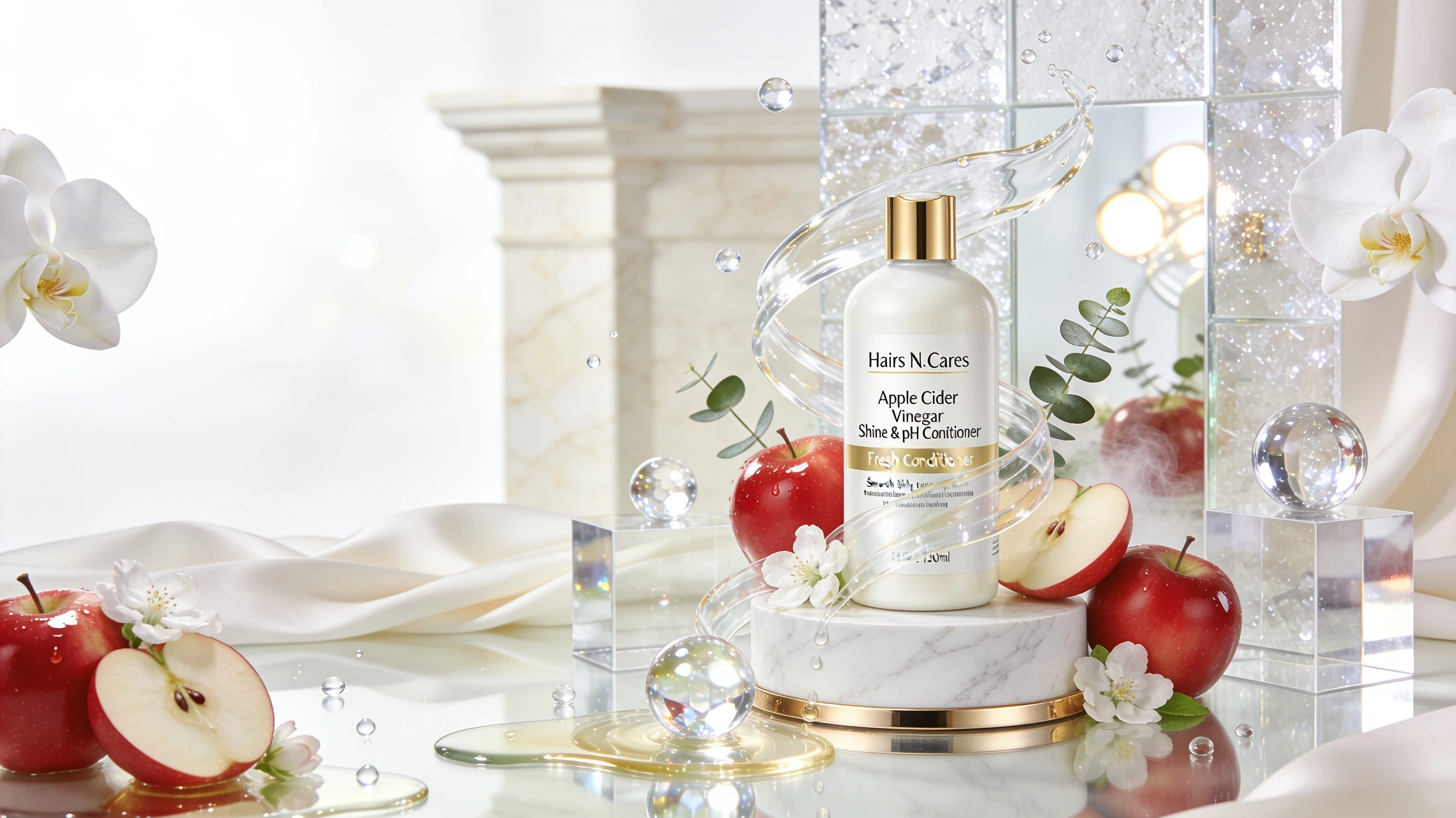
Myth
Apple cider vinegar conditioner regrows hair
Fact
ACV conditioner supports cosmetic shine and pH-style care. It has no proven effect on follicle activity and cannot regrow hair or stop root-level shedding.
Apple Cider Crystal Shine pH Atelier · Hairsncares
A dermatologist-guided conditioner guide for shine-feel, pH-style care, dullness, rough hair, light buildup feel and smoother-looking lengths — with balanced ACV education, sensitive scalp caution, pH overclaim safety and AI routine matching.
What ACV conditioner can and cannot do for hair shine
The pH-balancing claim — marketing vs cuticle science
How ACV conditioner differs from an ACV rinse
Best hair types for ACV conditioner — oily, dull, or buildup-prone
ACV conditioner vs silicone conditioner for shine compared
How often to use without stripping colour or drying ends
Potential risks on chemically treated or bleached hair
When dull hair signals a deeper problem than product choice
Apple cider vinegar conditioner is used for cosmetic shine, smoother-looking hair and pH-style positioning. It may help hair lengths feel cleaner, lighter or less dull when mild residue is a concern. It is not a medical detox product, not a true chelating treatment, and not a hair fall or dandruff cure. Finished formula pH, concentration and user tolerance matter more than the ingredient name alone.
Apple cider vinegar conditioner uses diluted acetic acid to help smooth the hair cuticle and add temporary shine. pH-balancing claims are largely marketing. It may help remove light product buildup but does not repair damage, treat hair loss, or replace deep conditioners. Can fade colour-treated hair. Best used occasionally, not daily. Pair with a moisturising conditioner for dry ends.
Apple cider vinegar conditioners are cosmetic hair-length support products positioned for shine, pH-style care, smoother-looking hair, dullness support and mild residue-feel routines. The clinical value depends on thefinished formula, pH, concentration, rinse-off instructions, hair type and user sensitivity. ACV conditioner does not treat androgenetic alopecia, alopecia areata, telogen effluvium, PCOS-related hair fall, thyroid-related hair fall, dandruff, seborrheic dermatitis or scalp infection.
⚠️ Avoid ACV-style products on sensitive, inflamed, wounded, recently treated or actively irritated scalp. Consult a dermatologist if hair fall is sudden, patchy, progressive, associated with scalp pain, pus, crusting, severe dandruff, postpartum changes, PCOS or thyroid symptoms or fatigue.
Ask a Hair DoctorPeople with oily, dull, or buildup-prone hair looking for a clarifying conditioner that adds shine. Best as an occasional weekly treatment, not a daily conditioner.
Deep conditioning for dry or damaged hair, protein treatments for breakage, or medicated scalp care. ACV conditioner is a cosmetic clarifier, not a repair product.
Hair remains dull despite proper care, you notice breakage alongside dullness, or scalp produces excess oil despite balanced washing. Underlying conditions may need evaluation.
pH-balancing claims depend on the finished conditioner formula, not only the presence of apple cider vinegar in the ingredient list. Concentration, buffering and formulation design are critical.
Smoother hair surfaces reflect light better, giving a shinier appearance. ACV-style conditioners may support surface smoothness on dull or rough lengths, temporarily improving shine feel.
ACV-style conditioners are positioned for hair that feels dull or mildly coated. They are not replacements for clarifying or chelating shampoos for significant product or mineral buildup.
Conditioner can reduce friction-related breakage by improving slip and smoothness. It cannot treat shedding from the root caused by medical or nutritional causes.
Acidic, fragranced or botanical ACV formulas can irritate sensitive, inflamed, wounded or reactive scalp. Avoid scalp application unless formula is specifically scalp-safe.
Finished product pH, ACV concentration, buffering system, fragrance, preservatives, rinse-off time, hair porosity, scalp sensitivity and full formula all determine what an ACV conditioner delivers.
Cosmetic shine, pH-style care and mild residue-feel support for dull or rough hair lengths.
Caution: finished formula pH and concentration matter. Raw ACV not advised.
Shine plus softness and smoother feel. Panthenol adds manageability and lightweight conditioning to ACV shine positioning.
Caution: patch-test if sensitive.
pH-style shine with gentle hydration feel for dull, rough or frizzy hair. Relatively lightweight combination.
Caution: botanical and fragrance sensitivity possible.
Shine plus hydration-feel support for dry/dull hair needing both moisture feel and cosmetic gloss.
Caution: formula balance matters for both effects.
Shine plus frizz-control appearance and smoothness. ACV provides pH-style gloss and argan adds botanical shine and softness.
Caution: may feel heavy on fine hair.
High-gloss slip plus ACV shine support. Silicone adds instant smoothness and mirror shine on top of ACV pH-style positioning.
Caution: buildup depends on formula and cleansing routine.
Shine plus barrier-like cuticle support. Ceramides add cuticle-sealing positioning to ACV shine conditioner.
Caution: still requires scalp-safe label if applying near roots.
Buildup/scalp-related formulas targeting surface residue. More suited to scalp-specific or targeted treatment products.
Caution: avoid overclaiming; follow label guidance strictly; irritation risk on sensitive scalp.
Stronger hard-water/mineral support only if real chelating agents (EDTA, phytic acid) are present in formula alongside ACV.
Caution: label must confirm chelating agents. ACV alone is not a chelating treatment.
Lower irritation preference for sensitive users wanting ACV shine positioning. Fragrance-free and mild preservative systems reduce reaction risk.
Caution: still patch-test; acid sensitivity can still occur.
Ingredient names alone do not guarantee results. UseIngredient Decoderto analyse finished formula pH, ACV concentration and buildup risk.
Apple cider vinegar is popularly associated with acidity and shine, but a conditioner's effect depends on the finished formulation. The ingredient name alone does not prove that the product will balance scalp pH, repair damage, detox the scalp or remove hard-water minerals.
The actual pH of the product, not only ACV presence, determines any pH-related effect on hair.
Buffering agents in the formula control the final pH. ACV without buffering may vary significantly.
Trace amounts of ACV provide different effects than higher concentrations. Label does not always specify.
Rinse-out conditioners have limited contact time. This affects how much any pH effect is realised.
Thorough rinsing removes most conditioner. Residual effect depends on what remains after rinsing.
Hair porosity affects how readily hair absorbs and responds to acidic or alkaline conditioning agents.
Acidic formulas tolerated by some users may irritate sensitive, inflamed or recently treated scalp.
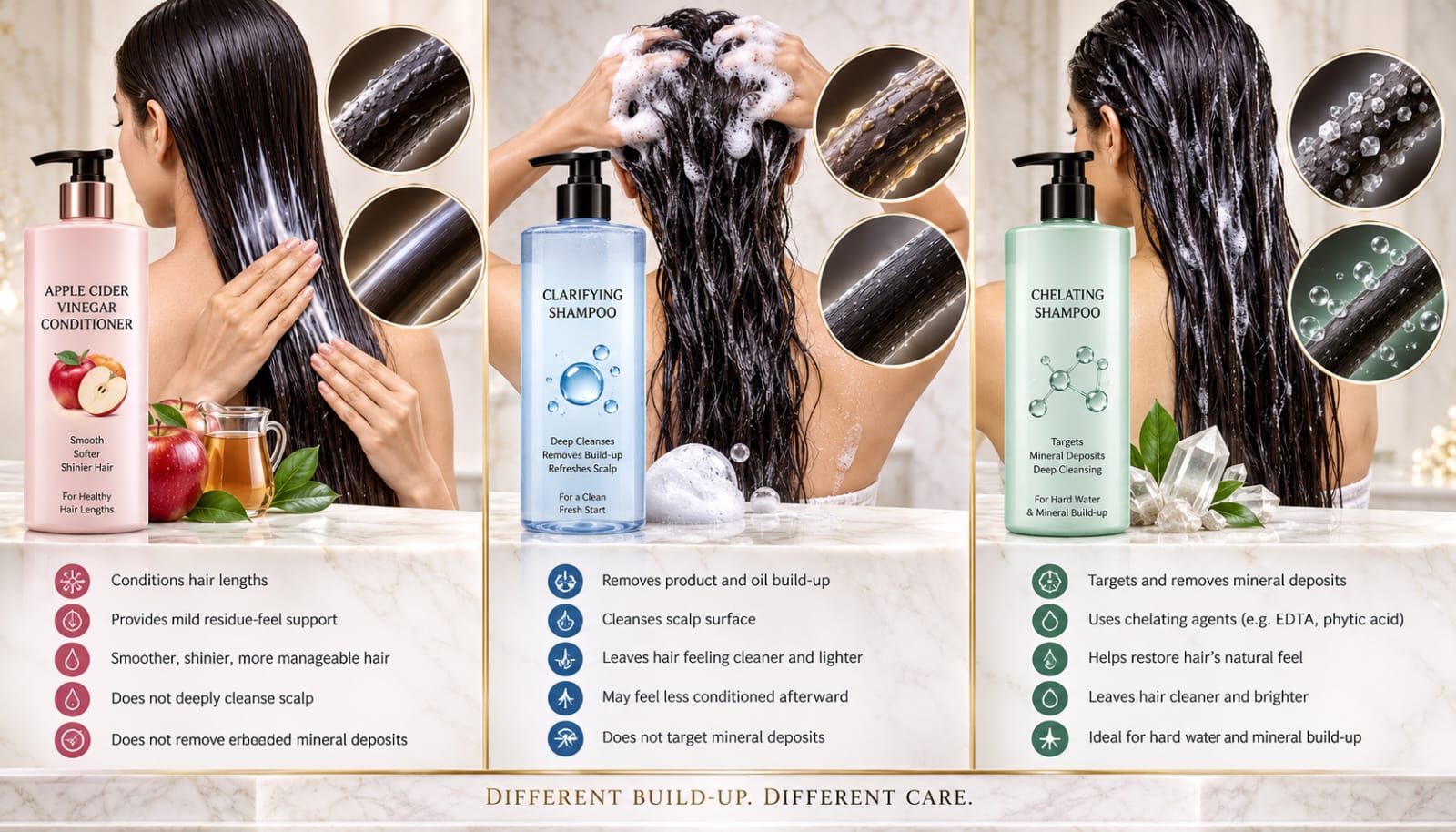
Clarifying shampoos are cleansers designed to remove build-up. ACV conditioner is a different product category.
Chelating agents (EDTA, phytic acid) target mineral deposits. ACV alone does not provide guaranteed chelating effect.
ACV conditioner is well-suited for dull, rough or frizzy hair needing cosmetic shine and smoother appearance. Apply to mid-lengths and ends.
Best MatchHair that feels mildly coated, flat or dull after product layering may benefit from ACV-style pH-positioning conditioner. Apply to mid-lengths and ends.
Good MatchUsers with oily roots and dull lengths may find ACV shine conditioner useful when applied only to mid-lengths and ends, never scalp.
Good MatchAvoid ACV conditioner near sensitive, inflamed, wounded or recently treated scalp. Acidic formulas can worsen irritation, burning and redness.
Avoid Scalp UseACV conditioner is not a dandruff treatment. Avoid during active scalp inflammation. See a dermatologist for persistent dandruff.
Consult DoctorACV conditioner is not a guaranteed chelating treatment. For significant mineral buildup from hard water, a chelating shampoo is more appropriate.
Use Chelating Shampoo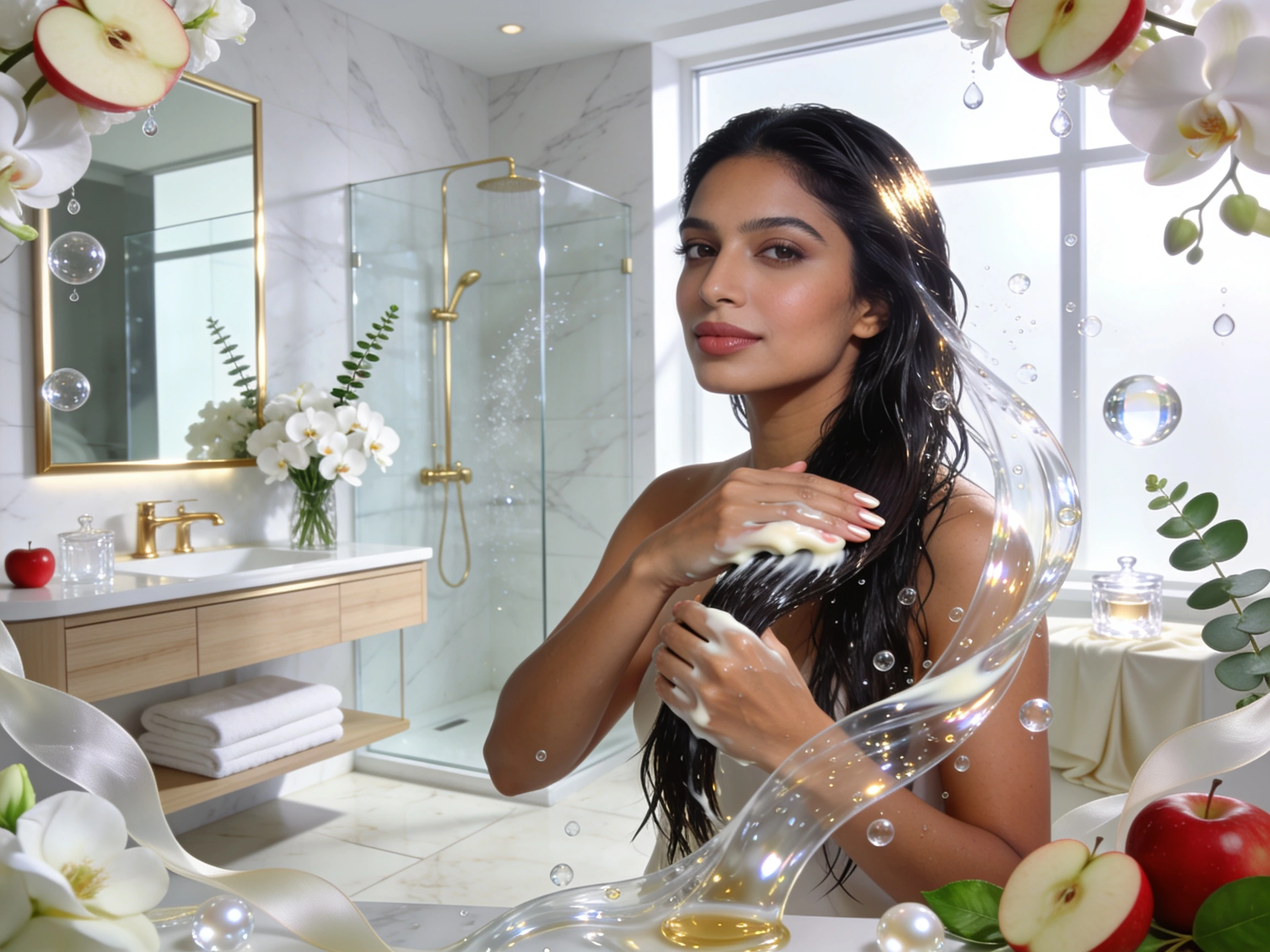
You may be wondering whether Apple Cider Vinegar Conditioner is the right type for your hair. The honest answer: conditioner is a cosmetic hair-shaft product that supports shine and pH balance. It may improve how your hair feels — softer, smoother, more manageable — but it cannot treat root-level hair loss, dandruff, scalp disease or conditions needing medical treatment. If your concern goes beyond dryness and texture, a dermatologist evaluation is the right first step.
9 dermatologist-guided steps for shine and pH-style care without scalp irritation or buildup.
Cleanse scalp first with appropriate shampoo — mild, anti-dandruff, clarifying or chelating, only when suitable. ACV conditioner is a hair-length product, not a scalp cleanser.
Gently squeeze water from lengths before conditioning. Conditioner on damp hair works better than on dripping wet hair.
Apply ACV conditioner from mid-lengths to ends. Avoid scalp unless formula specifically states scalp-safe.
Scalp caution: avoid if sensitive, inflamed, oily, acne-prone, dandruff-prone, wounded or post-transplant.
Acidic ACV-type formulas can burn or irritate sensitive, inflamed, recently treated or wounded scalp. Do not apply near any active scalp lesion, rash or wound.
Fine hair needs less. Dull, rough or frizzy lengths may need more if tolerated. Do not overload lengths as this can cause heaviness.
Follow product label. Do not extend contact time assuming more pH benefit. Longer is not always better with acidic formulas.
pH note: extended contact time beyond label recommendation is not advised for acidic formulas.
Rinse all conditioner from hair. Residue can cause heaviness, greasiness or irritation near the scalp.
Stop immediately if burning, stinging, redness, itching, rash, swelling, scalp pimples or worsening flakes occur. Consult a dermatologist if symptoms persist.
Never rinse back into scalp. Rinse thoroughly with clean water only.
If buildup, heavy residue or hard-water heaviness is significant, use a clarifying or chelating shampoo instead of relying on ACV conditioner alone. Different product categories serve different purposes.
The most common conditioner mistake is applying it to the scalp. Conditioner on an oily, dandruff-prone or acne-prone scalp causes buildup, greasiness and scalp pimples. Apply ACV conditioner from mid-lengths to ends only, use the minimum effective amount, and rinse thoroughly. If hair still feels dry after correct use, consider adding a leave-in product rather than increasing the rinse-out conditioner amount.
Dermatologist-curated ACV conditioner selection for dull, rough and frizzy hair. Price available on product page. Patch-test if sensitive.
Identifies scalp sensitivity, burning history, dandruff tendency and acne/folliculitis risk — so you know whether ACV-type conditioner is safe near your scalp type.
Start Scalp Test →Matches ACV or ACV-free conditioner to your dullness, roughness, residue concern, scalp sensitivity and desired shine finish.
Find My Conditioner →Builds a personalised shine and pH-style routine — matched to hair type, scalp type, buildup concern and cleansing approach.
Build My Routine →Identifies whether your concern is dullness, breakage, buildup or medical hair loss — so you know when conditioner helps vs when a doctor is needed.
Take AI Hair Test →Identifies finished formula pH, ACV concentration, chelating agents, fragrance risk and scalp-safe designation in your conditioner label.
Decode Ingredients →Apple cider vinegar conditioner regrows hair
ACV conditioner supports cosmetic shine and pH-style care. It has no proven effect on follicle activity and cannot regrow hair or stop root-level shedding.
ACV conditioner cures dandruff
Dandruff and seborrheic dermatitis may need anti-dandruff actives and dermatologist guidance. ACV conditioner does not treat dandruff.
ACV permanently balances scalp pH
pH claims depend on the finished formula and are temporary cosmetic effects. ACV conditioner cannot permanently balance scalp pH.
Raw apple cider vinegar is better than a formulated conditioner
Raw or undiluted ACV can irritate, burn or damage skin and hair. Always use properly formulated cosmetic products as directed on the label.
ACV conditioner removes all hard-water buildup
Hard-water mineral buildup needs chelating agents (EDTA, phytic acid) in shampoo. ACV conditioner is not a guaranteed chelating treatment and may provide only mild residue-feel support.
ACV conditioner should be applied on scalp for best results
Most conditioners should be applied to mid-lengths and ends only. ACV on scalp can worsen irritation, burning or buildup in sensitive or oily-scalp users.
Shine and hair fall are the same concern
Shine is a hair-shaft appearance issue related to surface smoothness and light reflection. Hair fall may be root-level shedding from androgenetic alopecia, hormonal or nutritional causes.
Conditioner can replace medical hair loss treatment
Medical hair loss requires dermatologist diagnosis and cause-based treatment. No conditioner, including ACV shine conditioner, treats androgenetic alopecia or medical hair fall.
Stop product and consult if any of these occur after conditioner use:
Doctor-Reviewed Resources
Apple cider vinegar conditioner is used for cosmetic shine, smoother-looking hair and pH-style positioning. It may help hair lengths feel less dull or mildly coated. It does not treat dandruff, scalp disease or root-level hair fall. Apply to mid-lengths and ends.
Shine and pH conditioner refers to formulas positioned for cosmetic shine and pH-style care. Results depend on the finished formula pH, ACV concentration, hair type and tolerance. It is a cosmetic product, not a medical pH treatment.
ACV conditioner may help dull hair feel shinier by supporting surface smoothness. Apply to mid-lengths and ends. Benefits are cosmetic and temporary.
Yes. ACV conditioner may help dull-looking hair feel cleaner and more reflective. Apply to mid-lengths and ends. Finished formula matters more than ACV presence alone.
ACV conditioner may support frizz-control appearance by smoothing hair surface in some hair types. Apply to mid-lengths and ends. Results are cosmetic and routine-dependent.
ACV conditioner may provide mild residue-feel support. For significant product or mineral buildup, a clarifying or chelating shampoo is more effective. Apply to mid-lengths and ends.
ACV conditioner is not a guaranteed chelating treatment. True chelating agents in shampoo are more effective for hard-water mineral removal. ACV conditioner may offer mild cosmetic support.
Most conditioners should not be applied to oily scalp. Apply ACV conditioner to mid-lengths and ends only. It does not treat scalp oiliness.
ACV conditioner is positioned for shine and pH-style care, not primarily for very dry hair. Very dry or coarse hair may need richer emollient conditioning. Apply to mid-lengths and ends.
Use a colour-safe formula. Acidic ACV formulas may affect colour differently. Patch-test and follow label guidance. Apply to mid-lengths and ends.
ACV conditioner may reduce friction-related breakage by smoothing hair surface and improving conditioning. It does not treat root-level shedding or medical hair fall.
No. ACV conditioner does not treat root-level hair fall. Androgenetic alopecia, hormonal causes, nutritional deficiency and scalp disease require medical diagnosis.
No. ACV conditioner supports cosmetic shine and pH-style care. It has no proven effect on follicle activity or hair regrowth.
ACV conditioner may temporarily smooth split-end appearance. Split ends cannot be permanently repaired by any conditioner. Trimming is the only permanent solution.
No. pH claims depend on the finished formula and are temporary cosmetic effects. ACV conditioner cannot permanently balance scalp pH.
No. ACV conditioner is not a dandruff treatment. Dandruff may need anti-dandruff actives and dermatologist guidance if persistent.
Yes. Acidic, fragranced or botanical ACV formulas can irritate sensitive, inflamed or reactive scalp. Avoid scalp application unless label says scalp-safe. Patch-test before use.
Most ACV conditioners should be applied to mid-lengths and ends only. Avoid scalp if sensitive, oily, inflamed, acne-prone, dandruff-prone or recently treated.
Follow the product label or your dermatologist advice. Most rinse-out conditioners can be used on every wash day. Monitor for irritation or residue build-up.
Some formulations allow daily use; others do not. Follow the product label. Monitor scalp and hair response, especially for irritation on sensitive scalp.
Follow the product label. Do not extend contact time assuming more pH benefit. Extended contact time with acidic formulas is not advised.
Yes. Rinse thoroughly. Residue near scalp can cause greasiness or irritation. Leave-in formulas follow label instructions.
Yes. Acidic formulas can cause burning on sensitive, inflamed or wounded scalp. Stop immediately and consult a dermatologist if burning occurs.
Yes. ACV-type conditioners can cause irritation on sensitive scalp. Avoid scalp application. Stop if redness, itching or rash occurs.
Any conditioner overused or applied near scalp can cause buildup. Rinse thoroughly and apply to mid-lengths and ends only.
Applying any conditioner near scalp or overusing it can make hair feel heavy or greasy. Apply to mid-lengths and ends only.
Raw or undiluted apple cider vinegar is not recommended for scalp or hair use. It can cause irritation or chemical burns. Use only properly formulated cosmetic products as directed.
Clarifying shampoo is a stronger cleanser for oil and product buildup. ACV conditioner provides cosmetic shine and pH-style positioning. For significant buildup, clarifying shampoo is more effective.
Chelating shampoo removes mineral deposits from hard water. ACV conditioner is not a guaranteed chelating treatment. For hard-water hair, chelating shampoo is more appropriate.
ACV conditioner provides lighter shine and pH-style care. Silicone conditioner provides high slip and mirror shine. Choose based on hair type and buildup tolerance.
ACV conditioner focuses on shine and pH-style care. Argan oil conditioner focuses on shine, softness and frizz control. For very dry or coarse hair, argan oil may provide more conditioning.
ACV conditioner focuses on shine and pH-style care. Hyaluronic acid conditioner focuses on hydration-feel support. For dry hair, hyaluronic acid may provide more moisture-feel benefit.
Yes. Rinse anti-dandruff shampoo thoroughly, then apply ACV conditioner to mid-lengths and ends only. Do not apply conditioner to dandruff-prone or inflamed scalp.
Do not change any conditioner on a post-transplant scalp without explicit clearance from your hair transplant surgeon. Follow post-operative protocols exactly.
Yes. Acidic formulas can worsen sensitive, inflamed or reactive scalp. Avoid scalp application. Patch-test before use. Consider a non-acidic or fragrance-free shine conditioner if sensitive.
Avoid if you have sensitive, inflamed, wounded or actively irritated scalp, scalp eczema, psoriasis flare, severe dandruff inflammation, folliculitis, scalp acne, recent hair transplant or known acid sensitivity.
Stop if burning, stinging, itching, redness, rash, swelling, scalp pimples or worsening flakes occur. Consult a dermatologist if symptoms persist after stopping.
Consult a dermatologist for sudden heavy hair fall, patchy bald spots, widening part, scalp pain, pus, crusting, severe dandruff, burning after products, PCOS or thyroid symptoms with hair fall, or postpartum hair fall.
Still unsure whether ACV conditioner suits your hair and scalp?
Take the AI Shine & pH Finder to identify the right conditioner for your dullness, frizz, residue concern and scalp sensitivity — or consult Dr. Amit Agarkar directly for any scalp or hair fall concern.
Your cart is empty