Mild dandruff
Light flaking, occasional itch, no pain or redness — often shampoo-manageable.
Dandruff with hair fall is a common pairing: flakes, oiliness, itching and inflammation disturb the scalp, and scratching adds breakage. Dandruff rarely destroys the hair root, but an inflamed scalp is not a good environment for healthy growth — so treating the scalp often improves the shedding too.
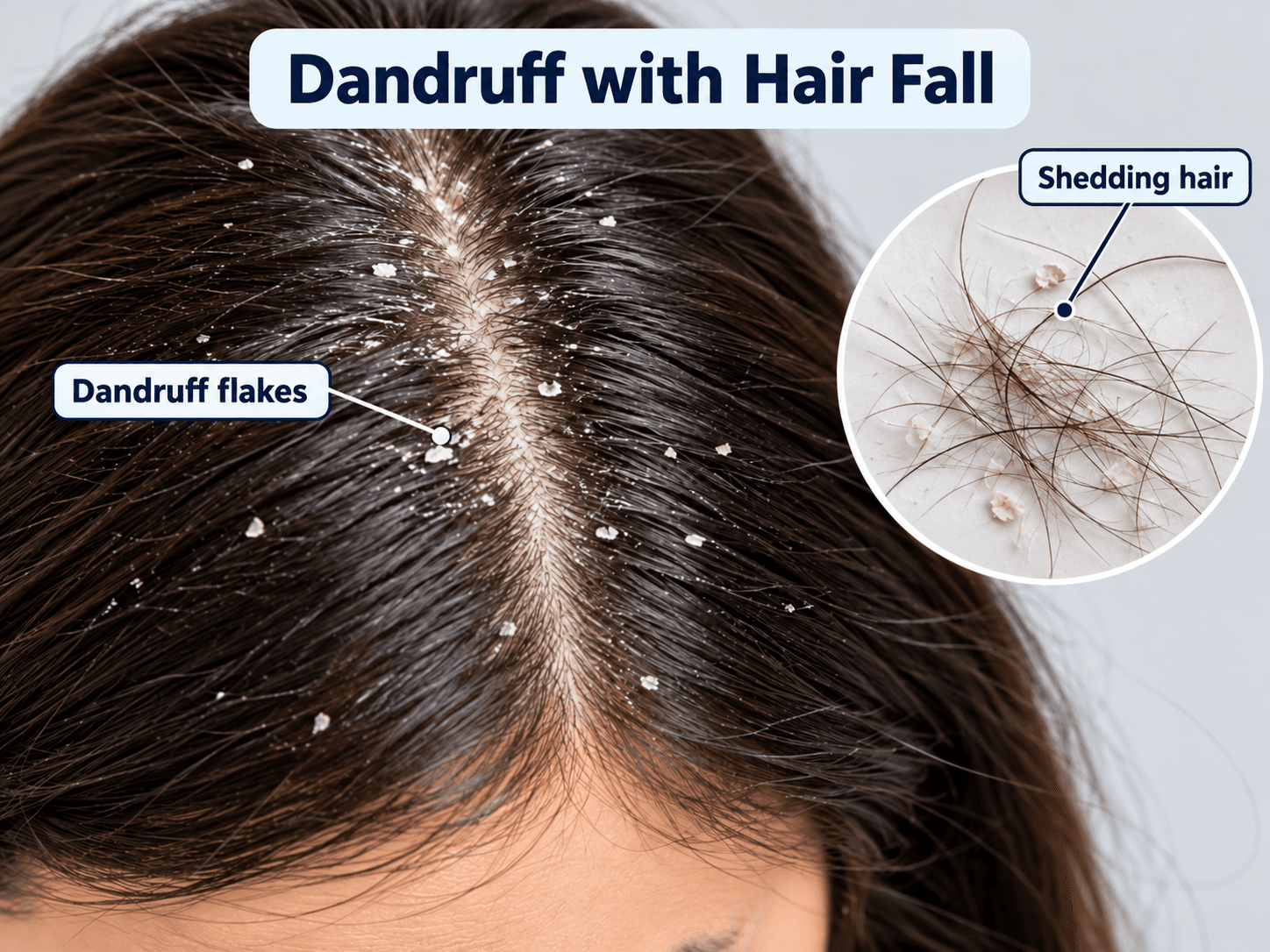
Scalp symptoms with hair fall may involve dandruff, dermatitis, allergy, infection, buildup or inflammation. Red flags need review.
Dandruff With Hair Fall is a symptom, not a final diagnosis. It may be related to root shedding, hair-shaft breakage, scalp inflammation, pattern thinning, patchy hair loss, product irritation or medical triggers.
The right next step depends on amount, duration, pattern, scalp symptoms, hairline, crown or parting changes, medical history, stress, illness, diet, hormonal clues and current products.
Bottom line: use this page to understand what the symptom may mean, what to track and which red flags matter, then take the AI Scalp Test or ask a dermatologist if it is severe, progressive or unclear. Results vary.
Dandruff can worsen hair fall when flakes, oiliness, itching and inflammation disturb the scalp environment or repeated scratching causes breakage. Mild dandruff may respond to the right shampoo routine, but severe scaling, redness, pain, pus, crusting, patchy loss or persistent shedding needs dermatologist review. An AI Scalp Analysis can help judge severity.
Dandruff and its more inflamed relative, seborrheic dermatitis, involve an imbalance of natural scalp yeast, excess oil and irritation. This creates flaking and itch — and an inflamed scalp is simply not the ideal environment for the hair cycle, so shedding can rise.
Add scratching, and you get breakage on top of shedding. The encouraging part: because dandruff rarely destroys the root, calming the scalp usually improves the hair fall too. The key is matching the right active to the type and severity of your flaking.
| Feature | Dandruff | Dry scalp | Seborrheic dermatitis |
|---|---|---|---|
| Flake type | White/yellowish flakes | Small dry flakes | Greasy scales/flakes |
| Itching | Common | Mild/moderate | Often stronger |
| Oiliness | Often present | Usually absent | Often oily |
| Redness | Sometimes | Usually mild | Common |
| Doctor review | If persistent/severe | If unclear | Often helpful |
Severity guides whether scalp-care products are enough or a doctor should step in.
Light flaking, occasional itch, no pain or redness — often shampoo-manageable.
More flaking and itch, some oiliness; needs consistent medicated washing.
Thick greasy scales, redness, stronger itch — often benefits from doctor review.
Noticeably more hair fall alongside flakes; treat the scalp, then reassess shedding.
Pain, pus, crusting, bald patches or rapid loss — see a dermatologist.
No change after weeks of correct anti-dandruff use — get it assessed.
Red-flag patterns should be examined by a dermatologist before trying any product — start with an online dermatologist consultation.
Educational, category-level directions matched to this symptom — not a bestseller list. Product availability is populated dynamically from the Hairsncares catalogue.
First-line flake and itch control for dandruff-linked shedding.
Explore category →For persistent dandruff or seborrheic scalp, as label-directed.
Explore category →Where oily, greasy flakes dominate.
Explore category →Soothing and barrier support between medicated washes.
Explore category →For gentle alternate-day cleansing.
Explore category →Where shedding persists after the scalp settles.
Explore category →Ketoconazole shampoo should be used as label-directed or doctor-directed. Severe scalp inflammation, pain, pus, crusting, thick plaques or patchy hair loss needs dermatologist review. Product category suggestions are educational; results vary.
Cautious, evidence-led language applies: "may support", "where suitable", "where deficiency exists". Results vary; doctor guidance is recommended.
Dandruff ranges from light flaking to inflamed seborrheic dermatitis. The AI Scalp Analysis helps judge severity and the AI Hair Test factors in shedding, pointing to a dermatologist-reviewed plan.
The Routine Builder sequences medicated and gentle washes, contact time and scalp care into a simple weekly plan.
Upload clear scalp photos for a dermatologist-reviewed read of flakes, oiliness and redness.
"Patients often fear that dandruff is "eating" their hair roots. It is not — dandruff does not usually cause permanent loss on its own. What it does is create an itchy, inflamed, frequently scratched scalp, and that combination increases shedding and breakage until it is brought under control. The good news is that most dandruff responds well to the right shampoo used correctly, especially giving medicated shampoos enough contact time. The cases I want examined are the severe ones: thick scaling, real redness and pain, or actual patches of loss."
A symptom needs context and does not confirm a diagnosis. Sudden, severe, patchy or progressive loss, or a painful, pus-filled, crusted or bleeding scalp, needs prompt medical review.
External links open in a new tab and are provided for general education; they are not endorsements and do not replace personalised medical advice.
Dandruff does not usually destroy hair roots, but the itching, inflammation and scratching it causes can increase shedding and breakage. Controlling dandruff often reduces the associated hair fall over a few weeks.
Ordinary dandruff does not typically damage the follicle permanently. Severe, untreated seborrheic dermatitis with strong inflammation is more concerning, which is why persistent or severe cases should be assessed by a dermatologist.
Anti-dandruff shampoos with ketoconazole, zinc pyrithione, piroctone olamine or salicylic acid are commonly used. The best choice depends on whether flakes are dry or oily and how severe they are — a scalp analysis helps.
Ketoconazole is a well-known antifungal used in medicated shampoos for dandruff and seborrheic dermatitis. Use it as label-directed or doctor-directed, and get assessed if the scalp is very inflamed, painful or not improving.
No. Dry scalp produces small dry flakes from lack of moisture, while dandruff and seborrheic dermatitis involve a yeast imbalance, often with oilier, larger flakes and more itching. They are managed differently.
Yes. Excess sebum can feed the yeast involved in dandruff and seborrheic dermatitis, so oily scalps are often more prone to greasy flaking. See our oily scalp with hair fall guide.
Dandruff is serious enough for a doctor when there is thick scaling, marked redness, pain, pus, crusting, bald patches, or when it does not improve with appropriate anti-dandruff shampoo used correctly for a few weeks.
Scratching does not usually cause permanent loss, but it breaks strands, worsens inflammation and can lead to more shedding. Soothing the itch and treating the dandruff protects the hair while the scalp recovers.
Many people see improvement within 2–4 weeks of using a suitable medicated shampoo correctly, including adequate contact time. Dandruff often recurs, so maintenance washing is commonly needed. Persistent cases should be reviewed.
See a dermatologist if dandruff is severe, painful or persistent, if there are patches of hair loss, thick plaques, pus or crusting, or if shedding continues after the scalp has settled with appropriate care.
Flaking and shedding together usually means scalp inflammation plus a separate hair-fall trigger. These dermatologist-reviewed categories target the flaking; the AI Hair Test helps map the shedding.

Calms flaking, itch and oil that often accompany increased shedding.
Supports a calmer, less reactive scalp barrier between washes.
Category-level support once flaking is controlled and the cause is understood.
Your cart is empty