👨‍⚕️ Ask Dr. Amit

Dermatologist-Guided Hair Supplement Science

Hair Supplements for Hair Fall, Growth,
Biotin, Iron, Vitamin D & Nutrition Support

Choose hair supplements by deficiency risk, diet pattern, gender, life stage, hair fall type and doctor-guided safety — from biotin, iron, vitamin D and zinc to collagen, amino acids and complete hair nutrition formulas.

Supplements can support hair health when nutrition gaps are relevant. For active hair fall, thinning, PCOS, thyroid symptoms, postpartum shedding or sudden loss — start with diagnosis-first guidance before buying blindly.

Doctor-ReviewedDeficiency-AwareLab-Test LogicVegetarian FiltersPostpartum CautionResults VarySubscribe & Refill
22
Subcategories
10+
Key Nutrients
3–6mo
Review Window
Lab-First
Safety Logic

Educational product-selection guidance only. Hair supplements do not replace dermatologist diagnosis or lab testing. Avoid high-dose supplements without doctor guidance. Results vary.

🤖 AI Supplement Finder
👨‍⚕️
Dr. Amit Agarkar
MD Dermatology · Trichologist
🫙
Hair supplement nutrient editorial
Quick Answer

The best hair supplement depends on whether you have a nutritional gap, deficiency risk or recovery phase. Biotin may help selected users but is not a universal hair-growth solution. Iron, vitamin D, B12, zinc, protein and ferritin-related support should ideally be guided by diet history, symptoms and blood tests. For sudden, patchy or progressive hair loss, consult a dermatologist before relying on supplements.


✅ Best for

People with nutritional gaps, deficiency-related hair fall risk, or diet-pattern concerns (vegetarian, postpartum, restricted diets) seeking dermatologist-guided supplement selection.

⚠️ Not a substitute for

A hair loss treatment. Supplements support nutrition but do not treat androgenetic alopecia, scarring alopecia or medical hair loss. Diagnosis comes first.

🩺 Doctor review if

Hair fall is progressive, patchy, sudden, heavy or accompanied by fatigue, thyroid symptoms or PCOS — supplements alone are not the answer.


What You'll Learn on This Page

What hair supplements do and do not do — nutritional support vs medical treatment

Which nutrients matter for hair — biotin, iron, ferritin, vitamin D, zinc, collagen, amino acids

How to choose hair supplements by concern — hair fall, thinning, postpartum, deficiency risk

When hair supplements help vs when they do not — deficiency-driven vs non-deficiency shedding

Doctor-guided safety — high-dose risks, blood test guidance, supplement-drug interactions

Supplement comparison guide — biotin vs iron vs multivitamin vs collagen — which suits you

Who should avoid self-supplementing — pregnancy, children, thyroid, PCOS, medical hair loss

When thinning needs diagnosis first — not just supplements

Featured Snippet

Which Hair Supplement Should You Choose?

The best hair supplement depends on whether you have a nutritional gap, deficiency risk or recovery phase. Biotin may help selected users but is not a universal hair-growth solution. Iron, vitamin D, B12, zinc, protein and ferritin-related support should ideally be guided by diet history, symptoms and blood tests. For sudden, patchy or progressive hair loss, consult a dermatologist before relying on supplements.

Educational product-selection guidance only. Not a substitute for dermatologist diagnosis or lab testing.

Intelligent Filter

Find the Right Hair Supplement for Your Profile

Filter by concern, nutrient, life stage, diet pattern and safety preference.

AI Supplement FinderAsk DoctorShowing 22 subcategories

Browse All Categories

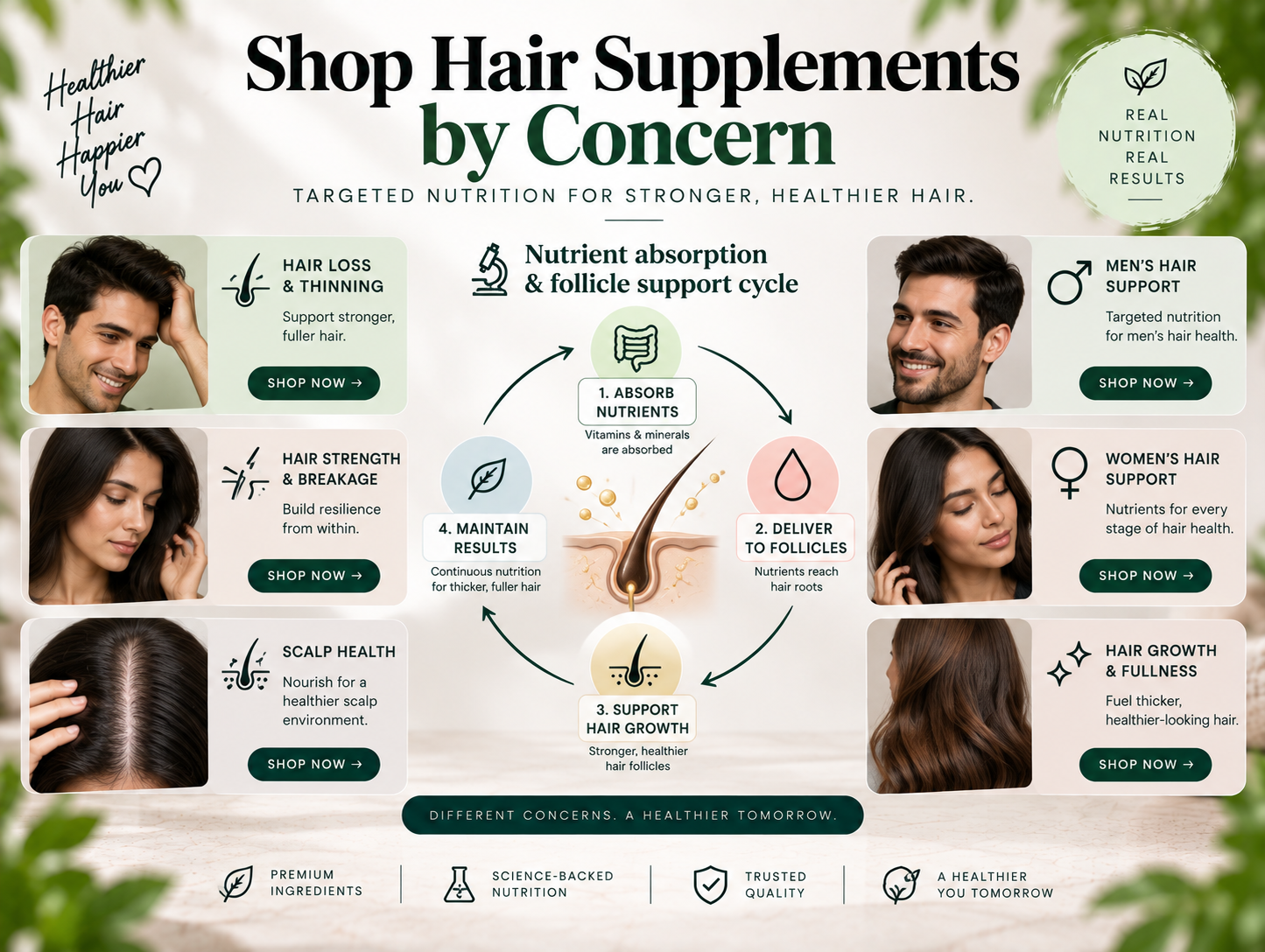
Shop Hair Supplements by Concern & Nutrient

22 curated subcategories. Each with honest, medically-responsible positioning.

Biotin Hair Supplements

For users looking for biotin support. Most useful when deficiency or increased requirement is relevant — not a universal regrowth shortcut.

BiotinDeficiency-awareVegetarian available

⚠️ May interfere with some lab tests at high doses.

Hair Growth Supplements

Growth-support nutrition blends with biotin, amino acids, zinc, vitamins and antioxidants. No regrowth guarantees.

Multivitamin blendAmino acidsZinc

Hair Fall Supplements

For hair fall support where nutrition, deficiency, stress, recovery or lifestyle gaps may contribute to shedding.

Diffuse sheddingStress supportRecovery

Hair Multivitamins

Broad-spectrum hair nutrition support with vitamins, minerals and amino acids for comprehensive daily nutrition.

Broad spectrumDaily useVitamins + minerals

Iron & Ferritin Support

For users with suspected or confirmed low iron/ferritin. Strongly recommend lab guidance before starting iron supplements.

Women's concernDiffuse sheddingFerritin

⚠️ Do not self-start high-dose iron without testing.

Vitamin D Hair Supplements

For users with low vitamin D or low sunlight exposure risk. Lab confirmation is preferred for dosing guidance.

Vitamin D3DeficiencyLab-guided

Zinc Hair Supplements

For nutrition support where zinc deficiency risk is relevant. Avoid high-dose self-use without doctor guidance.

ZincImmune supportScalp health

B12 Hair Supplements

For vegetarian, vegan or deficiency-risk users where B12 support may be relevant. Test and diet history recommended.

VegetarianVeganB12 deficiency

Collagen Hair Supplements

For hair-fiber, skin and nail support positioning. A cosmetic/supportive supplement, not a medical regrowth treatment.

Collagen peptidesSkin supportNail support

Amino Acid Hair Supplements

For protein building block support, brittle hair and low protein diet contexts. L-cysteine and L-methionine blends.

L-cysteineL-methionineBrittle hair

Protein Hair Supplements

For users with low protein intake, crash dieting, gym routines or recovery phases where dietary protein is insufficient.

Low protein dietCrash dietGym users

⚠️ Kidney/liver disease users need medical advice.

Hair Gummies

Convenient hair vitamin gummies. Check sugar content, dose limits and avoid overuse — gummies still contain active vitamins.

ConvenientCheck sugarDose matters

⚠️ Check sugar and dose — not for diabetics without advice.

Women's Hair Supplements

For female hair fall support, postpartum, PCOS, iron/ferritin, vitamin D and menopause-related nutrition needs.

WomenPCOSPostpartumIron

Men's Hair Supplements

For men with hair fall support, nutrition gaps, gym lifestyle and stress-related shedding. Pattern hair loss needs diagnosis.

MenGym usersStress shedding

Postpartum Hair Supplements

For postpartum shedding support. Breastfeeding safety and doctor guidance are clearly required before starting.

PostpartumPost-deliveryDoctor-guided

⚠️ Breastfeeding safety review recommended before use.

PCOS Hair Supplements

For PCOS-linked hair concerns with nutrition support. Supplements do not correct hormonal imbalance alone.

PCOSHormonal concernWomen

⚠️ PCOS needs doctor management — not supplements alone.

Menopause Hair Supplements

For women experiencing gradual thinning, dryness and nutrition support needs after 40. Dermatologist guidance helpful.

MenopauseThinning after 40Women

Vegetarian Hair Supplements

For vegetarian users needing B12, iron, protein, zinc or vitamin D support with vegetarian capsule options.

VegetarianB12IronProtein gap

Vegan Hair Supplements

For vegan users with plant-based capsule or gummy preferences and B12/protein-gap nutrition awareness.

VeganPlant-basedB12

Sugar-Free Hair Supplements

For users preferring sugar-free supplement formulas, especially those avoiding sugary gummies or managing blood sugar.

Sugar-freeDiabetes cautionClean formula

Hair Supplement Kits

Structured 1-month, 3-month and 6-month supplement bundles with refill logic and progress tracking built in.

1-month3-month6-monthRefill

Doctor-Guided Supplement Plans

For users with deficiency suspicion, medical conditions, medication use, pregnancy, postpartum or long-term hair fall.

High cautionMedical conditionsPregnancy

⚠️ Consult a doctor before starting. Do not self-select.

Active Ingredient Library

Shop by Nutrient & Ingredient

Understand each nutrient before choosing. Deficiency context matters more than hype.

💊
Biotin
Nutrition support

Supports hair when biotin deficiency or increased requirement is relevant. Useful in selected users, not universal.

High-dose biotin may interfere with certain lab tests.

🩸
Iron & Ferritin
Lab-test preferred

Supports hair when low ferritin or iron deficiency is identified. Particularly relevant for women with diffuse shedding.

Do not self-start high-dose iron without testing.

☀️
Vitamin D3
Lab-guided dosing

Supports general health and deficiency correction. Low vitamin D is commonly found in hair fall workups in India.

Lab-guided dosing preferred; excess can accumulate.

🌿
Vitamin B12
Veg/vegan risk

Important for vegetarian and vegan users where B12 deficiency risk is higher. Test and diet history help guide need.

Diet history and testing recommended before supplementing.

🔬
Zinc
Trace mineral

Supports hair, skin and immune nutrition. Relevant where zinc deficiency risk is identified through diet or symptom history.

Avoid long-term high-dose zinc without doctor guidance.

💫
Collagen Peptides
Supportive role

Hair-fiber, skin and nail supportive positioning. Collagen is a structural protein with general supportive benefits.

Supportive — not a medical regrowth treatment.

🥚
Amino Acids
Protein building blocks

L-cysteine, L-methionine and other amino acids support protein-dependent hair structure, especially with low dietary protein.

Most useful when protein intake is genuinely low.

🌊
Omega-3
General support

General inflammation and nutrition support positioning. Broad wellness benefits with indirect relevance to hair health.

Blood thinner caution if on relevant medication.

🍊
Vitamin C
Iron absorption aid

Supports iron absorption and provides antioxidant nutrition. Useful alongside iron supplementation routines.

Generally well tolerated — avoid extremely high doses.

🌿
Saw Palmetto
DHT-support role

DHT-support positioning in selected male hair concerns. Evidence varies across studies. More research ongoing.

Medication and pregnancy caution; evidence mixed.

Shop by Concern

Shop Hair Supplements by Concern

Curated product rails. Switch concern tabs below. All products carry honest safety notes.

Products coming soon

We're curating the right supportive products for this concern. In the meantime, browse the full Hairsncares shop or take the AI Hair Test for a tailored match.

Browse all products

Routine Combos

Hair Supplement Plans & Bundles

Curated supplement pathways. Each includes lab guidance, safety notes and refill logic.

Bundles coming soon

Value bundles for this concern aren't ready just yet. Browse the full Hairsncares shop to build the routine that fits your needs.

Browse all products

📍 Check Delivery to Your Pincode

What Science Says

What Hair Supplements Can and Cannot Do

Honest, evidence-aware positioning. No overclaiming. No false hope.

✓ May Support
  • Nutritional gaps and deficiency correction where confirmed
  • Recovery after illness, fever or diet stress
  • Protein and amino acid support for low-protein diets
  • Hair-shaft nutrition and structural support
  • Postpartum nutrition support where safe and doctor-approved
  • Vegetarian and vegan nutrition gap correction
  • General hair wellness routine as a complement to topical care
✕ Cannot Guarantee
  • Cure for baldness or androgenetic alopecia
  • Instant or guaranteed hair regrowth in any user
  • Treatment for alopecia areata, thyroid or PCOS without medical management
  • Replacement for minoxidil or dermatologist-prescribed treatment
  • Deficiency correction without appropriate dose and duration
  • The same result in every individual — results vary significantly
  • Safe use in all medical conditions without doctor guidance

Choosing supplements without identifying the cause of hair fall can waste time and money. Check your hair fall cause first.

Check My Hair Fall Cause First

Selection Framework

The Hairsncares 7-Step Supplement Selection Framework

Dr. Amit Agarkar's guided approach to choosing supplements responsibly.

01
🎯
Identify Your Hair Concern

Hair fall, thinning, weak hair, breakage, postpartum shedding, PCOS, menopause, stress or post-illness recovery. The concern shapes the supplement choice.

02
🩺
Identify Deficiency Risk

Vegetarian diet, low protein intake, heavy periods, recent illness, rapid weight loss, low sunlight exposure or irregular eating history all raise deficiency risk.

03
🚨
Check Red Flags First

Sudden severe loss, patchy loss, scalp pain, pregnancy, breastfeeding or children's hair fall require dermatologist assessment before any supplement.

04
💊
Match the Right Nutrient

Biotin, iron, vitamin D, B12, zinc, amino acids, collagen or multivitamin — based on your concern, deficiency risk and diet pattern. Not all at once.

05
⚠️
Check Safety & Interactions

Review current medicines, thyroid treatment, pregnancy, breastfeeding, kidney/liver conditions and allergies before starting any supplement.

06
📅
Choose the Right Duration

Most supplement routines need 3–6 months of consistent use. Avoid endless use without reassessment. Periodic review matters.

07
📊
Track and Reassess

Track shedding, density photos, energy, nail changes and scalp symptoms. Follow up with lab markers where relevant. Escalate if worsening.

Build a responsible supplement routine in minutes.

Build My Supplement Routine

How-To Guide

How to Use Hair Supplements Without Overdoing It

8 practical steps from Dr. Amit Agarkar for safe, effective supplement use.

1
Start with Your Hair Concern

Know whether your issue is shedding, thinning, breakage or scalp-related. The problem guides the supplement — not the other way around.

2
Review Diet & Deficiency Risk

Vegetarian diet, low protein, weight loss, postpartum, heavy periods or recent illness raise specific deficiency risks. Match supplement to risk.

3
Don't Stack Multiple Supplements

Taking several overlapping supplements can cause excess intake and interactions. Choose correctly rather than taking everything.

4
Follow the Label Dose

Do not double doses hoping for faster results. Overdosing vitamins and minerals can cause toxicity, especially with fat-soluble nutrients.

5
Check Medical Conditions

Pregnancy, breastfeeding, thyroid medicines, kidney or liver disease, blood thinners and other medicines need doctor guidance before starting.

6
Track for 8–12 Weeks

Supplements are not instant. Track hair fall count, density photos, energy, nail changes and overall response over 2–3 months.

7
Stop & Consult if Side Effects Occur

Stomach upset, skin rash, acne flare, unusual symptoms or worsening hair fall are signals to stop and consult a dermatologist immediately.

8
Reassess Regularly

If no improvement after 3 months of consistent use, escalate to a dermatologist for root-cause diagnosis — supplements may not be the issue.

Side-by-Side

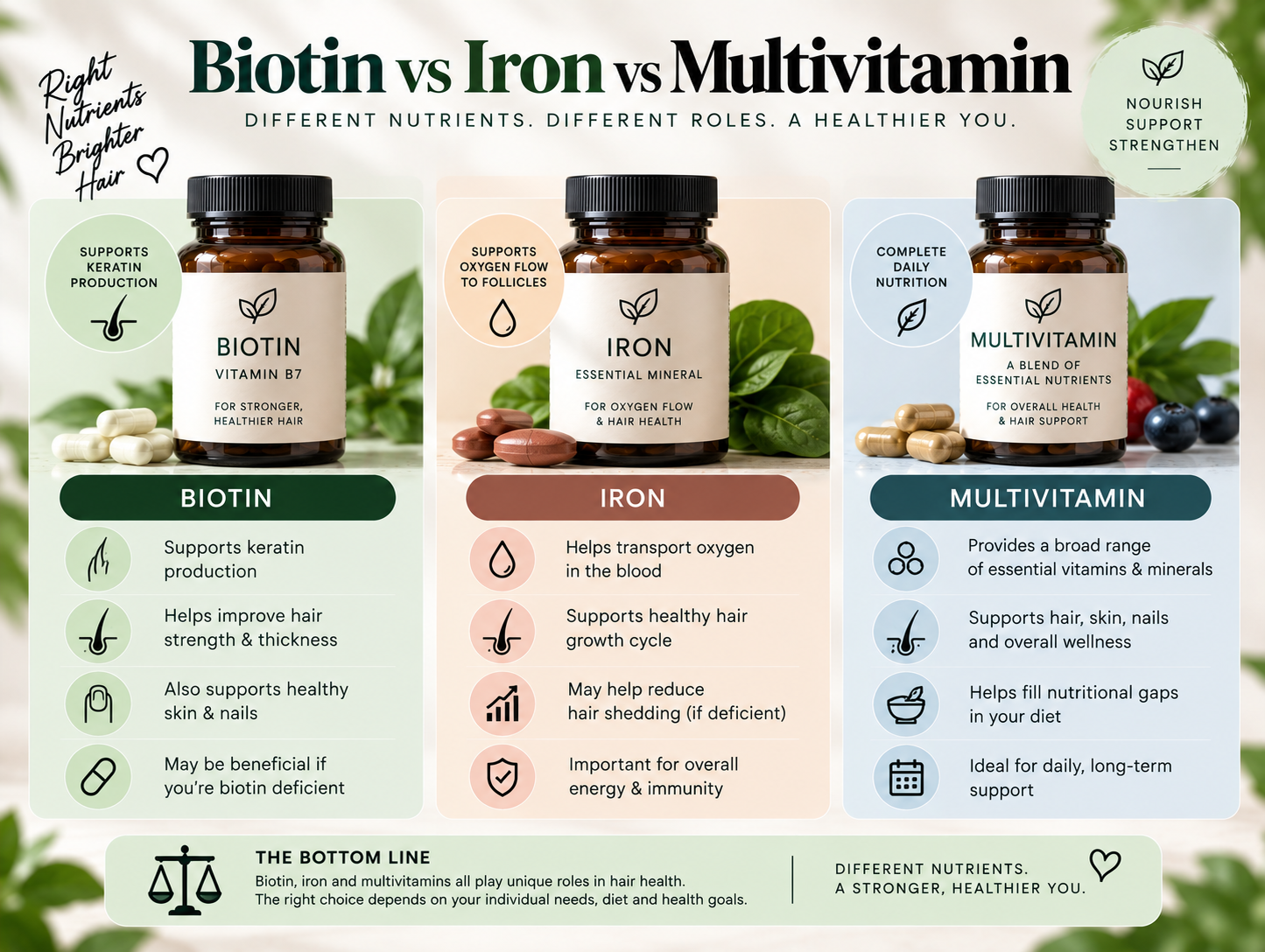
Supplement Type Comparison

Biotin
  • Single nutrient. Useful when deficiency or need is relevant. Not universal.
  • Most useful with crash dieting or specific metabolic issues.
  • May interfere with some lab tests at high doses.
Multivitamin
  • Broader nutrition support with multiple vitamins and minerals.
  • Good for general daily support across multiple gaps.
  • Choose multivitamin for general support; biotin only if specifically indicated.
Iron & Ferritin
  • Relevant when ferritin or iron deficiency is identified — especially in women.
  • Lab test preferred before starting.
  • Do not self-start high-dose iron.
Vitamin D
  • Relevant when vitamin D is low or sunlight exposure is limited.
  • Commonly low in Indian hair fall workups.
  • Match to deficiency — ideally test before taking either.
Collagen
  • Hair-fiber, skin and nail support. More cosmetic/supportive role.
  • Structural protein with general supportive benefits.
  • Not a medical regrowth treatment.
Amino Acids
  • Protein building blocks. Useful with low protein diet or brittle hair.
  • L-cysteine, L-methionine blends.
  • Amino acids for low protein; collagen for broader hair-skin support.
Gummies
  • Convenient but may contain sugar. Check dose limits carefully.
  • Better tolerated by those who dislike swallowing.
  • Gummies for convenience if sugar is not a concern.
Capsules
  • More concentrated, lower sugar. Often more precise dosing.
  • Preferred in medical or high-concern contexts.
  • Capsules preferred for medical context.
Supplement
  • Internal nutrition support addressing deficiency or gaps.
  • Works from inside out over weeks to months.
  • Can be combined with topical care.
Hair Serum
  • External leave-on scalp and hair support with topical actives.
  • Targets scalp and hair surface directly.
  • Both can be used together as part of a complete inside-out routine.
Supplement
  • Deficiency and nutrition support. Not a medical treatment.
  • Addresses nutritional gaps only.
  • Supplement for nutrition gaps alongside treatment.
Prescription
  • Doctor-prescribed treatment for pattern hair loss (minoxidil, finasteride).
  • Targets follicle biology directly.
  • Prescription for medical hair loss.

Myths vs Facts

Hair Supplement Myths vs Facts

Common misconceptions that cost people time, money and hair health.

Myth
"Biotin regrows hair in everyone."
Fact

Biotin is most useful when deficiency or increased requirement is relevant. It is not a universal hair regrowth treatment. Taking it without need may not produce meaningful results.

Myth
"More supplements mean faster hair growth."
Fact

Stacking multiple overlapping supplements can cause excess intake and harmful interactions. Correct selection — not quantity — drives response.

Myth
"Hair gummies are harmless because they look like sweets."
Fact

Gummies contain active vitamins and often sugar. Dose still matters. Overconsumption can cause adverse effects. They are supplements, not confectionery.

Myth
"Iron tablets are safe for any woman with hair fall."
Fact

Iron should ideally be guided by ferritin or iron tests. Excess iron can cause toxicity, constipation and other issues. Not everyone with hair fall has low iron.

Myth
"Supplements can replace minoxidil for hair loss."
Fact

Supplements address nutritional gaps. Minoxidil targets hair follicle biology. For androgenetic alopecia, medical treatment is not interchangeable with nutrition supplements.

Myth
"Natural supplements have no side effects."
Fact

Herbal or natural ingredients can interact with medicines, trigger allergies or cause liver/kidney stress in some users. Natural does not automatically mean safe for everyone.

🚨 Safety First

When You Should Not Self-Select Hair Supplements

These situations require dermatologist assessment before starting any supplement.

Sudden severe or rapidly progressing hair fall
Patchy bald spots appearing suddenly
Painful, sore or burning scalp
Pus, crusting, bleeding or scalp infection signs
Hair fall with unexplained fatigue, weight change or thyroid symptoms
Hair fall with irregular periods, acne, excess facial hair (PCOS concern)
Pregnancy — do not self-start supplements
Breastfeeding — check with your doctor
Child or teenage hair loss — paediatric/dermatologist assessment needed
Known kidney or liver disease
Currently on thyroid medicines, blood thinners or multiple medications
No improvement or worsening after 3 months of supplements
👨‍⚕️
Talk to Dr. Amit Agarkar

For sudden, patchy, progressive or symptom-linked hair fall, a dermatologist consultation identifies the root cause before any supplement is chosen.

Why Diagnosis First

Supplements support nutrition — they do not treat medical hair loss. A correct diagnosis prevents wasted months on the wrong product.

Powered by Intelligence

Let AI Help You Choose Supplements Safely

Six AI tools designed to guide supplement selection, safety and tracking. Educational only.

🔬

AI Hair Test

Identify your hair fall pattern, duration, severity, life stage and red flags before choosing any product.

Start AI Hair Test
💊

AI Product Finder

Match supplement by concern, diet pattern, life stage and deficiency risk. Personalised recommendation logic.

Find My Supplement
📋

Routine Builder

Plan supplement timing, shampoo, serum and oil routine as a complete inside-out hair care programme.

Build My Routine
🔍

Ingredient Decoder

Understand biotin, iron, vitamin D, zinc, collagen and amino acids — what they do and when they help.

Decode Ingredients
⚠️

Drug Interaction & Safety

Check current medicines, pregnancy or breastfeeding caution and supplement safety flags before starting.

Check Supplement Safety
📊

Progress Tracker

Track hair fall, density photos, refill reminders and supplement response over 3–6 months.

Track My Progress

Explore More Hair Supplement Guides

Education & Science


Expert Answers

Frequently Asked Hair Supplement Questions

Doctor-reviewed answers to common supplement questions.

The best supplement depends on the underlying cause. Iron or ferritin support may be relevant for women with low ferritin. Vitamin D and B12 may help those with deficiency risk. A broad multivitamin or amino acid formula can support diffuse shedding related to nutrition gaps. There is no single answer — diagnosis or deficiency assessment first.

Hair supplements can support hair health when a genuine nutritional gap or deficiency is addressed. They are less effective when the underlying cause is androgenetic alopecia, hormonal imbalance, thyroid disease or scalp disease. Results vary significantly based on cause, consistency and selection. They are not a universal solution.

Several nutritional deficiencies are associated with hair shedding — iron or ferritin, vitamin D, vitamin B12, zinc, protein and folic acid deficiencies are commonly discussed. However, hair fall has many causes beyond nutrition. A dermatologist can help identify whether a nutritional gap is contributing to your specific type of hair fall.

Biotin is most useful when biotin deficiency or increased requirement is relevant — such as with crash dieting or specific metabolic issues. For most people without a genuine deficiency, supplementing biotin is unlikely to stop hair fall. Biotin may also interfere with certain lab tests at high doses. Choose based on actual need.

No. Biotin is most relevant when deficiency or increased biotin requirement is present. For people with adequate biotin levels who are eating a reasonably balanced diet, additional biotin supplementation may not provide meaningful benefit for hair fall. Hair fall from genetic, hormonal or medical causes needs targeted treatment, not biotin.

Yes — low serum ferritin (the body's iron storage protein) is associated with diffuse hair shedding, particularly in women. If ferritin is low, doctor-guided iron support may be recommended alongside dietary changes. However, self-starting high-dose iron without testing can be harmful. A serum ferritin test and medical guidance is the right path.

Vitamin D deficiency has been associated with various types of hair loss in research, including alopecia areata and diffuse shedding. It is commonly found to be low in hair fall patients in India due to indoor lifestyles. A vitamin D blood test can help guide whether supplementation is appropriate and at what dose.

Only if iron or ferritin deficiency is confirmed or clinically suspected. A serum ferritin test is helpful before starting iron supplements. Excess iron can be harmful — it is not a benign supplement to take without indication. Women with heavy periods, vegetarians or those with dietary iron gaps may be more at risk and should discuss this with a doctor.

Collagen supplements are positioned for hair-fiber support, skin and nail benefits. They are not a direct hair regrowth treatment. Some studies suggest collagen peptides may support hair structure and elasticity, but the clinical evidence for significant hair regrowth is limited. Collagen is a supportive supplement, not a medical treatment for hair loss.

Yes. Hair is primarily made of keratin, a protein. Severe or prolonged protein deficiency — from crash dieting, extreme caloric restriction, very low intake or rapid weight loss — can cause diffuse hair shedding. Correcting protein intake through diet or amino acid/protein supplementation can support hair in such contexts. Results improve with nutritional adequacy over time.

Female hair thinning has many causes — PCOS, thyroid, low ferritin, vitamin D deficiency, postpartum shedding, menopause or androgenetic alopecia. The right supplement depends entirely on the underlying cause. A dermatologist evaluation with appropriate tests will give a clearer picture than choosing a supplement blindly based on a product description.

Men with diffuse shedding or nutrition-related hair fall may benefit from a hair multivitamin or amino acid formula. However, male pattern baldness (androgenetic alopecia) does not respond meaningfully to supplements alone — it requires dermatologist evaluation and appropriate treatment such as finasteride or minoxidil. Supplements support nutrition, not genetics.

Most hair supplements are not specifically tested or approved for use during pregnancy. Some ingredients at high doses can be harmful. Only supplements prescribed or specifically cleared by your obstetrician should be taken during pregnancy. Do not self-start any hair supplement while pregnant without medical guidance from your healthcare provider.

Many hair supplements are not specifically tested for breastfeeding safety. Some vitamins, minerals or herbal ingredients may pass into breast milk. Always consult your doctor or a lactation expert before starting any supplement while breastfeeding. Do not rely on general product claims or "natural" labels as proof of breastfeeding safety.

Postpartum hair fall (telogen effluvium) is largely a natural process following the hormonal shift after delivery — it typically improves on its own within 6–12 months. Nutritional support with iron, B12, biotin and protein where dietary gaps exist may help recovery. However, breastfeeding safety must be confirmed with a doctor before starting any supplement.

PCOS-linked hair fall is primarily hormonal in origin. Supplements alone cannot correct androgen excess or insulin resistance causing the hair loss. Nutritional support addressing iron, vitamin D or B12 deficiency may be relevant in some PCOS patients. Medical management of PCOS through a gynaecologist or dermatologist is the cornerstone of treatment.

Hair gummies contain the same active vitamins and minerals as capsule or tablet forms — so their effectiveness depends on the same factors: whether the nutrients address a real nutritional gap. Gummies are convenient, but may contain sugar and are sometimes lower in active nutrient concentration than capsule formulas. Dose and ingredient quality matter more than format.

Hair gummies are generally safe when used within the recommended dose. However, because they taste pleasant, some users overconsume them, which can lead to excess vitamin or mineral intake. Check sugar content if you manage blood sugar. Do not exceed the daily dose. They are not safe in unlimited quantities just because they look appealing.

Capsules are often more concentrated, lower in sugar and have a more precise dose. Gummies are more convenient and better tolerated by those who dislike swallowing tablets. For clinical or high-concern contexts, capsules or tablets may be preferable. For general wellness support in healthy adults, either can work if used correctly and within dose limits.

Most hair supplement courses are evaluated at 3–6 months for a meaningful response assessment. Consistency matters more than short bursts. After 3 months, reassess with a dermatologist. Avoid indefinite use without periodic review, especially for high-dose single nutrients like iron or vitamin D, which need monitoring to prevent excess accumulation.

Yes. Fat-soluble vitamins (A, D, E, K) can accumulate in the body to toxic levels. Excess iron can cause gastrointestinal problems and organ damage over time. Zinc toxicity can suppress copper absorption. High-dose biotin can interfere with lab tests. Taking more than the recommended dose of any supplement does not accelerate results and can cause harm.

Not always — but blood tests help in several situations: before starting iron or vitamin D (to guide dose), if you suspect thyroid or ferritin-related shedding, if you are vegetarian or vegan, if hair fall is sudden or severe, or if multiple supplements are being considered. A dermatologist can advise which tests are relevant to your situation.

No. Supplements and minoxidil work through entirely different mechanisms. Minoxidil is a proven topical treatment for androgenetic alopecia and works at the follicle level. Supplements address nutritional gaps. They serve different roles and are not interchangeable. In some cases, both may be used together as part of a dermatologist-guided treatment plan.

See a dermatologist for sudden or severe hair fall, patchy bald spots, painful or inflamed scalp, hair fall with systemic symptoms (fatigue, weight change, irregular periods), hair fall in pregnancy, postpartum or menopause, child hair loss, hair fall that has not improved after 3 months of supplements, or if you are unsure of the cause of your shedding.

The Hairsncares AI Product Finder matches supplements by hair concern, diet pattern, gender, life stage, deficiency risk, format preference and safety flags. It uses a structured question flow to narrow recommendations based on your profile. Results are educational — for clinical decision making, always confirm with a dermatologist or your doctor, especially for high-caution scenarios.

Yes — Hairsncares offers monthly refill subscriptions with 1, 3 and 6-month supply options, refill reminders, progress tracker integration and pause-anytime flexibility. Subscription ensures consistency, which is essential for meaningful supplement response. You will be prompted to review your progress before each refill and escalate to a doctor if improvement stalls.

Your Next Step

Not Sure Which Hair Supplement You Need?

Choosing supplements blindly can waste money or miss the real cause of hair fall. Let Hairsncares help you choose by concern, diet pattern, life stage, deficiency risk and safety profile.

Hairsncares by Dr. Amit Agarkar — Dermatologist, Trichologist & Hair Transplant Surgeon, Mumbai. This page is for educational product-selection guidance only. It does not replace medical diagnosis or dermatologist consultation. Supplements do not cure baldness or medical hair loss conditions. Results vary. Always read label instructions and consult a doctor for medical concerns.

Medically Reviewed

Dr. Amit Agarkar — MD Dermatology, Trichologist & Hair Transplant Surgeon

This hair supplements guide is medically reviewed for accuracy and responsible, non-overclaiming positioning. Supplements support nutrition and do not replace dermatologist diagnosis, lab testing or prescription treatment for medical hair loss.

Last reviewed: 20 June 2026

Your Cart (0)

Your cart is empty

Subtotal0
DeliveryFREE
Total0
🔒 Secure📦 Free above ₹499↩ Easy returns
💬 Hi! I'm Dr. Amit — your Hair Intelligence consultant
🌿
1
🌿
Dr. Amit
Virtual Dermatologist · Hairsncares.com
Online
What are you shopping for today?
Select a category to begin
AI-powered scalp diagnosis · Hairsncares.com
📸
Scalp Analyser
Upload scalp photo · Get conditions, root cause, and matched product protocol
📷
Drop scalp photo here or click to upload
JPG, PNG, WEBP · Clear, close-up, well-lit photo

Your image is processed privately by our AI engine and saved securely with your account.