India's hair intelligence ecosystem

Why HairsnCares

The future of haircare isn't choosing between a doctor, an algorithm, an article or a product. It's building the system that connects them. HairsnCares runs one continuous stack — assessment, clinical knowledge, ingredient intelligence, drug safety, commerce and longitudinal tracking — so your hair journey stops being a research project you have to manage yourself.

  • Dermatologist reviewed
  • Free assessment
  • Ingredient first
  • Ships across India
Hero — Hair intelligence laboratory 1600 × 1200 · whc-hero-hair-intelligence-lab.jpg
Dermatology, engineered into a system

The HairsnCares model in eight steps

01
Symptoms
What you're seeing
02
Assessment
8 minutes, free
03
Analysis
Pattern & drivers
04
Ingredients
Actives, then brands
05
Routine
Sequenced & timed
06
Products
One basket
07
Tracking
Monthly photos
08
Decision
Month six review
Quick answer

What makes HairsnCares different from other hair websites?

Most hair services solve one piece of the problem — a clinic diagnoses, a shop sells, a blog explains, an app tracks — and leave you to join them up. HairsnCares runs all of those as one chain under a single dermatologist's oversight, so an assessment leads into learning, learning into a routine, a routine into tracking, and tracking into a clinician when that is genuinely the next step. The practical difference is that nothing recommends a purchase before it has told you what your problem probably is, and the platform is willing to say when no product will help. It is not better at any one of these than a specialist. It is the handoffs between them that are the product.

  • One chain, not six silosAssessment through to clinical care
  • Dermatologist oversightNamed, dated and published
  • Willing to say noIncluding when nothing on a shelf helps

What this page covers

Why the industry is broken

Everyone solves
one-sixth of the problem.

Hair loss is unusual among common medical concerns in three ways at once, and every one of them breaks a different part of the internet. It is slow — nothing meaningful happens for four months, which defeats every feedback loop the web is built on. It is multi-causal — genetics, hormones, iron, thyroid, stress, styling and scalp inflammation frequently coexist in the same head, so single-answer content is usually wrong for the person reading it. And it is cosmetic and medical at the same time, which means it gets sold like shampoo and treated like a disease, by two different industries that never speak.

The result is not a shortage of information. India has plenty. The result is that a person losing hair has to become their own physician, pharmacist, researcher, procurement officer and record keeper — five jobs, unpaid, while anxious. Most people manage two of the five and then quietly give up somewhere in month three.

What follows is not a criticism of any company. Each category below is genuinely good at the thing it was built for. The failure is architectural: nobody owns the handoffs.

01

The clinic

Superb at diagnosis, trichoscopy and procedures. But the consultation ends, and the eleven months of daily routine that actually decide the outcome happen entirely without it. Nobody sees you again until you're worse.

Stops after diagnosis

02

The marketplace

Infinite shelf, zero clinical logic. Ranking is driven by margin, ad spend and review volume. Two bottles with identical actives sit at a fourfold price gap and nothing on the page tells you they're the same molecule.

Ranks by margin
03

The beauty platform

Built for cosmetics discovery, and excellent at it. Hair loss is a medical concern wearing a cosmetic costume, and the taxonomy — by brand, by scent, by finish — simply has no slot for "androgenetic, five years, family history".

Wrong taxonomy
04

The general chatbot

Fluent, confident, unreviewed, and inconsistent between sessions. It will name a molecule without checking you can obtain it in India, at a strength nobody verified against your history, and phrase it with the same certainty either way.

Confident, unverified
05

The hair blog

Often explains the science better than the clinic does — then abandons you at the hardest step. Knowing that a 5% topical works is not knowing which of forty Indian products contains it, at what price, with which vehicle.

No next step
06

The ingredient database

Rigorous about molecules, silent about you. It can tell you the mechanism of every active in the pharmacopoeia and still cannot tell you which two of them belong in your routine this month, or which one to stop.

Context free

Six months are usually lost not to the wrong product, but to the gaps between six right ones.

Dr. Amit S. Agarkar · MBBS, MD (Dermatology), FCPS, DDV
Tired of Assembling It Yourself?Take the Free Hair TestSee the architecture →

The cost of fragmentation

How four years
get spent on nothing.

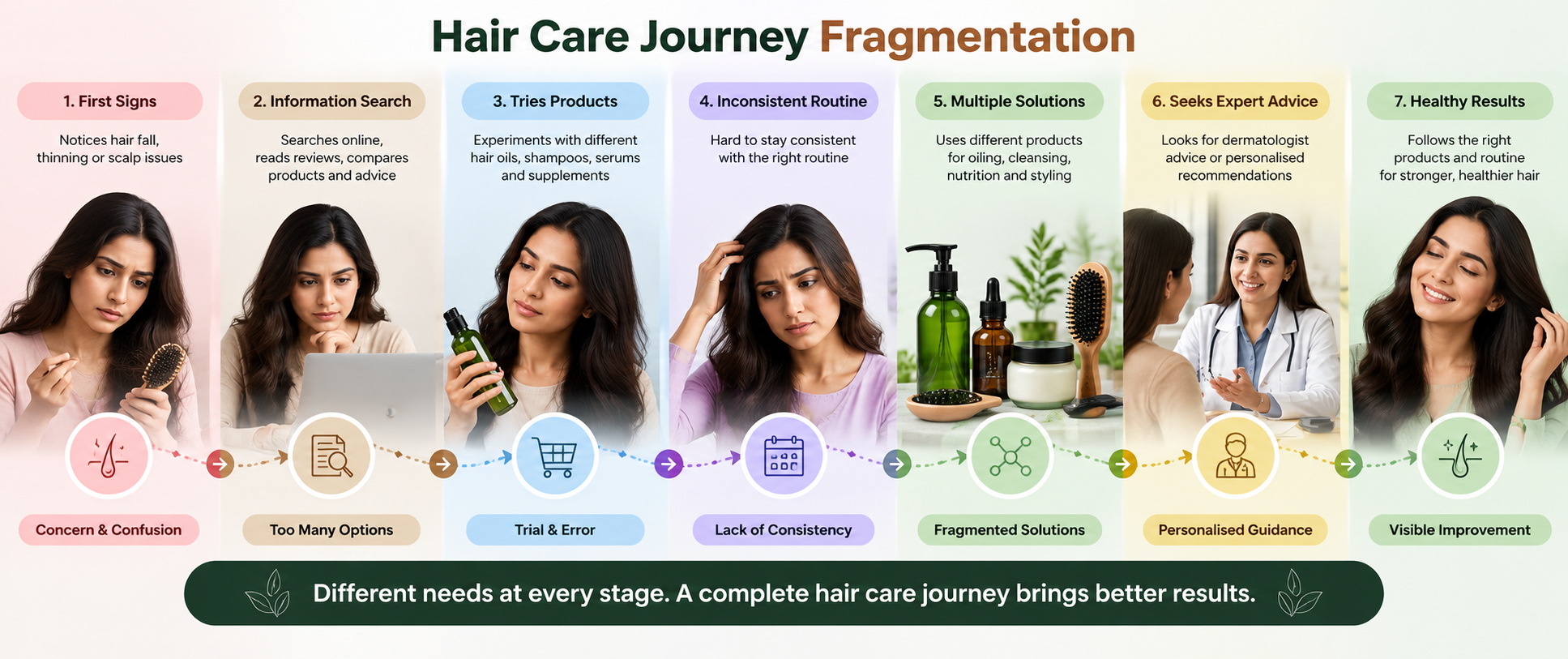
This is the pattern described in consulting rooms almost daily. Not a statistic — a shape. It is worth reading because almost every step in it is a reasonable decision made with incomplete information.

  1. Month 0–3
    Denial, then an oil

    Shedding becomes undeniable. The first response is almost always a hair oil or a switch of shampoo — low cost, low risk, and for genuine pattern hair loss, no mechanism of action against the actual problem.

  2. Month 4–8
    The search spiral

    Search, video, forum, reel. Five confident answers that contradict each other, most produced by someone selling the answer. No way to tell which of them was written by anyone who has examined a scalp.

  3. Month 9–12
    Supplement season

    Biotin, multivitamins, a collagen powder. Occasionally correct — if there is a real deficiency. Usually an expensive way to treat a deficiency you never tested for, while the actual driver continues unopposed.

  4. Year 2
    The first real consultation

    A dermatologist, finally. A correct diagnosis, a correct prescription, ten focused minutes. Then the visit ends, and the daily execution of the plan goes home alone.

  5. Year 2, month 3
    Stopped too early

    Some treatments cause increased shedding in the first weeks — expected, temporary, and almost never explained in the time available. It reads as proof of failure. The treatment is abandoned roughly two months before it would have started working.

  6. Year 3
    Restart, from zero

    A different product, a different source, no record of what was tried, at what dose, for how long, or why it stopped. Every previous year's information is gone. The loop begins again with less hair.

  7. Year 4
    The expensive conversation

    Miniaturised follicles that could have been held four years earlier are now gone, and the discussion has moved from a topical costing a few hundred rupees a month to a surgical one. This is the real price of fragmentation, and it is paid in follicles.

Read that list again and notice what is missing at every stage: not intelligence, and not effort. What is missing is a system that remembers, that explains why something is happening before it happens, and that is still present in month four when the decision to continue or stop is actually made. That absence is the entire reason HairsnCares exists.

Infographic — Journey fragmentation 1600 × 672 · whc-journey-fragmentation.jpg

The architecture

The Hair Intelligence Stack
Nine layers. One handoff chain.

Most haircare products are features. HairsnCares is built as a stack, because the value is not in any single layer — it is in the fact that each layer is obliged to hand a structured output to the next one. Select a layer to see what feeds it, what it produces, and what it refuses to do.

Layer 0

Input

Everything begins with what you can actually observe about yourself.

Receives
Produces
Will not
Open this layer →

The difference, in one shape

One hair journey.
One intelligent loop.

The stack describes how the system is built. The loop describes how it behaves. Eight capabilities, each obliged to hand off to the next: the assessment feeds the recommendation, the recommendation cites the ingredient page, the ingredient page links to the product, the product enters your routine, the routine enters your journal, and the journal decides what happens next. Nothing is a dead end, and nothing has to be re-explained.

The HairsnCares intelligence loopA continuous circular flow connecting dermatologist input, AI assessment, hair analysis, recommendation engine, education, shopping, tracking and results around a central hair intelligence core.HairIntelligenceCOREDerma-tologistAIAssessmentHairAnalysisRecommen-dationEducationShoppingTrackingResults
  1. Step 01
    Dermatologist

    Protocols and review standards set by a practising dermatologist.

  2. Step 02
    AI assessment

    A structured, dermatology-designed intake — not an open-ended chat.

  3. Step 03
    Hair analysis

    Pattern, density, scalp condition and history read together.

  4. Step 04
    Recommendation

    Ingredients first, then the products that contain them.

  5. Step 05
    Education

    Every claim links to a reviewed page you can read yourself.

  6. Step 06
    Shopping

    The routine becomes a cart, with nothing added that wasn't explained.

  7. Step 07
    Tracking

    Photo journal and routine log, because hair changes on a monthly clock.

  8. Step 08
    Results

    Continue, adjust, or escalate to clinic — decided on evidence, not mood.

Proprietary frameworks

Five methods,
not five metaphors.

A framework is only worth naming if it changes what the platform actually does. Each of these corresponds to real logic running inside the stack — you can see its output in your own report. Anything that would require testing we do not perform, or a prediction nobody can honestly make, is deliberately absent from this list.

Framework 01 · Layer 2

Root Driver Mapping

Most hair loss has more than one cause running at once. This maps your answers onto the drivers that are plausibly contributing, rather than forcing a single label.

  • Separates genetic, hormonal, nutritional, inflammatory and mechanical contributors
  • Marks each as likely, possible or unsupported by your answers
  • Names what a blood test or examination would be needed to settle
  • Refuses to assign a driver the questionnaire cannot see
Output: driver map in your hair report
Framework 02 · Layer 3

Ingredient Compatibility Matrix

Actives interact — some usefully, some wastefully, some badly. This checks every pair in a proposed routine before it reaches you.

  • Flags pairs that duplicate the same mechanism at added cost
  • Flags pairs where one degrades or destabilises the other
  • Separates actives that need different times of day
  • Preserves combinations with genuine additive evidence
Output: routine conflict flags
Framework 03 · Layer 4

Clinical Escalation Triage

The most important thing a haircare platform can do is know when to stop selling. This is the rule set that routes you out of the product pathway.

  • Red flags: patchy loss, scarring, pustules, scalp pain, bleeding
  • Systemic flags: rapid diffuse shedding, weight or cycle change, fatigue
  • Population flags: paediatric loss, pregnancy, planned conception
  • Any flag suppresses product recommendation and routes to consultation
Output: escalation notice, products withheld
Framework 04 · Layer 5

Treatment Readiness Scale

Hair treatment fails on adherence more often than on pharmacology. This asks, before recommending anything, whether the plan is one you can actually run for six months.

  • Assesses tolerance for daily application versus weekly
  • Accounts for budget, so the routine is sustainable not aspirational
  • Checks willingness to continue indefinitely where the treatment requires it
  • Downgrades a theoretically stronger routine you would abandon in week six
Output: routine complexity tier
Framework 05 · Layer 7

Evidence Grading Ladder

Every claim on the platform carries the strength of evidence behind it, so that "proven" and "plausible" never appear in the same typeface.

  • Grade A — randomised controlled trials or meta-analysis
  • Grade B — cohort and controlled observational studies
  • Grade C — case series, small or open-label studies
  • Grade D — mechanism, tradition or clinical experience only
Output: grade badge on every active
Deliberately absent

What we don't claim

Several things a haircare platform could market are missing from this page on purpose, because building them would mean asserting knowledge nobody has.

  • No regrowth percentage or recovery probability score
  • No genetic or genome mapping — we perform no genetic testing
  • No simulated before-and-after imagery of your own head
  • No diagnosis: presentations are described, not confirmed
Read why this matters below

That last card is the one worth pausing on. Any platform can generate a number — "78% recovery probability", "hair health score 62" — and it will always convert better than honesty does. It is also unknowable. Response to hair treatment depends on the correct diagnosis, how long the loss has been running, how far the follicles have miniaturised, adherence, and individual factors that cannot be read from a questionnaire. A number implies a precision that does not exist, and on a page carrying a doctor's registration, it is not a marketing decision — it is a medical claim. So instead of predicting your outcome, the platform gives you the one thing that is genuinely knowable in advance: the timeline on which each treatment can be fairly judged, which appears further down this page.

Fig. 07
Precision instruments1600 × 540 · whc-frameworks-precision-instruments.jpg
Fig. 07 Methods, not metaphors A framework is only worth naming when it changes what the system does. Each of the five above produces an output you can find in your own report.

Category comparison

Not better than everyone.
Doing more than one thing.

This compares categories of platform, not companies. A clinic is superb at what a clinic does; so is a marketplace, and both hold marks below that HairsnCares does not — including the two capabilities at the very top, where our column reads zero. The question here is coverage — how much of one hair journey a single category can carry before handing you back to the open internet.

Capability coverage by platform category · 23 capabilities scored
CapabilityTraditional
clinics
Generic
ecommerce
Beauty
marketplaces
AI
chatbots
Hair
blogs
HairsnCares
Physical examination
Confirmed diagnosis
Provisional assessment
Dermatologist led
Clinical education
Structured hair assessment
Ingredient intelligence
Personalised product matching
Natural & ayurvedic range
Pharma haircare
Hair cosmetics & styling
Treatment appliances
Routine builder
Drug safety information
Progress tracking
Hair journals
Comparison articles
Integrated shopping
Single connected ecosystem
Clinical decision support
Lifestyle & nutrition guidance
Root-cause focus
Premium end-to-end experience
Coverage of the full journey61%22%24%24%26%91%
Core capability Partial or varies by provider Generally outside scope HairsnCares

Swipe the table sideways to see all categories →

Read the first three rows together, because the distinction between them is the entire basis of the platform. No online system can examine your scalp or confirm a diagnosis — those require a clinician, a dermatoscope and often a blood test, and any platform implying otherwise is selling something. What a structured assessment genuinely can do is form a provisional assessment: a documented working impression of what your presentation most resembles, with its drivers ranked and its uncertainties printed. That is exactly what a clinician forms before examination confirms or overturns it — and it is the output that makes the remaining twenty rows possible. It is also why the ninth layer of the stack exists: the system is built to recognise the point at which a provisional assessment must become a confirmed one, and to hand you to a human being without first putting a product in your basket. Coverage percentages are the share of the twenty-three capabilities listed, scoring a full mark as one and a partial as one half; you are welcome to count the marks yourself.

Want the Whole Journey Covered?Take the Free Hair TestExplore products →

Pillar one · Dermatology

Built around dermatology.
Not marketing.

The platform's spine is clinical practice, not a content calendar. Protocols are written first; the catalogue is arranged to serve them, and not the reverse. That order of operations is the single most consequential decision in the whole system.

  • Written protocols. Each concern maps to a documented approach — first line, second line, what to add at month three, and the point at which to stop and see someone.
  • Named medical review. Clinical pages are reviewed under Dr. Amit S. Agarkar, MBBS, MD (Dermatology), FCPS, DDV, and carry the date they were last checked — not an anonymous "expert team".
  • Evidence, graded. Where a claim rests on randomised trial data the page says so; where it rests on mechanism or practice experience, it says that instead, in the same sentence.
  • Stated limits. Scarring alopecia, suspected autoimmune loss, paediatric hair loss and transplant planning belong in a consultation room, and the platform routes them there rather than around them.
  • Commercial separation. A product's margin has no input into whether a protocol recommends its ingredient class. Protocols are written before the catalogue is consulted.
Pillar 1 — Dermatologist review 1200 × 1440 · whc-dermatologist-follicle-review.jpg

Pillar two · Intelligence

Where artificial intelligence
meets hair science.

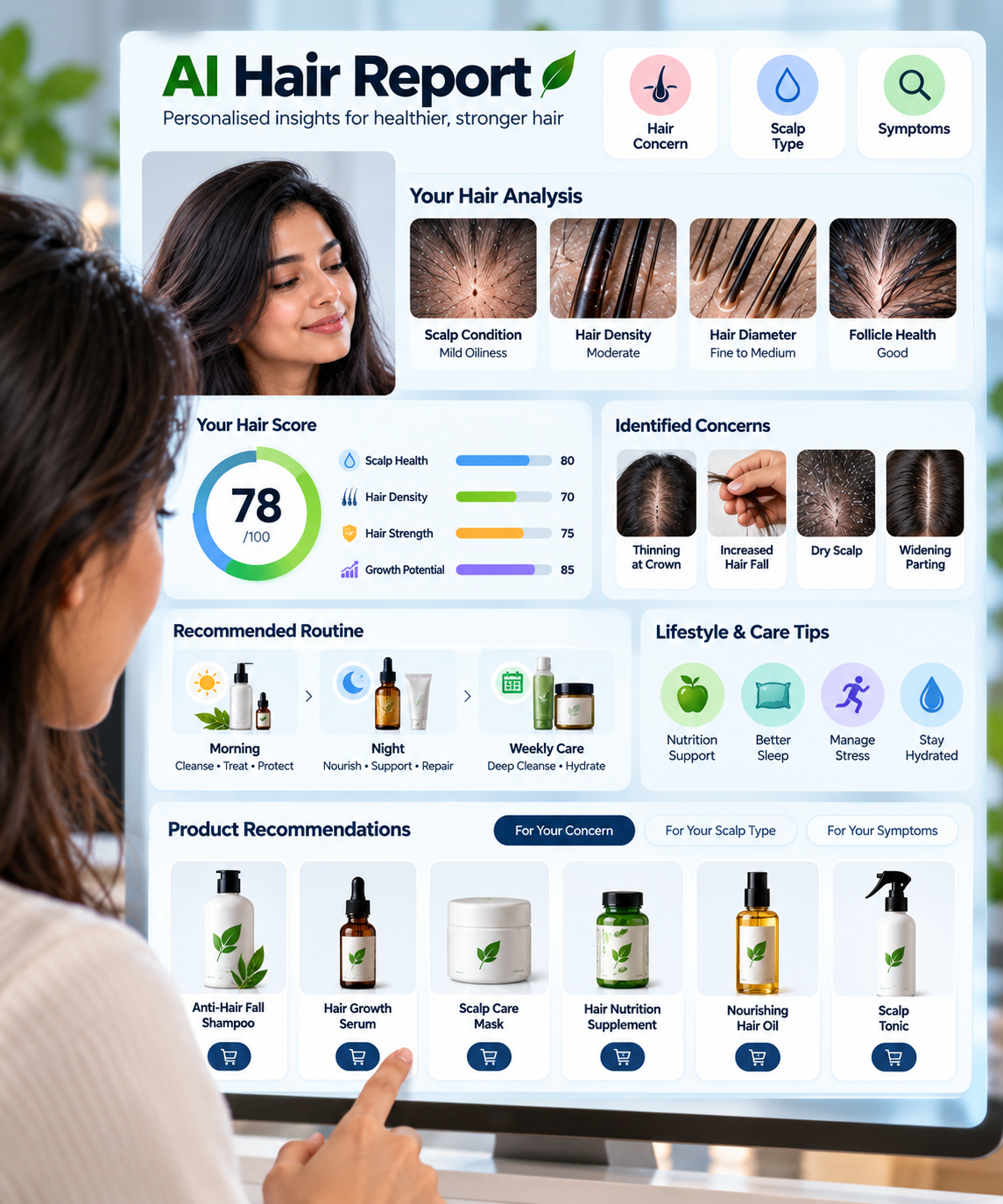
The assessment isn't a chat window. It's a fixed clinical intake, designed by a dermatologist, that turns scattered symptoms into a structured report — and returns the same reasoning for the same inputs, every time, which a conversational model cannot promise.

  • Structured assessment. Pattern, duration, rate of change, family history, scalp signs, diet, medication, hormonal events and styling load — asked in clinical order, not in whatever order you thought of them.
  • Pattern matching. Answers are matched against recognised presentations — androgenetic, telogen effluvium, traction, seborrheic — rather than against whatever text a model saw most recently.
  • Driver mapping. Where several causes plausibly coexist, all of them are named, with a note on which one the questionnaire can and cannot see.
  • Ingredient-level output. The report speaks in actives first — the molecule, its evidence grade, its timeline — and only then in products.
  • Explicit uncertainty. The report states where confidence is low and what would resolve it: a ferritin test, a thyroid panel, a trichoscopy. Uncertainty is printed, not hidden.
  • A report you own. Plain language, printable, and useful to any dermatologist you choose — including one who has never heard of us.
Pillar 2 — Hair report interface 1200 × 1440 · whc-ai-hair-report-dashboard.jpg

Pillar three · Recommendation

Recommendations that
understand hair.

Most engines rank what sells. This one ranks what fits — and shows its reasoning, so you are equipped to disagree with it. A recommendation you cannot interrogate is just an advertisement with better manners.

  • Concern-based discovery. Start from what you're experiencing, not from a brand you half-remember from a hoarding on the way to work.
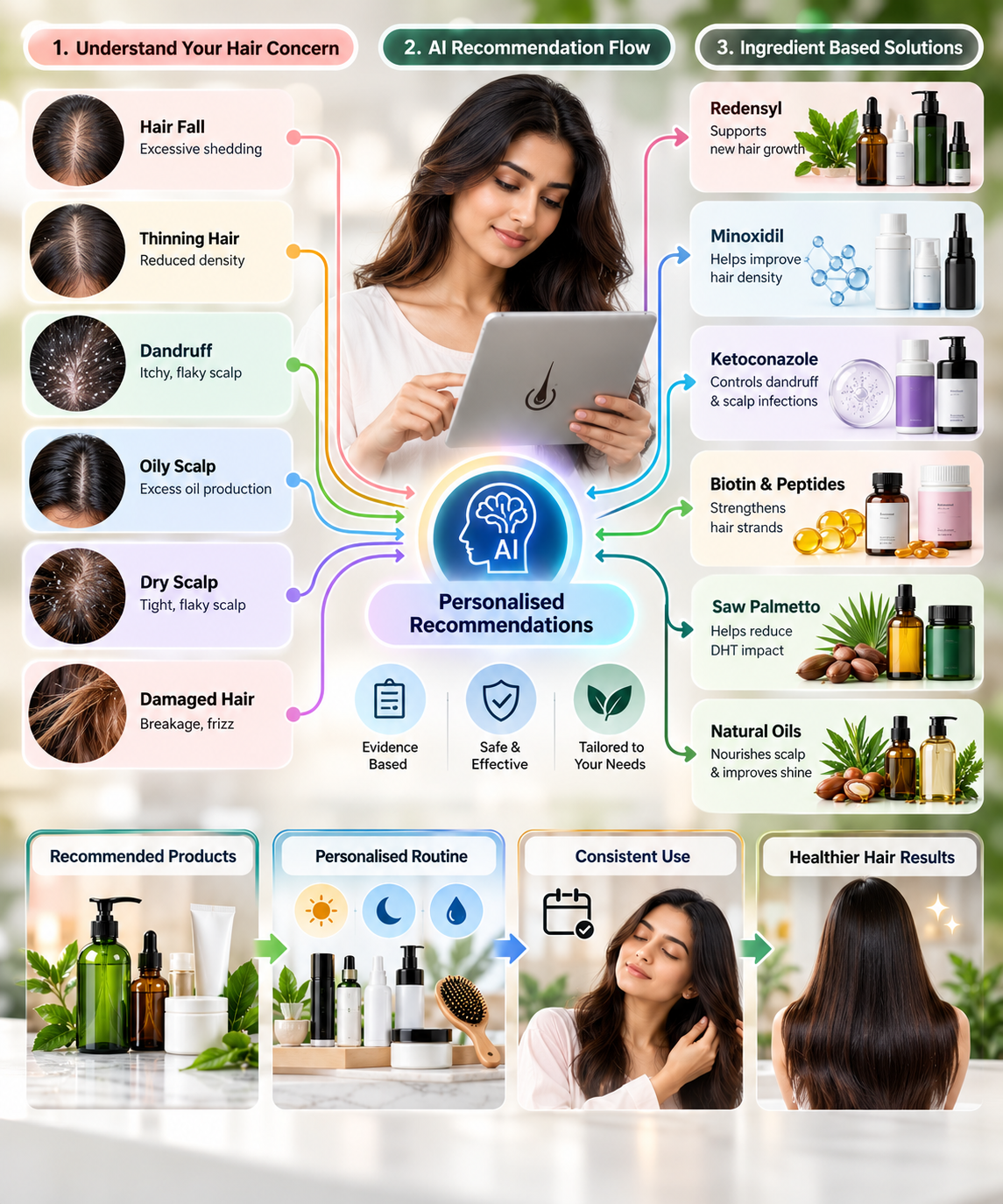
  • Ingredient first, brand second. The active is chosen before the bottle. Where the same molecule exists at the same strength for a third of the price, the cheaper option is shown alongside.
  • Whole routines, sequenced. Cleanse, treat, protect, support — with what to use on which day, in which order, at what interval, and for how long before judging it.
  • Conflicts flagged. Two products doing the same job, or one undermining another, are caught by the compatibility matrix before the basket, not after the first month.
  • Complexity matched to you. A four-step routine you will run beats a nine-step routine you will abandon, and the engine is built to prefer the former.
  • Reasons attached. Every suggestion carries its purpose, its evidence grade, its realistic timeline and the cautions that apply — in the recommendation itself, not two clicks away.
Pillar 3 — Recommendation flow 1200 × 1440 · whc-recommendation-ingredient-flow.jpg

Pillar four · Commerce

A haircare store built
on clinical thinking.

The catalogue depth you would expect from a marketplace, organised the way a dermatologist would arrange a pharmacy: by what a thing does, not by who paid for the end cap.

  • Pharma haircare. Topicals and oral agents presented with strength, vehicle, evidence grade and cautions, rather than adjectives.
  • Natural & ayurvedic. Traditional formulations held to exactly the same labelling standard as everything else on the shelf — including an honest evidence grade where the evidence is thin.
  • Supplements. Positioned as support for a documented deficiency, not as a substitute for treatment, and flagged as such when the report has no reason to suspect one.
  • Cosmetics, styling & fibres. Shampoos, conditioners, serums, masks and cosmetic camouflage, with realistic expectations attached and no pretence of being treatment.
  • Devices & appliances. Scalp devices and low-level light therapy, with the evidence and the commitment required stated before the price.
  • Clinical kits. Complete routines assembled as one purchase, so nothing in a protocol quietly goes missing at checkout because it was on a different page.
Pillar 4 — Clinical product wall 1200 × 1440 · whc-clinical-product-wall.jpg

Product intelligence

Not "recommended for you."
Here is exactly why.

The phrase "recommended for you" is the least informative sentence in ecommerce. Every product surfaced by the platform carries a fixed set of fields instead — the same fields, every time, so that two products can be compared on something other than their photography.

Anatomy of a recommendation
Every product page carries these
Why this
The specific finding in your assessment that put it here
Active
Molecule and concentration, linked to its reference page
Mechanism
What it does to the follicle, in one plain sentence
Evidence
Grade A to D, with what that grade is based on
Timeline
When change is typically visible; when to judge it
Placement
Morning or night, before or after which step
Synergy
What it works well alongside, and why
Avoid with
Actives that duplicate or destabilise it
Cautions
Pregnancy, breastfeeding, known interactions, adverse effects
Alternatives
Same active, other brands, including cheaper equivalents
Cost per month
Normalised, so bottle size cannot disguise the price
If it fails
What the protocol says to do at month six instead
Illustrative field structure. Individual products display the values relevant to them.

Cost per month is the field the industry avoids. Two products with identical actives can differ fourfold once you normalise for concentration and quantity, and nothing on a conventional product page makes that visible. Normalising it is not generosity — it is the natural consequence of recommending a molecule rather than a bottle.

"If it fails" is the field nobody writes. Every protocol has a decision point, and the honest thing is to publish it before you buy, not after. Knowing at the outset that month six is the review date, and knowing what happens then, is what stops a person from quietly abandoning a working treatment in week nine.

"Avoid with" costs sales, on purpose. Flagging that two items in a basket duplicate the same mechanism removes one of them from that basket. A system that only ever adds is a system optimised for the wrong outcome, and over a six-month course, the trust is worth more than the second bottle.

Together these fields have a single effect: they make the recommendation falsifiable. You can check the ingredient page, check the evidence grade, check the price against an equivalent, and conclude that the platform is wrong. That is the point. A recommendation that cannot be checked is not intelligence — it is just confidence with a bigger budget.

Product Science

The science behind
every bottle.

Before choosing a shampoo, serum, supplement or treatment, you should be able to see the chemistry, the biology, the evidence and the dermatology behind the formulation. Product Science is the reference layer that makes that possible — a scientific library rather than a catalogue. Knowledge first. Products second.

Below is the explorer in miniature. Choose an active on the left and the diagram shows where in the follicle it actually acts — the single fact that separates a treatment from a cosmetic, and the one almost no product page tells you.

Active ingredient
Cross-section of a hair follicle showing where actives workA vertical cross-section through scalp skin and one hair follicle, from the hair shaft above the surface, through the epidermis and follicular opening with its sebaceous gland, down the follicle canal to the hair bulb and dermal papilla with its capillary supply. Selecting an ingredient highlights the depth at which it acts.Hair shaftEpidermisDermisSebaceousFollicleBulbCapillary
Acts at the hair bulb

Minoxidil

Mechanism
Evidence
Timeline
Best for
Cautions
Combines with
Doctor's note

Educational reference only. Concentrations, suitability, combinations and duration are individual decisions — prescription items in particular require a dermatologist. Nothing here is a recommendation for any specific person.

Fourteen product categories, each with its own science

Every category has a ceiling — a thing it can genuinely do and a thing it cannot. Stating both is the whole purpose of the library.

The Product Intelligence Matrix

Nine dimensions assessed for every product in the library, so two bottles can be compared on something other than their photography.

Dimension 01
Science

The mechanism, stated in one plain sentence, and the layer of the follicle it acts on.

Dimension 02
Evidence

Grade A to D, with what the grade rests on — and the verbs that grade permits.

Dimension 03
Formulation

Concentration, vehicle and pH, because the same active behaves differently in a different base.

Dimension 04
Compatibility

What it duplicates, what it destabilises, and what genuinely belongs alongside it.

Dimension 05
Safety

Pregnancy and breastfeeding status, adverse effects, interactions, and who should not use it.

Dimension 06
Suitability

The concerns and hair types it fits, and the presentations it will not help at all.

Dimension 07
Timeline

When change becomes assessable, and the review date at which to decide.

Dimension 08
Alternatives

Same active, other products — including the cheaper equivalents, shown side by side.

Dimension 09
Dermatologist note

A signed clinical comment, including the reasons not to use it. Written by a person, not generated.

You may notice a tenth dimension missing. Several platforms publish an "AI confidence score" next to a product, and it converts extremely well — a number implies a machine checked something. In practice it is a weighting of the same evidence grade already shown in dimension two, wearing a decimal point to look precise. The matrix shows you the grade and the reasoning instead, and lets you do the weighting yourself.

Fig. 08
The active, magnified1600 × 700 · whc-product-science-active-droplet.jpg
Fig. 08 Where a molecule becomes a decision Every product in the library is indexed by what is inside it. The library exists so that a claim can be checked against a mechanism rather than a slogan.

The complete ecosystem

Every module,
and what it hands to the next.

Twenty modules, one dependency chain. The test of an ecosystem is not how many modules it has — it is whether any of them can be removed without the others noticing.

L1 · Entry
Hair test

The structured assessment. Feeds every other module downstream.

L2 · Output
Hair report

Presentation, drivers, uncertainties and a starting routine.

L3 · Knowledge
Ingredient library

Every active, with mechanism, evidence grade and timeline.

L4 · Safety
Drug safety

Cautions, pregnancy categories and known interactions.

L5 · Decision
Routine builder

Morning and night sequence, frequency, duration, conflicts.

L3 · Knowledge
Hair science

The biology behind every recommendation, written to be read.

L3 · Knowledge
Comparisons

Treatment against treatment, on evidence and on cost.

L3 · Knowledge
Hair type guides

Because texture changes what a routine should look like.

L6 · Commerce
Pharma haircare

Topicals and oral agents, with strength and vehicle stated.

L6 · Commerce
Natural & ayurvedic

Traditional formulations, same labelling standard as pharma.

L6 · Commerce
Supplements

For documented need, flagged when there is no reason to suspect one.

L6 · Commerce
Shampoos

Cleansing and medicated, indexed by active rather than fragrance.

L6 · Commerce
Conditioners

Fibre care, chosen against texture and processing history.

L6 · Commerce
Hair oils

What they can do for the fibre, and what they cannot do for the follicle.

L6 · Commerce
Cosmetics & fibres

Camouflage and styling, presented as cosmetic, never as treatment.

L6 · Commerce
Devices

Scalp and light devices, with the commitment stated before the price.

L6 · Commerce
Clinical kits

A whole protocol as one purchase, so nothing goes missing.

L7 · Longitudinal
Hair journal

Monthly photographs under fixed conditions, plus adherence.

L7 · Longitudinal
Progress tracking

The timeline view that makes slow change visible at all.

L8 · Escalation
Consultation

A dermatologist, with your report and journal already in hand.

The dependency chain is the product. A hair journal without an assessment is a photo album. An ingredient library without a routine builder is an encyclopaedia. A store without either is a shelf. What makes this an ecosystem rather than a feature list is that the output of each module is the required input of the next — and that when you arrive at a consultation in the eighth layer, the dermatologist opens six months of structured history instead of asking you to remember it.

Trust architecture

Trust isn't a badge.
It's a process you can inspect.

Anyone can print "dermatologist approved" on a page. What follows is the actual governance — who writes, who reviews, on what evidence, on what cycle, and what happens when the evidence changes. If it isn't inspectable, it isn't trust; it's decoration.

01

Authorship

Clinical content is drafted against a written protocol, not commissioned from a brief. The protocol exists before the article, and the article cannot exceed it.

02

Medical review

Every clinical page is reviewed by a named dermatologist with stated qualifications and a visible review date. Anonymity is where accountability goes to hide.

03

Evidence grading

Each claim carries a grade from A to D. A grade D active can still be listed — it simply cannot be described in the language reserved for grade A.

04

Commercial separation

Protocols are written before the catalogue is consulted. Margin has no input into which ingredient class a protocol recommends, and the two are edited separately.

05

Update cycle

Pages are re-reviewed on a schedule, and out of cycle whenever a regulatory change, safety communication or significant trial affects a recommendation.

06

Stated limits

The platform publishes what it cannot do, in the same typeface as what it can. Every page that could be mistaken for diagnosis says plainly that it is not.

The evidence ladder

Applied to every active in the ingredient library, and printed on the recommendation itself.

A
Randomised controlled trials or meta-analysis. Multiple well-designed studies, consistent direction of effect. Language permitted: "shown to".
B
Controlled observational or cohort evidence. Reasonable data, some limitation in design or size. Language permitted: "evidence supports".
C
Case series, small or open-label studies. Suggestive, not settled. Language permitted: "some evidence suggests".
D
Mechanism, tradition or clinical experience. Plausible, untested at scale. Language permitted: "traditionally used", "mechanistically plausible".

The grades matter less than the rule attached to them. An active's grade determines the verbs the platform is allowed to use about it. A traditional oil with grade D evidence can be sold, described accurately and enjoyed — it simply cannot borrow the word "proven" from a molecule that earned it in a controlled trial. Most misleading haircare copy in India is not a false statement; it is a grade D ingredient wearing grade A language.

Fig. 11
Under review1600 × 640 · whc-trust-editorial-review.jpg
Fig. 11 The review, not the badge Clinical pages are read by a named dermatologist and carry the date they were last checked. The value is in the date and the name — a badge with neither behind it is decoration.

The biology underneath

Why hair takes
months, not weeks.

Almost every bad decision in haircare comes from one misunderstanding: hair does not respond on a human attention span. Each follicle runs an independent cycle, and a treatment cannot show a result faster than that cycle allows — no matter what it costs.

The hair growth cycleA ring chart showing that at any moment roughly 88 percent of scalp follicles are in the growing anagen phase, about 1 percent in the transitional catagen phase, and about 11 percent in the resting telogen phase.88%growing at any momentSCALP FOLLICLES
Anagen — growth

Lasts roughly two to seven years, and determines how long your hair can ever get. Around 85–90% of scalp follicles are here at any moment. Treatments that work do so by protecting or extending this phase — which is why nothing visible happens quickly.

Catagen — transition

A brief regression of two to three weeks, affecting about 1% of follicles at a time. Short, silent, and not something any product meaningfully influences.

Telogen — rest, then shed

Roughly three months of rest before the hair is released and a new one begins. Losing 50–100 hairs a day is normal traffic through this phase, not loss. A stressor, illness, delivery or crash diet pushes many follicles into telogen at once — and the shedding appears two to three months later, which is why the cause is almost always missed.

Two practical consequences follow, and they explain most of what the platform does. First: the shedding you notice today usually began two to three months ago. Asking what changed last week is the wrong question; asking what happened in the previous quarter — an illness, a fever, a delivery, a surgery, a diet, a bereavement — is the right one, and the assessment is built to ask it.

Second: a treatment cannot outrun the cycle. Because a follicle must complete telogen before it can re-enter anagen, no topical or oral agent can show meaningful density change in weeks. Some treatments even increase shedding at first, as resting hairs are released to make way for new growth — a sign of the mechanism engaging, routinely mistaken for harm. This is precisely where people quit, and it is the reason the platform prints the timeline before it prints the price.

Fig. 12
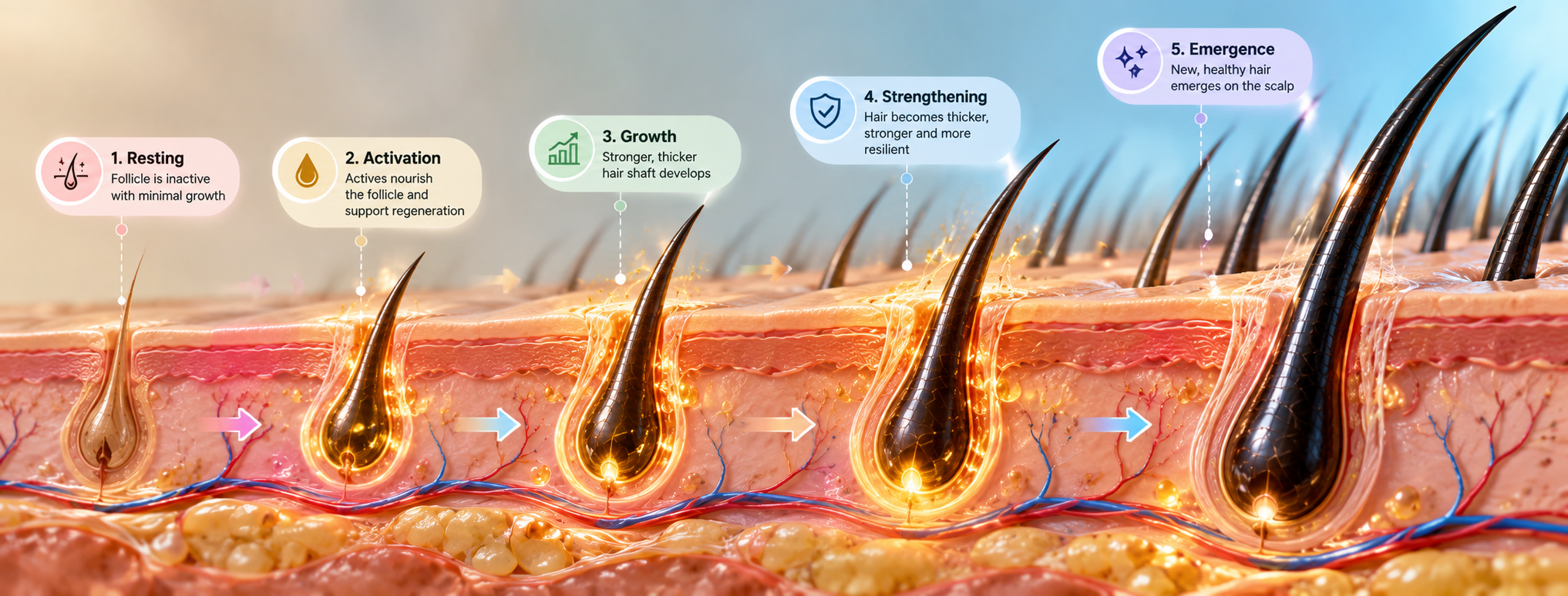
Emergence1600 × 608 · whc-science-follicle-macro.jpg
Fig. 12 Two to seven years, one follicle at a time Around 88% of scalp follicles are growing at any moment, each on its own independent clock. That independence is why hair changes slowly and why no treatment can outrun the cycle.

Honest timelines

We won't predict your result.
We'll tell you when to judge it.

This is the chart that replaces a fabricated regrowth score. Not what you will get — nobody honestly knows that — but when each intervention can fairly be assessed, so you neither quit early nor persist for years with something inert.

Intervention
M1M2M3M4M5M6
Cosmetic fibres & camouflageAppearance only
Conditioner & fibre careFeel and breakage
Medicated shampooFlaking, itch, inflammation
Telogen effluvium recoveryAfter the trigger is removed
Correcting a deficiencyWhere one is documented
Topical regrowth agentsShedding first, then change
Oral prescription therapyDermatologist-directed
Low-level light therapyRequires sustained use
Bars show the window in which change typically becomes assessable — not a guarantee, and not a prediction for any individual. Response depends on the correct diagnosis, how long loss has been running, follicle miniaturisation and adherence. Prescription agents require a dermatologist.

Read the chart top to bottom and the logic of the whole platform appears in one image. The interventions that act fastest change the least — camouflage and conditioner work in days because they act on the fibre you already have. The interventions that change the most act slowest, because they act on the follicle and must wait for the cycle. A market that sells on before-and-afters will always over-represent the top of this chart. A system built for outcomes has to be honest about the bottom of it.

Hair Science University

Learn hair
like a dermatologist.

Every hair concern, every treatment, every ingredient and every condition — explained by dermatologists, using evidence instead of myths. Not a blog and not a feed: a structured curriculum, arranged the way the subject is actually taught, so you can start at whatever depth you need and go further when you want to.

Four levels. Five faculties. Twenty-two domains. Choose a level to see what it covers.

Level I · Foundations

Start here if hair has never been explained to you

    The five faculties

    Every article in the library belongs to exactly one faculty, and every faculty links back into the assessment, the ingredient library and the store — so learning something never leaves you without a next step.

    Faculty 02Hair disorders

    What goes wrong, how each presentation differs, and which ones need a clinic today rather than a product.

    Faculty 04Formulation

    The chemistry layer, shared with Product Science — what is in the bottle and why it is in there.

    Faculty 05Systemic factors

    Everything that reaches the follicle through the bloodstream rather than through a bottle.

    The research library

    Where the evidence grades come from. Understanding these five study types is the difference between reading a headline and reading a result.

    01
    Meta-analysis

    Pools many trials to find the true size of an effect. Strongest single source, and only as good as the trials inside it.

    02
    Randomised trials

    Allocation by chance, ideally blinded. The only design that reliably separates a treatment from time passing.

    03
    Cohort studies

    Follow real groups over years. Excellent for safety signals, vulnerable to confounding on effectiveness.

    04
    Case series

    A handful of patients described in detail. Generates hypotheses; settles nothing on its own.

    05
    Laboratory work

    Cells and cultured follicles. Explains mechanism beautifully, and frequently fails to survive contact with a human scalp.

    That last card explains most of the haircare internet. An ingredient performs impressively on cultured follicles, a press release follows, and the finding arrives on a label as though it had been proven on people. It is not dishonest so much as untranslated — and knowing the difference between a laboratory result and a clinical one is the single most useful thing this library can teach you.

    Fig. 09
    The reading room900 × 1152 · whc-learn-reading-room.jpg
    Fig. 10
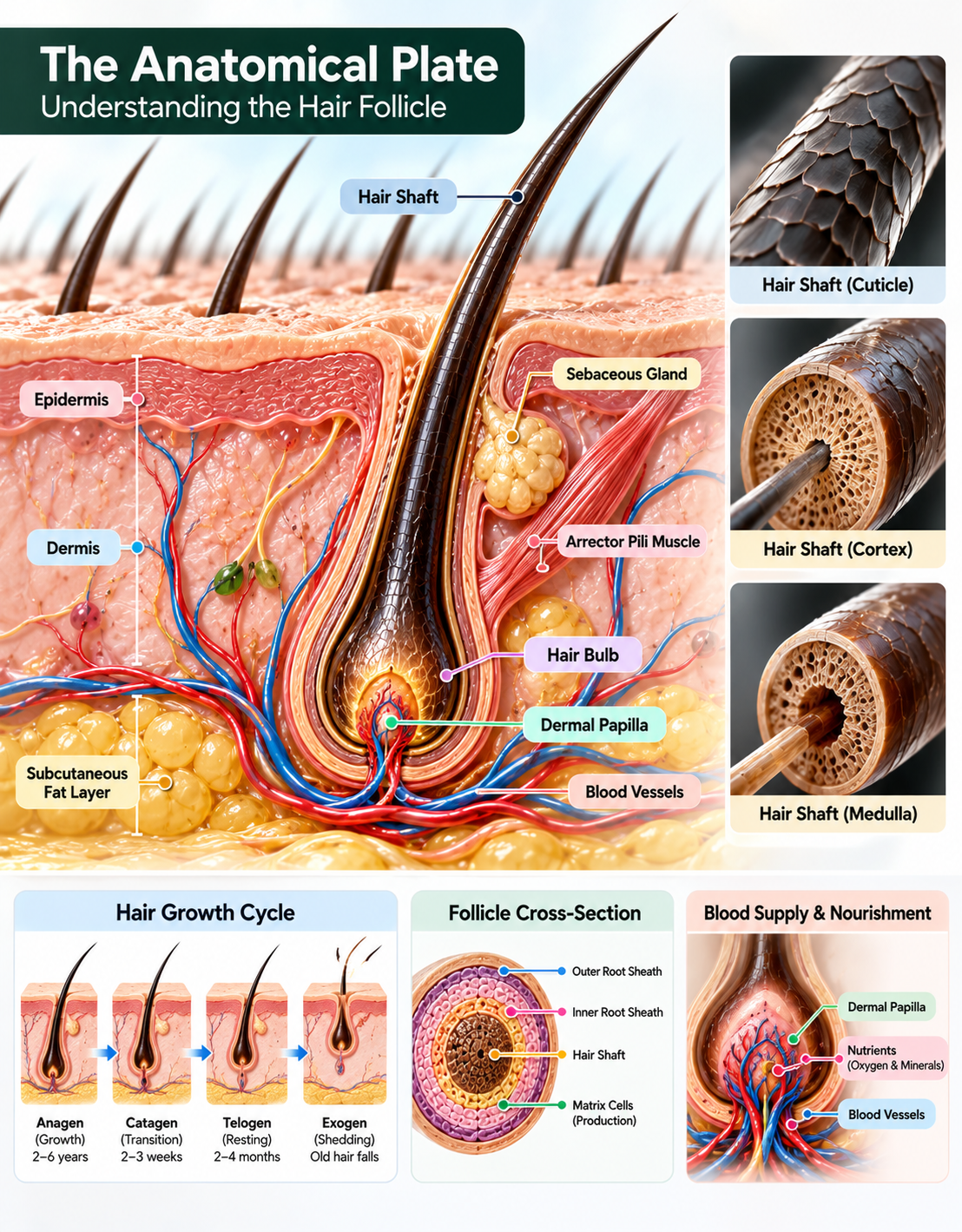
    The anatomical plate900 × 1152 · whc-learn-follicle-plate.jpg
    Fig. 09 – 10 Four levels, five faculties The curriculum is arranged the way the subject is taught, not the way a feed is ordered. Start at whatever depth you need; every article links back to the assessment and the ingredient library.

    Why this matters

    The same six months,
    spent two different ways.

    The usual route

    Assembled by you

    1. Search, and get five contradictory answers
    2. Watch a video that sells before it explains
    3. Book a clinic visit, six weeks out
    4. Read blogs to decode the prescription
    5. Buy from three sites at three prices
    6. Lose track of what started when
    7. Stop early, because nothing looks different yet
    8. Start again somewhere else, with less hair

    Eight decisions · Six sources · No record

    The HairsnCares route

    Assembled for you

    1. Take the assessment — about eight minutes, free
    2. Read your report, in plain language, with its uncertainties
    3. Learn the why behind each active, at its evidence grade
    4. Compare options, including cheaper equivalents
    5. Accept or adjust the routine; conflicts are flagged
    6. Order it as one basket, priced per month
    7. Photograph and log, on a fixed monthly protocol
    8. Review at month six — continue, adjust, or escalate

    One system · One record · One timeline

    Fig. 13
    Two routes2400 × 720 · whc-journey-two-paths.jpg
    Fig. 13 The same six months Both routes take the same time and cost roughly the same money. Only one of them keeps a record, and only one of them still knows in month five what was started in month one.

    What's actually behind the platform

    Verifiable capability.
    No borrowed numbers.

    0
    Products in catalogue
    0
    Ingredient reference pages
    0
    Reviewed learn articles
    0
    Concerns mapped to protocols

    Named medical accountability

    Clinical content is attributed to a practising dermatologist by name and qualification, with a visible review date — not to an anonymous "expert team".

    Free assessment, no wall

    The hair test and its report cost nothing and require no purchase. If the honest answer is "see a doctor", that is what the report says, and no products appear.

    Ingredients before brands

    Every product is indexed by its actives, and every active has a reference page with an evidence grade. You can always check what you are being sold, and why.

    Safety surfaced early

    Pregnancy, breastfeeding and interaction cautions appear on the ingredient page and again before checkout — not buried in a leaflet inside the box.

    Timelines before prices

    Every recommendation states when change becomes assessable and when to conclude something is not working, before you are asked to pay for it.

    Built for India

    Availability, generic equivalents, prescription status, pricing, climate, water hardness and the hair types actually represented here — not translated from a US catalogue.

    HairsnCares provides health information and products. It is not a substitute for examination, diagnosis or prescription by a qualified medical practitioner, and no content on this page constitutes a diagnosis or a promise of result. If you have sudden or severe hair loss, patchy loss, scalp pain, scarring, bleeding or associated systemic symptoms, consult a dermatologist directly rather than starting any product.

    Questions people actually ask

    Straight answers,
    before you commit.

    HairsnCares is a dermatologist-led hair intelligence platform. It combines a structured hair assessment, dermatologist-reviewed education, ingredient intelligence, drug safety information, a routine builder, a curated haircare store and a longitudinal hair journal in one place, so you don't have to assemble your hair journey from separate clinics, blogs, chatbots and marketplaces.

    Both functions sit inside one system. The clinical layer supplies dermatologist-reviewed protocols and education; the commerce layer lets you act on that guidance by obtaining the products a routine calls for. The assessment connects the two, and the hair journal keeps a record over time.

    Content is written and reviewed under the direction of Dr. Amit S. Agarkar, MBBS, MD (Dermatology), FCPS, DDV — a dermatologist, trichologist and hair transplant surgeon practising in Mumbai. Clinical pages carry the date they were last reviewed.

    Pharma haircare, natural and ayurvedic formulations, nutritional supplements, hair cosmetics and styling, hair fibres, scalp and hair appliances, and combined clinical kits — grouped by concern and by active ingredient rather than only by brand.

    The assessment, report, ingredient library, learn articles and hair journal cost nothing. You pay only for products you choose to buy, and for a consultation if you book one.

    Yes. Delivery timelines and availability for specific pharma items are shown on each product page and confirmed at checkout.

    No. It is a structured intake and decision-support tool. It organises your history, pattern, scalp signs and goals into a report and suggests a starting routine. It does not diagnose. Anything that needs physical examination, trichoscopy, blood investigation or prescription medicine needs a dermatologist.

    A general chatbot answers whatever it is asked, from open web text, with no clinical review step and no obligation to be consistent between sessions. The HairsnCares assessment runs a fixed dermatology-designed question set, maps answers to reviewed protocols, and returns the same reasoning for the same inputs, tied to ingredients and products actually available in India.

    The presentation your answers most resemble, the factors that appear to be contributing, what is worth ruling out with a doctor, an ingredient-level starting routine with timelines, safety cautions relevant to your answers, and an explicit statement of where confidence is low and why.

    No, and any platform that offers you a regrowth percentage is guessing. Response to hair treatment depends on the correct diagnosis, how long the loss has been running, how far the follicles have miniaturised, adherence and individual factors that cannot be read from a questionnaire. What HairsnCares provides instead is the evidence-based timeline for each active — when a change would typically become visible, and when to conclude that something is not working.

    For most topical and oral hair treatments, meaningful assessment is not possible before about four months, and six months is a fairer decision point. Early increased shedding in the first weeks of some treatments is expected rather than a failure. Judging at week three is the single most common reason people abandon treatments that were about to work.

    You photograph the same three views under the same lighting on day zero and then monthly, and log adherence to your routine. Because hair changes on a scale of months, a side-by-side timeline is the only reliable way to see change — memory and mirrors are not.

    Every product is indexed by its active ingredients, and every ingredient has a reference page covering mechanism, evidence level, realistic timeline, typical concentration, and known cautions and interactions. You can search by molecule rather than by marketing claim, and compare two products by what is actually inside them.

    Ingredient and drug pages carry pregnancy and breastfeeding categories, common adverse effects, and known interactions, and these are surfaced again before checkout rather than buried in a leaflet. This is reference information, not a personal safety clearance — confirm against your own medication list with your treating doctor or pharmacist.

    Recommendations are generated at the level of the active ingredient first, and where several products contain the same active at the same strength, the alternatives are shown together including cheaper ones. If the honest answer is an inexpensive generic, that is what appears.

    No. The assessment and the resulting report are free to take and free to read, with no purchase required and no results withheld behind a payment. Products are optional, and the report is yours to take to any dermatologist you choose.

    The platform is explicit about its limits. Where a concern points to in-clinic treatment — advanced pattern hair loss, scarring alopecia, suspected autoimmune causes or transplant evaluation — the report says so and directs you to a consultation instead of selling you a product.

    Sudden patchy hair loss, hair loss with scalp pain, scarring, pustules, bleeding or scaling plaques, hair loss in children, and hair loss with systemic symptoms all need direct medical assessment first. The assessment is designed to flag these and route you out of the product pathway rather than into it.

    Yes. Female pattern hair loss, postpartum shedding, hair loss around menopause and traction alopecia from styling are handled as distinct presentations with their own protocols, because the treatment logic and the safety cautions genuinely differ.

    Assessment answers and journal photographs are personal health information and are handled under the platform privacy policy. They are used to generate and improve your own report and routine, and are not sold. Full detail, including retention and deletion, is set out in the privacy policy.

    Clinical pages carry a visible last-reviewed date and are re-checked on a scheduled cycle, and out of cycle whenever a regulatory change, safety communication or significant new trial affects the recommendation.

    Product availability, brand and generic equivalents, prescription status, pricing, climate and water hardness effects, common dietary deficiency patterns and the hair types most represented in India — none of which translate cleanly from a US or European catalogue.

    Still deciding after all that?

    The assessment answers more than a page of questions can — and if the honest answer is “see a dermatologist”, it says so and shows you no products.

    Everything your hair needs.
    One intelligent system.

    Start with the assessment. It costs nothing, takes about eight minutes, and ends with a report you can act on — or take to any dermatologist you like.

    References

    Where the careful statements on this page come from

    Each source below supports something specific written above, and each opens in a new tab. None of them endorses this platform.

    Your Cart (0)

    Your cart is empty

    Subtotal0
    DeliveryFREE
    Total0
    🔒 Secure📦 Free above ₹499↩ Easy returns
    💬 Hi! I'm Dr. Amit — your Hair Intelligence consultant
    🌿
    1
    🌿
    Dr. Amit
    Virtual Dermatologist · Hairsncares.com
    Online
    What are you shopping for today?
    Select a category to begin
    AI-powered scalp diagnosis · Hairsncares.com
    📸
    Scalp Analyser
    Upload scalp photo · Get conditions, root cause, and matched product protocol
    📷
    Drop scalp photo here or click to upload
    JPG, PNG, WEBP · Clear, close-up, well-lit photo

    Your image is processed privately by our AI engine and saved securely with your account.