Hair Loss: Causes & Treatment
Dermatologist-led overview of how hair loss is evaluated and the evidence behind common treatments.
View AAD reference ›When shedding drags on for more than six months, it's rarely random. Chronic hair fall almost always has an underlying cause — chronic telogen effluvium, low iron or vitamin D, a thyroid or hormonal problem, a medicine, ongoing illness or stress, or underlying pattern loss — and often more than one at once. That's why the answer isn't another shampoo; it's finding what's driving it. Hairsncares helps you narrow the likely cause with an AI cause finder, see which tests to discuss, and follow a doctor-guided plan.

Illustrative sample only. AI screening helps guide decisions and does not replace a dermatologist's diagnosis or blood tests.
The best treatment is the one that targets your underlying cause — which is why finding it comes first. Chronic hair fall (shedding lasting more than about six months) is usually driven by chronic telogen effluvium, a deficiency such as low iron or vitamin D, a thyroid or hormonal problem, a medicine, ongoing stress or illness, or underlying pattern loss, and often more than one. Correcting the cause — guided by a dermatologist and blood tests — does the heavy lifting, while supportive products help meanwhile. Where pattern loss is confirmed, doctor-guided Minoxidil may be considered. Start with the AI cause finder and an assessment, not another random product.
Persistent shedding for more than six months needs cause-finding, not random product switching.
AI Summary
Chronic hair fall is one possible hair-loss pattern or trigger. The right next step depends on whether hair is shedding from the root, breaking from the shaft, thinning in a pattern, falling suddenly, persisting for months or appearing in patches.
This page is educational and screening-oriented. It does not diagnose, prescribe or guarantee results. Use the AI Hair Test to organise symptoms, and consult a dermatologist if symptoms are severe, persistent, patchy, painful or progressive.
Best next step: identify the pattern, check likely triggers, review red flags, then choose a routine, product pathway or doctor consultation safely.
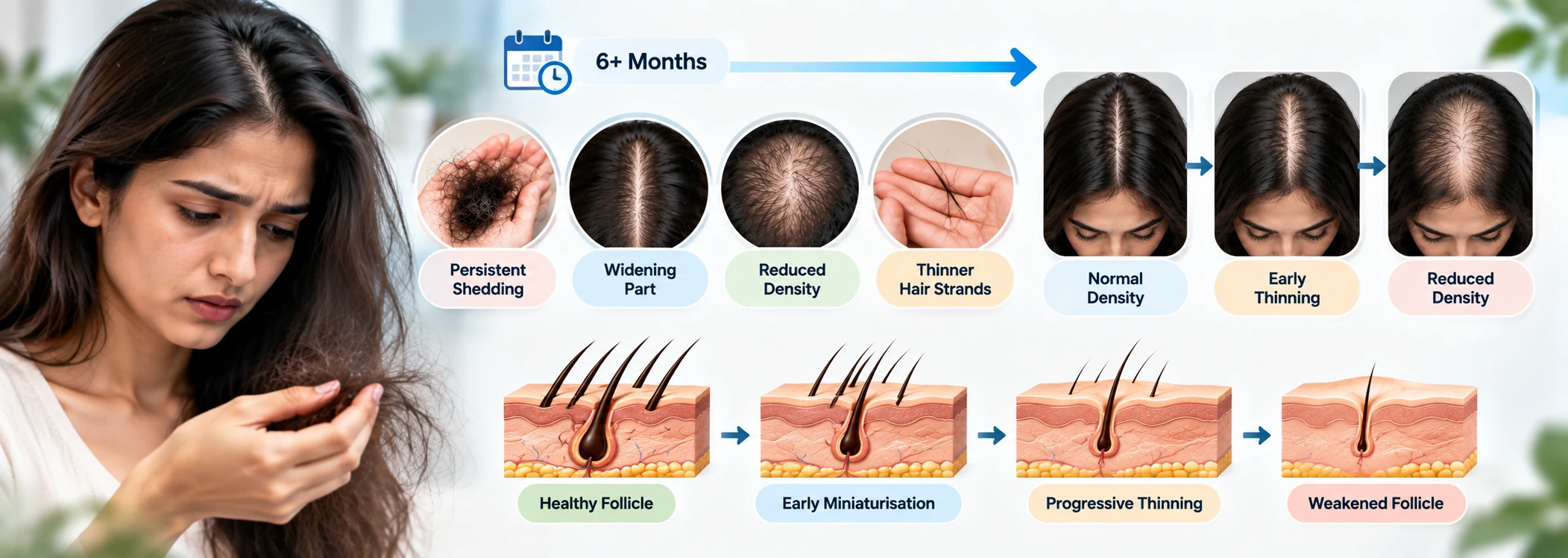
Chronic hair fall is persistent shedding that continues for more than about six months, rather than a short-lived episode. Some daily shedding is normal, but when a clear increase carries on month after month — often with a thinner ponytail and gradually reducing density — it points to an ongoing underlying cause.
The key feature of chronic hair fall is that it is usually multifactorial — driven by chronic telogen effluvium, a deficiency (low iron, vitamin D or B12), a thyroid or hormonal problem, certain medicines, ongoing stress or illness, or underlying pattern loss — and frequently more than one of these together. That's why a single product rarely fixes it, and why identifying the cause, usually with a dermatologist and a few blood tests, is the heart of treatment.
| Aspect | What it means |
|---|---|
| Duration | More than ~6 months |
| Pattern | Diffuse shedding, reducing density |
| Nature | Usually multifactorial |
| Common drivers | Chronic TE, deficiency, thyroid, hormonal, pattern |
| Key step | Find & treat the cause |
| Tests | Often needed (ferritin, thyroid, vit D, B12) |
Shedding for months? Narrow the likely cause and see which tests to discuss.
Find My CauseThese point toward chronic hair fall and help your dermatologist find the cause.
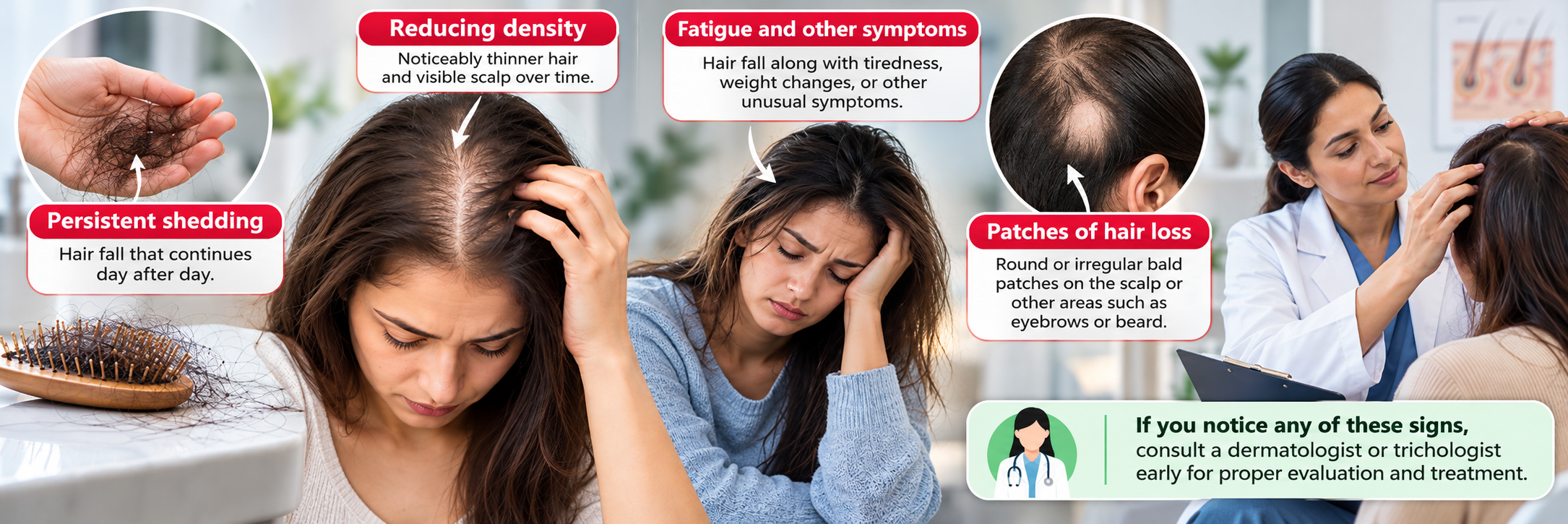
Increased shedding lasting more than six months
A thinner ponytail than before
Gradually reducing overall density
More hair on the pillow, brush and in the shower
Shedding that fluctuates but keeps returning
Fatigue, cold intolerance or weight change (thyroid)
Pale skin, breathlessness or heavy periods (iron)
Irregular periods, acne or facial hair (hormonal)
A widening parting (possible pattern loss)
Recognise these signs? Screen the likely cause and get a tests checklist.
Screen My SheddingOften several overlap. Identifying which apply to you guides the right treatment — usually with a dermatologist.

Several causes possible? The cause finder narrows them before you test.
Narrow My CausesChronic telogen effluvium (CTE) is a recognised form of long-standing diffuse shedding — often in otherwise healthy people, more commonly women — that continues or fluctuates for more than six months without a single obvious trigger. It typically causes ongoing shedding and some reduction in density, but usually not complete baldness.
Because its features overlap with other causes, a dermatologist often diagnoses CTE partly by excluding treatable contributors — checking iron, thyroid, vitamin D and B12, and examining the scalp — and by distinguishing it from early pattern hair loss. Management focuses on addressing any contributors, supporting the hair and general health, and patience, since it can wax and wane over time. It can be reassuring to know it is generally not a scarring or dangerous condition, but it is still worth a proper assessment.
Think it might be chronic TE? A dermatologist can assess and exclude other causes.
See a DermatologistYour doctor decides the exact tests based on your history. This is a guide to discuss, not a self-order list.
Ferritin & iron studies — for iron deficiency, a common contributor.
Thyroid function (TSH etc.) — for under- or over-active thyroid.
Vitamin D — deficiency is linked to shedding.
Vitamin B12 — especially on vegetarian diets.
Hormonal tests — where PCOS or hormonal causes are suspected.
Scalp exam & dermatoscopy — to assess the scalp and pattern.
Identifying a treatable cause like deficiency or thyroid disease can change the whole approach — which is why testing matters more than guessing with products.
Want the right tests ordered? Get a tests-to-discuss checklist, then see a doctor.
Get My ChecklistBook AssessmentKnowing whether shedding is short-lived or long-standing changes what you should do.
| Feature | Acute hair fall | Chronic hair fall |
|---|---|---|
| Duration | Under ~6 months | More than ~6 months |
| Trigger | Often one clear event | Often multifactorial / unclear |
| Typical example | Shedding after illness or childbirth | Chronic TE, deficiency, thyroid, pattern |
| Course | Usually settles on its own | Persists or fluctuates |
| Tests | Sometimes | Usually worthwhile |
| Main action | Treat trigger, wait, support | Find & treat the cause; assess |
Not sure which you have? The cause finder weighs your duration and symptoms.
Take Cause FinderTelogen Effluvium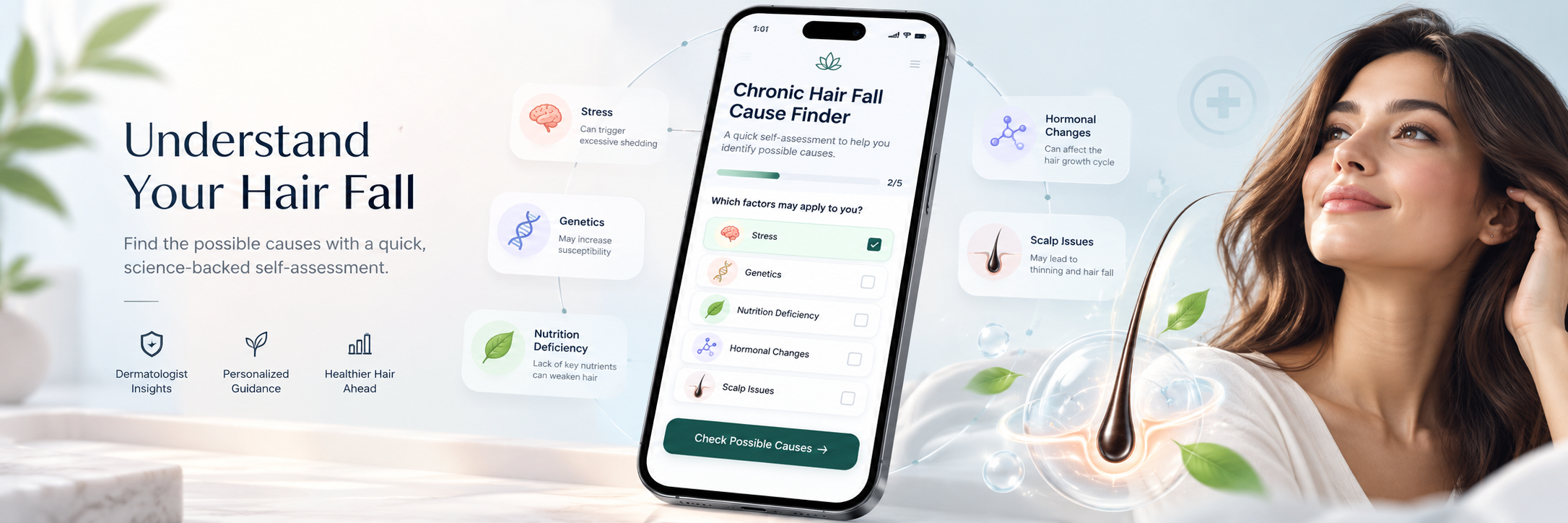
Chronic hair fall is often multifactorial and sometimes needs blood tests. Please see a dermatologist if any of the following apply, rather than relying on products alone.
These support chronic shedding while the cause is found and corrected. Supportive products do not cure deficiency, thyroid or genetic causes, and prescription items are doctor-guided.

Only if underlying pattern loss is confirmed; doctor-guided.
Not sure which fits you? The Product Finder matches support to your screening result.
Open Product FinderBrowse AllSample selection. Prices, ratings and availability shown are placeholders.
Final product suitability depends on the underlying cause, diagnosis, age, scalp condition, pregnancy/lactation status, medical history, current medicines, and doctor guidance where required. Supportive products do not cure deficiency, thyroid or genetic causes of shedding, and no product guarantees regrowth. Supplements help mainly where a deficiency is confirmed by testing. Prescription (Rx) items including Minoxidil require a valid prescription from a Registered Medical Practitioner and are doctor-guided, and are appropriate only where underlying pattern loss is confirmed. Minoxidil is generally not recommended during pregnancy or breastfeeding without medical advice. Results vary.
Before adding to cart, find the cause so you support it correctly.
Find My Cause FirstShop All ProductsChoose the routine closest to your situation, and treat any confirmed cause alongside it. Use active or prescription items only under dermatologist guidance, and avoid them in pregnancy or breastfeeding unless a doctor advises.
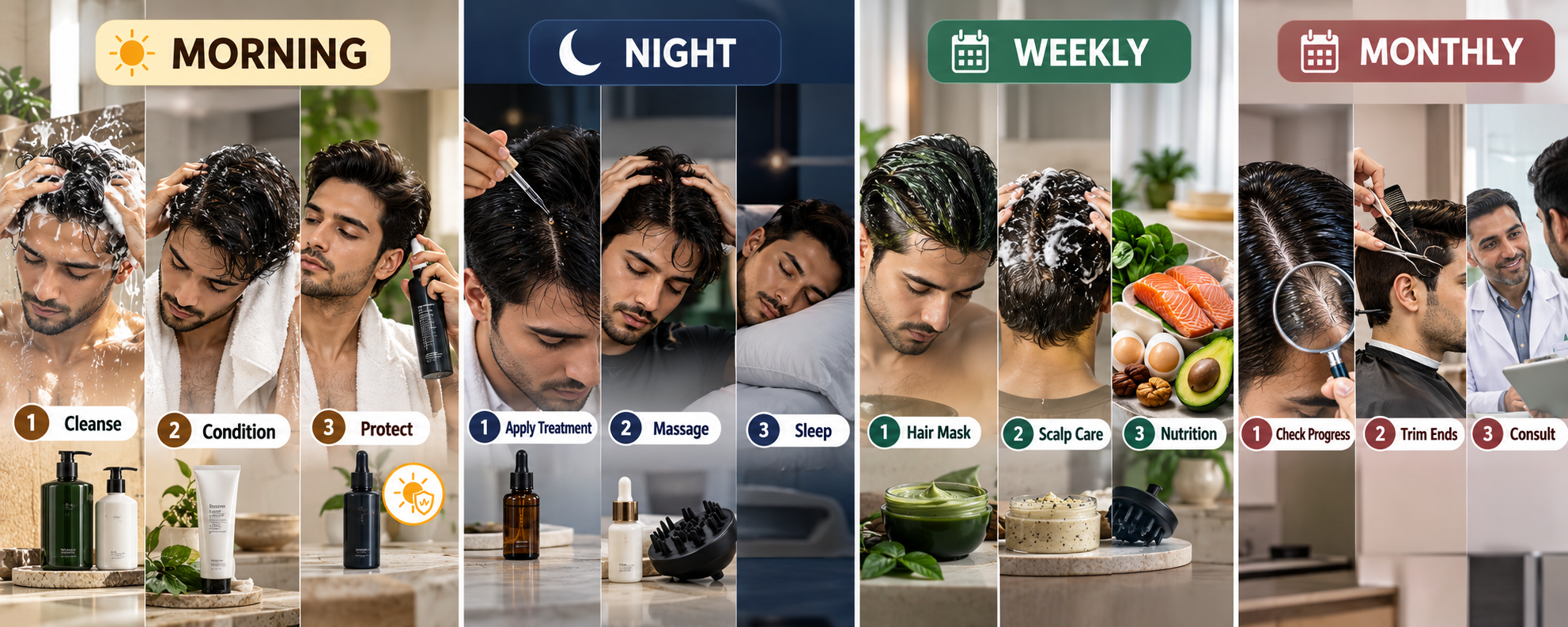
Use the cause finder; book an assessment and any advised blood tests.
Gentle growth-support shampoo and a supportive serum.
Balanced, protein-adequate meals; manage stress and sleep.
Overall-density photos; review results with your doctor.
Take any doctor-advised supplement for a confirmed deficiency.
Gentle care; supportive serum if desired.
Iron- and protein-rich foods; consistent nutrition.
Recheck levels with your doctor as advised; track density.
Gentle cleanse; manage any thyroid/hormonal cause with your doctor.
Doctor-guided Minoxidil only if pattern loss is confirmed.
Consistency; report any side effects to your doctor.
Review density and tolerance with your dermatologist.
Supportive shampoo; handle hair gently to limit added breakage.
Light serum; protect hair while sleeping.
Maintain general health; limit harsh styling.
Track density and shedding; adjust with medical input.
Want a routine built around your result? Generate a personalised plan in minutes.
Build My RoutineEvidence labels are a simple guide: strong, moderate, supportive or mainly cosmetic. Rx marks prescription items; the rose tag flags pregnancy/lactation caution.
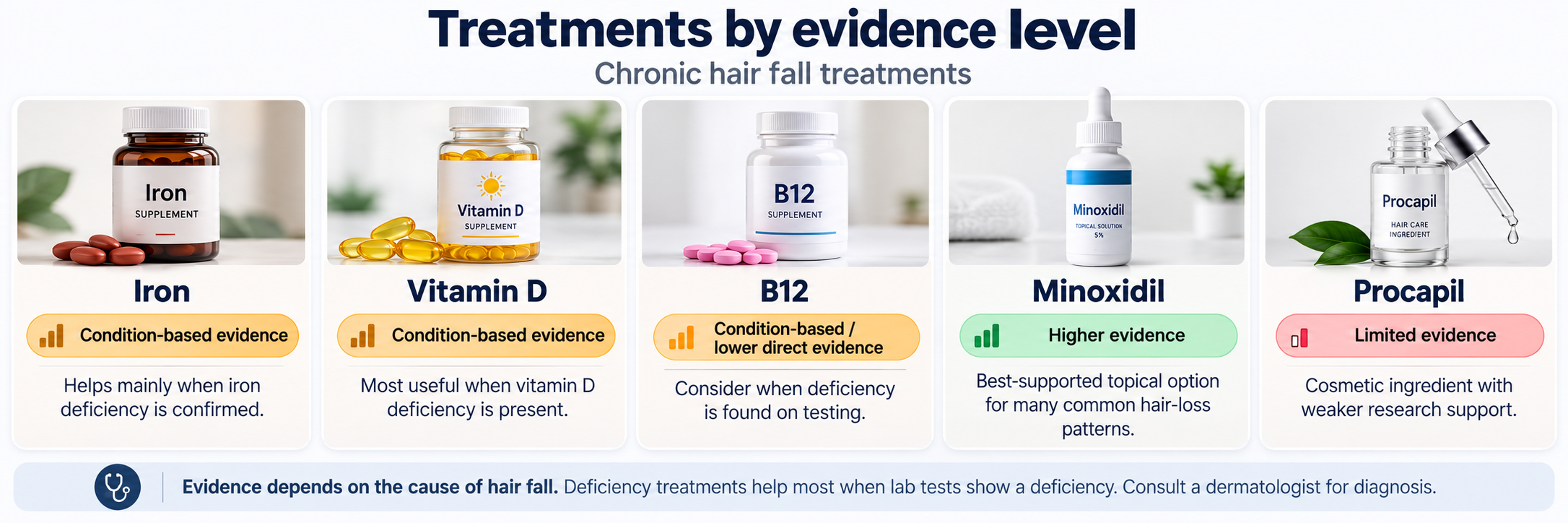
Pregnancy & breastfeeding note: Minoxidil is generally not recommended in pregnancy or breastfeeding. Supplements should be taken in pregnancy only on medical advice. Always speak to a doctor before any active treatment or new supplement.
Low iron is a recognised contributor to chronic shedding.
Best for: confirmed low ferritin.
Caution: take only after testing, under medical guidance.
Related productsDeficiency is linked to increased shedding.
Best for: confirmed deficiency.
Caution: correct after testing; avoid excess.
Related productsLow B12 can contribute, especially on vegetarian diets.
Best for: confirmed low B12.
Caution: test before supplementing.
Related productsHelps mainly when chronic shedding involves pattern loss.
Best for: confirmed underlying pattern loss.
Caution: doctor-guided; not in pregnancy/breastfeeding.
Related productsAntifungal shampoo supporting a healthy scalp.
Best for: oily or flaky scalp with shedding.
Caution: follow directed frequency; ask a doctor if pregnant/nursing.
Related productsAdequate protein supports the building blocks of hair.
Best for: low-protein or restricted diets.
Caution: aim for a balanced diet first.
Related productsA mineral involved in hair tissue health.
Best for: confirmed low zinc.
Caution: excess can be harmful; test first.
Related productsA B-vitamin involved in hair structure.
Best for: confirmed deficiency.
Caution: limited benefit without deficiency; can affect lab tests.
Related productsA cosmetic complex studied for supporting follicles.
Best for: density support.
Caution: supportive, not a replacement for treating the cause.
Related productsA cosmetic active marketed for density.
Best for: density support.
Caution: evidence is limited.
Related productsA common topical haircare ingredient.
Best for: supportive cosmetic use.
Caution: evidence is limited.
Related productsA botanical with some small-study interest.
Best for: supportive cosmetic use.
Caution: patch test; dilute; can irritate sensitive scalps.
Related productsThinking about supplements or Minoxidil? Test for deficiencies and get assessed first.
Ask a DermatologistAll Ingredients"When shedding has gone on for more than six months, I treat it as a question to answer, not a shampoo to buy. Is the ferritin low? Is the thyroid off? Is there a hormonal driver, a medicine, or early pattern loss hiding underneath? Very often it's two of these together. A handful of blood tests usually tells us more than a year of trial-and-error products. Once we know the cause, treatment becomes straightforward — and much chronic hair fall improves when we treat what's actually driving it."
Want the right tests ordered? Book a dermatologist assessment for chronic shedding.
Consult Dr. Amit's TeamCurated supportive combinations. Timelines are general estimates; results vary and are not guaranteed.

Prefer a kit tailored to you? Build a custom plan from your screening result.
Build a Custom KitTake Cause FinderChronic shedding recovers slowly once the cause is addressed, and can fluctuate, so consistent overall-density photos and notes are the clearest way to judge real progress.
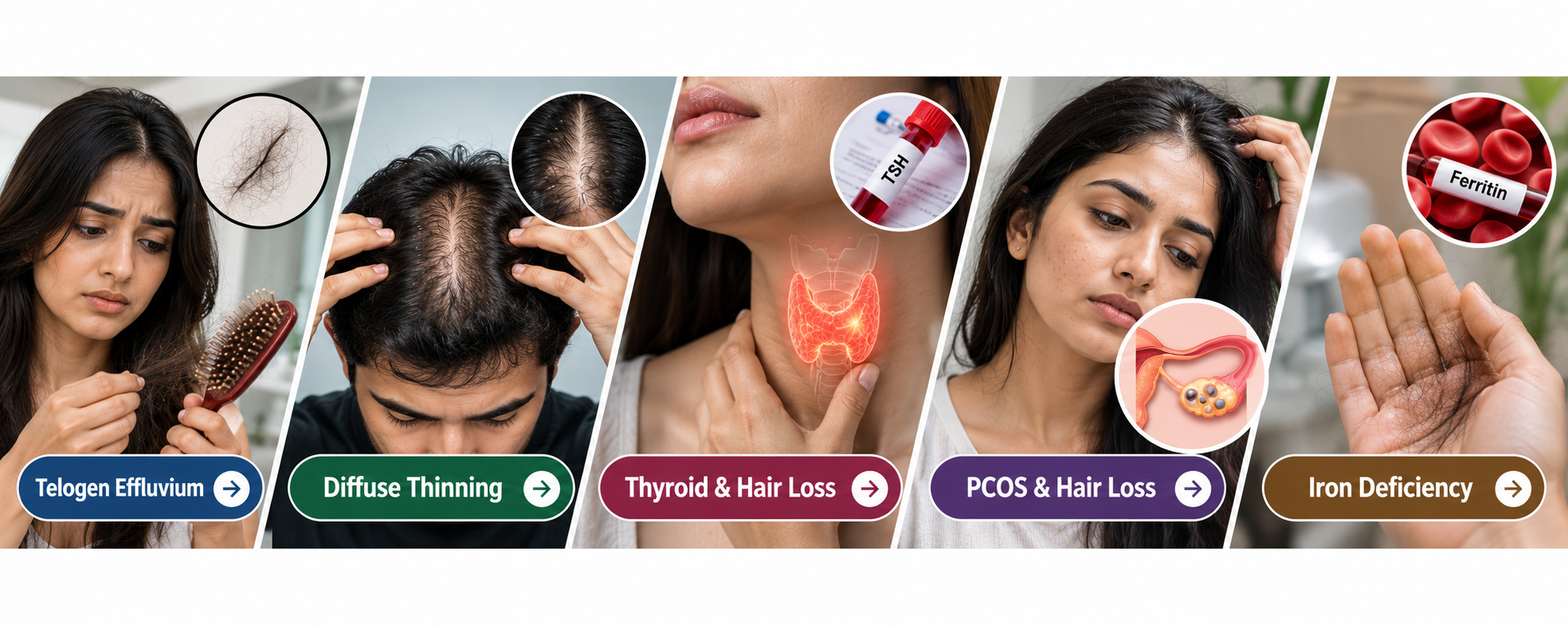
These references are provided for patient education and do not replace a dermatologist's diagnosis or individual medical advice.
Dermatologist-led overview of how hair loss is evaluated and the evidence behind common treatments.
View AAD reference ›Patient-education summary of common causes of hair loss and when to seek medical care.
View MedlinePlus reference ›Searchable index of peer-reviewed research on long-standing hair shedding.
Search PubMed ›Independent systematic reviews assessing the evidence behind hair-loss interventions.
View Cochrane Library ›Diagnosis Pathway
Hair loss treatment should start by identifying the pattern. Pattern thinning, diffuse shedding, patchy loss, sudden shedding and hair breakage need different next steps.
May suggest androgenetic alopecia or DHT-related pattern hair loss. Often gradual and progressive.
Androgenetic Alopecia →May relate to telogen effluvium, deficiency, thyroid, illness, stress, postpartum phase or diffuse pattern loss.
Diffuse Hair Thinning →Often follows a trigger weeks to months earlier, but sudden shedding should not be dismissed if severe or persistent.
Sudden Hair Fall →Persistent shedding needs cause-finding: chronic TE, thyroid, deficiency, medicines, hormones or pattern loss.
Chronic Hair Fall →Patchy loss may be alopecia areata, fungal infection or scarring alopecia and should be dermatologist-led.
Patchy Hair Loss →Breakage is shaft damage, not root shedding. It needs damage repair and styling changes, not root-hair-fall treatment.
Breakage vs Hair Fall →Cause Map
DHT-related follicle miniaturisation causing gradual pattern thinning in men and women.
Read Guide →Diffuse shedding after triggers such as fever, COVID, stress, childbirth, surgery, dieting or deficiency.
Read Guide →Iron, vitamin D, thyroid and nutritional issues can contribute to diffuse shedding and chronic hair fall.
Supplement Safety →Round bald patches need dermatologist diagnosis because causes and treatments differ greatly.
Patchy Hair Loss →Stress, rapid weight loss, illness, smoking and alcohol may contribute, but rarely act alone.
Stress Hair Loss →Breakage from heat, chemicals, friction or styling is different from root hair fall.
Breakage vs Hair Fall →Red Flags
Short-term shedding after a known trigger can be tracked with photos, routine consistency and symptom notes.
Use the AI Hair Test to organise pattern, duration, triggers, scalp symptoms and next-step direction.
Hair fall lasting more than 6 months, worsening crown thinning, a widening parting or unclear shedding needs evaluation.
Patchy loss, scalp pain, pus, crusting, bleeding, scarring-looking skin, sudden severe shedding or child scalp scaling needs prompt medical review.
Timeline
Fever, COVID, stress, surgery, childbirth, crash dieting or major illness may push hairs into the shedding phase.
Shedding may become noticeable after a delay, often once the original trigger already feels over.
Supportive care, trigger correction, nutrition and scalp comfort help recovery, but timelines vary.
Heavy, persistent, patchy or progressive loss should be checked rather than assumed harmless.
Assessment
Low ferritin can contribute to diffuse shedding. Iron should be taken only after testing and doctor advice.
Thyroid imbalance can cause diffuse shedding and needs medical management, not hair products alone.
Vitamin D, protein intake and nutritional history may matter, especially after dieting or illness.
Dermoscopy or scalp examination helps separate pattern loss, shedding, inflammation, fungal causes and scarring risks.
Comparison
| Feature | Pattern Hair Loss | Telogen Effluvium | Hair Breakage |
|---|---|---|---|
| Main sign | Receding hairline, crown thinning, widening parting | Diffuse shedding from all over the scalp | Short broken strands, split ends, roughness |
| Timeline | Gradual and progressive | Often starts after a trigger | Linked to damage, heat, chemicals, friction or styling |
| Root bulb? | May shed miniaturised hairs | Shed hairs often have a root bulb | No root bulb; the shaft snaps |
| Best next step | AI Hair Test + dermatologist review if progressive | Find the trigger + correct the cause | Damage-repair routine + styling changes |
Cause-Finding First
Hair fall lasting more than about six months is best approached by finding the cause rather than switching products. Chronic telogen effluvium, thyroid problems, deficiency, medicines, hormones and pattern loss can all contribute, and several need medical management.
AI-Guided Next Step
Screen hair fall pattern, duration, triggers, scalp symptoms and next-step direction.
Take AI Hair Test →Explore product directions based on cause, scalp type and safety needs after screening.
Find Products →Build a realistic routine for shedding, pattern thinning, scalp support or breakage.
Build Routine →Track shedding, density, parting, crown and treatment response over time.
Track Progress →Product & Routine Pathway
Supportive shampoos, serums and routines for shedding-related concerns. Products do not cure hair loss.
View Hair Fall Products →Cosmetic serums, deficiency-guided supplements and selected doctor-guided active pathways.
View Growth Products →For dandruff, itching, oiliness or inflammation-linked shedding, scalp care may be the first step.
View Scalp Care →If the issue is shaft snapping rather than root shedding, focus on damage repair and styling changes.
View Damage Care →Explore More
External links open in a new tab for education. They are not endorsements and do not replace a consultation.
Next Step
Hair loss can come from pattern thinning, telogen effluvium, deficiency, thyroid, stress, post-viral shedding, rapid weight loss, scalp inflammation, patchy alopecia or hair shaft breakage. Start with screening, then choose the right routine or doctor review.
Question not answered here? Ask Dr Amit for instant guidance or book a consultation.
Ask Dr AmitConsult a DoctorChronic hair fall almost always has a cause worth finding — and much of it improves once you treat the right one. Take the Hairsncares AI Cause Finder to narrow the likely reason, see which tests to discuss with your doctor, support your hair while it recovers, and get assessed.
A clear, dermatologist-reviewed overview of Chronic Hair Fall — what it is, the evidence behind treatment options, and the red flags that mean a doctor should look first. No exaggerated regrowth claims.
Results vary based on diagnosis, consistency, formulation and scalp condition.
Premium concern visual slot · 720×520 WebP
Hair fall continuing for six months or longer, which can have pattern, deficiency, hormonal or scalp causes
People with persistent, ongoing shedding
Chronic shedding needs the cause identified; treatment depends on it
Recommended — get a proper diagnosis
Reviewed by: Dr. Amit Agarkar, MD Dermatology
Medical focus: Dermatology, trichology, hair loss, scalp disorders and hair restoration.
Last reviewed: 1 June 2026
Editorial promise: This page explains causes, treatment evidence, limitations and safe next steps without exaggerating hair-growth claims.
Prepared by the Hairsncares editorial team and medically reviewed by a dermatologist experienced in hair and scalp disorders.
Checked for accuracy of causes, treatment evidence, safety warnings, limitations and suitability for Indian users.
To help you understand this concern and choose safe next steps, and to know when a dermatologist diagnosis matters most.
| Parameter | Assessment | What it means |
|---|---|---|
| What it is | Hair fall continuing for six months or longer, which can have pattern, deficiency, hormonal or scalp causes | The nature of this concern in plain terms. |
| Who it affects | People with persistent, ongoing shedding | The people in whom it is most commonly seen. |
| Best-evidence options | Chronic shedding needs the cause identified; treatment depends on it | Where the strongest support lies — most are doctor-guided. |
| When to see a doctor | Treating chronic loss blindly without a diagnosis | Situations needing diagnosis before any treatment. |
| Expected timeline | Depends on the cause; chronic cases benefit from medical assessment | Results vary based on diagnosis, consistency, formulation and scalp condition. |
Hair fall lasting beyond six months should be assessed by a dermatologist to identify the cause.
Product results should be selected based on diagnosis, scalp type, sensitivity, routine compatibility and dermatologist guidance where needed.
Find Products After AI Hair TestHair fall continuing for six months or longer, which can have pattern, deficiency, hormonal or scalp causes. The exact cause should be confirmed, because look-alike conditions are treated differently.
Chronic shedding needs the cause identified; treatment depends on it. Most effective options are doctor-guided, and results depend on diagnosis, consistency and realistic expectations.
Depends on the cause; chronic cases benefit from medical assessment.
For sudden, patchy, painful or unexplained loss, yes — see a dermatologist before treating. A suitability screen helps you understand likely causes.
Treating chronic loss blindly without a diagnosis — these need evaluation before any product or medicine.
Your cart is empty