Hair Loss: Causes & Treatment
Dermatologist-led overview of how hair loss is evaluated and the evidence behind common treatments.
View AAD reference ›Male hair loss can happen due to DHT sensitivity, male pattern baldness, a receding hairline, crown thinning, dandruff, stress, poor sleep, nutritional deficiency, post-fever shedding, scalp inflammation or wrong product use. Hairsncares helps you identify the likely pattern with an AI-powered hair test, then guides you toward suitable dermatologist-reviewed products, routines and consultation when needed.
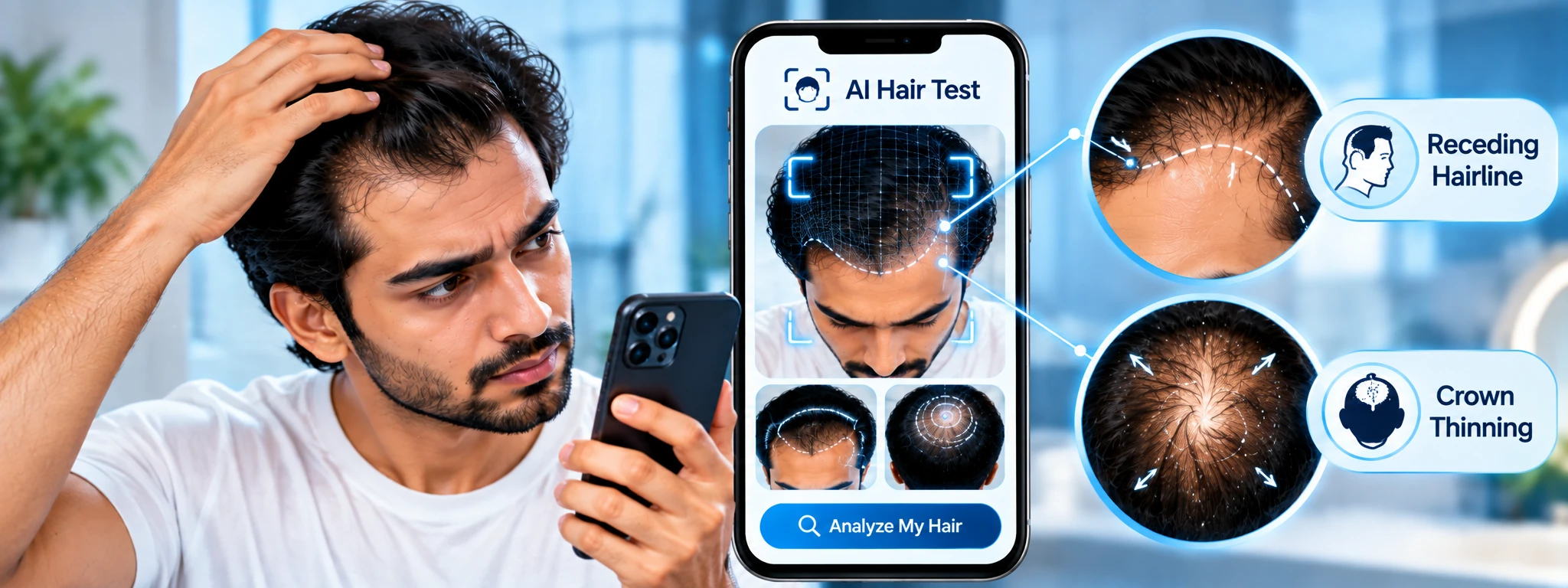
Illustrative sample only. AI screening helps guide product choice and does not replace a dermatologist's diagnosis.
The best male hair loss treatment in India depends on the pattern and cause. Receding hairline and crown thinning are commonly linked to male pattern hair loss and may need doctor-guided options such as Minoxidil or prescription medicines. Dandruff, stress, nutritional deficiency and post-illness shedding need different care. Hairsncares recommends starting with an AI hair test before choosing products.
Male hair loss guide for receding hairline, crown thinning and DHT-related pattern loss. Medical treatment and product direction should be suitability-led.
AI Summary
Male hair loss is one possible hair-loss pattern or trigger. The right next step depends on whether hair is shedding from the root, breaking from the shaft, thinning in a pattern, falling suddenly, persisting for months or appearing in patches.
This page is educational and screening-oriented. It does not diagnose, prescribe or guarantee results. Use the AI Hair Test to organise symptoms, and consult a dermatologist if symptoms are severe, persistent, patchy, painful or progressive.
Best next step: identify the pattern, check likely triggers, review red flags, then choose a routine, product pathway or doctor consultation safely.
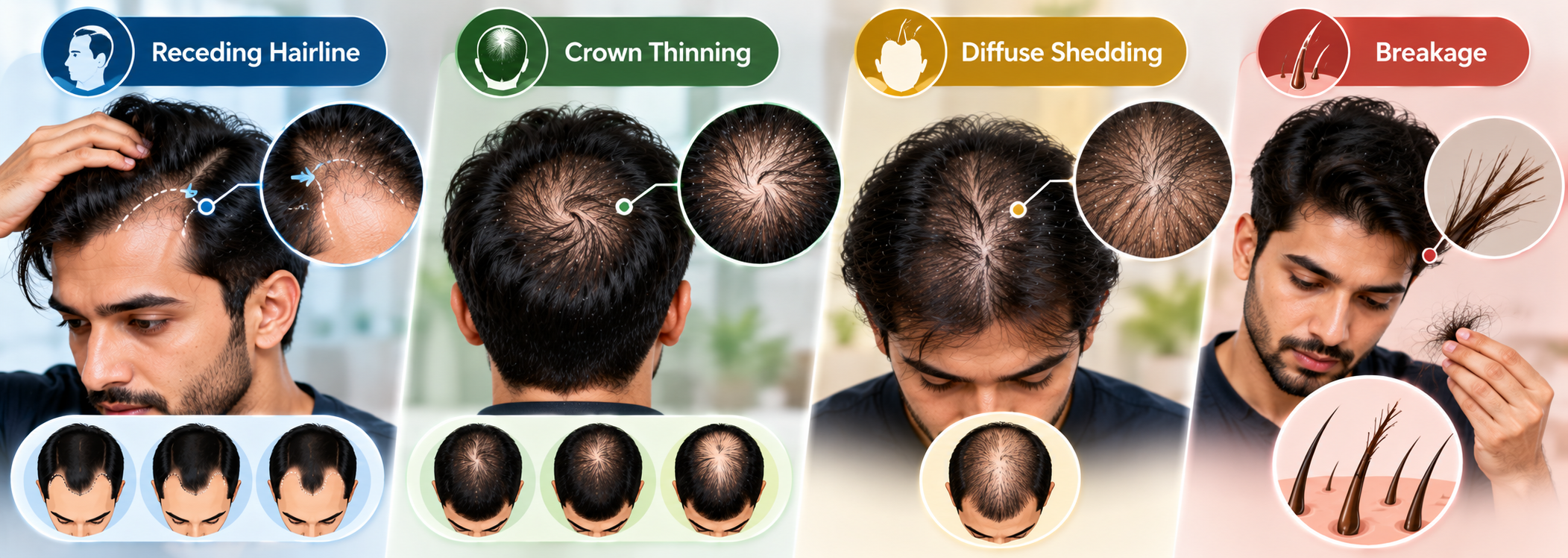
Male hair loss means excessive shedding, thinning or a visible reduction in hair density in men. Some daily shedding is normal — most people lose roughly 50–100 hairs a day — so the concern is a clear, sustained increase or visible thinning over time.
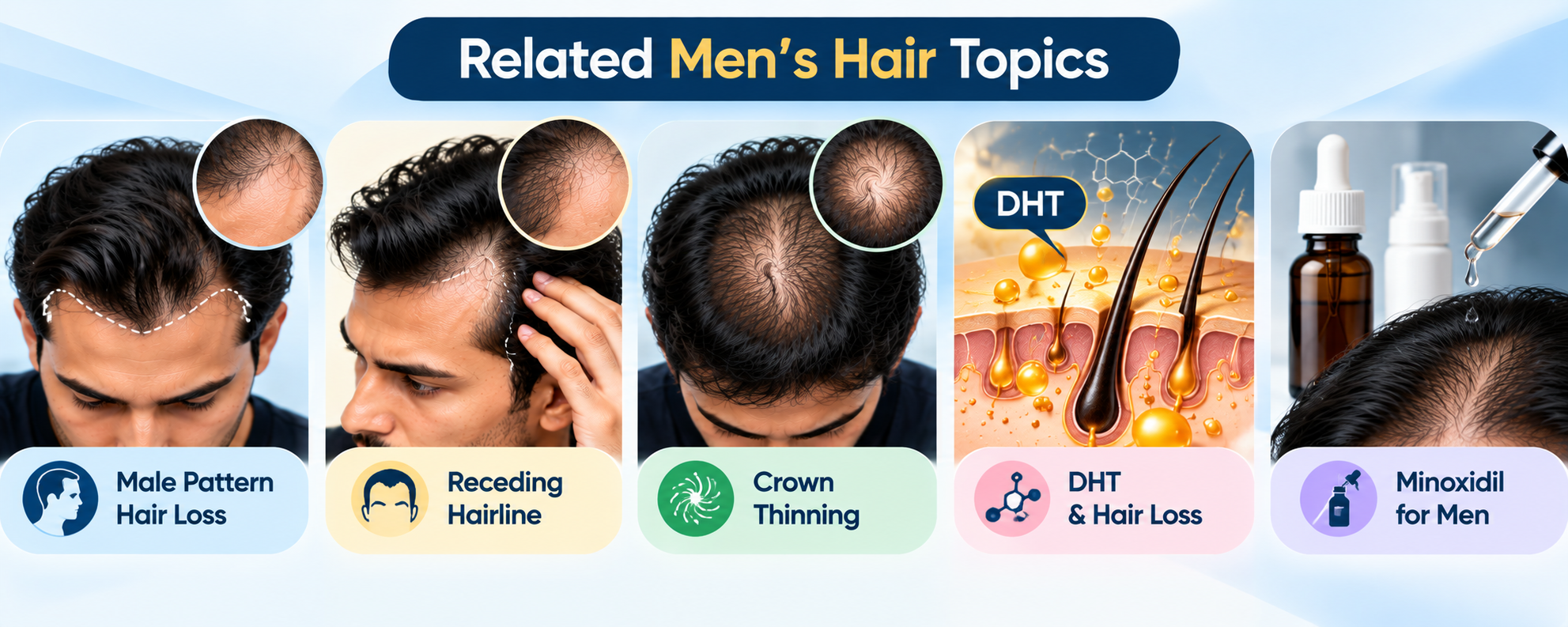
It helps to separate the terms. Hair fall is hair shed from the root. Hair thinning is strands becoming finer and density dropping. Hair breakage is the strand snapping along its length from damage. Male pattern baldness is gradual, genetic, DHT-driven loss. A receding hairline moves the front edge backward at the temples, while crown thinning affects the vertex at the back of the top. Each points to a different plan.
| Aspect | What it means |
|---|---|
| Receding hairline | Male pattern hair loss (DHT, genetic) |
| Crown thinning | Male pattern hair loss |
| Diffuse shedding | Stress, illness, deficiency, post-fever |
| Dandruff-associated fall | Scalp inflammation, seborrhoeic dermatitis |
| Patchy hair loss | Alopecia areata, infection, other causes |
| Hair breakage | Harsh styling, dryness, damage |
| Post-fever / post-COVID shedding | Telogen effluvium |
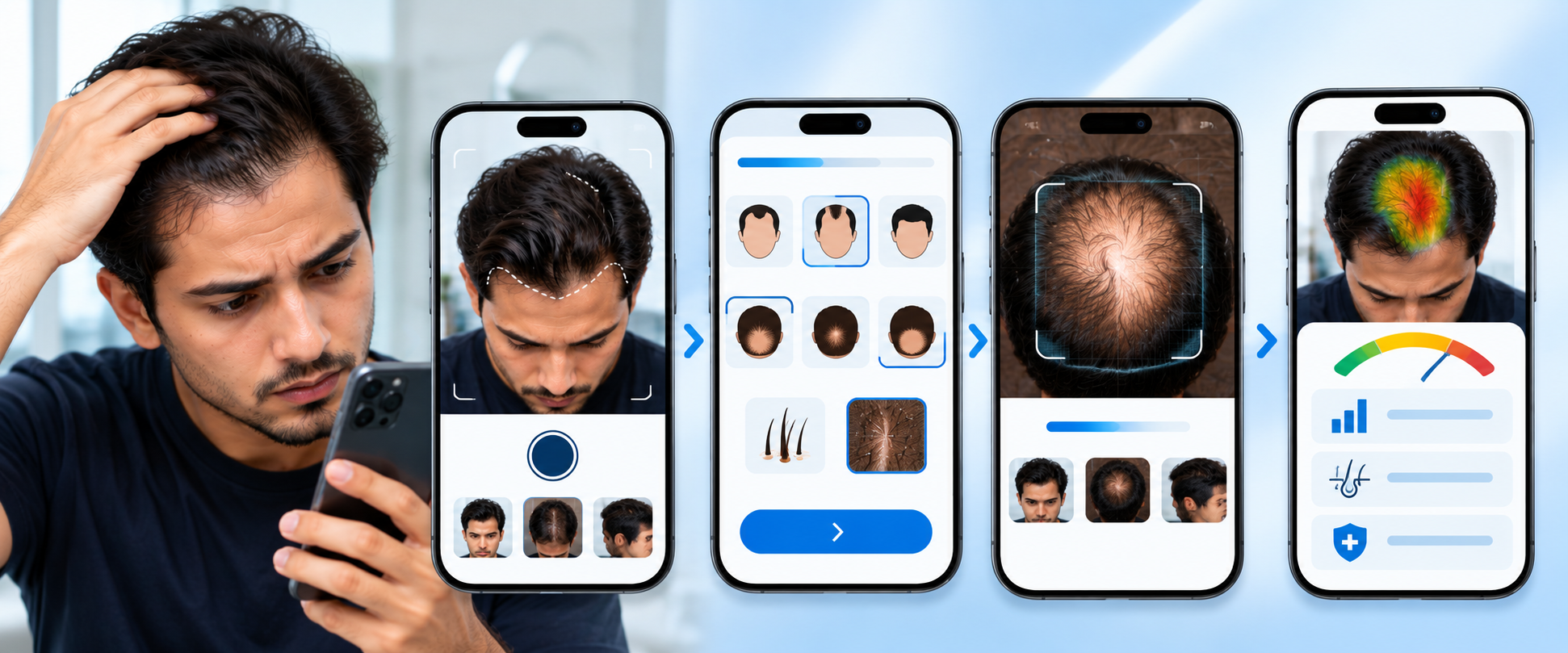
Not sure which type you have? A 90-second AI screen reads your hairline, crown and scalp signs.
Identify My PatternSpotting these early matters — there is usually more existing hair to protect when you act sooner rather than later.
Hairline moving backward over months
M-shaped temples appearing
Crown (back of the top) thinning
More scalp visible under bright light
Reduced hair density on top
Hair becoming noticeably finer
Family history of baldness
More hair fall while styling or washing
Wider gaps in the front hairline
Slow progression over months to years
Recognise a few of these? Get a male pattern score from your hairline and crown photos.
Check My Male Pattern ScoreMale hair loss is a symptom, not a single disease. DHT sensitivity and genetics are the biggest drivers, but scalp, lifestyle and nutritional factors often overlap.
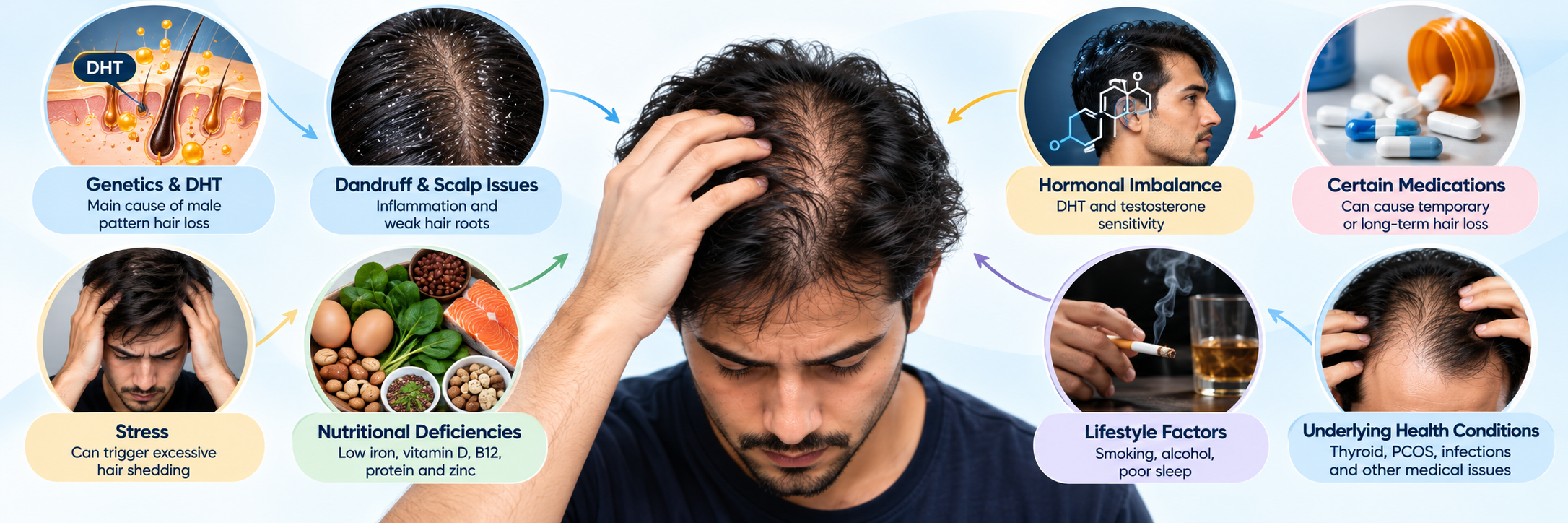
Many causes look alike from outside. Let the AI test narrow down the likely driver for you.
Find My Likely CauseAsk a Doctor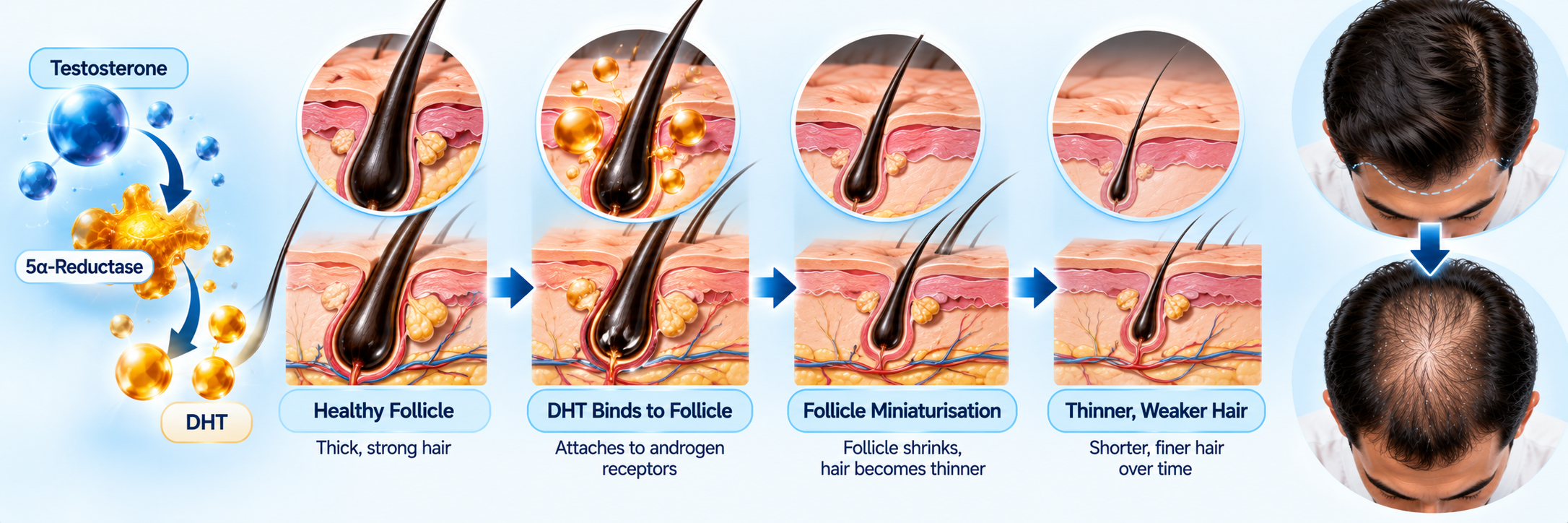
Male pattern baldness (androgenetic alopecia) is gradual hair loss driven by a genetic sensitivity to the hormone DHT. Over time, DHT causes affected follicles to shrink — a process called miniaturisation — so hair grows back finer, shorter and eventually not at all. It typically shows at the hairline, temples, crown and mid-scalp, and usually progresses slowly.
The practical takeaway: starting treatment early tends to help preserve existing hair better than waiting until baldness is advanced. Because long-term medical therapy needs proper assessment and monitoring, a dermatologist evaluation is recommended before beginning it.
This is a simplified, educational guide, not a clinical grading. An assessment gives a more accurate picture.
Want to know your likely stage? The male pattern checker estimates it from your photos.
Check My StageRead Full GuideBoth are common in male pattern hair loss but show up differently and are tracked differently.
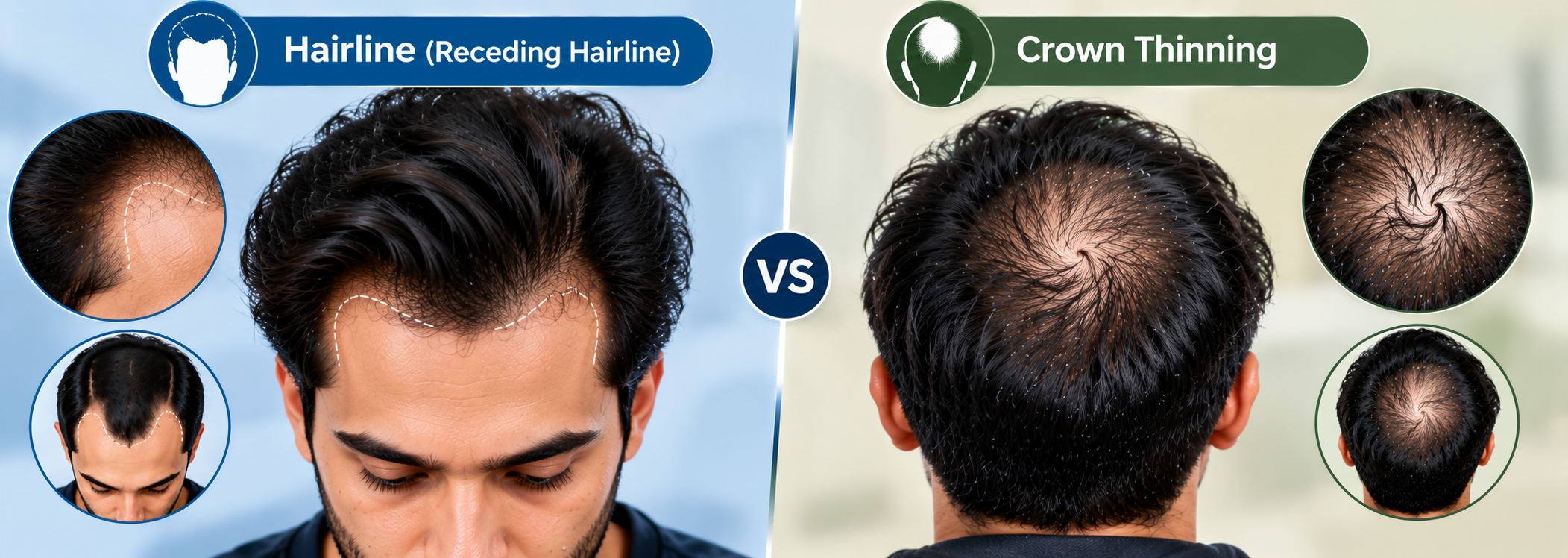
| Feature | Receding hairline | Crown thinning |
|---|---|---|
| First visible sign | Temples moving back, M-shape | Scalp showing at the vertex |
| Common cause | Male pattern hair loss (DHT) | Male pattern hair loss (DHT) |
| Progression | Gradual front-edge retreat | Gradual widening thin spot |
| Product approach | Doctor-guided topical + scalp care | Doctor-guided topical, often responds well early |
| When doctor help is needed | Active recession or starting therapy | Active thinning or starting therapy |
| Tracking method | Front-facing photos, same angle | Top-down photos of the crown |
Upload front and top photos for an AI hairline + crown check in under two minutes.
Upload Photos for AI CheckA starting point only. Final suitability depends on assessment, age, medical history and any prescription requirement.
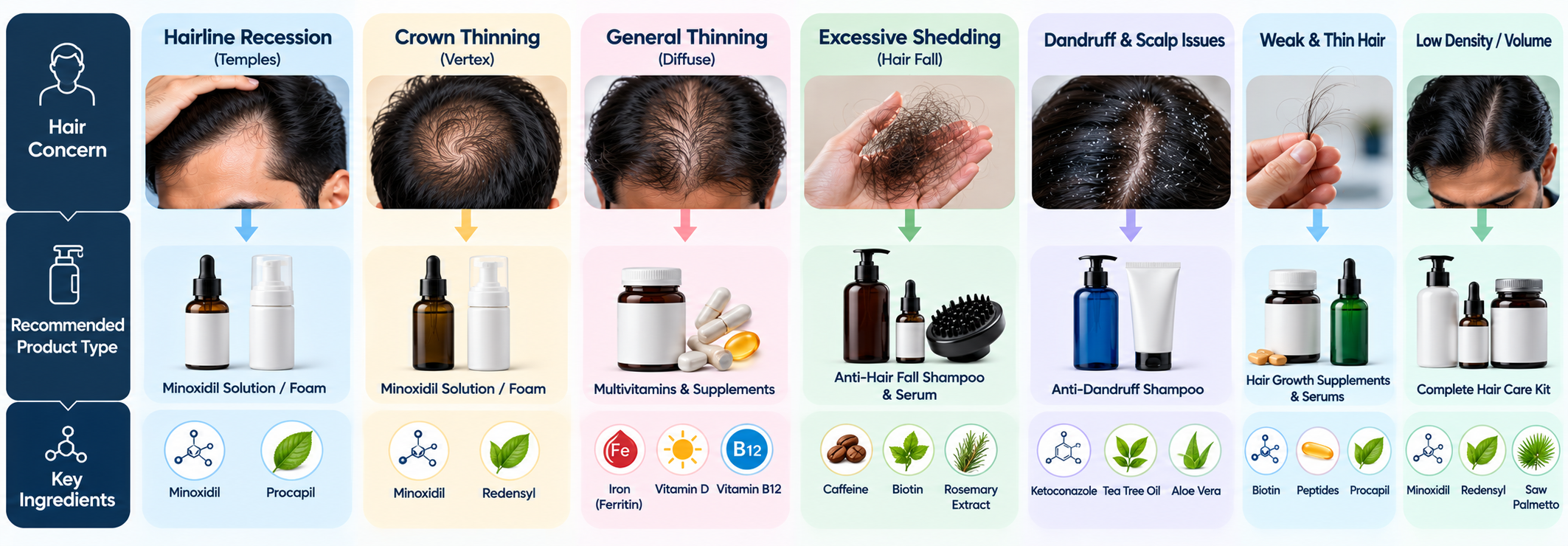
| Male concern | Suggested product type | Ingredient examples | Doctor guidance needed? |
|---|---|---|---|
| Receding hairline | Topical therapy + scalp care | Minoxidil (Rx), Procapil | Yes — assessment advised |
| Crown thinning | Topical therapy + serum | Minoxidil (Rx), Redensyl | Yes — assessment advised |
| Male pattern hair loss | Doctor-guided plan | Minoxidil, Finasteride (Rx) | Yes — prescription & monitoring |
| Hair fall with dandruff | Medicated anti-dandruff shampoo | Ketoconazole, zinc pyrithione | If severe or scaly |
| Oily scalp hair fall | Clarifying / balancing cleanse | Salicylic acid, zinc pyrithione | If irritation |
| Sudden shedding after stress/fever | Gentle care, supportive products | Mild actives | If prolonged |
| Nutritional hair fall | Diet correction + supplements if confirmed | Iron, vitamin D, B12, biotin | Yes — test first |
| Hair breakage | Conditioner, repair | Amino acids, peptides | Usually no |
| Beard patchiness | Beard support products | Supportive actives | If patchy or sudden |
| Post-transplant maintenance | Aftercare + maintenance plan | As advised by surgeon | Yes — follow surgeon's plan |
Want this mapped to you? Get product suggestions based on your own screening result.
Get My Personalised Picks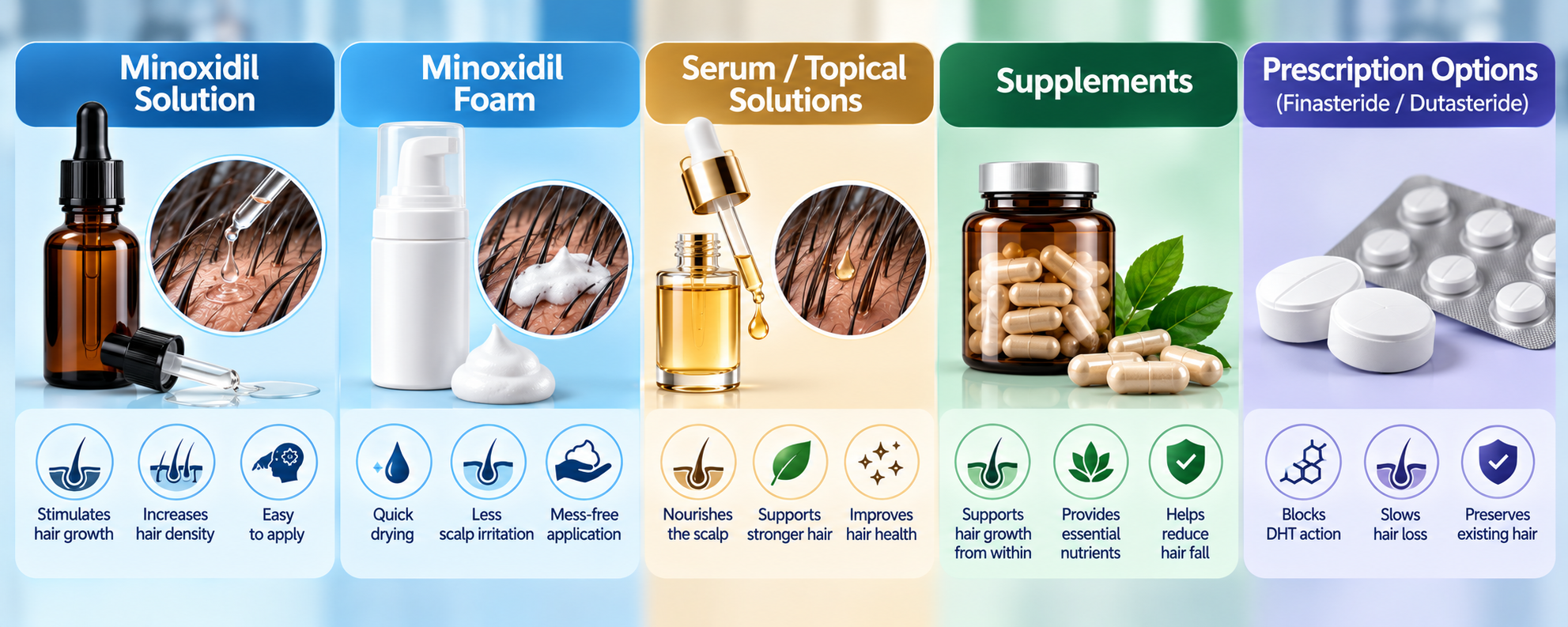
| Aspect | Solution | Foam |
|---|---|---|
| Texture | Liquid, spreads easily | Foam, dries faster |
| Scalp sensitivity | Contains propylene glycol — can irritate some | Often gentler for sensitive scalps |
| Both | Rx items; need assessment and consistent use |
| Aspect | Minoxidil | Hair growth serum |
|---|---|---|
| Role | Topical treatment for pattern loss | Cosmetic support actives |
| Evidence | Strong for pattern loss | Cosmetic to moderate |
| Status | Rx | Usually OTC |
| Option | Main role | Best for |
|---|---|---|
| Shampoo | Scalp cleansing | Dandruff, scalp health |
| Serum | Leave-on actives | Early thinning support |
| Supplement | Corrects deficiency | Confirmed low levels |
| Feature | Receding hairline | Crown thinning |
|---|---|---|
| Location | Front temples | Vertex (back of top) |
| Tracking | Front photos | Top-down photos |
| Response | Variable | Often responds well early |
| Feature | Male pattern baldness | Temporary shedding |
|---|---|---|
| Pattern | Hairline + crown, genetic | Diffuse, all over |
| Course | Slow, progressive | Often recovers in months |
| Trigger | DHT sensitivity | Stress, fever, diet, illness |
| Aspect | OTC products | Doctor-prescribed (Rx) |
|---|---|---|
| Access | Buy freely | Requires a prescription |
| Best for | Mild concerns, scalp health | Pattern loss, medical causes |
| Oversight | Self-managed | Monitored by a Registered Medical Practitioner |
| Aspect | Hair fall treatment | Hair transplant readiness |
|---|---|---|
| Goal | Preserve and support existing hair | Restore density in bald areas |
| When | Early to moderate loss | Stable, more advanced loss |
| Decision | Start medical/cosmetic plan | Specialist surgical assessment |
Still weighing OTC vs prescription, or considering a transplant? A doctor can advise what's right for your stage.
Ask a Hair DoctorTake AI Test
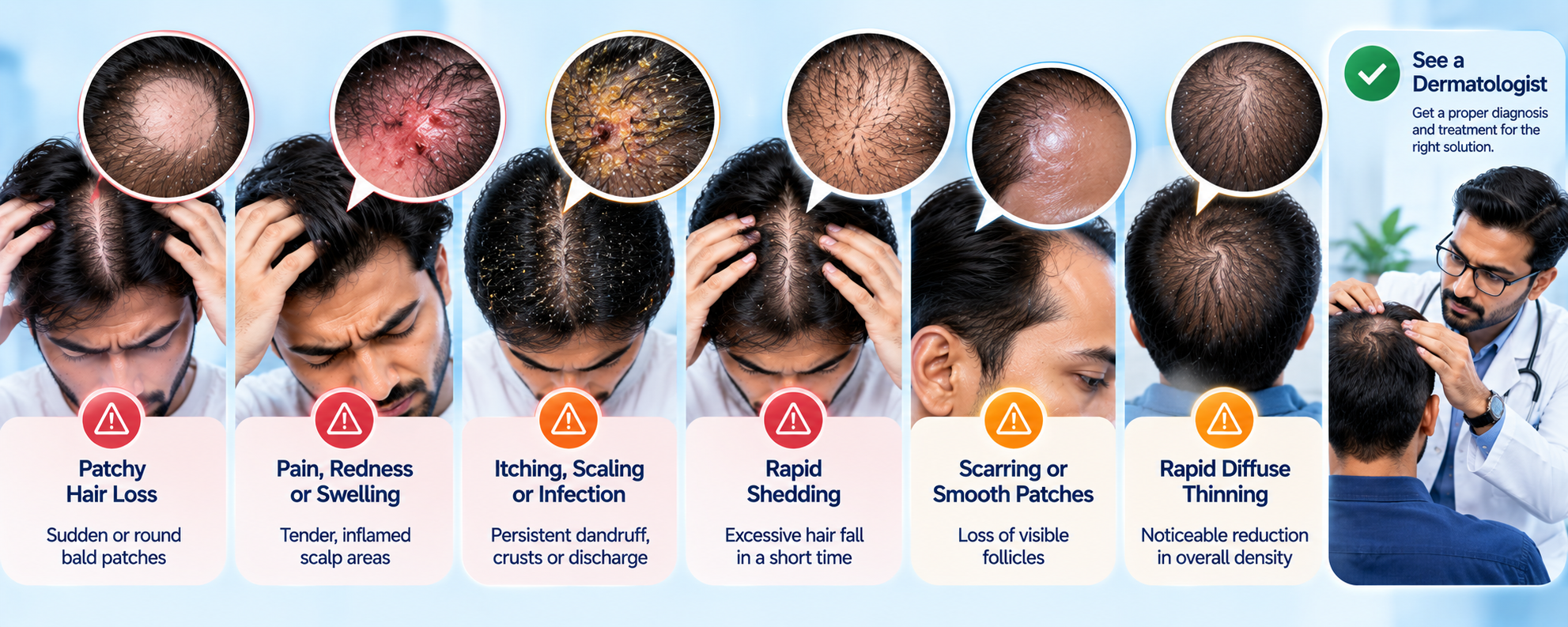
Some situations need a dermatologist's diagnosis, not over-the-counter products. Using random products here can delay correct treatment. Please consult a doctor if you notice any of the following.
Once you know the likely pattern, these categories make it easier to match products to your scalp and goal.

Topical therapy for male pattern hair loss in suitable, assessed cases.
Leave-on actives designed to support the hair cycle.
Products positioned around DHT-related thinning support.
Medicated formulas to settle flaking and related fall.
Stronger antifungal cleansing for stubborn dandruff.
Support where a genuine deficiency or need exists.
Support hair structure where intake is inadequate.
Cosmetic actives studied for supporting density.
Support for the front hairline and temples.
Curated combinations for common male concerns.
Don't know which category fits you? The Product Finder matches categories to your pattern and scalp type.
Open Product FinderBrowse AllSample selection. Prices, ratings and availability shown are placeholders.
Final product suitability depends on diagnosis, age, scalp condition, current medicines, side-effect history, and doctor guidance where required. Prescription (Rx) items, including Finasteride and Dutasteride, require a valid prescription from a Registered Medical Practitioner and medical supervision.
Before adding to cart, confirm a product suits your pattern and scalp with a quick screen.
Check Suitability FirstShop All ProductsChoose the routine closest to your pattern. Use prescription medicines only under dermatologist guidance.
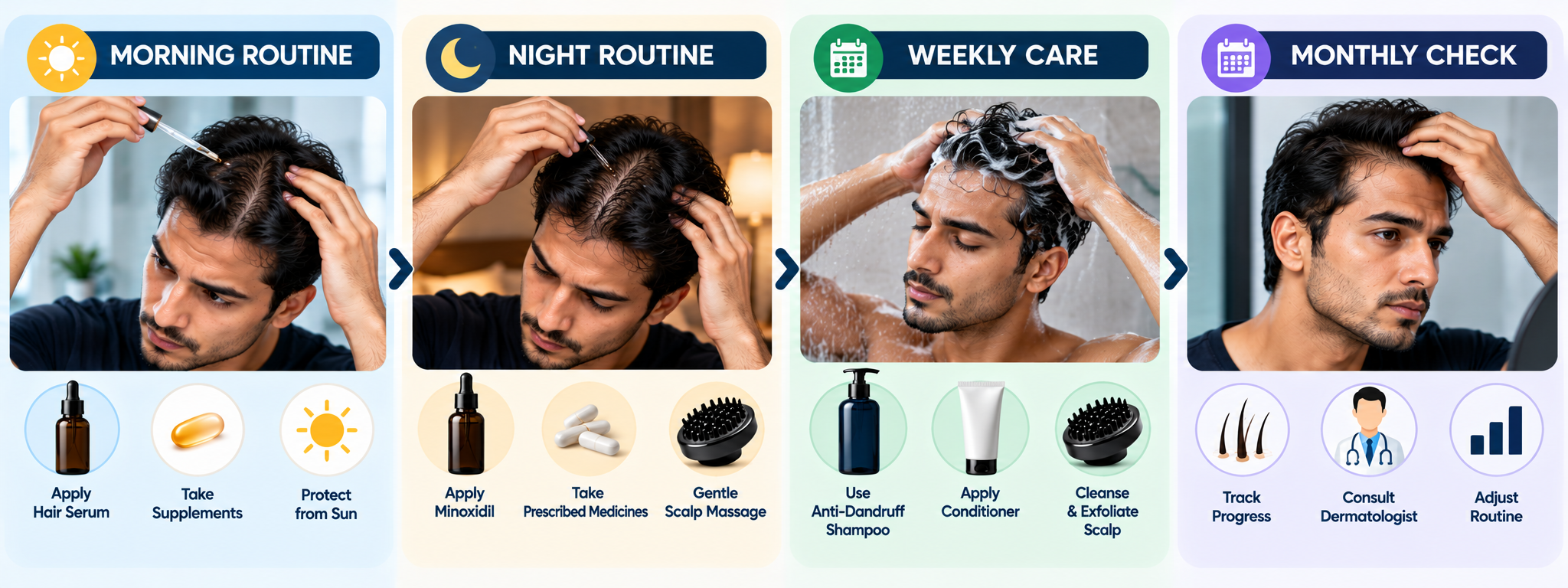
Gentle cleanse; take supplements only if a deficiency is confirmed.
Apply Minoxidil or a doctor-advised serum to a dry scalp if suitable for you.
Light conditioning; keep the topical schedule consistent.
Photograph the front hairline at the same angle; log shedding score.
Gentle cleanse; supportive supplements if advised.
Apply doctor-guided topical to the crown if suitable.
Scalp care; maintain consistency with the topical.
Top-down crown photos; note any change in the thin spot.
Medicated anti-dandruff shampoo as directed (often 2–3x weekly).
Soothing scalp serum if advised; avoid heavy products on a flaky scalp.
Gentle conditioner on lengths; keep medicated shampoo on schedule.
Track flaking, itch and shedding to judge improvement.
Gentle cleansing; balanced meals with adequate protein.
Light scalp care; prioritise sleep and stress reduction.
Nourishing care; avoid harsh styling that adds breakage.
Track shedding score; most stress/nutrition shedding settles with time.
Want a routine built around your result? Generate a personalised men's plan in minutes.
Build My Men's Hair RoutineEvidence labels are a simple guide: strong, moderate, supportive or mainly cosmetic. Prescription items are marked Rx and need doctor guidance.
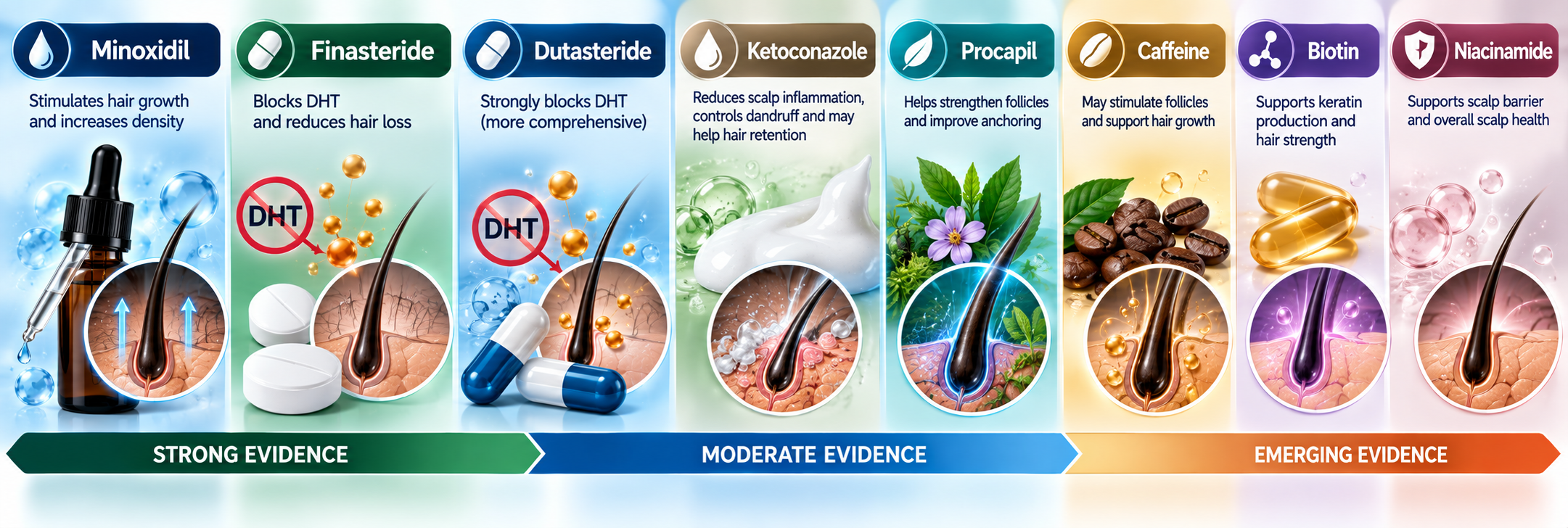
A topical treatment for male pattern hair loss.
Best for: hairline & crown thinning.
Caution: Rx item; needs assessment; some initial shedding can occur.
Related productsAn oral prescription medicine that reduces DHT.
Best for: male pattern hair loss, doctor-guided.
Caution: prescription only; possible side effects; use only under dermatologist supervision.
Related productsA prescription DHT-reducing medicine used in some cases.
Best for: selected cases, doctor-guided.
Caution: prescription only; specialist supervision required.
Related productsAn antifungal used in medicated shampoos.
Best for: dandruff, seborrhoeic dermatitis.
Caution: follow directed frequency; Rx strengths need a prescription.
Related productsA B-vitamin involved in hair structure.
Best for: confirmed deficiency.
Caution: limited benefit without deficiency; can affect some lab tests.
Related productsA cosmetic complex studied for supporting follicles.
Best for: early thinning support.
Caution: supportive, not a replacement for medical therapy.
Related productsA cosmetic active marketed for density.
Best for: early thinning support.
Caution: evidence is limited compared with Minoxidil.
Related productsA common topical haircare ingredient.
Best for: supportive cosmetic use.
Caution: evidence is limited.
Related productsA botanical with some small-study interest.
Best for: supportive cosmetic use.
Caution: patch test; can irritate sensitive scalps.
Related productsA botanical sometimes used for DHT support.
Best for: supportive use.
Caution: limited evidence; discuss with a doctor.
Related productsAn anti-dandruff agent in many shampoos.
Best for: dandruff control.
Caution: use as directed.
Related productsHelps remove scalp buildup and flakes.
Best for: flaky, oily scalp.
Caution: can be drying; avoid overuse.
Related productsConditioning actives in repair products.
Best for: damaged hair.
Caution: supportive cosmetic role.
Related productsConditioning agents that support strand strength.
Best for: breakage, dryness.
Caution: cosmetic benefit for the strand, not the root.
Related productsDeficiency is linked to increased shedding.
Best for: confirmed deficiency.
Caution: test before high-dose supplementation.
Related productsLow iron is a common shedding contributor.
Best for: confirmed deficiency.
Caution: take only under medical guidance.
Related productsA mineral involved in hair tissue health.
Best for: confirmed deficiency.
Caution: avoid excess; confirm need first.
Related productsConsidering a prescription medicine? Talk to a dermatologist before starting Finasteride or Dutasteride.
Ask a Hair DoctorAll Ingredients"As a dermatologist, I often see men starting random hair growth products without knowing whether they have male pattern hair loss, dandruff-related shedding, stress shedding, or nutritional deficiency. Male hair loss is common, but the treatment should match the pattern. Receding hairline and crown thinning need a different plan than sudden shedding or scalp inflammation. Early assessment helps protect existing hair and avoid unnecessary product use."
Have a question for the doctor? Book a consultation and get a plan built around your assessment.
Consult Dr. Amit's TeamCurated combinations. Timelines are general estimates; results vary and are not guaranteed.

Prefer a kit tailored to you? Build a custom men's kit from your screening result.
Build a Custom KitTake AI TestPattern hair loss changes slowly, so steady tracking helps you judge real progress rather than day-to-day noise.
These references are provided for patient education and do not replace a dermatologist's diagnosis or individual medical advice.
Dermatologist-led overview of how hair loss is evaluated and the evidence behind common treatments.
View AAD reference ›Patient-education summary of common causes of hair loss and when to seek medical care.
View MedlinePlus reference ›Searchable index of peer-reviewed research on male pattern hair loss.
Search PubMed ›Independent systematic reviews assessing the evidence behind hair-loss interventions.
View Cochrane Library ›Diagnosis Pathway
Hair loss treatment should start by identifying the pattern. Pattern thinning, diffuse shedding, patchy loss, sudden shedding and hair breakage need different next steps.
May suggest androgenetic alopecia or DHT-related pattern hair loss. Often gradual and progressive.
Androgenetic Alopecia →May relate to telogen effluvium, deficiency, thyroid, illness, stress, postpartum phase or diffuse pattern loss.
Diffuse Hair Thinning →Often follows a trigger weeks to months earlier, but sudden shedding should not be dismissed if severe or persistent.
Sudden Hair Fall →Persistent shedding needs cause-finding: chronic TE, thyroid, deficiency, medicines, hormones or pattern loss.
Chronic Hair Fall →Patchy loss may be alopecia areata, fungal infection or scarring alopecia and should be dermatologist-led.
Patchy Hair Loss →Breakage is shaft damage, not root shedding. It needs damage repair and styling changes, not root-hair-fall treatment.
Breakage vs Hair Fall →Cause Map
DHT-related follicle miniaturisation causing gradual pattern thinning in men and women.
Read Guide →Diffuse shedding after triggers such as fever, COVID, stress, childbirth, surgery, dieting or deficiency.
Read Guide →Iron, vitamin D, thyroid and nutritional issues can contribute to diffuse shedding and chronic hair fall.
Supplement Safety →Round bald patches need dermatologist diagnosis because causes and treatments differ greatly.
Patchy Hair Loss →Stress, rapid weight loss, illness, smoking and alcohol may contribute, but rarely act alone.
Stress Hair Loss →Breakage from heat, chemicals, friction or styling is different from root hair fall.
Breakage vs Hair Fall →Red Flags
Short-term shedding after a known trigger can be tracked with photos, routine consistency and symptom notes.
Use the AI Hair Test to organise pattern, duration, triggers, scalp symptoms and next-step direction.
Hair fall lasting more than 6 months, worsening crown thinning, a widening parting or unclear shedding needs evaluation.
Patchy loss, scalp pain, pus, crusting, bleeding, scarring-looking skin, sudden severe shedding or child scalp scaling needs prompt medical review.
Progression
Receding hairline, temple recession, crown thinning or a widening parting may appear slowly.
Hair strands become finer over time due to follicle miniaturisation in susceptible areas.
Doctor-guided options may aim to slow progression, support density and protect existing hair.
Progress photos and follow-up help decide whether products, medicines or procedural options are appropriate.
Realistic Expectations
Androgenetic (pattern) hair loss is usually gradual and progressive. Doctor-guided options may aim to slow progression and support density, but no product or routine cures it or guarantees regrowth, and active medicines such as minoxidil or finasteride are doctor-guided and not suitable for everyone.
AI-Guided Next Step
Screen hair fall pattern, duration, triggers, scalp symptoms and next-step direction.
Take AI Hair Test →Explore product directions based on cause, scalp type and safety needs after screening.
Find Products →Build a realistic routine for shedding, pattern thinning, scalp support or breakage.
Build Routine →Track shedding, density, parting, crown and treatment response over time.
Track Progress →Product & Routine Pathway
Supportive shampoos, serums and routines for shedding-related concerns. Products do not cure hair loss.
View Hair Fall Products →Cosmetic serums, deficiency-guided supplements and selected doctor-guided active pathways.
View Growth Products →For dandruff, itching, oiliness or inflammation-linked shedding, scalp care may be the first step.
View Scalp Care →If the issue is shaft snapping rather than root shedding, focus on damage repair and styling changes.
View Damage Care →Explore More
External links open in a new tab for education. They are not endorsements and do not replace a consultation.
Next Step
Hair loss can come from pattern thinning, telogen effluvium, deficiency, thyroid, stress, post-viral shedding, rapid weight loss, scalp inflammation, patchy alopecia or hair shaft breakage. Start with screening, then choose the right routine or doctor review.
Question not answered here? Ask Dr Amit for instant guidance or book a consultation.
Ask Dr AmitConsult a DoctorDo not start random products blindly. Take the Hairsncares Male AI Hair Test, understand your likely hair loss pattern, build a personalised routine, and shop more confidently with doctor-reviewed guidance.
A clear, dermatologist-reviewed overview of Male Hair Loss — what it is, the evidence behind treatment options, and the red flags that mean a doctor should look first. No exaggerated regrowth claims.
Results vary based on diagnosis, consistency, formulation and scalp condition.
Premium concern visual slot · 720×520 WebP
Hair loss in men, most commonly male pattern (androgenetic) loss but with other possible causes
Men of any age
Minoxidil and Finasteride have the strongest evidence; doctor-guided
Recommended — confirm the pattern
Reviewed by: Dr. Amit Agarkar, MD Dermatology
Medical focus: Dermatology, trichology, hair loss, scalp disorders and hair restoration.
Last reviewed: 1 June 2026
Editorial promise: This page explains causes, treatment evidence, limitations and safe next steps without exaggerating hair-growth claims.
Prepared by the Hairsncares editorial team and medically reviewed by a dermatologist experienced in hair and scalp disorders.
Checked for accuracy of causes, treatment evidence, safety warnings, limitations and suitability for Indian users.
To help you understand this concern and choose safe next steps, and to know when a dermatologist diagnosis matters most.
| Parameter | Assessment | What it means |
|---|---|---|
| What it is | Hair loss in men, most commonly male pattern (androgenetic) loss but with other possible causes | The nature of this concern in plain terms. |
| Who it affects | Men of any age | The people in whom it is most commonly seen. |
| Best-evidence options | Minoxidil and Finasteride have the strongest evidence; doctor-guided | Where the strongest support lies — most are doctor-guided. |
| When to see a doctor | Sudden, patchy or painful loss — see a doctor | Situations needing diagnosis before any treatment. |
| Expected timeline | Months; earlier treatment helps; benefit needs continuation | Results vary based on diagnosis, consistency, formulation and scalp condition. |
Sudden, patchy or painful loss is not male pattern baldness and needs a dermatologist first.
Product results should be selected based on diagnosis, scalp type, sensitivity, routine compatibility and dermatologist guidance where needed.
Find Products After AI Hair TestHair loss in men, most commonly male pattern (androgenetic) loss but with other possible causes. The exact cause should be confirmed, because look-alike conditions are treated differently.
Minoxidil and Finasteride have the strongest evidence; doctor-guided. Most effective options are doctor-guided, and results depend on diagnosis, consistency and realistic expectations.
Months; earlier treatment helps; benefit needs continuation.
For sudden, patchy, painful or unexplained loss, yes — see a dermatologist before treating. A suitability screen helps you understand likely causes.
Sudden, patchy or painful loss — see a doctor — these need evaluation before any product or medicine.
Your cart is empty