AI-POWERED HAIR DIAGNOSIS FOR INDIA

Sudden Hair Fall Treatment in India: Find the Trigger, Act Calmly

A sudden spike in shedding is alarming — handfuls in the shower, hair all over the pillow. The most common reason is acute telogen effluvium, where a trigger weeks or months earlier — an illness or fever, major stress, surgery, rapid weight loss or childbirth — pushed many hairs into the shedding phase. Often the trigger was about two to three months ago. It is usually temporary, but it isn't always harmless, so the right move is to map the trigger, support recovery, and get assessed if it's heavy or persistent.
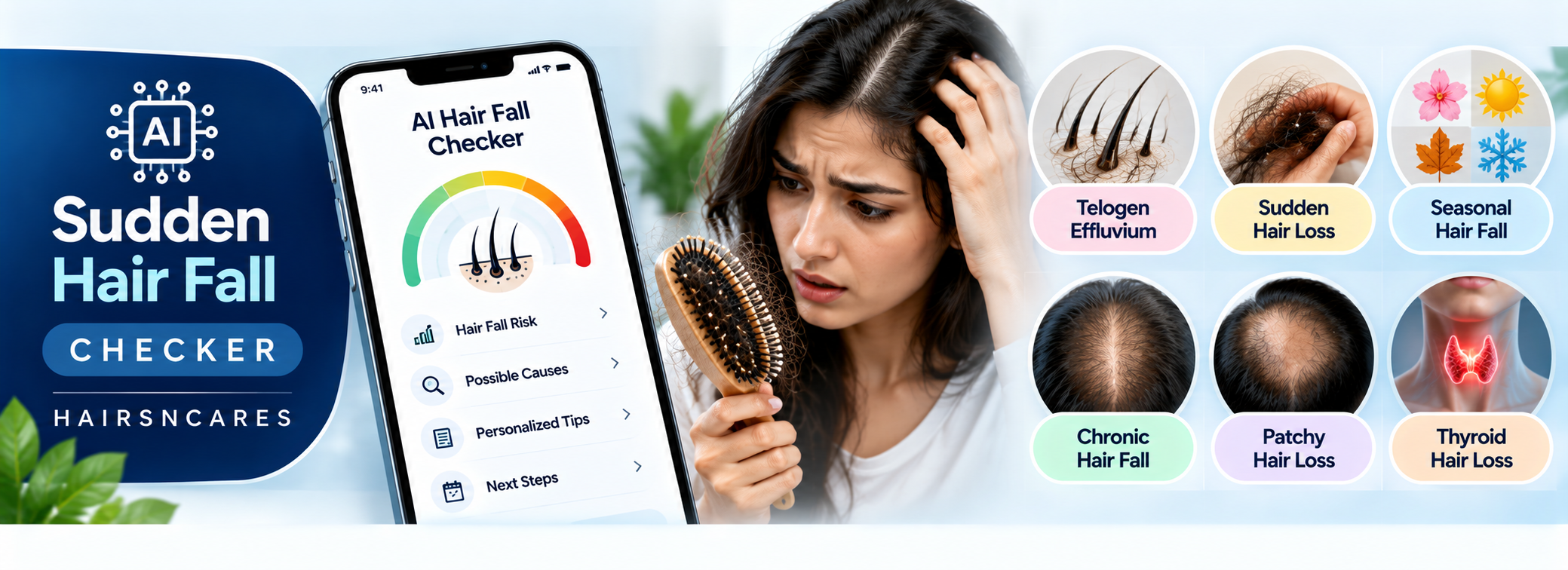
  • AI sudden-shedding checker
  • The 2–3 month trigger map
  • Acute telogen effluvium explained
  • Recovery timeline
  • Supportive products & routine
  • Clear red-flag guidance
Hero image
📷
Hero visualalt: "Using the AI sudden hair fall checker — Hairsncares" · 520×150 WebP
Your Sudden-Shedding CheckAI Checker — sample preview
OnsetRapid, last few weeks
Likely causeAcute telogen effluvium
Trigger window~2–3 months ago
Suggested actionSupport + assess if heavy
OutlookUsually recovers; results vary

Illustrative sample only. AI screening helps guide decisions and does not replace a dermatologist's diagnosis.

OnsetHow fast
Trigger2–3 mo ago
AmountHow heavy
Red flagsPatches etc.
AI trigger mapin 90 seconds
🩺
Doctor-reviewedhair guidance
📅
Recovery timelinewhat to expect
👩‍⚕️
Honest outlooknot "always harmless"
🚚
India-widedelivery
Quick Answer

Why is my hair suddenly falling out, and what should I do?

A sudden increase in shedding is most often acute telogen effluvium — a temporary reaction where a trigger pushes many hairs into the shedding phase at once. The classic clue is timing: the shedding usually appears about two to three months after the trigger, such as an illness or high fever, major stress, surgery, rapid weight loss or childbirth. It normally recovers over several months once the trigger passes. But sudden hair fall is not always harmless — thyroid changes, deficiency, a drug reaction or the onset of alopecia areata can look similar. So the sensible steps are: map what happened a couple of months ago, support your hair and health, and see a dermatologist if shedding is heavy, persistent, patchy or comes with other symptoms.

On this page
Doctor-Reviewed Hair Loss GuideSudden Hair Fall

A sudden spike in shedding often follows a trigger weeks to months earlier, but severe or persistent shedding needs assessment.

AI Summary

Sudden hair fall in Simple Terms

Sudden hair fall is one possible hair-loss pattern or trigger. The right next step depends on whether hair is shedding from the root, breaking from the shaft, thinning in a pattern, falling suddenly, persisting for months or appearing in patches.

This page is educational and screening-oriented. It does not diagnose, prescribe or guarantee results. Use the AI Hair Test to organise symptoms, and consult a dermatologist if symptoms are severe, persistent, patchy, painful or progressive.

Best next step: identify the pattern, check likely triggers, review red flags, then choose a routine, product pathway or doctor consultation safely.
The Basics

What Is Sudden Hair Fall?

Section image
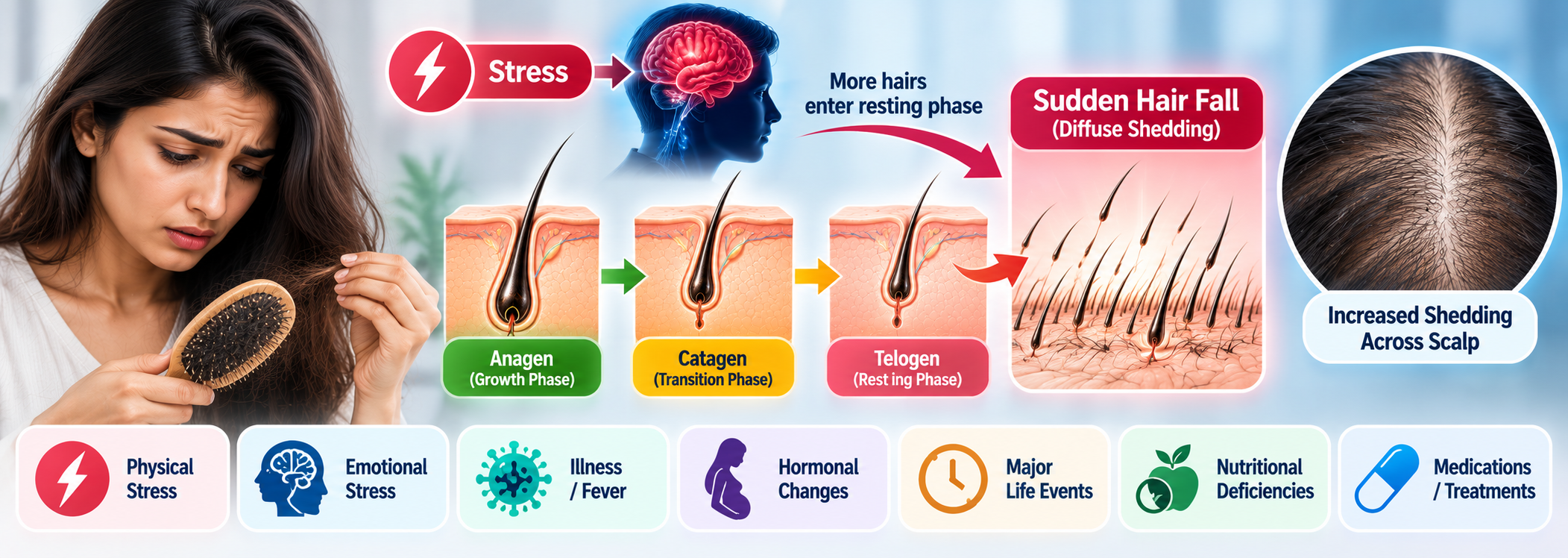
Sudden hair fall — explainer diagramalt: "A rapid spike in diffuse shedding from acute telogen effluvium" · 900×320 WebP

Sudden hair fall is a rapid, noticeable jump in how much hair you shed over a short period — suddenly seeing handfuls when you wash or brush, or far more hair than usual on your pillow and clothes. It is usually diffuse (spread across the whole scalp) rather than in patches.

The most common cause is acute telogen effluvium, a temporary reaction in which a trigger pushes an unusually large number of hairs into the resting and shedding phase at once. The hallmark is the delay: the shedding often shows up about two to three months after the trigger, which is why the cause can feel mysterious until you look back. The good news is that the follicles are not damaged, so it usually recovers over months once the trigger passes.

That said, sudden shedding is not always harmless. Occasionally it reflects a thyroid change, a significant deficiency, a medicine, or the onset of another condition such as alopecia areata. So the smart approach is to identify the likely trigger, support recovery, and get assessed if the shedding is heavy, persistent, patchy or comes with other symptoms.

Hair suddenly shedding? Map the likely trigger in 90 seconds.

Check My Shedding
What to Notice

Signs & Symptoms

These features describe sudden shedding and help your dermatologist judge what's happening.

1

A clear, recent jump in daily shedding

2

Handfuls of hair when washing or brushing

3

More hair on the pillow, clothes and floor

4

Diffuse thinning across the whole scalp

5

Full-length hairs with a small white bulb (shedding)

6

A trigger event around 2–3 months earlier

7

A thinner ponytail than before

8

Short regrowth hairs at the hairline (recovery sign)

9

No bald patches or scalp scarring (reassuring)

Recognise these signs? Screen them and get a tailored next step.

Screen My Symptoms
Map It

Sudden Hair Fall Trigger Map

Acute telogen effluvium usually traces back to one of these, around two to three months before the shedding began. Think back to that window.

Section image
📋
Trigger map — illustrated gridalt: "Sudden hair fall triggers: illness, stress, surgery, weight loss, childbirth, medicines" · 900×260 WebP

🟢Illness or high fever

Infections, viral illness or a high fever can trigger a wave of shedding.

Typical delay: ~2–3 months

🟠Major stress

A serious life event, accident or bereavement can tip hairs into shedding.

Typical delay: ~2–3 months

🟣Surgery or anaesthesia

The physical stress of surgery is a recognised trigger.

Typical delay: ~2–3 months

🟡Rapid weight loss / crash diet

Sudden calorie or protein restriction stresses the hair cycle.

Typical delay: ~2–3 months

👶Childbirth

Postpartum shedding is a common, usually temporary form.

Typical onset: ~2–4 months after

💊New medicine

Some medicines can trigger shedding — never stop them without advice.

Action: ask your doctor

🦴Thyroid / deficiency

Thyroid changes or low iron can present as sudden shedding.

Action: consider testing

🧩Onset of another condition

Occasionally the start of alopecia areata or another cause.

Action: dermatologist if patchy

Spotted your trigger? The checker confirms the fit and flags anything that needs care.

Map My Trigger
The Timeline

The 2–3 Month Delay, and Recovery

Understanding the timeline takes a lot of the fear out of sudden shedding.

0
The trigger
A trigger occurs

Illness, fever, major stress, surgery, rapid weight loss or childbirth. At this point your hair usually looks normal.

2–3
Months later
Shedding becomes obvious

Many hairs that entered the resting phase are now released together, so you suddenly notice heavy shedding — often without realising it links back to the trigger.

3–6
Settling
Shedding eases

Once the trigger has passed, the heavy phase usually settles over weeks to a few months. Short regrowth hairs may appear at the hairline.

6+
Recovery
Density recovers

Because hair grows slowly, visible recovery of density takes several months. If shedding continues beyond ~6 months, it may be becoming chronic or have another cause — get assessed.

Want to track your recovery against this timeline? Set a baseline today.

Start Tracking
The Main Cause

Understanding Acute Telogen Effluvium

Acute telogen effluvium (ATE) is the temporary, diffuse shedding behind most sudden hair fall. Normally only a small share of hairs are in the resting (telogen) phase at any time; a trigger can push a much larger share into that phase together, so a couple of months later they shed at once. It can look dramatic — but the follicles are healthy and primed to regrow.

Because it is self-limiting, ATE usually improves on its own once the trigger resolves, helped by good nutrition, stress and sleep management, and gentle haircare. The main job is to identify and address the trigger and be patient through recovery. It is reassuring that ATE does not normally cause baldness or scarring, but persistent or unusually heavy shedding still deserves a check, because other causes can overlap.

Think it's acute telogen effluvium? Confirm the fit and learn the recovery steps.

Telogen Effluvium Guide
Be Thorough

Other Causes to Rule Out

Most sudden shedding is acute telogen effluvium — but not all. These are worth excluding, especially if shedding is heavy, persistent or unusual.

🦴

Thyroid changes

Why
Thyroid disorders can cause diffuse shedding.
Clue
Fatigue, weight or temperature changes.
🦴

Deficiency

Why
Low iron or vitamin D can drive shedding.
Clue
Pale skin, tiredness, heavy periods.
🧩

Alopecia areata onset

Why
Can begin suddenly — but usually in patches.
Clue
Smooth round bald patches.
💊

Medicines

Why
Some medicines can trigger shedding.
Clue
Started a new medicine recently.
🧬

Underlying pattern loss

Why
A sudden episode can unmask gradual thinning.
Clue
Widening parting, family history.
📋

Becoming chronic

Why
Shedding beyond ~6 months may be chronic.
Clue
It just won't settle.

Want these checked properly? A dermatologist can assess and test where needed.

See a DermatologistScreen First

Self-Assessment

Screen Your Sudden Shedding

Section image
📱
Sudden Hair Fall Checker — app screen previewalt: "Sudden shedding self-assessment on a smartphone" · 900×150 WebP
  1. 1Did the shedding increase suddenly, over days to weeks?
  2. 2Is the shedding spread over the whole scalp (not patchy)?
  3. 3Did anything major happen 2–3 months ago?
  4. 4Were you ill, feverish or recently had surgery?
  5. 5Have you lost weight rapidly or changed your diet sharply?
  6. 6Did you give birth in the last few months?
  7. 7Did you start a new medicine recently?
  8. 8Do you have fatigue, weight or period changes?
  9. 9Are there any bald patches or scalp symptoms?
  10. 10Has the shedding lasted more than six months?
Your AI check gives you
  • Likely-trigger mapping
  • Acute-telogen-effluvium fit
  • Expected recovery timeline
  • Red-flag / urgency flags
  • Tests-to-discuss suggestions
  • Supportive product ideas
  • Progress tracker baseline
Start Checker
Medical Safety

Sudden Hair Fall Isn't Always Harmless

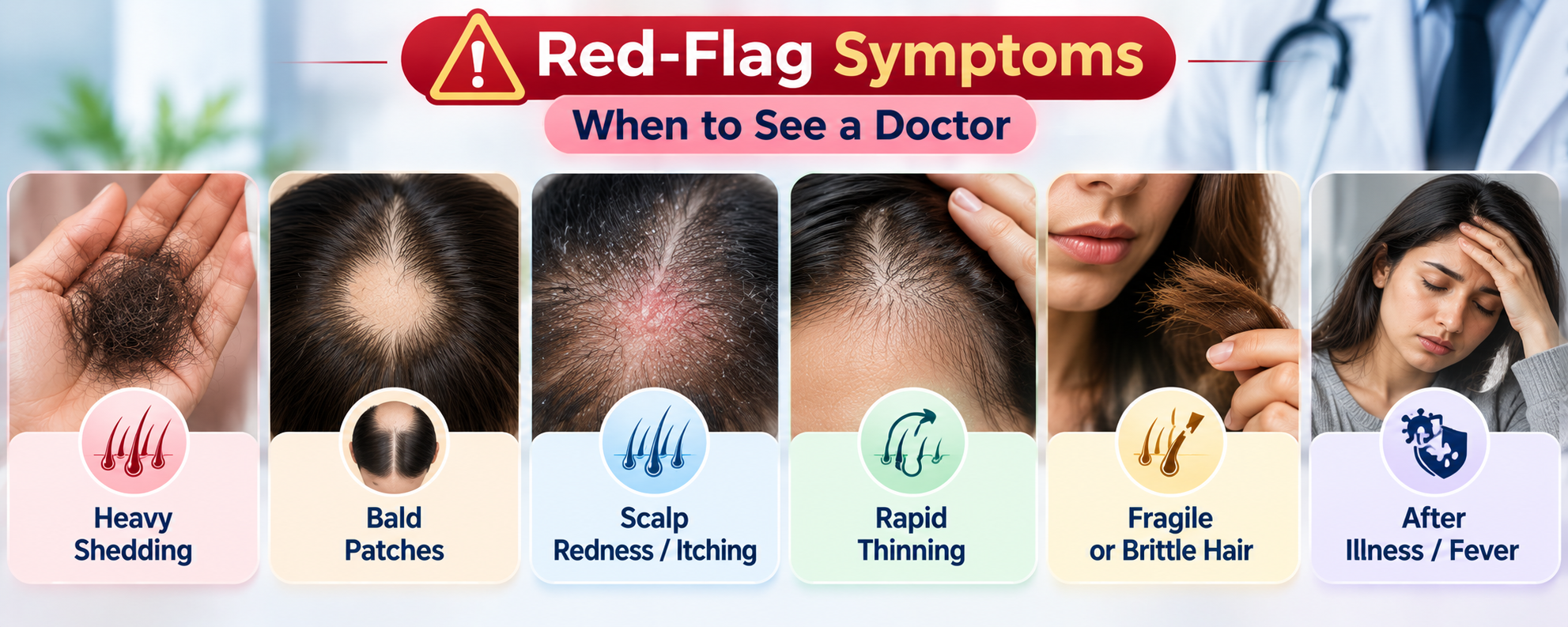
Much sudden shedding is temporary acute telogen effluvium — but please see a dermatologist if any of the following apply rather than assuming it will simply pass.
Section image
Red-flag symptoms — when to see a doctoralt: "Sudden hair fall warning signs: patches, heavy shedding, scalp symptoms, illness" · 900×240 WebP
Consult a Dermatologist
Shop by Need

Best Product Categories for Sudden Hair Fall

These support your hair gently while acute telogen effluvium settles. Supportive products do not treat underlying medical causes, and prescription items are doctor-guided.

Section image
🛍
Support categories — shelf overviewalt: "Sudden hair fall support: gentle shampoos, anti-shedding serums, multivitamins, scalp care" · 900×260 WebP
💊

Gentle shampoos

Mild cleansing that's kind to shedding-prone hair.

Best for: daily care
Shop
💧

Anti-shedding serums

Supportive leave-on serums during a shedding phase.

Best for: support
Shop
🦴

Hair multivitamins

Broad nutrition support during recovery.

Best for: general support
Shop
🦴

Iron / vitamin support

Where deficiency is confirmed, under medical advice.

Best for: tested deficiency
Shop

Scalp care

Maintain a healthy scalp environment.

Best for: scalp health
Shop
🫙

Strengthening care

If breakage adds to the appearance of loss.

Best for: mixed breakage
Shop

Not sure which fits you? The Product Finder matches support to your result.

Open Product FinderBrowse All
Featured

Sudden Hair Fall Support Products

Sample selection. Prices, ratings and availability shown are placeholders.

💊OTC
Hairsncares
Gentle Daily Shampoo
Best for: shedding phase
Key: Mild, supportive
★★★★☆ (placeholder)
₹449 placeholder
Add to cart
💧OTC
Hairsncares
Anti-Shedding Support Serum
Best for: support
Key: Procapil, caffeine
★★★★☆ (placeholder)
₹649 placeholder
Add to cart
🦴OTCAsk a doctor if pregnant/nursing
Hairsncares
Hair Multivitamin
Best for: general support
Key: Biotin, zinc, vitamins
★★★★☆ (placeholder)
₹599 placeholder
Add to cart
🦴OTCOnly if low iron confirmed; doctor advice
Hairsncares
Iron Support Supplement
Best for: tested low iron
Key: Iron + vitamin C
★★★★☆ (placeholder)
₹549 placeholder
Add to cart
OTC
Hairsncares
Scalp Support Serum
Best for: scalp health
Key: Soothing actives
★★★★☆ (placeholder)
₹549 placeholder
Add to cart
🌱OTC
Hairsncares
Hair Growth Support Shampoo
Best for: recovery phase
Key: Caffeine + actives
★★★★☆ (placeholder)
₹499 placeholder
Add to cart
🫙OTC
Hairsncares
Strengthening Conditioner
Best for: fragile hair
Key: Proteins + ceramides
★★★★☆ (placeholder)
₹549 placeholder
Add to cart
🎁OTC
Hairsncares
Sudden Hair Fall Support Kit
Best for: combined support
Key: Shampoo + serum + vitamin
★★★★☆ (placeholder)
₹1,099 placeholder
Add to cart

These products offer gentle, supportive care during a phase of sudden shedding and a healthy recovery routine. They do not treat the underlying medical causes of hair fall such as thyroid disease, deficiency or pattern loss, and no product or supplement is guaranteed to regrow hair. Supplements help mainly where a deficiency is confirmed by testing. If shedding is very heavy, lasts beyond a few months, is patchy, or comes with other symptoms, see a dermatologist rather than relying on products. Prices, ratings and availability are placeholders to be populated dynamically. Results vary.

Before adding to cart, confirm the likely trigger and rule out red flags.

Check FirstShop All Products
Build a Habit

Sudden Hair Fall Recovery Routine

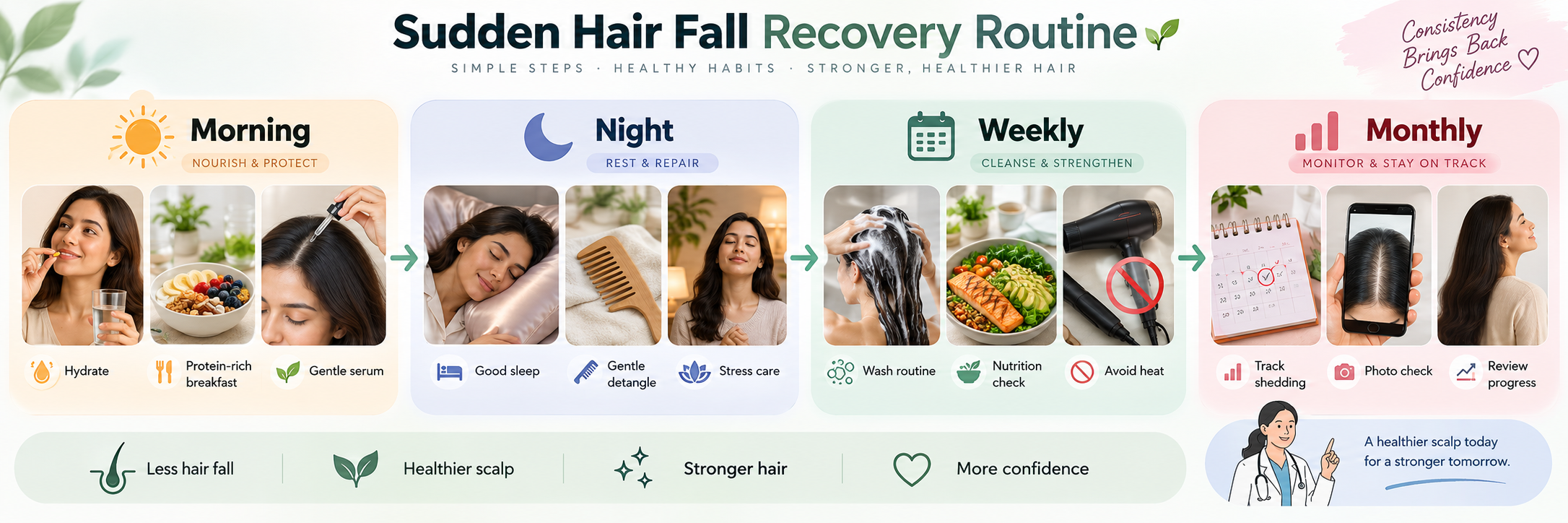
A gentle routine that supports recovery while acute telogen effluvium settles. Use active or prescription items only under dermatologist guidance, and avoid them in pregnancy or breastfeeding unless a doctor advises.
Section image
📝
Recovery routine flow — illustrated stepsalt: "Sudden hair fall recovery routine: morning, night, weekly, monthly steps" · 900×240 WebP
Mindset

Know that acute shedding is usually temporary; panic-buying rarely helps.

Daily

Gentle shampoo on wash days; supportive serum if you wish.

Weekly

Manage stress and sleep — both support the hair cycle.

Monthly

Photograph density; note whether shedding is easing.

Diet

Balanced, protein-adequate meals; avoid crash dieting.

Tests

If suspected, ask a doctor to check iron, vitamin D and thyroid.

Supplements

Only for a confirmed deficiency, under medical advice.

Review

Recheck levels and progress as your doctor advises.

Washing

Don't over-wash; be gentle and pat dry.

Styling

Avoid tight styles, harsh chemicals and excess heat.

Detangle

Wide-tooth comb; work gently from the ends up.

Protect

Silk pillowcase and soft ties reduce added breakage.

Daily

Growth-support shampoo as new hairs come through.

Night

Supportive serum; consistency matters more than intensity.

Weekly

Watch for regrowth fringe at the hairline.

Monthly

Track density; review with a doctor if not recovering by ~6 months.

Want a routine built around your result? Generate a personalised plan in minutes.

Build My Routine
Know Your Actives

Ingredient & Treatment Guide

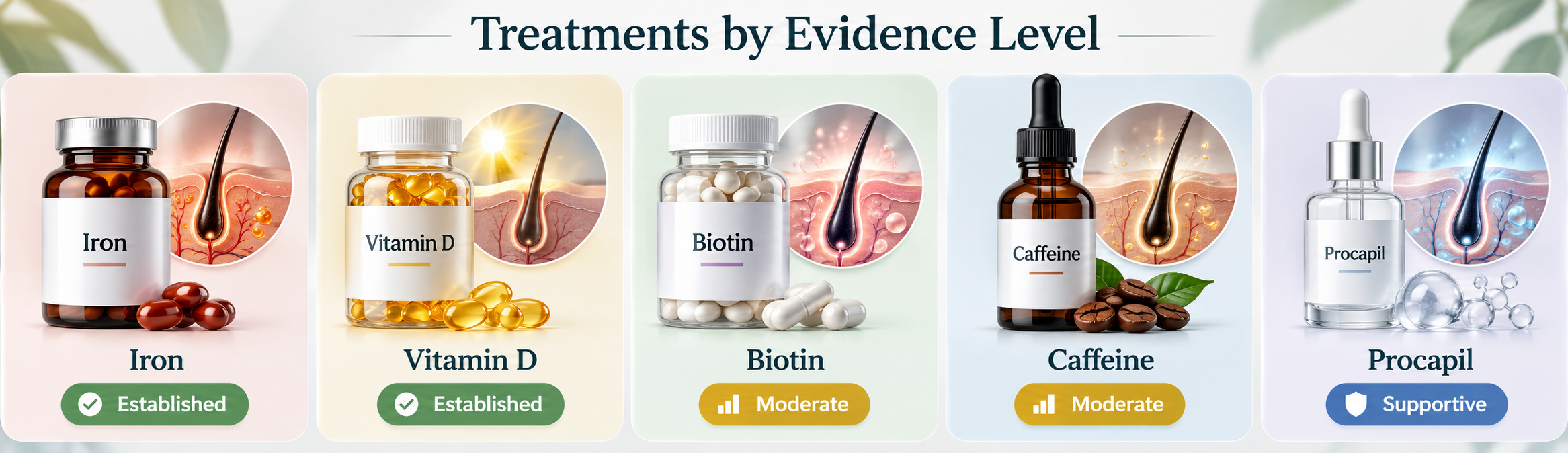
Evidence labels are a simple guide: strong, moderate, supportive or mainly cosmetic. Rx marks prescription items; the rose tag flags pregnancy/lactation caution.
Section image
🔬
Treatments by evidence level — visual guidealt: "Sudden hair fall support: iron, vitamin D, biotin, caffeine, procapil with evidence levels" · 900×260 WebP
🤱

Pregnancy & breastfeeding note: Sudden shedding after childbirth is common and usually temporary. Avoid Minoxidil in pregnancy or breastfeeding unless a doctor advises, and take supplements only on medical advice.

Iron

Strong (if low)

Low iron is a recognised contributor to shedding.

Best for: confirmed low ferritin.

Caution: take only after testing, under medical guidance.

Related products

Vitamin D

Strong (if low)

Deficiency is linked to increased shedding.

Best for: confirmed deficiency.

Caution: correct after testing; avoid excess.

Related products

Protein / amino acids

Moderate

Adequate protein supports the hair growth cycle.

Best for: low-protein or crash diets.

Caution: aim for a balanced diet first.

Related products

Vitamin B12

Moderate (if low)

Low B12 can contribute, especially on vegetarian diets.

Best for: confirmed low B12.

Caution: test before supplementing.

Related products

Zinc

Supportive

A mineral involved in hair tissue health.

Best for: confirmed low zinc.

Caution: excess can be harmful; test first.

Related products

Biotin

Supportive

A B-vitamin involved in hair structure.

Best for: confirmed deficiency.

Caution: limited benefit without deficiency; can affect lab tests.

Related products

Caffeine

Cosmetic

A common topical haircare ingredient.

Best for: supportive cosmetic use.

Caution: evidence is limited.

Related products

Procapil

Moderate

A cosmetic complex studied for follicle support.

Best for: supportive density.

Caution: supportive, not a cure.

Related products

Redensyl

Moderate

A cosmetic active marketed for density.

Best for: supportive density.

Caution: evidence is limited.

Related products

Rosemary oil

Supportive

A botanical with some small-study interest.

Best for: supportive cosmetic use.

Caution: patch test; dilute; can irritate.

Related products

KetoconazolePreg caution

Strong (scalp)

Antifungal shampoo supporting a healthy scalp.

Best for: oily or flaky scalp with shedding.

Caution: follow directed use; ask a doctor if pregnant/nursing.

Related products

MinoxidilRxPreg caution

Strong (pattern)

For pattern loss, not routine acute shedding; doctor-guided.

Best for: overlapping pattern loss.

Caution: prescription; not in pregnancy/breastfeeding.

Related products

Thinking about supplements or actives? Test for deficiencies and get assessed first.

Ask a DermatologistAll Ingredients
🩺
Doctor's Note

Look Back Three Months, Then Don't Panic

"When someone tells me their hair is suddenly pouring out, my first question is: what happened about two to three months ago? An illness, a fever, surgery, a crash diet, a baby, a big stress? Far more often than not, that's the answer — acute telogen effluvium — and it recovers on its own once the trigger has passed. The panic itself doesn't help. But I never tell anyone sudden shedding is automatically harmless: if it's very heavy, drags on past a few months, comes in patches, or there are other symptoms, we check the thyroid, iron and the scalp. Map the trigger, support the hair, and get assessed if anything doesn't fit."

Reviewed by Dr. Amit Agarkar, MD DermatologyDermatologist & Hair Specialist · Last reviewed 1 June 2026

Shedding heavy or not settling? Book a dermatologist assessment.

Consult Dr. Amit's Team
Bundles

Sudden Hair Fall Support Kits

Curated supportive combinations for a shedding phase. Timelines are general estimates; results vary and are not guaranteed.

Section image
🎁
Kits & bundles — product flat-layalt: "Sudden hair fall support kits for recovery, nutrition, scalp care" · 900×260 WebP

Calm-the-Shed Starter Kit

Includes
Gentle shampoo + anti-shedding serum
Best for
The early heavy-shedding phase
Who should avoid
Using instead of finding the trigger
Pregnancy/lactation
Choose pregnancy-safe items; ask doctor
Timeline
Review at 8–12 weeks

Recovery Nutrition Kit

Includes
Hair multivitamin + supportive serum
Best for
Recovery after a trigger
Who should avoid
Replacing tested deficiency care
Pregnancy/lactation
Use supplements only on medical advice
Timeline
Review at 12–24 weeks

Postpartum Shedding Kit

Includes
Gentle shampoo + scalp serum
Best for
Shedding after childbirth
Who should avoid
Expecting an instant fix
Pregnancy/lactation
Pick breastfeeding-safe options; ask doctor
Timeline
Usually settles by 6–12 months

Scalp & Strength Kit

Includes
Scalp serum + strengthening conditioner
Best for
Scalp health and fragile hair
Who should avoid
Irritated or broken scalp without advice
Pregnancy/lactation
Cosmetic; check sensitivities
Timeline
Review at 8–12 weeks

Recovery Growth Kit

Includes
Growth-support shampoo + serum
Best for
The regrowth phase
Who should avoid
Ignoring an ongoing trigger
Pregnancy/lactation
Choose pregnancy-safe items; ask doctor
Timeline
Review at 12–16 weeks

Doctor Pathway

Includes
Consult + assessment if needed
Best for
Heavy, persistent or unexplained shedding
Who should avoid
Delaying if there are red flags
Pregnancy/lactation
Plan adjusted for pregnancy safety
Timeline
Directed by your doctor

Prefer a kit tailored to you? Build a custom plan from your screening result.

Build a Custom KitTake the Checker
Stay Consistent

Track Recovery From Sudden Shedding

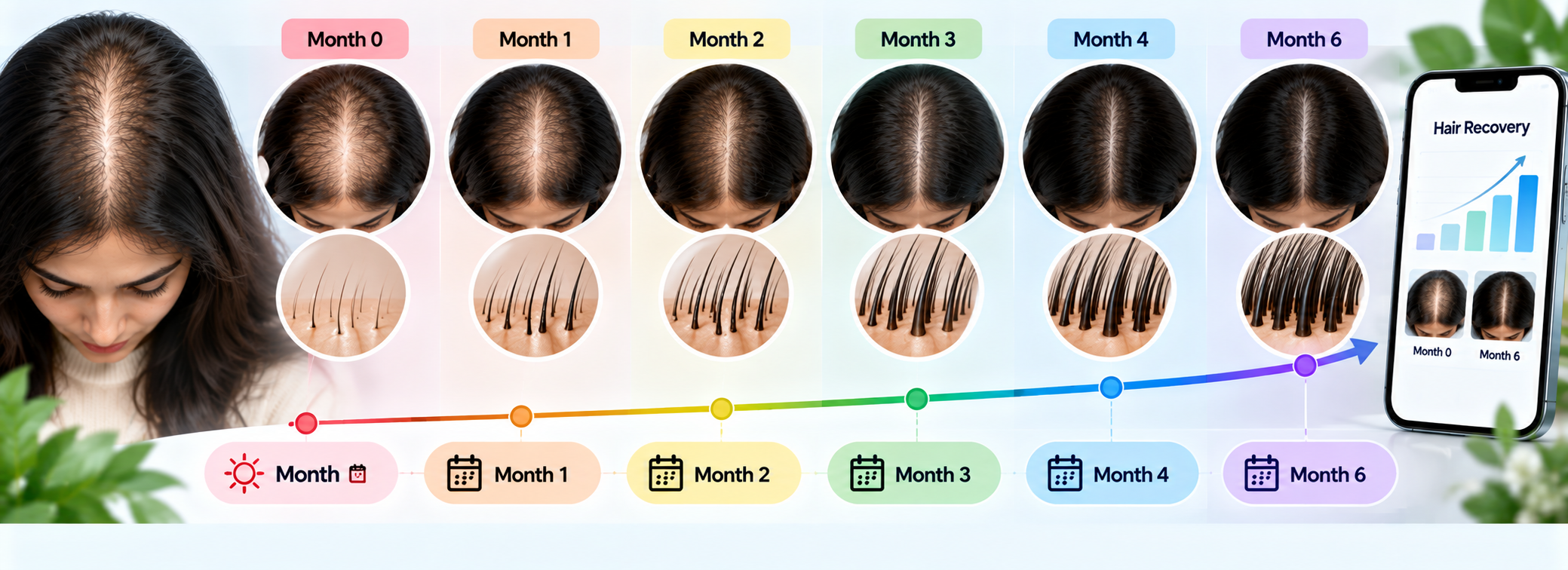
Acute shedding eases and then density rebuilds slowly. Tracking shows the turning point — and flags if it isn't settling within a few months.
Section image
📈
Recovery tracking — density over monthsalt: "Tracking recovery from sudden shedding with density photos" · 900×200 WebP
Shedding amountDaily/weekly
Trigger dateAnchor point
Overall densityWhole-scalp photos
Ponytail thicknessIf applicable
Regrowth fringeNew short hairs
Routine adherenceUsed as planned
Energy / symptomsFatigue etc.
Improvement scoreOverall trend
Doctor review triggerFlags ~6 months
Start Progress Tracker
Evidence & Safety

Medical References Behind This Guidance

These references are provided for patient education and do not replace a dermatologist’s diagnosis or individual medical advice.

AAD

Hair Loss: Causes & Treatment

Dermatologist-led overview of how hair loss is evaluated and the evidence behind common treatments.

View AAD reference ›
NIH / MedlinePlus

Hair Loss Overview

Patient-education summary of common causes of hair loss and when to seek medical care.

View MedlinePlus reference ›
PubMed

Peer-Reviewed Literature

Searchable index of peer-reviewed research on sudden, recent hair shedding.

Search PubMed ›
Cochrane Library

Systematic Reviews

Independent systematic reviews assessing the evidence behind hair-loss interventions.

View Cochrane Library ›

Diagnosis Pathway

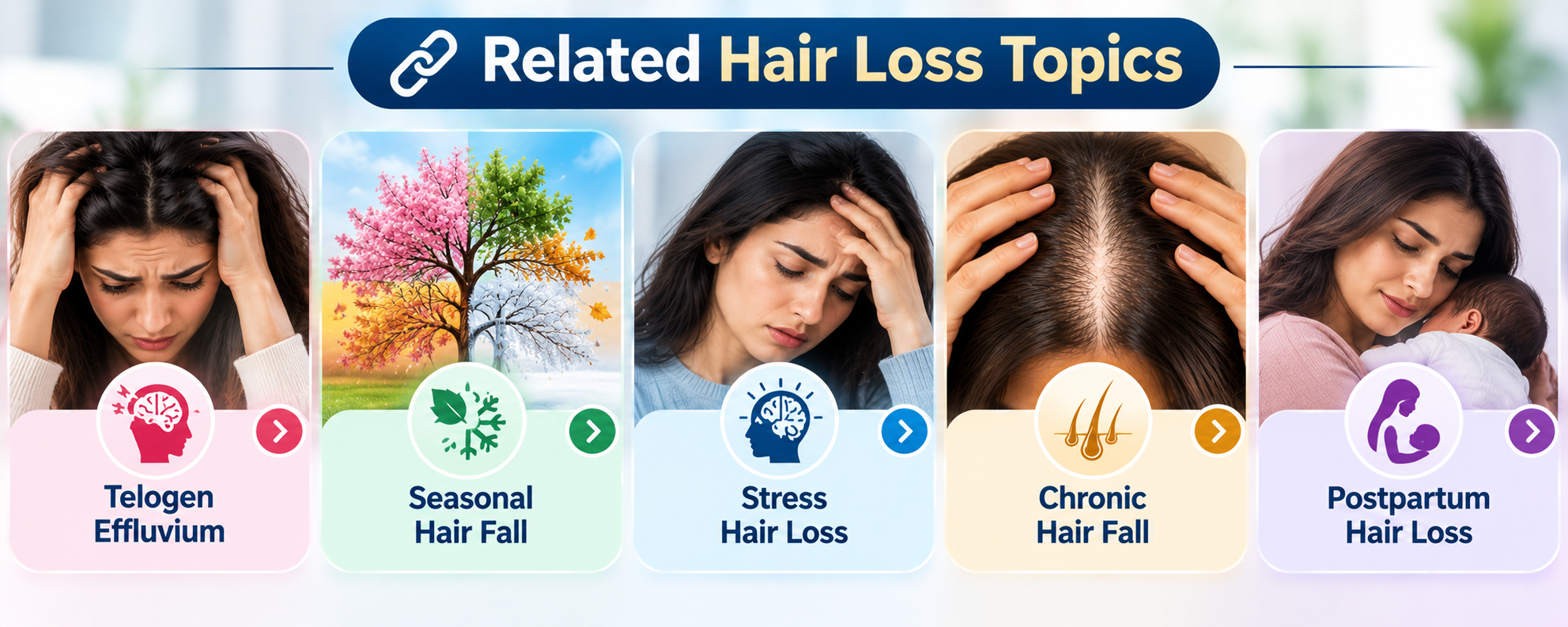
First Identify the Hair Loss Pattern

Hair loss treatment should start by identifying the pattern. Pattern thinning, diffuse shedding, patchy loss, sudden shedding and hair breakage need different next steps.

Pattern

Receding Hairline / Crown Thinning

May suggest androgenetic alopecia or DHT-related pattern hair loss. Often gradual and progressive.

Androgenetic Alopecia →
Diffuse

All-Over Shedding or Thinning

May relate to telogen effluvium, deficiency, thyroid, illness, stress, postpartum phase or diffuse pattern loss.

Diffuse Hair Thinning →
Sudden

Rapid Increase in Hair Fall

Often follows a trigger weeks to months earlier, but sudden shedding should not be dismissed if severe or persistent.

Sudden Hair Fall →
Chronic

Hair Fall Over 6 Months

Persistent shedding needs cause-finding: chronic TE, thyroid, deficiency, medicines, hormones or pattern loss.

Chronic Hair Fall →
Patchy

Round Bald Patches

Patchy loss may be alopecia areata, fungal infection or scarring alopecia and should be dermatologist-led.

Patchy Hair Loss →
Breakage

Short Broken Hair, No Root Bulb

Breakage is shaft damage, not root shedding. It needs damage repair and styling changes, not root-hair-fall treatment.

Breakage vs Hair Fall →

Cause Map

Common Causes Behind Hair Loss Patterns

Androgenetic Alopecia

DHT-related follicle miniaturisation causing gradual pattern thinning in men and women.

Read Guide →

Telogen Effluvium

Diffuse shedding after triggers such as fever, COVID, stress, childbirth, surgery, dieting or deficiency.

Read Guide →

Deficiency / Thyroid

Iron, vitamin D, thyroid and nutritional issues can contribute to diffuse shedding and chronic hair fall.

Supplement Safety →

Patchy / Autoimmune / Fungal

Round bald patches need dermatologist diagnosis because causes and treatments differ greatly.

Patchy Hair Loss →

Lifestyle / Trigger-Related

Stress, rapid weight loss, illness, smoking and alcohol may contribute, but rarely act alone.

Stress Hair Loss →

Hair Shaft Breakage

Breakage from heat, chemicals, friction or styling is different from root hair fall.

Breakage vs Hair Fall →

Red Flags

When Should Hair Loss Be Checked by a Dermatologist?

Monitor

Mild, Recent Shedding

Short-term shedding after a known trigger can be tracked with photos, routine consistency and symptom notes.

Screen

Use AI Hair Test

Use the AI Hair Test to organise pattern, duration, triggers, scalp symptoms and next-step direction.

Doctor Review

Persistent or Progressive

Hair fall lasting more than 6 months, worsening crown thinning, a widening parting or unclear shedding needs evaluation.

Urgent

Do Not Delay

Patchy loss, scalp pain, pus, crusting, bleeding, scarring-looking skin, sudden severe shedding or child scalp scaling needs prompt medical review.

Timeline

Trigger-Related Shedding Often Appears Later

Trigger Event

Fever, COVID, stress, surgery, childbirth, crash dieting or major illness may push hairs into the shedding phase.

Weeks to Months Later

Shedding may become noticeable after a delay, often once the original trigger already feels over.

Recovery Phase

Supportive care, trigger correction, nutrition and scalp comfort help recovery, but timelines vary.

Review Needed

Heavy, persistent, patchy or progressive loss should be checked rather than assumed harmless.

Assessment

Do Not Guess the Cause of Hair Fall

Ferritin / Iron

Low ferritin can contribute to diffuse shedding. Iron should be taken only after testing and doctor advice.

Thyroid Profile

Thyroid imbalance can cause diffuse shedding and needs medical management, not hair products alone.

Vitamin D / Nutrition

Vitamin D, protein intake and nutritional history may matter, especially after dieting or illness.

Scalp Examination

Dermoscopy or scalp examination helps separate pattern loss, shedding, inflammation, fungal causes and scarring risks.

Comparison

Pattern Loss vs Telogen Effluvium vs Breakage

FeaturePattern Hair LossTelogen EffluviumHair Breakage
Main signReceding hairline, crown thinning, widening partingDiffuse shedding from all over the scalpShort broken strands, split ends, roughness
TimelineGradual and progressiveOften starts after a triggerLinked to damage, heat, chemicals, friction or styling
Root bulb?May shed miniaturised hairsShed hairs often have a root bulbNo root bulb; the shaft snaps
Best next stepAI Hair Test + dermatologist review if progressiveFind the trigger + correct the causeDamage-repair routine + styling changes

Sudden Shedding

Don't Dismiss Severe or Patchy Sudden Loss

A sudden increase in shedding is often telogen effluvium following a trigger weeks to months earlier, but sudden loss can also be alopecia areata or, rarely, a reaction to a medicine, so severe, patchy or persistent sudden loss should be assessed rather than dismissed.

  • Acute telogen effluvium often follows a trigger and tends to settle.
  • Round, patchy or smooth bald spots need a doctor (possible alopecia areata).
  • A new medicine starting around the shedding is worth discussing with a doctor.
  • Heavy, persistent or distressing sudden loss deserves prompt assessment.

AI-Guided Next Step

Use the Right Hairsncares Tool

AI Hair Test

Screen hair fall pattern, duration, triggers, scalp symptoms and next-step direction.

Take AI Hair Test →

Product Finder

Explore product directions based on cause, scalp type and safety needs after screening.

Find Products →

Routine Builder

Build a realistic routine for shedding, pattern thinning, scalp support or breakage.

Build Routine →

Progress Tracker

Track shedding, density, parting, crown and treatment response over time.

Track Progress →

Product & Routine Pathway

Choose Products Only After Cause Screening

Hair Fall Control

Supportive shampoos, serums and routines for shedding-related concerns. Products do not cure hair loss.

View Hair Fall Products →

Hair Growth Products

Cosmetic serums, deficiency-guided supplements and selected doctor-guided active pathways.

View Growth Products →

Scalp Care

For dandruff, itching, oiliness or inflammation-linked shedding, scalp care may be the first step.

View Scalp Care →

Breakage Repair

If the issue is shaft snapping rather than root shedding, focus on damage repair and styling changes.

View Damage Care →
Sudden hair fall diagnosis pathway showing pattern, triggers, red flags, AI test and doctor review
Sudden hair fall pathway: identify the pattern, check triggers, screen safely and choose the next step.

Next Step

Find the Cause Before Choosing Treatment

Hair loss can come from pattern thinning, telogen effluvium, deficiency, thyroid, stress, post-viral shedding, rapid weight loss, scalp inflammation, patchy alopecia or hair shaft breakage. Start with screening, then choose the right routine or doctor review.

Questions

Frequently Asked Questions

Section image
Sudden hair fall FAQs — banneralt: "Frequently asked questions about sudden hair fall treatment in India" · 900×160 WebP
What is sudden hair fall?
Sudden hair fall is a rapid, noticeable increase in shedding over a short time. The most common cause is acute telogen effluvium, where a trigger such as illness, fever, major stress, surgery, childbirth or crash dieting pushes many hairs into the shedding phase. A characteristic feature is that the shedding often appears about two to three months after the trigger. Other causes are possible, so heavy or unexplained sudden shedding is worth assessing.
Why is my hair suddenly falling out?
A sudden spike in shedding is most often acute telogen effluvium, usually traced to a trigger two to three months earlier — an illness or fever, major stress, surgery, rapid weight loss, childbirth or a new medicine. Sometimes thyroid changes, low iron or the onset of alopecia areata present this way. Because the cause guides what to do, mapping recent events and, if it is heavy or persistent, seeing a dermatologist, is the sensible approach.
Is sudden hair fall serious?
Often it is not dangerous — acute telogen effluvium is usually self-limiting and improves once the trigger passes. However, sudden hair fall is not always harmless: it can occasionally signal a thyroid problem, significant deficiency, a drug reaction or the start of another condition such as alopecia areata. That is why heavy, persistent or unexplained sudden shedding, or shedding with other symptoms, should be assessed by a dermatologist rather than assumed to be harmless.
What is acute telogen effluvium?
Acute telogen effluvium is a temporary form of diffuse hair shedding in which a trigger causes an unusually large number of hairs to enter the resting and shedding phase at once. The shedding typically begins about two to three months after the trigger and can look alarming, but the follicles are not damaged. It usually recovers over several months once the trigger resolves, though results vary and persistent cases need assessment.
How long does sudden hair fall last?
For acute telogen effluvium, the heavy shedding phase often lasts a few weeks to a few months and then settles once the trigger has passed, with density gradually recovering over the following months. Because hair grows slowly, full recovery can take several months. If sudden shedding continues beyond about six months, or keeps returning, it may be becoming chronic or have another cause, and a dermatologist assessment is advisable.
Can stress cause sudden hair fall?
Yes. A major physical or emotional stress — such as a serious illness, accident, bereavement or significant life event — is a well-recognised trigger for acute telogen effluvium, with shedding typically appearing a couple of months later. Managing stress, sleep and general health supports recovery. Because other causes can coexist, it is still worth ruling them out if the shedding is heavy or persistent rather than assuming stress is the only factor.
Can illness or fever cause sudden hair fall?
Yes. A high fever or significant illness is a common trigger for acute telogen effluvium, with increased shedding often showing up about two to three months afterwards. This includes infections and other acute illnesses. The shedding is usually temporary and recovers as health returns, but if it is very heavy, prolonged, or accompanied by other symptoms, it is worth seeing a doctor to check for contributors such as deficiency or thyroid changes.
Will my hair grow back after sudden hair fall?
In acute telogen effluvium, the follicles are not destroyed, so hair usually regrows over several months once the trigger passes, and density recovers gradually — though results vary. You may notice short regrowth hairs at the hairline as recovery begins. If hair does not recover, shedding persists beyond a few months, or there are bald patches, a dermatologist should assess for other causes, since not all sudden shedding behaves the same way.
Should I take supplements for sudden hair fall?
Supplements help mainly if there is a genuine deficiency, such as low iron or vitamin D, contributing to the shedding, which is best confirmed by testing rather than guessing. A general hair multivitamin may offer supportive nutrition, but it does not cure shedding and is not a substitute for addressing the trigger. If you suspect a deficiency, ask a doctor to test your levels and guide correction.
Does Minoxidil help sudden hair fall?
For straightforward acute telogen effluvium, Minoxidil is not usually the first step, because the shedding is temporary and tends to recover once the trigger passes. Minoxidil is mainly used for pattern hair loss. If sudden shedding is unmasking or overlapping with pattern loss, a dermatologist may consider it. Any use of Minoxidil should be doctor-guided, and it is generally not recommended in pregnancy or breastfeeding without medical advice.
Is sudden hair fall the same as going bald?
Usually not. Sudden hair fall from acute telogen effluvium is diffuse, temporary shedding that does not normally cause baldness, because the follicles remain healthy and regrow. Going bald is more associated with pattern hair loss, which is gradual and genetic. However, a sudden episode can sometimes make underlying pattern loss more noticeable. If you are worried about bald areas or a receding hairline, a dermatologist can clarify what is happening.
What helps sudden hair fall at home?
Supportive steps include eating a balanced, protein-adequate diet, managing stress and sleep, handling hair gently, avoiding tight styles and harsh treatments, and using mild, supportive haircare. These create good conditions for recovery while acute telogen effluvium settles. They support rather than cure, and they do not replace addressing the trigger or seeing a doctor if shedding is heavy, persistent or unexplained.
Should I take an AI check before buying products?
It helps. An AI checker can map your likely trigger, estimate whether the shedding fits acute telogen effluvium, and flag features that need prompt care, so you act sensibly rather than buying products blindly. It supports screening and education only and does not replace a dermatologist's diagnosis, which is important if the shedding is heavy, persistent, patchy or accompanied by other symptoms.
When should I worry about sudden hair fall?
See a dermatologist if shedding is very heavy or lasts beyond a few months, if you notice bald patches, a widening parting or a receding hairline, if there are scalp symptoms such as itching, scaling or pain, if you have other symptoms like fatigue or weight change, or if shedding follows a new medicine. While much sudden shedding is temporary, it is not always harmless, so these features deserve assessment.
Can sudden hair fall become chronic?
Sometimes. Most acute telogen effluvium settles within a few months, but if a trigger continues, several triggers overlap, or another cause is present, shedding can persist and become chronic hair fall lasting more than six months. In that case, finding and treating the underlying cause, often with a dermatologist and blood tests, becomes important. Tracking how long shedding lasts helps you know when to seek assessment.
Why did my hair suddenly start falling out?
A sudden spike in shedding is often telogen effluvium triggered by an event — fever, illness, stress, surgery, childbirth or a crash diet — weeks to months earlier. Other causes exist too, so screening and, if needed, a doctor help clarify. Results vary.
Is sudden hair fall always telogen effluvium?
No — while acute telogen effluvium is common, sudden loss can also be alopecia areata (round patches) or a reaction to a medicine, so severe or patchy sudden loss should be assessed rather than assumed. Results vary.
When is sudden shedding urgent?
Seek prompt review for round bald patches, scalp pain, pus, crusting or scarring-looking skin, or very heavy sudden loss, as these need a dermatologist rather than products. Results vary.
Will it grow back?
Acute telogen effluvium often recovers once the trigger passes, but timelines vary and not all sudden loss behaves the same way, so persistent or patchy loss should be checked. Results vary.

Question not answered here? Ask Dr Amit for instant guidance or book a consultation.

Ask Dr AmitConsult a Doctor

Hair Suddenly Falling Out?

Take a breath — most sudden shedding is acute telogen effluvium and recovers once the trigger passes. Use the Hairsncares AI Sudden Hair Fall Checker to map the likely trigger, support your hair through recovery, and get assessed if it's heavy, persistent or unusual.

Medical disclaimer. Hairsncares provides educational and product guidance support. AI screening helps guide decisions but does not replace a dermatologist's diagnosis. Sudden hair fall is most often acute telogen effluvium, a usually temporary, diffuse shedding triggered weeks to months earlier — but it is not always harmless, and can occasionally reflect a thyroid problem, deficiency, a drug reaction or the onset of another condition such as alopecia areata. The products on this page offer gentle, supportive care and do not treat underlying medical causes; no product or supplement is guaranteed to regrow hair, and supplements help mainly where a deficiency is confirmed by testing. Heavy, persistent or patchy shedding, scalp symptoms, or shedding with other symptoms should be assessed by a dermatologist. Prescription medicines such as Minoxidil are doctor-guided and generally not recommended in pregnancy or breastfeeding without medical advice; never stop a prescribed medicine without advice. Results vary.
💬 Ask Dr Amit
Your Cart (0)

Your cart is empty

Subtotal0
DeliveryFREE
Total0
🔒 Secure📦 Free above ₹499↩ Easy returns
💬 Hi! I'm Dr. Amit — your Hair Intelligence consultant
🌿
1
🌿
Dr. Amit
Virtual Dermatologist · Hairsncares.com
Online
What are you shopping for today?
Select a category to begin
AI-powered scalp diagnosis · Hairsncares.com
📸
Scalp Analyser
Upload scalp photo · Get conditions, root cause, and matched product protocol
📷
Drop scalp photo here or click to upload
JPG, PNG, WEBP · Clear, close-up, well-lit photo

Your image is processed privately by our AI engine and saved securely with your account.